Academic Writer & Subject Expert • STEM • Lab Reports • Research Methods
Orion Tate is an academic writer and subject expert at Apex Essays who works mainly with STEM students. His day-to-day work is lab reports, research-methods assignments, and data-driven coursework across biology, chemistry, and physics classes. Students usually reach him at the moment a technical format stops making sense — a rubric that demands a discussion section they have never written, a methods write-up that keeps getting marked vague, or a results section full of numbers with no idea what to say about them.
What sets Orion's work apart is how he handles structure. He treats every scientific document as a chain of decisions: what the hypothesis commits you to, what the method has to record, what the data can and cannot support. Then he turns that chain into a checklist the student can actually follow. The finished work reports procedures accurately, keeps claims inside what the data shows, and reads in plain language rather than padded jargon.
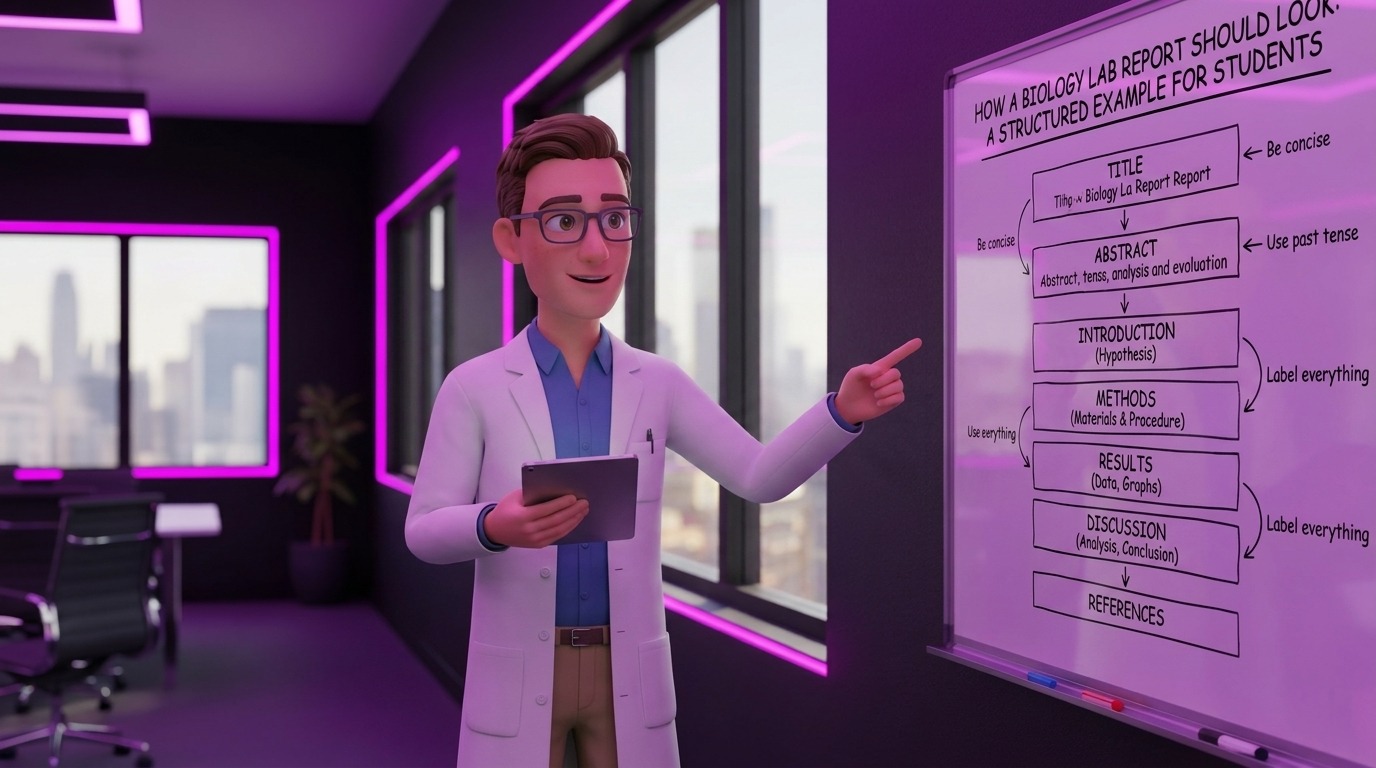
A lab report is graded less on the experiment than on whether a reader could repeat it and arrive at the same reading of the data. That puts most of the weight on the two sections students tend to write fastest.
Methods has one test: could somebody else run this? That means named equipment and quantities rather than “the apparatus”, the number of trials rather than “several”, and the order in which things actually happened. Past tense, and no instructions — a methods section reports what was done, it does not tell the reader what to do. Anything that would change the result if it changed belongs in there; anything that would not is clutter.
Results reports, and does not explain. Every table and figure needs a caption that stands on its own, axis labels with units, and a precision that matches the instrument — a device reading to two decimal places does not produce a five-decimal answer, and writing one tells a grader the numbers were copied out of a calculator rather than understood. Long raw data belongs in an appendix; the results section carries the values the argument uses.
Uncertainty is part of the result, not an apology for it. Where trials disagree, the spread gets reported rather than quietly averaged away, and the discussion names a likely source — timing lag, friction, a systematic offset in the instrument — instead of the catch-all “human error”, which tells a grader nothing at all.
The discussion is where the report earns its grade. It should say what the data show, whether that matches what theory predicted, and where it does not, what would account for the gap. A result that contradicts the expected value is not a failed experiment; a discussion that fails to notice the contradiction is a failed report.
Research methods coursework runs on the same logic one level up. The design has to answer the question actually asked: whether the study needs random assignment or only random sampling, whether the comparison group is doing the work you think it is, and what the design cannot tell you however clean the data turn out. Naming that limit is a strength — its absence reads as a writer who has not thought about it.
Orion writes practical guides on scientific writing for the Apex Essays blog — how lab reports are structured, what a methods section needs to record, and how to report results without overstating them.
Ask to see a sample lab report before you order — check the section structure, data presentation, and writing style first.
Request a Sample PreviewSend your lab manual, rubric, or assignment brief and get matched with a STEM writer who knows the format inside out.
Submit Your Details Start Live ChatFrom $7.89/page • All deadlines covered
Browse other subject specialists across different academic areas.
Send Orion your lab manual and rubric, and get back a clearly structured, accurately reported piece of scientific writing — from $7.89/page.
Three simple steps, a clear price upfront, and every order backed by real guarantees.
Share your topic, deadline, and instructions, and see a clear quote from $7.89/page — before you commit.
Pay securely to start your order, and a vetted, US-based writer who knows your field is assigned to it.
Read your draft and request free revisions until it’s right — backed by our money-back guarantee.

 256-bit SSL secured & 100% confidential
Not sure yet? Ask for a free sample of our Writers/orion Tate work. No payment, no obligation — see the standard before you order.
Your order is handled by a subject-matched member of our in-house team — a real, vetted expert with an advanced degree and a track record of academic work. Not anonymous freelancers.
Reviews submitted by verified customers through our own review form, after their order was delivered.
"Essay on special needs education policy — writer used up-to-date academic literature and a well-structured argument. APA formatting was correct and the draft needed no significant revision."
"Critical essay on homeschooling outcomes and academic achievement. The writer engaged with the academic debate fairly and sourced both sides well. Took one small revision but the quality was good overall."
"Argumentative essay on the ethical implications of AI in healthcare. The writer grounded the argument in academic literature and structured it clearly. IEEE citations were correctly formatted throughout."
"My literature research paper on postcolonial theory needed strong academic sourcing and a clear analytical framework. The writer understood literary analysis conventions perfectly and delivered a genuinely strong paper."
"Paper on Victorian literature and social commentary was handled well. Good sourcing from literary journals and a clean structure. The argument developed logically from introduction to conclusion."
"Research paper on comparative literature needed cross-cultural theoretical sources. The writer navigated this well with a clear argument structure and solid citations from peer-reviewed literary journals."

Trusted by students worldwide since 2012 · from $7.89/page
 Live Chat