Live Chat


Homework's measured link to achievement is strongest for high school students, modest in middle school, and close to nothing in the elementary grades. That split has held up across the major research syntheses for most of the last forty years, and it is the single most useful thing to know about the question.
Here is the part that usually gets left out. Nearly all of that evidence is correlational. Researchers recorded how much homework students said they did, lined it up against grades and test scores, and found the two moved together. That design can show a pattern. It cannot show that homework produced the pattern.
So the honest answer comes in two halves. Yes, homework is associated with achievement, and the association strengthens as students get older. And no, the case is not as settled as most confident headlines make it sound: a 2024 systematic review of homework experiments found eleven usable studies and rated every one of them low quality.
- The association is stronger in grades 7–12 than in K–6. Cooper, Robinson and Patall's synthesis of US research found exactly that split.
- "Homework works" rests mostly on correlations. The experimental base is thin: a 2024 Campbell systematic review included 11 studies, all rated low quality.
- Hours spent is a poor measure. Trautwein's three studies concluded the benefit of homework is not captured by the "time on homework" number.
- The common guideline is 10 minutes per grade level per night, across every subject combined — a ceiling, not a target.
- In one study of 4,317 students at high-performing high schools, where homework averaged over three hours a night, doing more of it went with more academic stress, more physical complaints and less balance.
- How a parent helps flips the sign. Supportive help correlates slightly positive with math achievement; intrusive help correlates negative, and the penalty grows through high school.
The short answer, by grade band
The reference point for this question is still Harris Cooper, Jorgianne Robinson and Erika Patall's 2006 synthesis in Review of Educational Research, which pulled together US homework research published between 1987 and 2003. Their finding on grade level was blunt: the homework–achievement correlation was stronger "in Grades 7–12 than in K–6."
Cooper put it more plainly in a Duke commentary the same year, describing little or no relationship between homework and achievement for elementary school students. That is not a claim that elementary homework is harmful. It is a claim that the achievement argument for it is weak.
The table below uses the ordinary US grade bands. Cooper's synthesis split its own data at K–6 and 7–12, so the boundary between "weak" and "strong" sits somewhere inside the middle school years rather than on a clean line.
| Grade band | What the evidence supports | What it does not support |
|---|---|---|
| Elementary (K–5) | Little to no measurable correlation with achievement in the large syntheses. Schools that assign it usually cite habit-building instead. | Any claim that more nightly homework raises elementary test scores. |
| Middle (6–8) | A real but moderate association, sensitive to how much is assigned. | The idea that piling on more keeps paying. Cooper places diminishing returns near 90 minutes. |
| High school (9–12) | The strongest association in the literature, and the clearest case for assigning it. | A causal guarantee. Even here the design is mostly correlational. |
One more detail from the same synthesis is easy to miss and quietly important: the correlation was stronger when students reported their own homework time than when parents reported it. The measurement itself moves the answer.
Why the answer changes so much between fourth grade and tenth
The age gradient is the most reliable finding in this literature, so it is worth understanding rather than memorizing. Four things are probably doing the work at once.
Independent study is a skill, and it develops late. A ten-year-old asked to work alone at a kitchen table competes with siblings, screens and fatigue, and has few strategies for restarting after a distraction. The same task at sixteen sits inside a much better-developed set of habits.
The work itself is different. Elementary homework is often a worksheet repeating something already covered. High school homework is frequently the reading, the problem set or the draft — the place where the thinking actually happens, not a rehearsal of it.
Adults are in the middle of the elementary measurement. Younger children get more help, so a survey question about "how much homework do you do" is partly measuring a parent. That is one reason Cooper's team saw the correlation shift depending on who answered.
Elementary achievement tests have less room to move. When most of a class scores near the top of a basic skills test, there is little variation left for homework to explain, even if it is helping.
If you are a parent of an elementary student, the research does not give you a reason to fight over a worksheet. It also does not tell you to ignore school policy. The defensible position is to cap the time, protect sleep, and treat reading together as a legitimate use of the same half hour.
What the research can prove, and what it only suggests
This is where almost every article on the topic stops short, and it is the part that changes how you read every statistic in this article. Homework evidence comes in three tiers, and they do not carry the same weight.
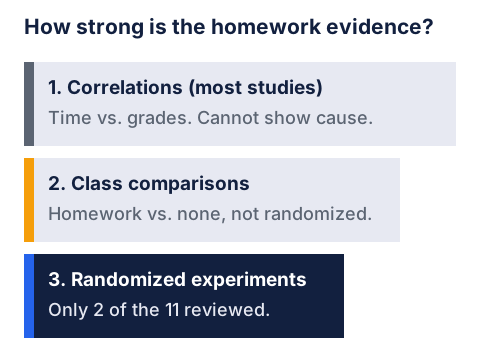
Tier one is correlation. Ask students how long they spend on homework, compare against grades, report the relationship. This is most of what gets quoted. It cannot separate homework from everything that travels with it — motivation, family support, course track, sleep, school quality.
Tier two compares groups. Classes assigned homework are compared against classes that were not. Better, but the classes were not assigned at random, so the comparison still carries whatever made them different.
Tier three is the randomized experiment, the only design that supports the word "causes." Here is how thin that tier actually is. Guo and colleagues started from 4,904 identified records for their 2024 Campbell systematic review and ended with eleven primary studies — and only two of those eleven were randomized controlled trials. The other nine used quasi-experimental designs, which belong in tier two. Pooled across the ten studies that compared homework against no homework at all, students who did homework performed better (Hedges' g = 0.45, 95% CI 0.24–0.66), but the authors rated every included study low quality and concluded that the optimal daily amount "remains uncertain." Most of that experimental evidence also comes from elementary and middle grades; the review says outright that more research is needed on secondary students. Note what that leaves for the elementary case: the thin experimental tier points positive for younger students, the much larger correlational tier points to almost nothing, and because every one of those experiments was rated low quality, neither side is strong enough to close the question.
Cooper's team said something similar about their own material twenty years ago: all the studies they reviewed, whatever the design, had design flaws. Two independent syntheses, eighteen years apart, both flagged the quality of the underlying work.
When a page tells you homework "improves achievement by X percent," look for the design. If the number came from asking students how many hours they study, it describes an association inside a crowd of other causes — not an effect you can expect from adding an hour tonight.
Why hours of homework is the wrong number to watch
Ulrich Trautwein tested the popular claim directly. Across three studies published in Learning and Instruction in 2007, he separated three things that usually get collapsed into one: how often homework is assigned, how much effort a student puts into it, and how long it takes.
The result: homework assignments were positively associated with achievement at the class level, and doing homework was associated with achievement gains at the student level — but, in his words, "the positive effects of homework assignments and completion are not captured by the 'time on homework' measure."
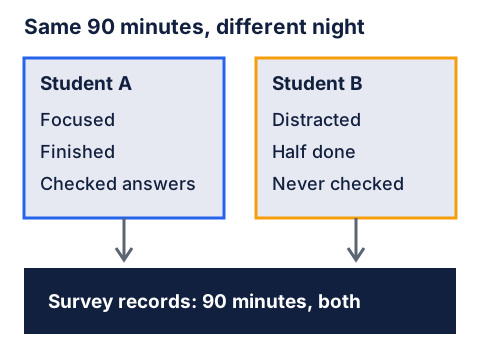
Time on homework records the same ninety minutes whether the work got finished or not. No wonder it keeps producing muddled results.
There is a second problem baked into the measure. A student who finds algebra hard spends longer on the same problem set than a student who finds it easy, and will usually score lower. Time and difficulty are tangled together, which can push a homework-time correlation toward zero or below without homework doing anything wrong.
The practical translation is short. Two signals are worth watching, and hours is not one of them: whether the work is assigned regularly enough to build a routine, and whether it is actually finished with real attention.
How much homework is too much
The best-known guideline is the 10-minute rule Cooper endorses: ten more minutes of homework for each grade a student advances, which Duke's write-up of the study illustrates as 40 minutes for a fourth-grader and about two hours for a high school senior. An NEA guidance article notes that many districts follow the same 10-minutes-per-grade guideline as a rule of thumb, adjustable for individual students and subjects.
Two things about that rule get misread constantly. It is a nightly total across every class combined, not a per-subject allowance. And it is an upper bound, not a target to hit.
| Grade | Nightly total, all subjects | Where the ceiling comes from |
|---|---|---|
| 1st–5th | 10–50 minutes | 10 minutes per grade level |
| 6th–8th | 60–80 minutes | Same rule; Cooper places diminishing returns near 90 minutes for this age |
| 9th–12th | 90 minutes–2 hours | Same rule; Cooper puts the point where returns start to diminish somewhere between 90 minutes and 2½ hours |
Above those ranges the picture gets worse rather than flat. Galloway, Conner and Pope surveyed 4,317 students across ten high-performing high schools in upper-middle-class communities, where the average was more than three hours of homework a night. Students doing more of it showed greater behavioral engagement in school, and also more academic stress, more physical health problems and less balance in their lives.
Worth keeping in proportion, though: that sample was deliberately drawn from unusually pressured schools. Brookings' "Homework in America" analysis of national trend data concluded that US homework loads have remained roughly stable since 1984, and that the share of 17-year-olds carrying more than two hours a night has stayed in the 10–13% range. The typical American student is not buried. Some students genuinely are, and they are not imagining it.
Four checks before you start tonight's assignment
All of the above answers a policy question — should schools assign homework. It does not answer the question a student actually has at 8 p.m., which is narrower: will this particular assignment do anything for me? Run these four checks in order. The first one that fails tells you what to change.
Practice of something taught this week, first exposure to something new, or proof that you did it. The research supports the first kind most clearly. If it is first exposure, expect it to take longer and to need the textbook open — that is the assignment's design, not your failure.
Cover the worked example and do one problem cold. If you get it, the remaining nineteen are teaching you very little. Do five to confirm, then move the saved time to the topic you actually missed. If you cannot do it cold, stop and fix the gap before grinding through twenty repetitions of a mistake.
Pick a stopping time near the range for your grade and write it down. When a subject blows through it, stop and note where you stopped. That note is information your instructor needs — and it is far more useful than three silent hours. A running record of what each class is actually costing you makes this easy; a system for tracking assignments is worth more here than willpower.
Homework only teaches when you find out what was wrong. Check the answer key, circle what you missed, and bring one specific question to class. Unchecked homework is rehearsal at your current level of error — which is the most common way an hour of genuine effort produces nothing.
That last check is the one students skip most and the one that costs most. Trautwein's finding points the same way: what predicted gains was doing the work, not sitting with it.
What helping looks like, and what backfires
Parents get told to be involved, and the advice usually stops there. A 2023 meta-analysis is more specific. Jiang, Shi, Zheng and Mao pooled 20 studies covering 16,338 participants and separated supportive involvement from intrusive involvement in mathematics homework.
Supportive involvement correlated positively with achievement (r = 0.076). Intrusive involvement correlated negatively (r = −0.153). Within the supportive category, autonomy support was the strongest single component (r = 0.133) — meaning help that hands the problem back rather than solving it.
These are small correlations, and they describe math homework specifically. The useful part is not their size but their sign, and one moderator: the cost of intrusive help rose steadily with age, from r = −0.093 in elementary school — small enough that its confidence interval still crosses zero — to −0.228 in middle school and −0.360 in high school. Hovering gets more expensive the older the student.
Supports learning
- Asking what the assignment is asking for, then leaving
- Protecting a quiet time and place, and a bedtime
- Answering a specific question with a hint, not a solution
- Helping set the stopping point and honoring it
- Telling the instructor when a subject routinely runs long
Backfires
- Sitting alongside and correcting each step as it happens
- Re-teaching the lesson your own way mid-assignment
- Supplying answers to end the argument
- Adding extra work on top of what was assigned
- Treating a single low grade as a crisis
For teachers, the same evidence points at assignment design rather than volume. Work that asks a student to retrieve, apply or decide something carries the load; work that asks for twenty more of what they already did in class does not. That principle sits underneath our guide to building research assignments that actually develop research skills.
The honest bottom line
Does homework help students learn? For high schoolers, the association is real, consistent and the strongest in the literature — and Cooper puts the point where it stops paying somewhere between 90 minutes and two and a half hours a night. For middle schoolers it is present and moderate. For elementary students, the achievement case is weak enough that no one should be defending it as settled.
Underneath all three, the evidence is mostly correlational, and the best experimental review available found eleven studies, rated all of them low quality, and only two of them were randomized. That is not a reason to dismiss homework. It is a reason to stop treating "homework helps" as a physical law and start treating it as what it is: a claim about a task, where the design of the task does most of the work.
Which is why the practical question is never "does homework help." It is whether tonight's assignment is practice you need, whether it gets finished with attention, and whether you find out what you got wrong. Get those three right and the hours take care of themselves.
If the reason it isn't getting done is that the load has outrun the week rather than the material being hard, that is a scheduling problem before it is a learning problem — a tracker you actually maintain fixes more of it than most students expect. And if you want to know where the whole institution came from, the answer is stranger and less deliberate than the internet suggests: nobody really invented homework.
When a genuine backlog has already built up, our writers can take a specific piece off the stack so you can get back to the work that is teaching you something — see how our homework help service works, subject by subject.