Live Chat

APA 7 publishes two title pages, and if you are handing a paper to an instructor, you need the student one. APA puts the rule in a single sentence: “Students should use the student version of the title page unless their instructor or institution has requested they use the professional version.” The professional version exists for a manuscript going to a journal, and it carries two things a course paper does not — a running head and an author note.
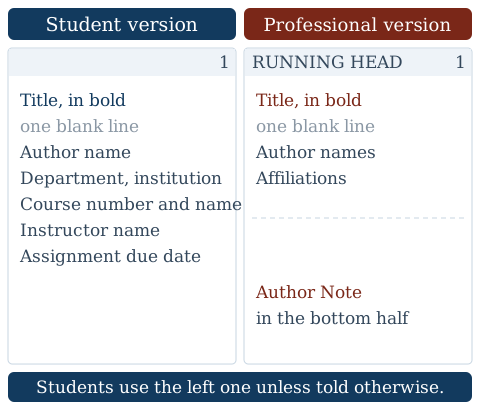
The student title page holds seven elements: the paper title, your name, your affiliation, the course number and name, the instructor's name, the assignment due date, and the page number in the header. The professional title page holds six: the paper title, the author names, the affiliations, the author note, the running head, and the page number. Both are laid out below, element by element, in APA's order.
- Two versions, one rule. Use the student title page unless your instructor or institution has asked for the professional one.
- Student papers have no running head — unless one is requested. APA states that exception in three of its own documents; most guides drop it.
- The order is fixed: title, one blank line, author name, department and institution, course number and name, instructor name, assignment due date.
- The affiliation is two things, your department and your school, separated by a comma.
- A running head is 50 characters at most, all capitals, flush left, with no “Running head:” label in front of it.
- If your instructor's template disagrees with APA, follow the instructor. APA says so itself.
Two title pages, and the one that is yours
APA's Title page setup page, stamped Last updated: July 2022, names both: “A title page is required for all APA Style papers. There are both student and professional versions of the title page.” The split is about audience, not how advanced the paper is. A first-year reflection and a doctoral seminar paper both go to an instructor, so both take the student version.
Three questions settle it.
- Who receives this paper? An instructor, a department, a course site — student version. A journal editor or conference committee — professional version.
- Has anyone asked for the professional format in writing? A syllabus line, an assignment sheet, a program handbook. That instruction wins.
- Does the assignment want an abstract? APA notes student papers “generally do not include an abstract unless requested,” and a request for one often travels with the professional setup.
Where APA and your instructor's template disagree, APA hands the decision to the instructor. Its Student Title Page Guide handout opens with the note: “if instructors or institutions provide different guidance, students should abide by those directions.” The sample-papers page repeats it — “Students should follow the guidelines and requirements of their instructor, department, and/or institution when writing papers.”
If your course posts a title-page template, use it, even where it departs from what follows. A common departure is a template that puts a running head on a student paper — not a mistake, but the exception APA writes into its own rule.
The student title page, line by line
Everything sits on page one, centered, double-spaced, with one-inch margins on all four sides. APA's handout is specific about the vertical position: the block is “positioned in the upper-middle of the page (3 or 4 lines below the top of the page),” with “each element placed on a separate line” and “no extra lines added between elements, except after the paper title.”
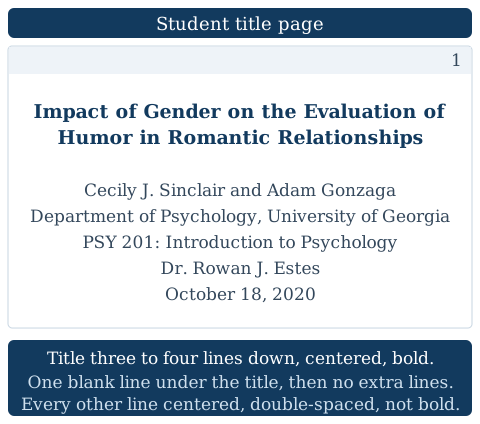
Each line, in APA's wording, with its own examples:
| Element | APA 7's rule | APA's example |
|---|---|---|
| Paper title | “Place the title three to four lines down from the top of the title page. Center it and type it in bold font.” Title case, no maximum length; a subtitle may take its own line. | Impact of Gender on the Evaluation of Humor in Romantic Relationships |
| Author name | “Place one double-spaced blank line between the paper title and the author names.” First name, middle initial, last name. Two authors take and; three or more take commas and a final and. | Cecily J. Sinclair and Adam Gonzaga |
| Affiliation | “Include both the name of any department and the name of the college, university, or other institution, separated by a comma.” | Department of Psychology, University of Georgia |
| Course number and name | “Provide the course number as shown on instructional materials, followed by a colon and the course name.” | PSY 201: Introduction to Psychology |
| Instructor name | “Provide the name of the instructor for the course using the format shown on instructional materials.” | Dr. Rowan J. Estes |
| Assignment due date | The due date, not the date you finished. “Use the date format commonly used in your country” — in the US, spell the month out. | October 18, 2020 |
| Page number | “Use the page number 1 on the title page,” inserted with your word processor's automatic page numbering, top right. No running head. | 1 |
Two lines cause most of the trouble. The affiliation is a department and an institution, so University of Georgia alone is short by half. And the course line takes a colon, which is why PSY 201: Introduction to Psychology is right and a hyphen is not.
One layout question never gets answered directly: how far down is “three to four lines”? APA's downloadable student template settles it. Open it and the title sits after exactly three empty paragraphs, with exactly one empty paragraph between the title and the byline — then no gaps at all through the remaining five lines, and one-inch margins on every side.
Insert the page number with the header tool, not by typing a “1”. APA asks for “the automatic page-numbering function of your word processing program” for a practical reason: a typed number stays on page one and never reaches page two.
The professional title page: what it adds and what it drops
The professional version shares the title and byline, then diverges. It adds a running head in the page header and an author note in the lower half. It drops the three course details: no course number and name, no instructor, no due date. Its affiliation changes meaning too — for a professional paper, APA says, “the affiliation is the institution at which the research was conducted.”
Where authors come from different institutions, the byline uses superscript numerals after each name and matching numerals before each affiliation. Where every author shares one affiliation, APA is explicit that “superscript numerals are not used.”
The author note is the block most students have never seen, because it carries things a course paper has no use for. APA places it “in the bottom half of the title page,” with the label Author Note centered and bold and the paragraphs left-aligned; the contents are set out in Section 2.7 of the Publication Manual. In APA's own professional sample they disclose who funded the data collection, where the findings were presented, that the authors have no conflicts of interest, and how to reach the corresponding author — none of which belongs on a paper submitted for a grade.
Side by side: what changes and what does not
| Element | Student version | Professional version |
|---|---|---|
| Paper title | Bold, title case, three to four lines down | Identical rule |
| Author name or names | One blank line under the title | Same, plus superscripts when affiliations differ |
| Affiliation | The school you attend, department first | Where the research was conducted |
| Course number and name | Yes | No |
| Instructor name | Yes | No |
| Assignment due date | Yes | No |
| Author note | No | Yes, in the bottom half |
| Running head | No, unless requested | Yes, on every page |
| Page number | Top right, starting at 1 | Top right, starting at 1 |
| Margins and spacing | 1 inch all sides, double-spaced | Identical |
The page header is where the two genuinely part company, and APA keeps the vocabulary tidy even where other guides do not. The page header is the strip inside the top margin; the running head is one thing that can sit in it. APA's sentence: “For student papers, the page header consists of the page number only. For professional papers, the page header consists of the page number and running head.”
Building a running head, if you are asked for one
APA describes the running head as “an abbreviated version of the title of your paper (or the full title if the title is already short),” then adds the clause so much advice drops: “The running head is not required for student papers unless the instructor or institution requests it.” A guide saying student papers have none and a template showing one are both correct, and the template wins.
The rules are short. All capitals. No more than 50 characters, “including spaces and punctuation.” Flush left in the page header, across from the right-aligned page number, on every page including the first. And no label: “Do not use the label ‘Running head:’ before the running head” — APA marks its page-header guidance as “revised and expanded from the 6th edition,” and that label is a common survivor in an old template. Abbreviations are discouraged, though an ampersand may replace and.
Start from the title as it appears on your title page. If it already runs to 50 characters or fewer, you are finished — APA says a short title can be used whole.
Keep the terms a reader would recognize it by. There is no single correct cut — APA's own two examples cut in opposite directions.
Use your word processor's character count. Fifty is the ceiling, not a target.
All capitals, flush left, on the same line as the page number, which stays on the right. Nothing in front of it.
APA's two published examples are worth counting, because the cut is a judgment call rather than a formula. On the title-page page, the professional example title is Predict and Redirect: Prediction Errors Support Children's Word Learning — 72 characters. Its running head reads PREDICTION ERRORS SUPPORT CHILDREN'S WORD LEARNING: exactly 50, made by throwing away the main title and keeping the subtitle. In APA's downloadable professional sample paper, the title Comparison of Student Evaluations of Teaching With Online and Paper-Based Administration runs to 88 characters, and its running head is COMPARISON OF STUDENT EVALUATIONS OF TEACHING, 45 characters, made the opposite way — opening words kept, tail dropped. Same style body, same edition, two strategies. Either is fine; 51 characters is not.
What the pages ranking for this question leave out
In August 2026 we opened the ten results returned for “apa title page.” Two are APA's own and one is a video; the rest are university writing centers, library guides and one citation-software lesson — a more credible result set than most formatting queries get, and still an incomplete answer page by page. We downloaded those seven, added the two pages ranking for the student-versus-professional variant, and searched all nine mechanically.
| What we counted across nine pages | Result |
|---|---|
| Cover both title pages rather than one | 3 of 9 |
| Never use the words running head or running header at all | 4 of 9 |
| Of the five that do mention it, carry APA's unless requested exception | 3 of 5 |
| Tell you to include your department, which APA 7 requires | 4 of 9 |
| Name no edition of APA anywhere on the page | 3 of 9 |
Two of those gaps have names. Purdue OWL merges the two header terms: “Include a page header (also known as the ‘running head’) at the top of every page… For a student paper, this only includes the page number.” A workable summary that loses APA's exception — and the same page applies that caveat elsewhere, noting abstracts “are not typically required for student papers unless advised by an instructor.”
The second is an edition problem. The University of Wisconsin–Madison Writer's Handbook, still live and still ranking, tells students: “The APA Manual doesn't give instructions for the title page of a class paper; the contents and placement of items on the sample title page below are adapted from APA instructions for the title page of a paper to be submitted for publication.” The word edition appears nowhere on that page. APA 7 publishes a student title page, a handout for it and a downloadable student sample — which is the argument for checking which edition any formatting page was written for.
APA's own material shows a smaller version of the same drift. Its Font page, stamped Last updated: February 2026, permits seven faces and opens the sans-serif list with 12-point Aptos; the Student Title Page Guide handout, still linked from the title-page page, lists six and has no Aptos. Both are current APA 7 documents — the handout predates the revision. Any of the seven works, used consistently.
Nine checks before you submit
Run these on the finished page. Each maps to a rule quoted above.
- Page number 1, top right, inserted with the header tool rather than typed.
- No running head — unless asked for, in which case all caps, 50 characters or fewer, flush left, unlabeled.
- Title three to four lines down, centered, bold, in title case.
- Exactly one blank line between the title and your name, and none after that.
- Your name as first name, middle initial, last name — no degrees.
- Department and institution, separated by a comma.
- Course number, a colon, course name, as your course materials write it.
- Instructor's name and the due date, each on its own line, month spelled out.
- One-inch margins, double-spaced throughout, one font used consistently.
Title-page setup is Section 2.3 of the Publication Manual and Section 1.6 of the Concise Guide, if you want the source text. Once the first page is right, the rest is a separate job: APA research paper examples shows the pages after it, and term paper format in APA and MLA is the one to read if you are carrying an MLA class too. Not every APA assignment needs a title page — short weekly submissions usually do not, which is why writing a discussion post in APA format starts somewhere else.
And if the real problem is not the title page but the four thousand words behind it, that is a deadline rather than a formatting question — our APA paper writing service is built for that one.