Live Chat

Most "college application essay examples" are essays somebody says got somebody into somewhere, printed without the one thing you actually need: the reasoning inside them. You cannot check the outcome, and the essay by itself never tells you why its second paragraph is where it is.
This post works the other way around. It pins down the frame first, out of documents you can open yourself — the Common App's 2026–2027 prompts, its own guidance on what the essay is for, and what four named US colleges publish about the essay itself. Then it prints two complete essays written for this article, 587 words and 429 words, and annotates every paragraph against that frame.
Both essays below were written for this article by our editorial team. They are demonstrations. They are not real applicants' essays, they were not submitted anywhere, no college has read them, and nobody was admitted with them. Do not submit either one, or any part of either one. An application essay is the one part of the application that has to be yours — copy the structure, not the sentences.
- The 2026–2027 Common App prompts are the same seven as 2025–2026. Common App announced it directly: "we are keeping the essay prompts unchanged."
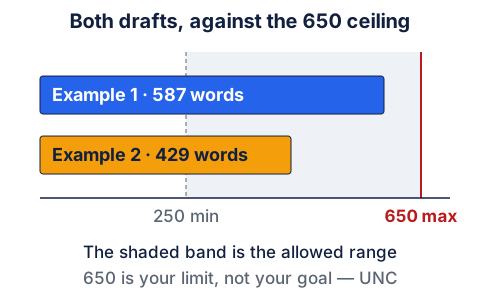
- 250–650 words, and the ceiling is not a target. UNC publishes the sharpest version of this: "Remember: 650 words is your limit, not your goal."
- Common App's own test is subtraction. Its essay resource tells you to ask "What's missing from the rest of my application?" and "Does this essay provide new information to my colleges?"
- Prompt 7 is the crowded one. In 2025–2026, 28% of applicants chose "Topic of your choice" and only 5% chose the intellectual-curiosity prompt — Common App's published figures.
- A college application essay is not a scholarship essay. Different reader, different question, different document. Do not recycle one as the other.
What you are actually writing
The Common App personal essay is one essay, written once, that goes to every college on your list that requires it. It lives in the writing section of My Common Application, and as Common App's own first-year application guide puts it, "Colleges can either make the personal essay optional or required." That is the structural fact that shapes everything else: you are writing one piece for many readers, none of whom you can name.
For 2026–2027 there are seven prompts, and you pick one. Common App published them on its essay prompts page under the heading "Here is the full set of essay prompts for 2026–2027," and confirmed in its announcement that nothing changed: "Based on positive feedback from students, counselors, teachers, and colleges, we are keeping the essay prompts unchanged." If a guide you are reading lists prompts that look different from the seven on that page, it is out of date — check the source before you plan around it.
The length is 250–650 words. That range is not printed on Common App's prompts page, but member colleges publish it. UNC-Chapel Hill's Application Prompts for 2026-2027 page — whose URL still carries the previous cycle's slug, though the page itself is the current one — states it plainly: "You'll choose one Common Essay prompt to respond to in 250-650 words." Then it adds the line most students never hear:
Remember: 650 words is your limit, not your goal. Use the full range if you need it, but don't feel obligated to do so. — UNC-Chapel Hill, Undergraduate Admissions
This is not a scholarship essay, and it is not a supplement
Three different documents get called "the essay," and students lose weeks by treating them as one.
| Document | Who reads it | What it has to do |
|---|---|---|
| Common App personal essay | Every college on your list that requires it | Tell them something about you that the rest of the application does not carry |
| College supplement | One college's own readers | Answer that college's specific question, usually about fit or a named program |
| Scholarship essay | A sponsor's selection committee | Meet that award's stated criteria and answer the sponsor's question directly |
The difference that matters is the reader's job. A college reader is deciding whether you belong in a class of students. A scholarship committee is usually allocating a fixed pot of money against criteria the sponsor wrote down — service, field of study, financial need, a theme — so a personal essay recycled into that slot answers a question nobody asked. Everything below is about the application essay. For a college's own prompt, the shape changes again; our walkthrough of Cornell's supplemental essays shows how much.
The test these examples are built to pass
You do not need to guess what an application essay is for. Common App's own essay resource — the "Telling your story" PDF it links from the 2026–2027 prompt announcement — opens with it: "The Common App essay instructions ask you what you want the readers of your application to know about you apart from courses, grades, and test scores." Two of the questions it tells you to ask yourself are subtraction, not addition: "What's missing from the rest of my application?" and "Does this essay provide new information to my colleges?"
Georgia Tech's personal essays page, which carries "the essay questions for 2026-27 applications," lists what a strong one does. Strong essays, it says, "Demonstrate authenticity & self-awareness," "Deepen our understanding of you or your interests," and "Answer the chosen prompt completely and thoughtfully." It also prints the single most useful sentence an admissions office has published on the subject: "If you start to focus on what you think we want to hear, pause."
Johns Hopkins states the purpose in one line on its Essays That Worked page: "The essays are a place to show us who you are and who you'll be in our community." The essays it chose, it says, "share stories from their everyday lives to reveal something about their character, values, and life that aligned with the culture and values at Hopkins." Connecticut College, in its own version, deflates the genre in two sentences: "We don't expect to be on the edge of our seats as we read essays. We just want you to be yourself in your content and style so we can learn more about you and see a sample of your writing skills."
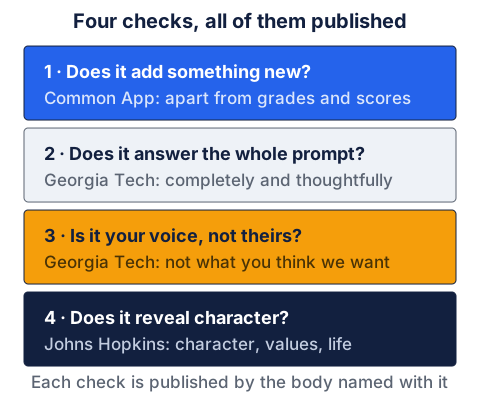
Read your activities list and your transcript first, then write down the three things about you that appear nowhere on either. Your essay comes from that list. That is Common App's "What's missing from the rest of my application?" turned into a fifteen-minute task.
Example 1: the curiosity essay, in full (587 words)
This one answers prompt 6: "Describe a topic, idea, or concept you find so engaging that it makes you lose all track of time. Why does it captivate you? What or who do you turn to when you want to learn more?" It was written for this article. It is not a real student's essay and it was never submitted anywhere.
The 6:42
The 6:42 bus is never at 6:42. For most of my sophomore year I treated that the way you treat weather: something that happens to you, not something with a reason.
Then in November I lost a shift at the pharmacy because two buses pulled up nose to tail at 6:58 and both were full. Standing at the stop with a phone at four percent, I did the only thing available to me. I opened my notes app and wrote down the time. 6:58. 6:58. Next one 7:19.
I did it again the next day, and the next. By February I had eleven weeks of arrival times in a spreadsheet my sister called the saddest document in America.
What the spreadsheet showed was that the bus was not random. It was bunched. Buses that left the depot evenly spaced kept clumping into pairs, and the pairs got tighter the further down the line they went. Nobody was scheduling it that way. The delay was building itself.
The explanation, when I finally found it, was almost annoying in how simple it was. A bus running slightly late reaches a stop with slightly more people waiting, so it loses more time boarding them, so it falls further behind. Meanwhile the bus behind it finds fewer people, moves faster, and catches up. The gap does not close. It widens on its own, without anyone deciding anything.
I have not stopped thinking about that. A system with no villain in it can still produce a bad outcome, reliably, forever, and everyone inside it will experience that outcome as bad luck.
Once I had the idea, I started finding it everywhere. The single winding checkout line at the grocery store that beats four separate ones. The reason our lunch period feels shorter than the bell schedule says it is. The way a group project ends up with one person doing the last forty percent, not because anyone is lazy, but because whoever finishes early gets handed more.
For a while I turned to the internet, which was mostly people arguing. Then I turned to Ms. Ferreira, who teaches statistics and who let me eat lunch in her room for a semester while she explained what a queue actually is, and why the average of a wait is not the wait most people experience. She gave me the phrase I had been circling for months without having: the bunching is a feedback loop.
Since then I have built a small simulation of my route. Twelve stops, eight buses, one variable for how long a rider takes to board. It is crude. It bunches anyway. I have run it more times than I want to admit, changing one number at a time to see what stops it, and so far the only thing that works is holding a bus at a stop even when it is empty. Making one bus wait shortens everybody's wait. That result still bothers me, and I like that it bothers me.
I am not going to claim I have solved public transit. I have a spreadsheet, a crude simulation, and a teacher who was generous with her lunch hour. What I actually have is a habit. When something feels like bad luck arriving on a schedule, I now assume there is a loop inside it, and I go looking for the loop.
I still miss the 6:42. But I know why now, and knowing why turned an eleven-week complaint into the thing I want to spend four years studying.
What each paragraph is doing
- Paragraph 1 states a fact and a wrong belief. No scene-setting, no quotation, no "ever since I was young." The first sentence is seven words long and contains a bus route and a time, which is as concrete as an opening gets.
- Paragraph 2 buys the stakes cheaply. A lost shift is a small consequence, deliberately. It explains why anyone would start logging times without asking the reader to be moved.
- Paragraph 3 compresses eleven weeks into 30 words — and the sister's joke does double duty, carrying a family relationship the essay never spends a paragraph on.
- Paragraph 4 states the finding before explaining it. "The delay was building itself" is the sentence the rest of the essay is about.
- Paragraph 5 explains the mechanism in the writer's own words. No jargon is imported. This is where Georgia Tech's "deepen our understanding of you or your interests" gets earned; naming the theory instead of explaining it would have earned nothing.
- Paragraph 6 is the pivot, and it is 33 words long. The essay stops being about a bus here. Everything before it is evidence for this claim; everything after it is the claim being used.
- Paragraph 7 proves the idea travels. Three unrelated examples in three sentences — what turns an anecdote into a way of thinking.
- Paragraph 8 answers the prompt's second question outright. Prompt 6 asks "What or who do you turn to when you want to learn more?" The essay names a person, says what she gave, and admits the internet was useless first. That is Georgia Tech's "answer the chosen prompt completely" as a checklist item, checked.
- Paragraph 9 is present tense and unfinished. The simulation is called crude twice. "That result still bothers me, and I like that it bothers me" is character rather than achievement — the Hopkins check.
- Paragraph 10 refuses the grand claim before a reader can suspect it. Deflation is credibility.
- Paragraph 11 returns to the opening image, changed. It ends forward, and it never names a major, a college or a career.
Notice what is absent: no dictionary definition, no epigraph, no list of awards, no sentence about why some school is the perfect fit. The activities section already carries the pharmacy job and the statistics class. The essay carries what is nowhere else on the application — how this person goes at a problem.
Example 2: the setback essay, in full (429 words)
This one answers prompt 2: "The lessons we take from obstacles we encounter can be fundamental to later success. Recount a time when you faced a challenge, setback, or failure. How did it affect you, and what did you learn from the experience?" It is 429 words — well short of 650, on purpose. It was written for this article, by us, and it belongs to nobody.
Ninety Parking Attempts
I failed my driving test three times. The third examiner did not let me leave the lot.
The first failure was a right turn on red where a sign said not to. Fair. The second was speed, twenty-nine in a school zone, announced in the flat tone you would use to read out a lottery number. The third, I curbed the wheel on the parallel park, corrected, and curbed it again.
I want to be careful here, because there is a version of this story where the point is that I passed on the fourth try. I did. That is not the interesting part.
The interesting part is what I did between the second attempt and the third, which was nothing. I did not practice. I told my mother I had been practicing. For six weeks I said "I've got it" to the person who was paying for the lessons, and the reason was not laziness. It was that I had never been bad at something in front of somebody before, and I could not work out how to be bad at it on purpose, in a parking lot, with a witness.
School had never asked me to do that. School asks you to be right in writing, alone, at night. Driving asked me to be visibly incompetent at four in the afternoon, next to my mother, over and over, until I wasn't.
After the third failure I stopped negotiating with it. I asked my uncle, who is not a patient man and does not pretend to be, to sit in the passenger seat for an hour every Saturday. He said "again" a lot. I parked that car something like ninety times. Most of those were bad. He counted the bad ones out loud, which I hated, and which worked.
What changed was not my parking. It was that I stopped treating an audience as a verdict.
I noticed it first in chemistry, where I had spent a year not asking questions in front of the class because I did not want to be the person who did not understand. I started asking. Not bravely. I asked badly, in a small voice, and twice about something we had already covered. My grade moved less than my willingness to find out I was wrong, and I would take the willingness over the grade.
I still do not love parallel parking. But I have a reliable test for whether I am learning something or just protecting my record. If nobody can see me doing it, I am probably not learning yet.
What each paragraph is doing
- Paragraph 1 is 17 words and contains the whole setback. Nothing is withheld for suspense. An essay that saves its subject for paragraph four is three paragraphs into its budget before the reader knows what it is about.
- Paragraph 2 itemizes. Three specific failures instead of the word "struggled." Specificity is the cheapest credibility available to a seventeen-year-old.
- Paragraph 3 refuses the redemption arc out loud. "That is not the interesting part" is the most important sentence here, because prompt 2 asks what you learned and most drafts answer with the outcome instead.
- Paragraph 4 is the confession, and the longest paragraph at 88 words. The lie to her mother is what the essay is really about. Self-awareness, in Georgia Tech's sense, means being willing to be the least sympathetic person in your own story.
- Paragraph 5 generalizes to school — the one domain the reader has independent information about. It reframes the driving test as a fact about how she had been learning for years.
- Paragraph 6 shows the repair with texture. The uncle is not warm. "He counted the bad ones out loud, which I hated, and which worked" is a sentence no template produces.
- Paragraph 7 is two sentences and carries the claim. "I stopped treating an audience as a verdict" is the thesis, and it arrives in paragraph 7, past word 300 — not in the opening.
- Paragraph 8 transfers the change to an unrelated subject. That is the difference between an anecdote and evidence of a trait, and "I asked badly, in a small voice" keeps it from sounding like a triumph.
- Paragraph 9 ends on a usable test, not a moral. "Hard work pays off" would have cost the essay everything it built.
At 429 words this draft leaves 221 words unspent, and spending them would make it worse. Length here is not a signal of effort. It is a budget, and the two essays spend it differently.
What the two drafts have in common
They look nothing alike — one is a slow build around an idea, the other opens on its own failure. The decisions underneath them are the same five.
| Decision | Example 1 (587 words) | Example 2 (429 words) |
|---|---|---|
| First sentence | A concrete fact, no context | The setback itself, no context |
| Where the central claim lands | Paragraph 6, roughly the middle | Paragraph 7, near the end |
| Named other person | Ms. Ferreira, and what she gave | The uncle, and what he cost |
| Proof the change is real | Three unrelated examples | One unrelated subject, chemistry |
| Last line | Forward, unresolved | A test she can reuse |
| What it never does | Name a major or a college | Claim the outcome was the lesson |
Choosing a prompt, with Common App's own numbers
Common App publishes which prompts applicants actually pick. In its 2026–2027 announcement it reported the breakdown for the 2025–2026 application year: "The most popular essay prompt was 'Topic of your choice' (28%), followed by 'Facing adversity' (23%)." Here is the full set, in Common App's own labels, numbered by the order the prompts appear on its page.
Read that carefully, because it is easy to misuse. These numbers describe what applicants chose, and nothing else. None of the four colleges quoted above mentions a prompt number anywhere in what it publishes about reading essays. Two honest things do follow.
First, four prompts absorb 89% of applicants between them, so the situations behind those four are the situations a reader meets all day. That is not a reason to avoid them. It is a reason a common situation needs an uncommon paragraph 6. Second, prompt 6 took 5% and prompt 3 took 3%, so an ordinary intellectual obsession is simply rarer material than a hardship. Example 1 above is written to prompt 6 partly to show what that looks like.
The prompt is also the last decision, not the first. Write down the material you have — the three things missing from the rest of your application — then find which of the seven your material already answers. Prompt 7 exists so material that fits none of them still has a home; it is not a shortcut past the choosing.
Do not pick a prompt because it sounds impressive, and do not invent a hardship to fit prompt 2. A story you did not live is nearly impossible to write with any specific detail, and specific detail is the entire currency of this document — which is the one place in your application where you are the only available source.
The moves that cost you the most words
These are the openings and habits we see most often in the drafts students bring us. Each one is listed with the published line it collides with, so you can check the reasoning rather than take our word for it.
| The move | What it costs | The published line it runs into |
|---|---|---|
| Opening with a dictionary definition or a famous quotation | 30–60 words of your 650 spent on somebody else's sentence | Common App: the essay is "what you want the readers of your application to know about you" |
| "Ever since I was young…" | Dates the essay to a version of you no reader can meet, and delays the actual subject | JHU: essays that "reveal something about their character, values, and life" |
| The activities list rewritten as prose | Repeats information the application already carries | Common App: "Does this essay provide new information to my colleges?" |
| Competing on how bad it got | Turns the essay into a severity contest and crowds out the reflection | Conn College: "it doesn't have to cover a life-changing, earth-shattering or mind-blowing experience, because those are rare" |
| The pitch ending — "…which is why your school is perfect for me" | Converts a personal essay into a supplement, in the wrong box, for one of many colleges | Georgia Tech: "If you start to focus on what you think we want to hear, pause" |
| The moral in the last line ("I learned that hard work pays off") | Replaces your specific finding with a sentence anyone could write | JHU: "be original as you share your own story, thoughts, and ideas with us" |
| Answering half the prompt | Prompt 6 asks two follow-up questions; many drafts answer neither | Georgia Tech: "Answer the chosen prompt completely and thoughtfully" |
The pattern under all seven is the same: each one substitutes something borrowed for something only you have. That is also the honest reason to be careful with an AI draft — it produces the borrowed version by design. We covered what colleges are doing about that in whether colleges check for AI in application essays.
Before you draft
Work in this order. Read your own application first and list what it does not say about you. Pick the material, then pick the prompt your material already answers. Draft long and badly, in a document rather than in the application box — Georgia Tech recommends the same and gives a reason: "Once you paste your writing into the Common App, reread your work. Sometimes cutting and pasting can change punctuation marks in the text box."
Then cut. Both essays above went through that; 587 and 429 are what was left, not what was aimed at. If your draft is 640 words and every one of them is doing something, keep it. If it is 640 words because 650 was the number on the screen, some of them are ballast.
Two last things, and neither is negotiable. Do not submit either essay above, in whole or in part. They exist to be taken apart, not turned in. And the story in yours has to be one you actually lived, because the whole value of this document is that you are the only person who could have written it. For more on the underlying craft, our guides to writing a personal statement and to reading personal statement examples go further into structure and voice.
An outside reader earns their place after the draft exists: someone who will tell you which paragraph is doing nothing, where you answered half the prompt, and which sentence is the one only you could have written. That is what our admission essay editing service is for — feedback and line editing on the essay you wrote, never a story invented on your behalf.