Live Chat


The University of North Carolina at Chapel Hill's Learning Center opens its widely shared Studying 101 guide by telling readers that many students find their high school study habits are not very effective in college, and that college is quite different from high school. It is a good guide, and it is plainly planning a college week. Most study tips for high school students are that same college advice with the label changed and the week never re-checked. Yours is a different shape in four specific ways, and each one changes what the advice should say.
Advice built for that shape comes down to three moves. Find the study minutes your week already contains rather than inventing new ones. Rotate your classes instead of pretending you will touch all six tonight. And let the gradebook tell you where an hour is worth spending — it will answer that in actual numbers if you ask it. The rest of this is those three moves, the arithmetic behind them, and the places students reliably fall off.
- You are not short of time, you are short of claimed time. A free period, an hour after school and 90 minutes at night come to about three hours a day that most students never count.
- Six classes cannot each get a block every night. Run a two-tier system: a nightly pass on whatever is due tomorrow, then one rotating deep block on a single subject.
- Your gradebook is a calculator. Under the illustrative weighting below, one skipped homework costs about the same as eight points on a unit test.
- A test is worth more per item, but missing homework is the easier loss to prevent. Five zeros cost about three points of your final grade — more than you can realistically win back by studying harder for tests.
- Rereading and highlighting rated low in the research; testing yourself and spacing the work rated high.
- Your bedtime sets your study blocks, not the other way around. Work backward from the alarm.
Four ways a high school week is not a college week
Read three or four of the top results for this question and the same list appears: find a quiet spot, take good notes, use flashcards, avoid distractions, sleep well. None of it is wrong. All of it is written as though you have four courses, unscheduled afternoons, and a syllabus that tells you the whole semester in week one.
A high school week has four features that change the advice:
- Six or seven subjects at once, usually for the whole year. Unless your school runs a semester block schedule, nothing ends in December. The load is wide and shallow rather than narrow and deep.
- Work is due tomorrow, constantly. A college course tends to hang on a few large deadlines a term. High school hands you something small and gradeable in most classes most days.
- You do not own your daytime. Your only self-directed school-day minutes are a free period, a study hall, or an advisory block.
- The gradebook is live. You can see the exact effect of every assignment, which is either the best planning tool you will ever get or a source of low-grade panic, depending on how you use it.
The last one is the real advantage, and almost nobody teaches students to use it.
Find the study minutes your week already contains
Before building any schedule, spend one week auditing where your minutes actually go. Not an estimate — write it down for five days. Most students discover the same three pockets, and the three together come to about three hours a day.
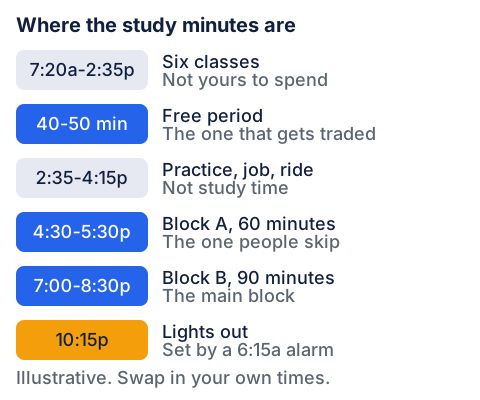
Pocket one: the free period. Forty to fifty minutes, in a building, with teachers down the hall, on material you heard two hours ago. It is the highest-value study window in your week, the first of the three blue bands on the map above, and the one most consistently traded for a conversation. If your school collects phones during the day, it is already distraction-free.
Pocket two: the hour between the last bell and dinner. Practice, a shift, or a ride home eats part of it. What is left is often 45 to 60 usable minutes, and it is the block students skip because it does not feel like study time yet.
Pocket three: the evening block. Ninety minutes somewhere between 7:00 and 9:00. This one everybody knows about. It is also the one that quietly becomes 40 minutes of work and 50 minutes of phone.
Do the audit on paper, not in your head. Write the five weekdays across the top of a page and mark every 30-minute slot from first bell to bedtime as committed, usable, or gone. The point is not to fill every usable slot. It is to stop planning around time you do not have.
A schedule you abandon by Wednesday was never a schedule. It was a wish list with times written next to it.
Six classes, five weeknights: build a rotation
The plan that fails is the one that gives every subject a slot every night. Six subjects, 20 minutes each, is two hours of switching costs and nothing finished. Split the work into two tiers instead, and run the four moves below in the order they are numbered — the week gets decided on Sunday, before you live it.
Look at the next seven days of quizzes, tests, labs and papers. Write which subject owns which night. Ten minutes of planning. Do not re-decide on Tuesday at 7 p.m., because at 7 p.m. on Tuesday you will pick the easy subject every time.
Before anything else, handle what is due tomorrow in every class. On a light night that is ten minutes; on a normal one it is closer to 30 to 45 across six classes, and on a heavy one it can run to an hour. This tier exists for one reason: it is what stops zeros, and a zero is the largest loss any single assignment can hand you (see the arithmetic below).
30 to 45 minutes on exactly one subject — whichever one Sunday assigned to tonight. Not the one you like. The one with the next assessment, or the one where the gradebook says you are losing points. One subject per night means the classes that need a block get one most weeks, and the one with a test coming gets two.
Essays, lab reports and projects do not fit a 40-minute block. They need one uninterrupted 90-minute session, and the only reliable place to find that is Saturday or Sunday morning.
Add the two nightly tiers up and a light night is about 40 minutes; a normal one runs an hour to an hour and a half; a heavy one, with six classes all wanting something, reaches an hour and three quarters. That is deliberately less than the three hours the map marks in blue, and the gap is the point. On a normal night both tiers fit inside the evening block alone, which leaves the free period and the after-school hour as the slack a heavy night spends — the lab write-up that lands Wednesday, the test that moves up a week, the practice that runs long. A plan that assigns every claimable minute in advance is the plan you abandon the first Wednesday something goes wrong.
Here is what a filled-in week looks like for a student with a biology test on Friday:
| Night | Deep block (30–45 min) | Why it landed there |
|---|---|---|
| Monday | Biology | Test Friday. Starting Monday gives the material two separated passes instead of one long Thursday night. |
| Tuesday | Algebra 2 | Math needs worked problems, not reading. Forty minutes of problems beats two hours of reviewing solutions. |
| Wednesday | US History | Heaviest reading load, and midweek is when the reading backlog starts. |
| Thursday | Biology (second pass) | The night before the test, testing yourself on what you got wrong Monday. |
| Saturday | English essay | Long-form work, so it gets the 90-minute session rather than a weeknight block. |
| Every night | Spanish, 10 minutes | Vocabulary is the one subject where short daily contact beats a weekly block. It rides along in tier one. |
Notice what is missing: art, any class you are comfortably passing, and Friday night. That is deliberate. A rotation that covers everything covers nothing.
If you would rather have the rotation live somewhere you cannot lose it, our free assignment tracker templates for Sheets, Excel and Notion give you a column to put it in.
Let the gradebook decide where the hour goes
This takes five minutes with your own numbers, and it is the only part of this page you can check against your own grade.
Plenty of high school classes weight their categories: tests are worth one share of your grade, quizzes another, homework another. Plenty of others grade on total points, where every assignment just adds its points to one running pile. Both are standard options in US gradebook software: PowerSchool lists total points and category weighting among its grade calculation types, and in Infinite Campus, weighting the categories is a checkbox a teacher either checks or leaves off. Check your syllabus, or the gradebook itself, before you assume. The weighted version comes first below; the total-points version follows it, and both end in the same place.
Open your gradebook and write down the weights and how many items sit in each category. Here is an illustrative set — yours will differ, and yours is the one that matters:
| Category | Weight | Items this semester | Each item is worth |
|---|---|---|---|
| Tests | 40% | 5 | 8.0% of the final grade |
| Labs and projects | 20% | 4 | 5.0% |
| Quizzes | 20% | 10 | 2.0% |
| Homework | 15% | 25 | 0.6% |
| Classwork | 5% | — | — |
Now run two numbers against that table.
Skip one homework assignment. Your homework category drops from 25 out of 25 to 24 out of 25, which is 96%. That category contributes 14.4 points instead of 15.0. Cost: 0.6 points off your final grade.
Turn an 82 on one unit test into a 90. Your test average moves from 82% to 83.6%, so the category contributes 33.44 instead of 32.8. Gain: 0.64 points.
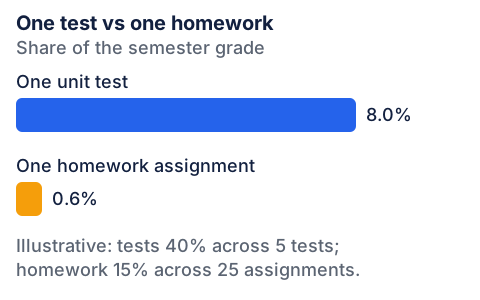
Read those two numbers next to each other. Eight extra points on a unit test — the difference between a rushed review and a real one — buys you 0.64. One homework you did not turn in costs 0.60. They are nearly the same size.
Push it further. Five missed homeworks drop the category to 80% and cost 3.0 points. Taking one 82 all the way to a perfect 100 gains 1.44. You would need to do that on more than two separate tests just to get back to even — and nobody gets 18 extra points twice by trying harder.
If your class grades on total points, run it this way instead. Add up every point available for the semester — say 1,000 — and divide each item by that total. A 100-point unit test is 10% of your grade; a 10-point homework is 1%. Skip five of those homeworks and you have handed back 50 points, or 5% of the semester, without getting a single test question wrong. The arithmetic is easier and the conclusion is the same one: find out what the thing in front of you is actually worth before you decide how much of tonight it gets.
The trap in a live gradebook is checking it instead of using it. Refreshing your grade six times a day is not studying, and the number barely moves between assignments anyway. Look at it twice a week: once on Sunday when you assign the rotation, once midweek. Both times, ask the same question — which category, or which stack of assignments, is costing me the most points, and is it costing them through low scores or through missing items?
The answer to that question is your rotation for the week. If the losses are in homework, you have a tier-one problem and no amount of test prep fixes it. If the losses are in tests, tier two needs to change — which brings us to what you actually do in a block.
What to actually do inside a 40-minute block
Most students spend a study block rereading. It feels productive, because the material gets more familiar every pass, and familiarity feels like knowing. It is one of the best-documented mismatches in study skills.
In a 2013 review in Psychological Science in the Public Interest, Dunlosky and colleagues assessed ten common study techniques and rated practice testing and distributed practice as high utility, while rereading and highlighting came out surprisingly low. Practice testing means retrieving the material from memory. Distributed practice means spreading the sessions out. Your two-tier rotation already delivers the second one; here is how to get the first inside a block.
A 40-minute biology block, four days before the unit test.
Minutes 0–10. Notebook shut, phone in another room. On blank paper, write the stages of cellular respiration in order, where each one happens in the cell, and what each one produces. Whatever you cannot produce, leave a gap and keep going.
Minutes 10–20. Open the notes. Mark only the gaps and the wrong answers, in a color you use for nothing else. Do not rewrite the parts you got right — you already have them.
Minutes 20–35. Work only the marked material. Read it, close the book, write it again from memory. Repeat until the page comes out clean.
Minutes 35–40. Turn each marked item into a question and write it on an index card or a note on your phone. That card is what Thursday's second pass uses. You will not have to decide what to study; Monday already decided.
Three things make this work where rereading does not. You find out what you do not know while there is still time to fix it. You spend your minutes only on the gaps. And the block ends by producing the input for the next block, so nothing has to be re-planned.
The same loop fits any subject. In math, the blank page is a problem you have not seen the solution to. In history, it is a timeline or a paragraph arguing a cause. In English, it is a claim about the text, written without opening the text. If a claim is what you are being graded on, it helps to know how to outline an essay before the writing starts.
Sleep is a scheduling constraint, not a wellness tip
Every list on this topic ends with "get enough sleep," positioned as a nice extra. For a high school student it is not an extra. It is the fixed edge of the container that everything else has to fit inside, because your first bell is not negotiable.
The American Academy of Sleep Medicine's teen sleep duration health advisory (adopted 2014, updated 2016) recommends that teenagers 13 to 18 sleep 8 to 10 hours per 24 hours, and notes that regularly sleeping less is associated with attention, behavior and learning problems. Note the direction of that finding: it is an association, not a promise that an early bedtime raises your grades. But it does set the boundary of your evening.
Work backward, using the weekday map further up this page. A 7:20 first bell means leaving at 6:45, which means an alarm around 6:15. Eight hours puts you asleep by 10:15 p.m., not in bed at 10:15 scrolling. Subtract 45 minutes to wind down and your study time has to be finished by 9:30.
That one calculation does more scheduling work than any app. It fixes the evening block at 7:00 to 8:30 rather than "whenever I get to it," makes the after-school hour necessary instead of optional, and reframes a 1 a.m. cram session as study time borrowed from tomorrow's first three periods at a bad rate.
What goes wrong, and what to do about it
You built the schedule on Sunday and dropped it by Wednesday
The usual cause is that the schedule was built by addition: you listed what you wished you would do and assigned times to it. Build the next one by subtraction. Start from the real week you audited, cross out everything committed, and place blocks only in what is left. Then halve it. One deep block a night that you actually run beats three you abandon — and the abandoned plan also costs you the belief that any plan works.
You keep studying the class you are already good at
Close to universal, and it is not laziness. Your strong subject gives you a feeling of progress; the one you are failing gives you a feeling of being behind, so attention drifts to the pleasant one. The gradebook check fixes it by removing the choice. If the numbers say history, the block is history, and you did not have to talk yourself into it at 7 p.m.
Your season started and the whole system collapsed
Three months of practice until 6 p.m. removes the after-school pocket entirely. Do not run the same plan on less time — change the plan. In season, your free period stops being optional and becomes tier two, the evening block shrinks to 45 minutes, and the weekend session carries the long-form work. Write the in-season version down before the season starts, while you can still think about it clearly.
Your "study group" is a group chat
Four people with the same notes open is not a study group; it is company. A working session has a job: one person writes ten questions from the unit before anyone arrives, everyone answers them on paper without notes, then you compare and argue about the ones you disagreed on. Thirty minutes of that beats two hours of everyone reading in the same room.
The backlog is genuinely past fixing on your own
Sometimes the pile is not a scheduling problem. If you have missed three weeks of one class through illness, a move, or something heavier, a rotation does not dig you out, and pretending otherwise costs another week. Talk to the teacher first — most will restructure a late-work plan for a student who comes to them before the grade closes. If you need help with the work itself while you rebuild the habit, that is what our homework help service is for. And if the immediate problem is a paper due in the morning, we have a realistic plan for writing 2,000 words in one night that is not "stay up until 4 a.m."
Which of these habits survive college
Worth knowing now, because a few of the things that carry you through eleventh grade are scaffolding your school provides, and that scaffolding is gone the week your first college semester starts.
| High school habit | What happens to it in college | What to build now |
|---|---|---|
| Checking a live gradebook that does the math for you | Often unavailable. Many courses post a handful of scores and expect you to work out your own standing from the syllabus. | Learn to do the weight or point-total arithmetic yourself, from the syllabus, rather than reading a number off a screen. |
| Homework graded for completion | Frequently ungraded or worth very little. The exams and papers carry the course. | Get used to testing yourself when nothing is being collected. That is the habit that transfers. |
| Teacher reminders and late-work windows | Largely gone. A missed deadline is usually just a missed deadline. | Own one list of every due date. Our guide to keeping track of assignments in college is the grown-up version of tier one. |
| Nightly rotation across six subjects | Survives, but with fewer courses carrying much more reading each. | Keep the rotation. Stretch the block from 40 minutes to 90 and expect fewer subjects per week. |
| A free period inside the school day | Often becomes a two-hour gap between classes on campus. | The habit of claiming small daytime windows is the single most transferable thing on this page. |
| Cramming the night before | Stops working, because a college unit is too large to hold for one night. | Distributed practice. It is the habit with the longest runway, which is why it is worth building now rather than in your first college semester. |
None of this asks you to become a different person. It asks you to claim the three bands the weekday map further up this page marks in blue — about three hours between a free period, an hour after school and 90 minutes at night — spend the assigned part of them on one subject at a time, and let a table of numbers pick which subject. Do the audit this week. Assign the rotation Sunday. Run the gradebook arithmetic once, with your own weights or your own point totals, and it keeps paying for the rest of the year.