Live Chat

Write a term paper by counting backward from the due date, not forward from today. Set six checkpoints — question, sources, thesis, draft, revision, format — and give each one a deadline of its own. The paper then gets written in six short blocks instead of one desperate scramble at the end, which is what this task turns into when nobody dates it.
A term paper is the long researched paper a course assigns across a whole term and collects at the end, usually carrying a large share of the final grade. Your assignment sheet will tell you that much. What it won't tell you is that a term paper is a scheduling problem before it is a writing problem. You are handed ten weeks, you use two, and you submit the paper that two weeks can produce.
- Give each of the six checkpoints its own dated deadline the day the assignment lands, not the week it is due.
- Your instinct about how long the paper will take is measurably optimistic — plan against your worst-case estimate, then start earlier than that.
- Narrow the topic until it is a question reasonable people could answer two different ways, then test it against your page count.
- Draft the body sections first; the introduction is easier to write once you know what it introduces.
- Revise structure and sentences in separate passes — a reverse outline shows you the structure you actually wrote.
- If the semester has already slipped, cut scope, never the last revision pass.
Count backward from the due date, not forward from today
Open your syllabus and find the submission date. That date is the only fixed point in the project; everything else is negotiable, and so everything else should be scheduled relative to it.
The table below is our default plan for a paper assigned early in a 14-week semester. The left column is weeks before the paper is due, not calendar dates, so it transfers to a quarter system, a summer session, or a syllabus that hands the assignment out halfway through the term.
| Weeks before it's due | The block's job | What exists when the block ends |
|---|---|---|
| 10 | Decode the assignment sheet and narrow the subject | One arguable question, written down in a single sentence |
| 8 | Read and take notes | Notes on your sources, in your own words, with page numbers |
| 6 | Commit to a position | A working thesis plus a one-page outline of the sections |
| 4 | Draft, badly and completely | A full draft with every section written, however rough |
| 2 | Revise for structure | A reverse outline done and the ordering problems fixed |
| 1 | Cite, format, proofread | A finished file, done two days before the deadline so you can reread it cold |
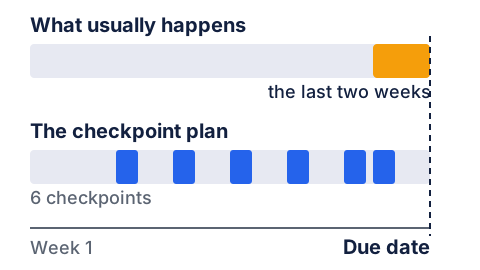
If your paper was assigned late and you have fewer weeks than the table assumes, compress the middle. Reading and drafting can be squeezed. The last two blocks cannot: a paper that has never been revised for structure reads like a set of notes, and a grader notices that on the first page.
Put all six checkpoint dates into whatever you already use for coursework the day the paper is assigned, with the last one set two days before the real deadline. A checkpoint that lives only in your head is not a checkpoint. If you don't have a system for this yet, our guide to keeping track of assignments covers setting one up.
Your own time estimate is the thing that fails
The reason the checkpoints have to be dated in advance is that your sense of how long the paper will take is unreliable in one predictable direction. This is documented, and the best-known study measured students writing a long academic paper of their own.
In Exploring the "Planning Fallacy": Why People Underestimate Their Task Completion Times (Buehler, Griffin and Ross, Journal of Personality and Social Psychology, 1994), 37 psychology students in the final semester of an honors thesis course at the University of Waterloo were phoned and asked to predict, as accurately as they could, when they would hand the thesis in. The course coordinator recorded the real submission dates.
The more revealing finding is what happened to the pessimists. The same students were asked how long it would take "if everything went as poorly as it possibly could." They said 48.6 days — still short of the 55.5 they took, a gap the authors themselves report as not statistically significant. The count is the harder number: fewer than half of them, 48.7%, made even that date. The averages are calculated on 33 students, because four had still not submitted when the researchers closed their records two semesters later, which means the real picture is worse than the numbers above.
Their worst-case estimate was still optimistic. Treat yours the same way: whatever you think the draft will take, schedule the pessimistic number and start earlier than that.
This is not an argument for panic. It is an argument for putting dates on paper the day the assignment lands, while you are still calm enough to be honest, and then following them instead of re-estimating every week.
Read the assignment sheet like a spec
Before you think about topics, mine the assignment sheet and the rubric for the six things that constrain everything downstream. Write them at the top of the document you'll draft in, so they stay visible.
- Length, and whether the title page and reference list count toward it — instructors differ, and the difference is a full page of writing.
- Source requirements: how many, and what kinds. "Five peer-reviewed articles" and "five sources" are different assignments.
- Citation style, decided now rather than at 2 a.m. on the last night.
- The intermediate deadlines — proposal, annotated bibliography, draft, peer review. These are your checkpoints, already dated for you.
- The rubric's point weights, which tell you where the grade actually lives.
- The paper's weight in the course, which tells you how many hours it deserves relative to everything else on your plate.
Those intermediate deadlines matter more than they look. A term paper proposal handout posted on Union College's course server, for one course, asks for exactly three things: a working title, a thesis statement, and an annotated bibliography of "4-5 books, book chapters, articles, etc., that you have carefully read in relation to your term paper." That is one instructor's version, not a universal rule — but notice what it does. It forces the first three checkpoints in our table to happen on schedule, and it hands you a response to your thesis before the paper is written.
If your course has no proposal deadline, build one anyway. Email your instructor your question and your three best sources six weeks before the due date and ask whether the angle works. A two-line reply then is worth more than any comment you get back on the finished paper.
Pick a question that still holds up with two weeks to go
A lot of weak term papers are traceable to a topic that was never a question. "Immigration policy" is a subject. You cannot be wrong about it, so you cannot be interesting about it either.
Run any candidate through three tests before you commit:
- Can you state the disagreement? Name the two positions a reasonable person could hold. If you can't name a second position, you have a topic, not a question.
- Do at least five credible sources argue with each other about it? If everything you find says the same thing, there is nothing for your paper to do.
- Does it fit the page count? A question that needs 40 pages produces a 10-page summary, which is a reliable way to lose points.
Narrowing, one step at a time, for a US public-policy course. Start: "the gig economy" — a subject. Narrower: "gig-economy labor law" — still a subject. A question: "Should app-based delivery drivers be classified as employees?" — arguable, but a book. The 10-page version: "Did California's Proposition 22, which classified app-based drivers as independent contractors, leave those drivers better or worse off?" Now the disagreement is real, the evidence is findable, and the scope stops at one state and one measure.
The topic list, or your own idea?
When your instructor supplies a list of approved topics, that list is the safe default — the scope has already been checked against the page count. Going off it is a real choice with a real cost.
Pros of your own topic
- You read more willingly, and that shows at the eight-weeks-out checkpoint.
- Your paper won't sit in a stack of thirty near-identical ones.
- You can build on something you already know, which shortens the reading.
Cons of your own topic
- Nobody has checked the scope against your page count. You carry that risk.
- The sources may not be in the course reserves, so finding them costs days.
- Your instructor may know the literature less well, so feedback is thinner.
- It only works if you clear it in advance, in writing.
The rule: bring your own if you already have a specific question and a course concept it connects to. Take one off the list if what you have is an area you find interesting. Either way, the next move is turning it into a position you can defend — our thesis statement guide handles the sentence itself.
Turn reading into notes you can draft from
The failure at the eight-weeks-out checkpoint is almost never "I didn't read enough." It is that the reading is in twenty open tabs and a highlighted PDF, and drafting means reading it all again.
Take notes in a fixed four-part shape, one entry per idea, not per source:
- Claim — what this source argues, in your own sentence.
- Evidence — the specific data, case or quotation, with the page number.
- Why it matters to me — how it supports, complicates or contradicts my question.
- Where it goes — the section of my paper it belongs in.
That last field is what converts a reading list into an outline. When you finish reading, sort the entries by their "where it goes" value and the structure of the paper is largely written. Rewriting each claim in your own words at the note stage also closes off the most familiar route to accidental plagiarism, which is drafting from copied phrasing you no longer remember copying — the mechanics are covered in our guide to reducing plagiarism in a research paper.
On volume: if the assignment sheet doesn't set a number, a workable default is roughly one source per page — eight to twelve for a 10-page paper, all of them genuinely read, of which four or five carry real weight in the argument. The sheet always overrides this.
Sometimes the reading kills your thesis — you set out to argue one position and the evidence goes the other way. Change the thesis, not the evidence. A paper that says "I expected X, the record shows Y, here is why the difference matters" is a stronger paper than the one you planned, and it is the only honest option available. Discovering this at the eight-weeks-out checkpoint is fine; discovering it with one week to go is why that checkpoint exists.
Draft the middle first, on a page budget
Give every section a page allocation before you write a word of it. Without one, the background section eats four pages and the argument gets two, which is the shape of a term paper that reads like a report.
Here is the budget we'd hand a student writing a 10-page paper, at roughly 250 words to a double-spaced page:
| Section | Pages (of 10) | What it has to accomplish |
|---|---|---|
| Introduction | 1 | The question, why it's contested, and your thesis in the last sentence or two |
| Background | 2 | Only the context a reader needs to follow the argument — not everything you read |
| Argument, section one | 2 | Your strongest supporting claim, with evidence and your analysis of it |
| Argument, section two | 2 | The second claim, plus the counterargument you take seriously |
| Argument, section three | 2 | The claim that only works once the first two are established |
| Conclusion | 1 | What follows from the argument — not a summary of it |
That is 2,500 words, and it is an illustration rather than a template: a 15-page paper scales the argument sections, not the introduction. Then draft in this order:
- The three argument sections, starting with whichever one you understand best.
- The background, once you know which context the argument actually needed.
- The conclusion.
- The introduction, last, because you now know what it is introducing.
- Title page, abstract if required, and the reference list or Works Cited.
Write this draft badly on purpose. The four-weeks-out block produces a complete rough draft, not a good one — every section written through to its end, gaps marked with a bracketed note like [need a source here] rather than left blank. A complete bad draft can be fixed in the two-weeks-out block. An elegant half-draft cannot. If the outline stage is where you tend to stall, our walkthrough of how to outline before you write is the shorter road into it.
Revise for structure, then for sentences
Do these in separate passes. Editing prose while the section order is still wrong means polishing paragraphs you are about to delete.
The structural pass has a name and a method. The University of Wisconsin–Madison Writing Center calls it a reverse outline: you strip away the supporting writing until only the paper's main points are left, then look at what you've got. Their handbook supplies the concept; the four moves below are our working version of it.
Work from a complete draft, not a partial one — the point is to see the whole shape at once.
Not what the paragraph should say. What it does say. If you need two sentences, the paragraph is doing two jobs.
Does it follow? Does anything repeat? Does every line connect to the thesis? Is one section three paragraphs while another is nine?
Reorder, merge and cut in the list first — it takes minutes. Then apply those moves to the real document.
Only after the structure holds should you touch sentences: tighten, cut hedging, check that every quotation is followed by your own analysis of it rather than left to speak for itself.
Before you submit
- Any intermediate deliverable the course required — proposal, annotated bibliography, peer review — is attached or already submitted.
- The page count is met without counting the title page and reference list, if your instructor said those do not count.
- Every in-text citation has a matching entry in the reference list or Works Cited, and the reverse.
- Margins, spacing, font, page numbers and header match the required style — the differences are laid out in our APA and MLA term paper format comparison.
- The thesis sentence in your introduction still describes the paper you ended up writing.
- The file is named as the instructor asked, in the format they asked for.
- You read it once on paper or on a phone screen, which surfaces errors a laptop hides. A final proofreading pass is a separate job from revising, and it goes last.
If the semester already got away from you
If you found this page with two weeks to go, you do not have ten weeks. The plan still works; the blocks just get shorter, and you buy the time by cutting scope rather than by cutting the revision.
| Time left | What you still do | What you drop |
|---|---|---|
| 10 days | Two days to lock the question and find six sources; three to read and note; one to outline; three to draft; one for the reverse outline and formatting. | Reading widely. A second full draft. Any section the rubric doesn't score. |
| 4 days | Take the narrowest version of the question your sheet allows. Four or five sources, read abstract, introduction and conclusion first. Draft on days two and three, revise and cite on day four. | The broad background section. Sources you haven't opened. Perfect sentences. |
| Under 48 hours | Ask about an extension before you write anything, then draft the narrowest defensible version. Reserve the last two hours for one structural read-through against your thesis, then citations and format. | Everything optional. At this point the goal is a complete, honest, correctly cited paper, not an ambitious one. |
The extension question is arithmetic, not a favor. If your syllabus states the late penalty as a fixed number of points per day — many do — compare that stated penalty against what the rubric takes off for a paper with no revision pass and three sources. Sometimes the late paper scores higher, and you can estimate that in two minutes. If you truly have one night and no extension available, our notes on writing 2,000 words in one night are about triage rather than magic.
What never gets cut, at any length: a thesis that takes a position, evidence you have actually read, and citations that match. Those three sit near the top of almost any rubric you will be graded against.
The habit the whole plan rests on
Nothing above is hard in isolation. Narrowing a question takes an hour. Reverse-outlining a draft takes twenty minutes. The method is only a refusal to let those hours land on the same weekend, and the refusal happens on the day the assignment lands, with a calendar open.
If a paper is already past rescuing and you want a subject writer to produce a draft you can work from, that is what our term paper writing service does — written from your assignment sheet and delivered to you, from $7.89 a page, for you to review and use as you decide. Other coursework papers go through our paper writing service. And if the assignment is really a research paper — the two overlap, and one paper can be both — the middle of the process differs; our step-by-step research paper guide covers that version.