Live Chat


Search for book review examples and the results mix two genres that have almost nothing in common. A review in a literary magazine and a review written for a seminar are built differently, aimed at different readers, and judged by different standards.
Below is the same book reviewed both ways, so you can see which one your assignment is asking for — and why copying the wrong model costs you credit even when the writing is good. After that, an academic review annotated paragraph by paragraph, and a way to tell what any example you find is fit to teach you.
- A published review helps a stranger decide whether to read the book. An academic review argues about the book for a reader who already has.
- Published reviews avoid spoilers and describe the experience. Academic reviews cite page numbers and assess the argument.
- Academic reviews judge the book against what it set out to do, not against personal taste.
- "Engaging", "compelling" and "beautifully written" belong to one genre and are dead weight in the other.
- If your assignment prompt uses the verbs evaluate, assess or critique, you want the academic version.
- The useful question about any example is not "is this good writing?" but "what is this example fit to teach me?"
The same book, reviewed twice
Both reviews below cover one book: The Quiet Archive, a history monograph arguing that gaps in colonial records should be read as evidence of suppression rather than as accidental loss.
The book, its author, the scholars it is measured against and every page number here are invented — you cannot show located evidence working without pages to point at. There is no such book, so do not cite any of it.
"Ruth Halvorsen has written the rare history book that changes how you look at a filing cabinet. The Quiet Archive takes the empty spaces in colonial records — the missing years, the removed pages — and asks what silence is doing there. It is a quietly angry book, and it earns its anger slowly, through patient work in four national archives. The prose is clear and occasionally beautiful. Readers new to the period may find the middle chapters demanding, but the argument is worth the effort, and the final chapter is genuinely moving."
"Halvorsen's central claim — that archival absence functions as evidence of suppression rather than as loss — is convincingly established for the four national collections she examines (23–89). The methodological chapter is the book's strongest contribution, offering a workable procedure for distinguishing deliberate removal from ordinary attrition (31–44). The argument weakens where it generalizes. Chapter 6 extends the claim to municipal records without new evidence, resting on the assertion that the same logic applies (167). Given that municipal archives had different retention rules, that assertion needed defending. The book nonetheless supersedes Ferreira's account as the standard treatment of the methodological problem."
Same book, same judgment broadly, entirely different documents. One tells you what reading it is like; the other tells you whether the argument holds and where the field now stands.
What changed, line by line
| What differs | Published review | Academic review |
|---|---|---|
| Reader | Has not read the book | Has read it, or knows the field |
| Purpose | Recommend or warn | Assess the contribution |
| Summary | Substantial, spoiler-aware | Brief, spoilers irrelevant |
| Ending | Withheld on purpose | Discussed freely if it matters |
| Evidence | Impressions, quoted lines | Page references throughout |
| Criticism | General, often gentle | Located, specific, expected |
| Other books | Rarely mentioned | Essential — places it in the field |
| Voice | Personality allowed | Restrained, argument-led |
An academic review, paragraph by paragraph
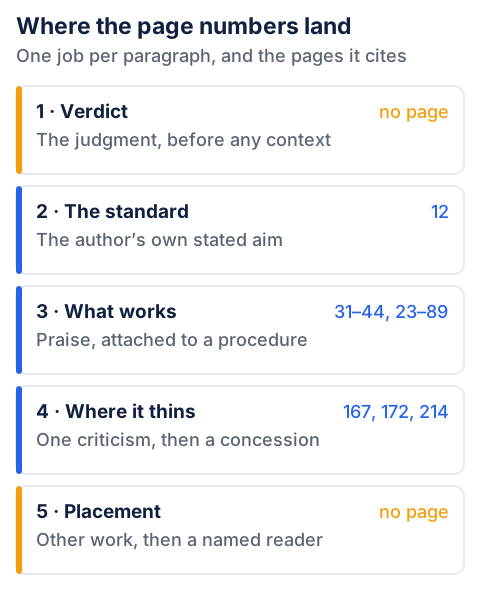
The academic version above is compressed to make the contrast visible. A coursework review has room to show the work behind the verdict, and that room is where the credit sits. Here is the same judgment as five paragraphs, one job each, with what each one is doing underneath it. The five run just under 270 words together — roughly a third of the shortest coursework review — because each is shown at the length it takes to demonstrate its job; in a 750-to-1,500-word review each would run three to six times longer. The book, its author, the scholars it is measured against and every page number below are the invented ones described above.
"The Quiet Archive sets out to show that archival absence can be read as evidence of suppression rather than as ordinary loss, and for the four national collections Halvorsen examines, it succeeds. The book is strongest where it is most technical and weakest where it is most ambitious."
What it is doing. The verdict arrives before any context, and it announces the shape of the review — strongest here, weakest there — so the reader knows what the next four paragraphs will prove. No page reference is needed yet, because nothing here is a claim about a specific passage.
"Halvorsen states the aim plainly: a repeatable method for telling records that were removed from records that were never kept (12). That is the standard the book asks to be judged by, and it is narrower than the title suggests."
What it is doing. This paragraph does the work most student reviews skip. It cites the author's own aim, with a page, and fixes the standard before any judgment is passed. The UNC Writing Center puts the same instruction as a rule: "Review the book in front of you, not the book you wish the author had written."
"The methodological chapter is the contribution. Halvorsen builds a procedure — retention schedule, transfer record, gap, corroborating correspondence — that separates deliberate removal from ordinary attrition without falling back on intuition (31–44). Applied across four national collections, it produces a consistent pattern rather than a set of anecdotes (23–89)."
What it is doing. Praise is as located as criticism. The page range is attached to the specific thing being praised, and the procedure is named in enough detail that a reader can tell the reviewer worked through it. "The methodology is excellent" says nothing.
"The argument weakens when it travels. Chapter 6 extends the claim to municipal archives on the ground that the same logic applies (167), but municipal records were kept under different retention rules, and the book's own procedure depends on knowing what those rules required. Halvorsen acknowledges the difficulty in a footnote (172) without resolving it, and the conclusion restates the municipal claim as though it had been settled (214). The national case is untouched by this, and remains convincing."
What it is doing. Three page references, one criticism, one concession. The complaint is not that the book overreaches — it is that a named chapter makes a named move on a named page, and the book's own method is what that move breaks. The concession keeps the review proportionate.
"For the methodological problem it takes on, this supersedes Ferreira's account as the standard treatment, and the procedure in chapter 2 is usable by anyone working with incomplete records. Readers wanting a general account of colonial record-keeping should look elsewhere; readers who need to argue from a gap should start here."
What it is doing. The close measures the book against a named alternative, then names a specific reader and a specific use. "I would recommend this book" does none of the three.
Where the opening sentence goes wrong
The opening is where students most often slip into the wrong genre. Three that give it away:
"Ruth Halvorsen's new book is a fascinating read from start to finish." · "Born in 1974, Halvorsen studied at…" · "This book is about colonial archives."
Author biography is almost never relevant in a coursework review, and "this book is about" wastes your strongest sentence on a topic label. Genre is only the first move, though. Here is one opening sentence revised twice; what improves is not the prose but how much of the sentence a reader could go and check.
"The Quiet Archive is an interesting book about colonial archives that raises important questions."
"Halvorsen argues convincingly that archival silence is evidence, though the book is less persuasive in its later chapters."
"Halvorsen establishes that archival silence can be read as evidence, and does it well for the four national collections she works in; the claim thins the moment it leaves them."
The first names a topic and stops. The second carries a judgment, but "less persuasive" is not a place and "later chapters" is not a location — nobody can turn to it. The third names the judgment, the scope on which it holds, and the point where it fails: the whole review in one sentence, and the same rules apply to it as to any thesis statement.
The single most useful habit: locate the criticism
The move in paragraph 4 is the habit worth taking from all of this, and it works on any book. Every criticism in an academic review should be findable — a reader should be able to turn to the page and see what you saw. That is the difference between critique and opinion, and it is almost the whole of the grading criteria.
Keep two running lists while you read: places the argument is working, and places you resisted. Note the page every time. Reconstructing this after finishing is close to impossible, which is why so many student reviews end up unevidenced.
What changes when the book is a novel
Almost every example you will find assumes a monograph with an argument to test. Copy one for a novel and you produce a paragraph about "the author's thesis" that a literature instructor will not recognize. Three things change, and one does not.
- The claim becomes yours. A novel rarely argues anything, so you build an interpretive claim about what its form is doing, then defend it.
- The evidence becomes quoted text. Scenes, images, a narrator's habits — still carrying a page number every time.
- Craft is the mechanism. Structure, pacing and voice are not decoration here, so they can be assessed directly.
- Taste is still not the point. How the book produces its effects is assessable; whether you enjoyed those effects is not.
"The novel's refusal to date its chapters is not a stylistic tic but the mechanism of the whole book: the narrator's memory arrives without chronology, so the reader assembles a sequence and, in doing so, repeats the narrator's own error (47, 112, 188). The device pays off in the final section, where one dated document reorders everything that came before (219). What it costs is momentum — the middle third asks the reader to hold more than the payoff finally uses."
Same moves as the monograph review — a claim about how the book works, located instances, a cost named without hedging. Only the kind of evidence changed. (The novel and its pages are invented too.)
Where your example came from, and what it can teach you
Most of the frustration with book review examples comes from reading them all as one category. Each source is good for something specific and useless for the rest.
| Where you found it | What it actually is | What it can teach you — and what it can't |
|---|---|---|
| Amazon or Goodreads | A reader's response | Nothing structural. No argument is being assessed and no evidence located — the genre furthest from your assignment. |
| A newspaper or magazine review | A published review, usually written well | Compression and sentence rhythm. Not its taste vocabulary, not its spoiler-avoidance, and not its habit of rarely naming other scholarship. |
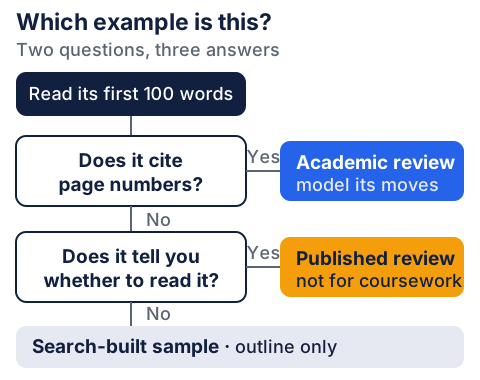
| A journal review on JSTOR or Project MUSE | The professional academic model | Every move you need, in order. But it is short, so it states conclusions that your review has to work through. |
| A "book review example" on a content blog | Usually a hybrid, written to rank | Treat it as an outline. Many cite no page anywhere, which tells you how closely the writer read one. |
| A sample from a university writing center | A teaching model, often annotated | Structure, and the reasoning behind it. Built for one course's expectations, so check it against your own prompt. |
| A classmate's graded review | The closest match to your actual task | What your program rewards. Read it if your instructor allows; reusing its sentences is plagiarism, and your criticism is the graded part. |
When the source is not obvious, the first hundred words settle it faster than the byline does.
Why the examples you find are shorter than your assignment
Two journals' instructions to reviewers explain a lot of the confusion. The Journal of American History tells its reviewers that "for reviews of monographs, the standard length is 500 words; for those of edited collections of essays, it is 600," with joint reviews at least 900 and feature reviews at least 1,000. International Studies Review caps book reviews at 1,000 words, footnotes included — a ceiling below the midpoint of the 750-to-1,500 words a course will ask you for.
A 500-word review is a compressed form. It states a verdict, gives one paragraph of support, places the book, and stops. Every explanatory move a coursework review is graded on — how you reached the verdict, the walk through the evidence, the concession — has been cut, because that journal's readers supply it themselves. Your grader will not: supplying it is the assignment.
Coursework reviews usually run 750 to 1,500 words, and your prompt's number is the one that counts. Model a 1,200-word review on a 500-word journal review and you copy its compression, run out of things to say around word 500, then pad the rest with summary. Model the moves, not the length.
Summary rarely gets a section of its own in a journal review or in a coursework review, and unless your prompt asks for one, distribute it — a sentence of context wherever the reader needs one, never a standalone recap.
Chapter-by-chapter walkthroughs ("Chapter 1 covers… Chapter 2 covers…") and quotation without comment. Both fill space while deferring the judgment you are being graded on. If you quote, the next sentence should say what the quotation demonstrates.
Deciding which one you were assigned
If the prompt is ambiguous, three tests settle it quickly. The verbs: evaluate, assess, critique, situate mean academic, while respond, recommend, describe your reaction lean published. The audience: if the prompt names a publication or a general reader, write the published version; if it names no audience, assume your instructor and the field. The citation requirement: if a citation style is specified, it is academic, because magazine reviews do not have Works Cited pages.
Before you copy an example, check five things
Run whichever example you settle on past this list before you build a draft around it.
- Does it cite pages, and name another book? Those two habits carry most of the credit in an academic review. An example with neither cannot model either.
- Is it the length your prompt asks for? A compressed journal review and a 1,500-word coursework review are different documents.
- Does it review a book like yours? A monograph review will not fit a novel, an edited collection or a textbook without adjustment.
- Whose expectations was it written for? Writing-center samples answer one course's prompt. Yours may weight summary differently.
- Are you copying moves or sentences? Structure, ordering and the habit of locating evidence are yours to take. Wording is not, published or not.
If the reading is done but the writing is not, our book review help works from the text with page-referenced criticism throughout, inside our coursework service from $7.89 a page.