Live Chat

You have eleven days, three exams, and a shift on Saturday, and none of those dates is going to move. The fix is to build your study schedule backward from the exam date instead of forwards from today — decide what has to be true on the morning of the test, then work back to what tonight has to look like.
That one change solves the problem with almost every list of study tips for exams. The tips themselves are usually fine. What no page tells you is which ones to keep when the calendar shrinks. Below is a 14-day countdown, the hour arithmetic underneath it, and the exact order to cut things in at seven days, three days, and one.
- Plan backward. Fix the exam date, place the timed practice attempt first, then fill in the days before it.
- Rate every topic cold before you plan. You cannot split your hours across a syllabus until you know which topics are actually broken.
- Weight the budget. Shaky topics get roughly double the standard slot; topics you could teach get half.
- Practice testing and spacing carry the strongest research support. Rereading and highlighting do not.
- Cut coverage first, retrieval last. One timed attempt plus the repair it triggers is the piece that never goes.
- The day before is for your own error list and sleep, not for new material.
Start at the exam date and work backward
Forward planning fails in a predictable way. You start on Monday with the first topic in the syllabus, work at a comfortable pace, and by the weekend you have covered a third of the course beautifully. The material you actually fail on is the material you never reached.
Backward planning inverts the risk. You put the immovable thing on the calendar first — a full, timed practice attempt under exam conditions — and everything else has to fit around it. That attempt is usually the first thing to go when time gets tight, and it is the only thing that tests all of the material at once, under the clock, in the order the exam will ask for it.
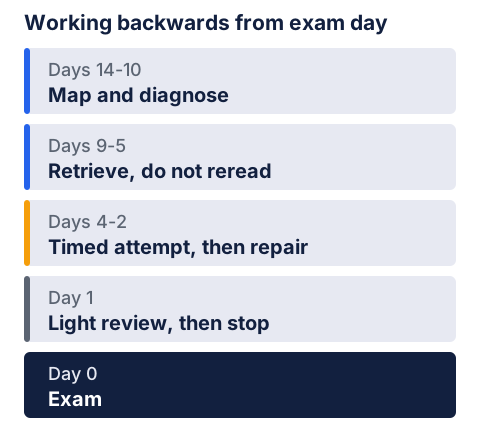
Three working phases sit between today and the test. Map and diagnose tells you what is on the exam, how bad the damage is, and turns the worst of it into questions you can test yourself against. Retrieve is where the learning happens. Timed attempt and repair converts a rough sense of readiness into a specific list of things you got wrong. Then one light day, then the exam.
Count the hours you actually have
A plan built on hours you do not have is a plan you will abandon on day four. Before you schedule anything, open a calendar and write down the realistic study time in each of the next fourteen days — after class, work, commuting, and the two evenings you already promised to someone else.
Here is the arithmetic on an illustrative case: a 200-level psychology midterm covering nine lecture topics, fourteen days out. The student has one honest hour on each of the ten weekdays, three hours on each Saturday, and two on each Sunday.
| Line item | Hours | Note |
|---|---|---|
| Total realistic study time | 20 | (10 × 1) + (2 × 3) + (2 × 2) |
| Reserved: timed attempt | 2 | Day 4, under exam conditions |
| Reserved: repair after the attempt | 3 | Days 3-2 |
| Reserved: light review | 1 | Day 1 |
| Left for covering the material | 14 | Across nine topics |
Fourteen hours over nine topics averages about 93 minutes per topic. That number is only useful as a starting point, because nine topics are never equally broken. The next section splits it properly.
The plan that survives a bad week is the one you built with the bad week already in it.
Rate every topic cold, then spend where it hurts
The University of North Carolina at Chapel Hill's Learning Center recommends scoring each topic on a three-point scale before you build a finals plan: "1. I don't know … 2. I sort of know … 3. I know well — I could teach this information or solve most or all the problems correctly," and starting with the ones you scored 1. That is the right instinct. The part usually left out is what the scores do to your hour budget.
First, get honest scores. Rating topics by flipping through your notes produces inflated numbers, because recognizing a heading feels like knowing the material. Cornell's Learning Strategies Center calls the alternative "Blank Page Testing" — actively recalling information from memory and putting it on paper before you look at anything.
Notes open means you are rating your reading speed, not your memory.
One page per topic. Use the syllabus wording, not your own shorthand.
Definitions, formulas, the shape of the argument, one example. Messy is fine.
Circle what you missed and what you had backward. The backward items matter more.
A topic you could not start counts as a 1, however familiar the words felt.
Now weight the budget. Give a score-1 topic double the standard slot and a score-3 topic half of it. In the worked example — three topics in each band, fourteen hours to spend — that resolves cleanly.
| Band | Topics | Time each | Band total |
|---|---|---|---|
| Score 1 — could not start | 3 | 2 h 40 m | 8 h |
| Score 2 — recognized it, patchy | 3 | 1 h 20 m | 4 h |
| Score 3 — could teach it | 3 | 40 m | 2 h |
| All topics | 9 | — | 14 h |
Run the same arithmetic with your own numbers. Add up your weights — 2 for each score-1 topic, 1 for each score-2, 0.5 for each score-3 — and divide your coverage hours by that total. Here the weights sum to 10.5, and 14 hours over 10.5 gives 80 minutes per unit of weight.
Re-score after the timed attempt on day 4. Topics move both directions, and a score-3 topic that collapses under time pressure is the most valuable thing that attempt can find for you.
The 14-day plan, day by day
Days count down to zero, so "Day 4" means four days before the exam. Sessions are short on purpose: UNC's finals guidance is that "studying in several smaller sessions over the course of the week is more effective than one huge block of time."
| Days out | What you do | Why it sits here |
|---|---|---|
| 14-13 | Build the topic list from the syllabus and any study guide. Blank-page every topic and score it. | You cannot budget time you have not measured. |
| 12-10 | Turn notes on your score-1 and score-2 topics into questions, worked problems, or flashcards. Do not write summaries. | Preparation is only useful if it produces something you can test yourself against. |
| 9-7 | First retrieval pass: answer your own questions cold, then check. Score-1 topics first, then score-2 once the score-1 questions are running. | The worse a topic scored, the earlier it enters and the more spacing it gets. |
| 6-5 | Second pass, mixing score-1 and score-2 topics in the same session rather than one topic per sitting. Give each score-3 topic its single 40-minute pass here too. | Mixing forces you to identify which method a question needs, which is what the exam asks. |
| 4 | Full timed attempt, same time limit and same materials rule as the real exam. | Topic-by-topic scoring cannot tell you how the whole thing holds up under time. |
| 3-2 | Repair. Work only through what the attempt exposed, in order of how badly you missed it. | A specific error list beats a general review every time. |
| 1 | One pass over your error list and your score-1 questions. Set out ID, calculator, and login details. Stop early. | New material on day 1 buys almost nothing and costs sleep. |
| 0 | Exam. Skim nothing more than a single page of your own notes. | Anything longer turns into a confidence test you can only fail. |
Cornell's Learning Strategies Center makes the same argument for testing early rather than only at the end: "try taking one at the beginning of your studying to get a baseline sense of your knowledge," then take another after studying. If your course gives you two practice exams, use one on day 13 in place of the blank-page pass — it scores your topics for you — and hold the second for day 4.
What to cut at 7 days, 3 days, or 1
Most students find this page with fewer than fourteen days left. Compressing is not a matter of doing everything faster — it is a matter of deleting things in a fixed order, and putting the deletions in the wrong order is what turns a short timeline into a bad grade.
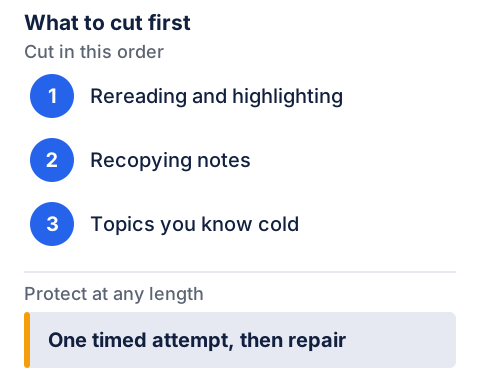
Rereading and highlighting go first because they are the cheapest to lose. Recopying notes into neater notes goes second: it feels productive and produces no retrieval. Third, drop broad coverage of the topics you scored 3 — you will meet them again in the timed attempt anyway.
| Time left | What the plan becomes |
|---|---|
| 7 days | Score your topics in one evening. Preparation and first retrieval pass collapse into days 6-4. Timed attempt moves to day 3, repair on days 2-1 from the error list only. Score-3 topics get no dedicated slot. |
| 3 days | Score topics in 20 minutes, from the syllabus alone. Day 3 is retrieval on score-1 topics only. Timed attempt on day 2. Day 1 is pure repair. No new material after the attempt. |
| 1 day | Timed attempt in the morning, on whatever practice questions exist. Repair through the afternoon. Stop at a fixed hour in the evening and sleep. Coverage of anything you have never seen is a lost cause worth abandoning early. |
The instinct on a short timeline is to cut the practice attempt because "there is no time to test, only time to learn." That is backward. With three days left, two hours of testing followed by targeted repair usually moves more points than eight hours of reading, because testing is the only way to find out which eight hours would have mattered.
This ordering is not a hunch. Dunlosky and colleagues reviewed ten common study techniques in Psychological Science in the Public Interest in 2013, and the Association for Psychological Science summarizes the review plainly: "practice tests and spreading study sessions out over time … were found to be of high utility," while "underlining, rereading material, and using mnemonic devices, were found to be of surprisingly low utility." The two things a compressed plan protects are the two the evidence supports best.
The exam format changes what studying means
"Study for two hours" means four different activities depending on the exam you will take. Match the practice to the test, as closely as your materials allow.
| Format | What to practice | Common mistake |
|---|---|---|
| Multiple choice | Discriminating between near-identical options. Write your own distractors for each definition. | Studying by recognition, then being asked to separate two things that both look right. |
| Problem sets | Full problems, timed, from a blank page. Redo the ones you already got right, cold. | Reading worked solutions and mistaking following them for producing them. |
| Essay or short answer | Outlines against likely prompts, then one full timed essay. Practice the thesis sentence specifically. | Knowing the content and having no plan for turning it into a structured argument in 40 minutes. |
| Open book or open note | Navigation. Build an index of your own materials and practice finding things in under 30 seconds. | Assuming access to notes replaces knowing the material. Open-book exams are usually written to test application rather than recall, so the notes save you less than you expect. |
When the two weeks do not look like the plan
Three exams in four days changes the arithmetic, not the method. Build one countdown per exam, then look at where they collide and move only preparation work — never a timed attempt — into the gaps. If two attempts have to land on the same day, put the harder subject in the morning.
A cumulative final is where the score-3 band earns its keep. Blank-page the early material before you assume anything about it: whatever you were already tested on at the midterm often comes back as a 3, and a 3 costs you one short slot rather than a full one. Spend what that frees up on the last three weeks of the course, which almost nobody has gone back to even once.
An online or remotely proctored exam adds a logistics layer that has nothing to do with studying, and it is worth clearing on day 2 rather than day 0. Run the system check, confirm what materials are permitted, and know the policy if your connection drops. Our guide on how to prepare for a proctored exam covers the setup end of it.
If you lose three days to illness, work, or a family emergency, do not compress the plan evenly. Delete from the cut list above in order and keep the timed attempt where it is. A plan that keeps its shape under a lost weekend is worth more than a perfect plan you abandon. The same principle applies to tracking everything else you owe that month — our post on keeping track of assignments in college covers the system side.
Four ways good plans fail
The fluency illusion. Rereading a chapter makes it feel familiar, and familiarity feels like knowledge until a blank page asks you to produce it. If you have not written something down without looking, you have not tested anything.
The attempt saved for last. A practice test taken the night before is a scorecard, not a study tool. Taken on day 4, it becomes a work order you still have time to act on.
The plan built for a perfect week. Four hours a night, every night, is a fantasy schedule. Two honest hours you actually complete beats four planned hours you skip on Wednesday and never recover.
The study group that becomes a hangout. Group study is genuinely powerful in the last week, and genuinely easy to waste. The decision is worth making deliberately.
Group study earns its place when
- Everyone arrives having already scored their own topics
- You explain concepts out loud rather than listening — explaining is retrieval
- Someone asks a question you would never have asked yourself
- It has a fixed end time on the calendar
Group study wastes your time when
- You have not done a blank-page pass yet, so you would just absorb someone else's summary
- The group runs at the pace of whoever prepared least
- You are inside the last 48 hours and need repair, not discussion
- Scheduling it costs more time than the session gives back
The last 24 hours
Day 1 has one job: consolidate what you already fixed and protect your sleep. Read through your error list from the timed attempt, run one blank-page pass on whatever is still scoring 1, and stop.
Then do the boring things while you are still calm. Confirm the room, time, and what you are allowed to bring. Charge what needs charging. Put your ID somewhere you cannot fail to find it. Decide what you are eating.
An all-nighter trades the consolidation that happens while you sleep for a few extra hours of low-quality reading, and it degrades exactly the recall and judgment the exam is testing. If you are so far behind that an all-nighter looks necessary, the better move is to triage hard — pick the three highest-value topics, test yourself on those, and sleep. If you have ever had to work against a deadline like that on a paper, our one-night essay guide makes the same argument about protecting the last few hours.
None of this makes an exam pleasant. It does make the two weeks in front of it a set of decisions rather than a vague sense of dread, and it means the hours you spend land on the material that was actually going to cost you points. If the reason you have eleven days and three exams is that coursework has stacked up behind you, our writers can take the homework load off your plate from $7.89 a page while you spend the time on the test itself — see our homework help service.