Live Chat

You have written thirty pages about what everyone else found, and now you have to stop. The conclusion is where literature reviews most often go flat, because the obvious move — summarizing what you just said — is the one thing it should not do.
A literature review conclusion has three jobs. Do those, in that order, and it writes itself in a page or two. Each job below is worked on the same example, and that example's ending then appears three times: as a recap, as a near-miss, and as a version that works.
- Three jobs: state the synthesis, name the gap, hand off to your research question.
- It is not a summary. A reader who has read the chapter does not need a recap of it.
- The gap must be specific enough to research — "more research is needed" is not a gap.
- A gap is only one of four ways to open a space for your study, and often not the strongest.
- End by making your own question feel inevitable, not merely announced.
- Typical length is 5 to 10% of the chapter: one to three pages on a master's review.
Everything below comes from one imaginary master's thesis in education, on whether co-requisite remediation — putting students straight into college-level math with extra support instead of a prerequisite developmental course — improves outcomes. Delgado, Whitfield, Ansari, Brennan and Voss are placeholder studies invented for this article. They are not real work and their findings are made up, so the moves stay visible without anyone's actual research being misreported. The shape of the field is invented too. Real co-requisite research is much larger than five studies and its findings run well past the gateway course, so treat nothing here as a description of that literature. What is simplified is the evidence, not the moves.
Job one: state what the literature now says
Not what each source said. What the body of work, taken together, establishes.
This is a synthesis in miniature — two or three paragraphs that hold the whole field. Where there is consensus, say so plainly and cite it in groups. Where the field splits, name the axis of the split, because that is more useful than either position.
The move that separates a conclusion from a recap happens inside a single sentence.
Describes the field: "Four studies report gains in the gateway course, and one reports no gain in the course that follows it."
Says something about the field: "The field has treated the gateway result as the finding and the null result as a footnote — a choice about which outcome counts, not a conclusion the evidence forces."
Both sentences are true and only the second one is a conclusion. It makes an observation the reader could argue with, which is the whole difference.
Hence a quick test: a synthesis sentence should be false if the field were different. "Several studies have examined co-requisite models" is true of every subject anyone has written a thesis about, so it carries nothing. And if the honest answer is that the field agrees on nothing, write that — a well-argued "this literature does not cohere" is a finding, not a failure.
Job two: name the gap
The gap follows from the synthesis. If you have written job one properly, the gap should already be visible to the reader before you state it.
Gaps come in recognizable kinds, and naming which kind yours is makes it sharper:
- Empirical — a population, setting or period nobody has studied.
- Methodological — everyone has used one approach, and its limitation is now the constraint.
- Conceptual — the field disagrees about what it is measuring, and nobody has resolved it.
- Contextual — findings exist but have not been tested where you are looking.
Not a gap
- "Further research is needed."
- "Few studies have examined co-requisite models."
- "The literature remains limited."
- "No study has looked at colleges in my state."
A gap
- Empirical: "Only one evaluation follows students past the gateway course, and it covers a single system."
- Methodological: "Students who took the co-requisite are compared with students who placed straight into the course, confounding the program with the students it enrolls."
- Conceptual: "Support means three different things across the five studies, and none of them reports contact hours."
- Contextual: "No evaluation covers a system that places by high-school GPA rather than a test score."
Each item on the right names something a study could actually do, and each is one of the four kinds above. That is the test. The methodological one is the strongest, because it names a design flaw rather than an absence — our explainer on random assignment versus random sampling is the short version of what your committee will ask about it.
"No study has examined this in my specific city" is technically true of almost any topic, and committees recognize it as a manufactured gap. A gap has to matter — something the field would benefit from knowing, not merely something nobody has bothered to do.
When a gap is the wrong move
Most students assume a gap is the only way to justify a study. It is not, and reaching for it by reflex is why so many conclusions sound alike.
The linguist John Swales described what academic writers actually do at this point as establishing a niche, and identified four ways of doing it. In the version the University of Waterloo's Writing and Communication Centre teaches, adapted from Swales and Feak's Academic Writing for Graduate Students: make a counter-claim (something is wrong), indicate a gap (something is missing), raise a question (something is unclear), or continue a tradition (add something).
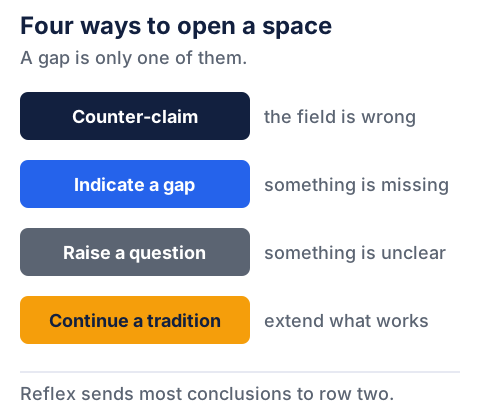
In the example, they sound like this:
- Counter-claim — "the reported success of co-requisite placement rests on an outcome the reform was not adopted to change." Strongest and riskiest; you must be able to defend it against the people you are contradicting.
- Gap — "no evaluation follows a cohort past the gateway course in more than one system." The default, and the one to earn rather than assume.
- Question — "these designs cannot tell us whether the gain belongs to the program or to the students it enrolls." The same confound as the methodological gap above, framed as something unclear rather than something absent.
- Tradition — "this study extends the multi-system evaluation model to a state where placement rules differ." Modest and true beats grand and unsupportable.
There is a live argument about this in the methods literature. Writing in the Academy of Management Review (2011, 36(2), 247–271), Mats Alvesson and Jörgen Sandberg argued that gap-spotting is the standard route to a research question and a limited one, because it accepts the assumptions the literature already shares; their alternative, problematization, means challenging those assumptions instead. Nobody expects a master's thesis to overturn a field, but the check is cheap: ask what every study in your review takes for granted. In the invented example, the shared assumption is that the gateway course is the outcome that counts — which is why the one study that looked past it has been read as an anomaly rather than as a challenge.
Job three: hand off to your question
The final paragraph connects the gap to your own study, and it should read as a consequence rather than an announcement. The weak version says "this study will therefore examine…"; the strong version first rules something out.
Before naming your design, name the obvious one and say why it fails: "A study reporting another gateway pass rate would measure the thing already known." Your design then arrives as the only option left standing, and the paragraph closes by pointing at the next chapter by name — "Chapter 3 sets out how the cohorts were matched" — rather than trailing off.
That closing pointer matters more than it looks. A literature review conclusion in a thesis is a hinge, not an ending, and naming the chapter it opens onto helps your committee follow the thread.
The same conclusion, three drafts
Most students do not write the weak version. They write the middle one, get a comment they cannot act on, and rewrite it into a slightly longer middle version. Seeing all three together is the fastest way out of that loop. These are compressed so the moves stay on one screen.
"This chapter has reviewed the literature on co-requisite remediation. Delgado (2018) found higher pass rates in the gateway course. Whitfield (2020) reported a similar result in a larger sample. Ansari (2021) and Voss (2023) found comparable gains. Brennan (2022) found no difference in the following course. Overall, the literature suggests that co-requisite models are effective, although further research is needed in this area."
Every sentence is accurate and the paragraph is worth nothing. It retells the chapter to someone who has just read it, files Brennan as one more item in a list rather than as the interesting result, and closes on a sentence that would fit any review ever written.
"Taken together, the literature indicates that co-requisite placement improves pass rates in the gateway course (Delgado, 2018; Whitfield, 2020; Ansari, 2021; Voss, 2023), although findings beyond that course are less consistent (Brennan, 2022). Few studies have examined longer-term outcomes. This study will therefore examine the effect of co-requisite placement on later course performance."
This is the draft that gets waved through by a busy reader and comes back with "needs a clearer gap" in the margin. Three things are wrong with it, and none is obvious.
"Less consistent" hides the finding. One study looked past the gateway course and found nothing. That is not inconsistency; it is a single contrary result nobody has tried to replicate, and calling it inconsistency makes it sound like noise.
"Few studies have examined" is a count, not a gap. It reports how much has been written rather than what is unknown, and nothing in it names a study anyone could run.
The last sentence announces instead of following. Delete the word "therefore" and the sentence loses nothing. That is the tell.
"Taken together, this literature establishes one thing firmly and a second one on almost no evidence. Co-requisite placement raises pass rates in the gateway course; four independent evaluations agree (Delgado, 2018; Whitfield, 2020; Ansari, 2021; Voss, 2023). Whether that gain survives into the next course has been tested once, in one system, and did not (Brennan, 2022). The field has treated the first result as the finding and the second as a footnote.
That ordering is the gap. No study follows a co-requisite cohort past the gateway course in more than one system, so the durability of the gain is unmeasured rather than established — and durability is the outcome the reform was adopted for. No design has separated the effect of the program from the population it enrolls.
A study reporting another gateway pass rate would measure the thing already known. What is missing is a design that tracks the same students into the following course across several systems. That is the design used here; Chapter 3 sets out how the cohorts were matched."
Same five sources and the same findings, in more than three times the words of Draft 2. A reader now knows what the field believes, why that belief is thinner than it looks, what nobody has done, and why this study is the thing that does it.
How long it should be, and where the words go
As a working rule, the conclusion runs about 5 to 10% of the chapter, with the percentage flattening as chapters get longer: roughly a page to three on a 15-to-30-page master's review, two to four on a doctoral chapter regardless of what 10% of sixty pages would give you. Past four pages you are usually reviewing the literature a second time.
The proportions inside it are not equal. Job one takes the most room, because it is the only part that has to carry the whole field.
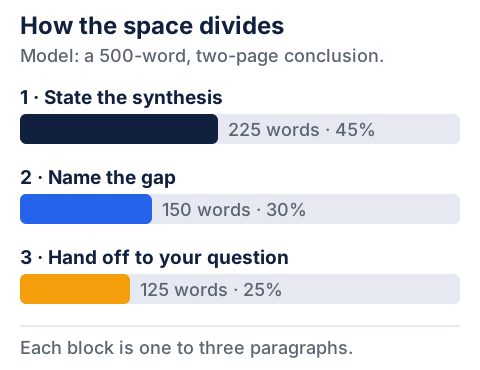
Draft the conclusion when you are about two-thirds through the reading, before the chapter is finished. Trying to state the synthesis at that point exposes exactly which parts of the field you have not understood yet — and you still have time to read them.
Where the review sits changes the ending
A literature review is not one document, and the conclusion's job changes with the container. Copying a dissertation chapter's ending onto a course paper is a common way to sound inflated.
| Where the review sits | Typical length | Conclusion | Hands off to |
|---|---|---|---|
| Section of a research paper | A few paragraphs to 2 pages | One or two short paragraphs | Your aim or hypotheses, often in the same paragraph |
| Undergraduate capstone review | Typically 8–15 pages | 2–3 paragraphs | Your project's rationale |
| Master's thesis, Chapter 2 | 15–30 pages | 1–3 pages | The methods chapter |
| Doctoral dissertation, Chapter 2 | 30–60 pages | 2–4 pages | Methods, plus your claim to a contribution |
| Standalone review article | Varies widely | 3–5 paragraphs | An agenda for the field, not one study |
| Systematic review | Set by the protocol | Discussion: four prescribed items | Practice, policy and future research |
The two middle rows follow US usage, where a master's student writes a thesis and a doctoral student writes a dissertation. UK programs reverse the pair, so a British chapter template will not map onto a US committee's expectations; our guide to the difference between a thesis and a dissertation covers what else changes with degree level.
The last two rows are different animals. A standalone review article has no subsequent study to hand off to, so job three becomes an agenda: what the field should do next, in priority order, with reasons. Job two matters more there, not less — the gaps are the contribution.
A systematic review does not let you design the ending at all. Under the PRISMA 2020 reporting guideline (Page et al., BMJ 2021;372:n71), item 23 splits the discussion into four prescribed reporting items: a general interpretation of the results in the context of other evidence, the limitations of the evidence included, the limitations of the review process itself, and the implications for practice, policy and future research. If your assignment says systematic, write to that list rather than to the three jobs above.
Two situations the templates do not cover
Your template has both a "Summary" and a "Conclusion." Some departments require both headings, and students then write the same paragraph twice. They are not the same thing: the summary is allowed to retell the chapter section by section, and the conclusion is the part that is not. Put the retelling in the summary and keep the three jobs for the conclusion.
Your reading suggests the question has already been answered. Do not write a gap you no longer believe in — you will have to defend it to a committee that has read the same studies you have. Say what the literature settled, then look for the assumption it settled the question under — a population, a period, a measure. If that yields nothing either, change the question, and our guide to finding a dissertation research topic covers how to do that without starting from zero.
What to leave out
Four things belong elsewhere and weaken the conclusion if they appear here.
- New sources. Anything worth citing here should already have been discussed in the body. A first appearance in the conclusion signals that the chapter is incomplete.
- Your method. Name the approach in a sentence as a hand-off; design, sampling and instruments belong in the methods chapter.
- A source-by-source recap. If your conclusion lists what each author found, you have written a summary of your own summary.
- Your own study's limitations. They belong in the discussion, at the other end of the thesis. Conceding them here reads as apologizing for a study you have not described yet.
Diagnose your own conclusion
Read it on its own, without the chapter, and answer six questions. Each "no" points at one specific repair.
| Ask | If the answer is no |
|---|---|
| Could a reader state what the field currently establishes, in one sentence? | Job one is missing. Write that sentence first, then choose the sources that support it. |
| Does at least one sentence say something about the literature rather than something in it? | You have a summary. Add the observation: what the pattern of findings means. |
| Could a reader restate your gap in their own words? | It is too abstract. Name the specific missing thing — a population, a measure, a comparison, a period. |
| Could a real study do the thing your gap names? | It is a complaint about coverage, not a gap. Convert it into a design. |
| Does the last paragraph say why a more obvious study would not answer the question? | You announced your study instead of deriving it. Add the design you are ruling out, and why. |
| Is everything here — every source, term and idea — already in the body? | Something is appearing for the first time. Move it into the body, or cut it. |
Four mechanical checks finish the pass, each under a minute.
- Every citation here also appears in the body — search the chapter for each surname.
- The next chapter is named, not gestured at: "Chapter 3", not "the following discussion".
- No instrument, sample size or procedure has crept in from the methods chapter.
- The length lands in the 5 to 10% band, with job one holding the largest share.
If all six answers are yes and the conclusion is still short, leave it short. Brevity is not the problem here.
For the chapter on the other side of the hinge, see our guide to reporting findings clearly. If the chapter is written and the ending will not come, our literature review help can work on a section rather than the whole thing, from $7.89 a page, inside our paper writing service.