Live Chat

Two study techniques have survived decades of testing: quizzing yourself instead of reviewing, and spreading that quizzing across days instead of stacking it into one night. Nearly everything else students actually do — rereading, highlighting, summarizing — sits near the bottom of the same evidence reviews. Most of what students report doing falls in the bottom half of that list. What follows sorts the common techniques by what the research supports, explains why the weaker ones feel better while you are doing them, and gives you a direct swap for each, so the hours already on your calendar return more.
- Two techniques rated high in the 2013 review that assessed ten of them: practice testing and distributed practice.
- Five rated low — including rereading, the habit students report doing most.
- The weaker methods feel stronger. Rereading raises your confidence faster than it raises your recall.
- Set the gap between review sessions from the date of the test, not from how you feel.
- The blank-page test separates what you recognize from what you can produce, in about ten minutes.
- Rereading is the correct move exactly once — the first pass. After that it is the expensive option.
What the evidence actually ranks
The reference point here is a 2013 review in Psychological Science in the Public Interest by John Dunlosky, Katherine Rawson, Elizabeth Marsh, Mitchell Nathan and Daniel Willingham. They took ten techniques students genuinely use and gave each a utility rating based on how broadly the benefit held up — across ages, abilities, materials and real classrooms, not just in a lab.
Two came out high. Three came out moderate. Five came out low, and that bottom group contains the habit students report doing most.
| Technique | 2013 rating | What you actually get |
|---|---|---|
| Practice testing | High | You produce the answer, which is the thing the exam asks for |
| Distributed practice | High | The same minutes, spread out, retain better than the same minutes stacked |
| Interleaved practice | Moderate | Mixing problem types forces you to pick the method, not just run it |
| Self-explanation | Moderate | Saying why a step follows exposes the step you were skipping |
| Elaborative interrogation | Moderate | Asking "why is that true?" ties a new fact to what you already hold |
| Summarization | Low | Helps once you have been trained to do it well, which takes hours |
| Highlighting and underlining | Low | Flags importance and defers the work of learning it |
| Rereading | Low | Familiarity, which your brain reads as knowledge |
| Keyword mnemonic | Low | Works for isolated vocabulary, fades fast, transfers poorly |
| Imagery for text | Low | Depends on the material being imageable, and most coursework is not |
One correction before you throw out your highlighters. A 2021 meta-analysis by Gregory Donoghue and John Hattie, pooling 1,619 effects from 242 studies and 169,179 participants, puts the same two techniques on top — distributed practice at d = 0.85, practice testing at d = 0.74 — with rereading at d = 0.47 and underlining and summarization tied at the bottom on d = 0.44. The authors report much correspondence between those effect sizes and the 2013 ratings, but the middle of the table does not line up: imagery (d = 0.56) and the keyword mnemonic (d = 0.50) both landed above interleaved practice (d = 0.47), which the 2013 review rated moderate. The two are not measuring the same thing — the 2013 ratings judge how broadly a benefit generalizes across ages, materials and settings, while these are raw effect sizes — and every one of the ten came out positive. The low-rated methods are not worthless. They are a worse use of the same minute — the only comparison that matters when the minutes are finite.
The two techniques that clear the bar
Retrieval practice means producing information from memory with the source closed. Not recognizing it, not reviewing it — producing it. In a 2011 Science paper, Jeffrey Karpicke and Janell Blunt set retrieval practice against elaborative studying with concept mapping on science texts. Eighty undergraduates read a passage in an opening five-minute study period, then split four ways: nothing further, three more five-minute study periods, a concept map drawn with the text still open, or free recall, a reread, and free recall again. A week later, on short-answer questions covering both stated facts and inferences, the retrieval group averaged 67 percent correct — against 49 percent for the four-study-period group, 45 percent for the concept mappers and 27 percent for the students who read once. A second experiment put 120 students through the retrieval-versus-concept-mapping comparison across two kinds of science text and two final-test formats, and retrieval practice came out ahead in every combination, including the one where the final test was building a concept map. An open-access review in CBE—Life Sciences Education sets it in the wider testing-effect literature.
Distributed practice means the same total study time broken across separate days. The 2006 synthesis by Nicholas Cepeda and colleagues in Psychological Bulletin pulled together 839 assessments from 317 experiments across 184 articles, and found that the interval producing the best retention grows as the final test moves further away. Spacing is not just "start earlier." It has a shape, and the shape comes off your calendar.
Setting the gap from the date
A follow-up in Psychological Science in 2008, with more than 1,350 participants, put numbers on it. The best gap between sessions was 20–40% of a one-week delay, falling to 5–10% when the test was a year away. So as the test gets further off, the ideal gap grows in days but shrinks as a share of the wait.
The paper states its band at two anchors, a week and a year, so applying it to a normal semester means interpolating between them. As a starting figure, the gap runs from about a fifth to about two fifths of the time you have left, sitting near the low end once the wait stretches into months:
- Quiz in 7 days — review every 2 days. Four sessions, not one long one.
- Unit exam in 3 weeks — review every 4 to 5 days. Five sessions.
- Final in 10 weeks — review every 2 weeks at first, tightening to every 3 days in the final 2 weeks.
Put the review dates where your deadlines already live, or they will not happen. If you do not have one place for them, our walkthrough on keeping track of assignments in college and the free tracker templates both solve that in under an hour.
Why the weaker methods feel better
This is the part the study-tips lists skip, and it explains the rest. In 2006 Henry Roediger and Jeffrey Karpicke, writing in Psychological Science, had students learn prose passages either by rereading them or by reading once and then taking recall tests. Five minutes later, the rereading group did better. On the delayed tests, prior testing produced substantially greater retention — and rereading had raised students' confidence in their ability to remember the material.
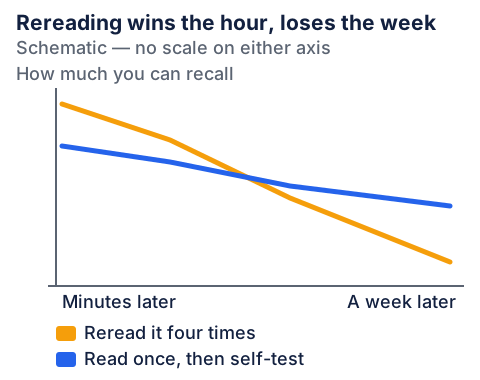
Karpicke and Blunt hit the same inversion five years later. At the end of the learning session every student predicted the share of the text they would still have in a week. The four-study-period group gave the highest figure of the four conditions, 79 percent; the group that had closed the text and recalled it gave the lowest, 58 percent. The week-later scores above ran the other way. Your sense of how a session went measures fluency — how smoothly the words came off the page — and fluency climbs fastest under the methods that teach you least.
Recognizing a sentence is not the same as being able to produce it, and only one of those is graded.
"I know this" after a third read is not evidence. It is the predictable output of having seen the same sentences three times. The only honest check is whether you can produce the material with the source closed.
The blank-page test
Here is a ten-minute audit for any topic you think you have covered. Cornell's Learning Strategies Center calls the underlying move blank page testing, “because you just start with a blank piece of paper and write things down.” Close every book, tab and note. On a blank sheet, write everything you can about the topic — definitions, steps, the worked example, the exception your instructor flagged. Stop at ten minutes, then open your notes and mark what you missed in a second color.
What is in your handwriting is what you know. What is in the second color is your actual study list, and it is reliably longer than the ten minutes made it feel. Run this before you plan a session, not after, or the session goes on material you already had.
Six swaps that cost you nothing
Every row below takes the same time as the habit it replaces. This is a reallocation, not a demand for more hours.
| What you do now | Swap it for | Why the swap wins |
|---|---|---|
| Reread the chapter | Read it once, close it, write what you remember | The second read adds recognition. The blank page adds retrieval, which is what the exam measures. |
| Highlight as you read | After each section, write one question you would set on it | Highlighting decides something is important and postpones learning it. A question forces the decision now. |
| Recopy your notes neatly | Turn each heading into a question, then answer it from memory | Copying is a motor task. Answering is the graded task. |
| One long session the night before | The same minutes split across days, with the gap set by the date | Distributed practice rated high utility on identical total time. |
| All twenty problems of one type in a row | Shuffle types so you must first identify which method applies | On the exam nobody tells you which method it is. Blocked practice never trains that step. |
| Rewatch the lecture recording | Pause every ten minutes and say the last point aloud, screen hidden | Replaying a recording is recognition with better production values. |
The shuffling row has direct evidence behind it. Doug Rohrer and Kelli Taylor, writing in Instructional Science in 2007, taught students to solve several types of math problem, then gave them practice sets either blocked by type or randomly mixed. Tested one week later, performance was, in their words, “vastly superior after mixed practice.”
A four-hour block, rebuilt
Abstract advice is easy to agree with and hard to act on, so here is one real block. Intro biology, the cellular respiration unit, midterm in twelve days, four hours of study time to give it — most of it free this weekend. Twelve days out, a fifth of the wait is about two and a half days, and stretching the 2008 paper's short-delay band of 20 to 40% across those twelve days takes it to five, so a three-day gap fits and lands cleanly on a weekend start: this weekend, then days 4, 7 and 10.
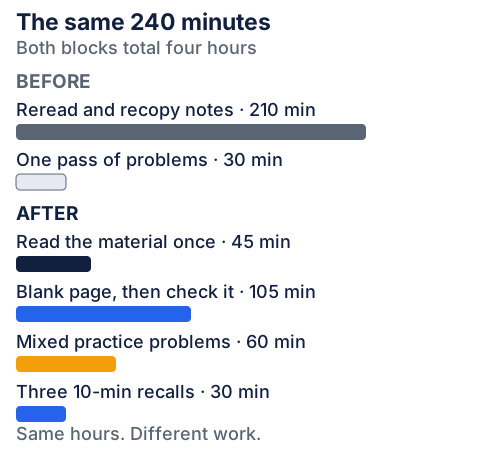
The before column is the usual weekend: read the chapter, recopy the lecture notes in color, read them again Sunday night, and run one set of end-of-chapter problems if there is time. Three and a half of the four hours go to looking at material rather than producing it. Only the first pass of that is work the chapter genuinely needs — the after column budgets forty-five minutes for it, then gives the bulk of the block to retrieval instead. Here is the loop that fills those 105 minutes.
Turn every section heading into a question — eight to ten for a chapter. It takes five minutes and it is the only part done with the source in front of you.
Book shut, tabs shut, notes face down. Retrieval only counts when nothing is visible.
Not bullet fragments. If you cannot write the sentence here, you cannot write it in the exam booklet either. Leave a blank where you go blank — that blank is data.
Feedback immediately after the attempt is what turns a failed retrieval into a learned one. Correct answers need no further attention.
Missed items return in the next session three days out. Items you produced cleanly return one session later than that. Your review list should shrink as the date approaches.
The last after-column bar is the three ten-minute recalls, on days 4, 7 and 10, done from memory in a phone note between classes. They are short on purpose: the gap is doing the work, not the duration.
One honest limit. None of this rescues a weekend with three assignments due Monday and no runway left — spacing cannot be applied retroactively. If the backlog is the real problem rather than the study method, clear the backlog first, either by triaging it yourself or by getting help with the homework that is blocking the schedule so the review sessions have somewhere to live. And if the plan has already collapsed into one night, our guide to writing 2,000 words in a single night is damage control, not a method.
Three pieces of folklore, checked
Three claims appear on nearly every study-tips page. The first has been tested directly and failed. The second has been measured against plain reading and adds nothing. The third is not a learning technique at all, and was never on the list.
"Study to your learning style"
The idea that a visual learner should be taught visually is called the meshing hypothesis, and Harold Pashler, Mark McDaniel, Doug Rohrer and Robert Bjork examined it in Psychological Science in the Public Interest in 2008. They found virtually no evidence for the interaction pattern the hypothesis requires, noted that several adequately designed studies produced results contradicting it, and concluded that limited education resources would be better spent on practices with a strong evidence base. Preferring diagrams is real. Sorting your study plan by that preference is not supported.
"Highlight the important parts"
Writing in American Educator in 2013, Dunlosky put the highlighting evidence bluntly: compared with simply reading a text, highlighting has failed to help students of all sorts, including Air Force trainees, children and undergraduates. The same article carries the survey figure quoted earlier — 84 percent of students at an elite university studied by rereading their notes or textbooks. The underlying survey, by Karpicke, Butler and Roediger in Memory in 2009, asked 177 college students what they did and found a majority repeatedly reading notes or textbook while relatively few self-tested.
"Use the Pomodoro Technique"
Twenty-five minutes on, five off, is not on the list of ten, and that is not a criticism of it. The list rates what you do with the material and how far apart your sessions sit. A timer sets neither — it decides when you sit down, which is a real problem and one it genuinely solves. It does not decide what happens inside the twenty-five minutes, and that is the part that determines whether you learn anything.
Worth the minute
- Answering questions with the source closed
- Splitting total time across days
- Mixing problem types in one set
- Explaining a step out loud to someone
- Checking every attempt against the source
Not worth the minute
- A second, third or fourth read of the same page
- Recopying notes into neater notes
- Highlighting instead of answering
- Matching material to a learning style
- Rewatching a recording end to end
When rereading is the right call
You cannot retrieve what you never encoded. The first pass through genuinely new material is reading, and it should be — nobody self-tests their way into a chapter they have not opened. The low rating applies to the second, third and fourth passes, which is where most rereading time goes.
Two other cases earn a real reread. When the vocabulary is unfamiliar enough that the sentences are not parsing — a first meeting with organic chemistry nomenclature, or a translated primary text — read for meaning before testing anything, because a blank page will only confirm you did not understand it. And when a section is procedural rather than factual, read the worked example once at full attention before covering it.
The working rule: one read to encode, then everything after that is retrieval. If you cannot produce three sentences about a section after one read, read it once more — once — and then test. A third read is almost never what stands between you and the material.
Open-book and take-home formats change the target rather than the method. The content is in front of you, so the graded skill is locating and applying it under time pressure: practice retrieving where a rule lives and which method a question calls for, not the wording. Timed online formats follow the same logic, and our proctored exam preparation checklist covers the logistics.
Four ways self-testing fails, and the fix
Students who take up retrieval practice and see no gain almost always have one of these four problems.
You recognized the answer instead of producing it
Flipping a flashcard after two seconds, or picking from multiple choice, tests whether the answer looks right. That is an easier task than generating it, and it is not the task most exams set. Fix: say or write the full answer before anything is revealed. If nothing comes, mark it missed — seeing the answer afterward does not retroactively make it a success.
You tested without checking
A quiz you never grade tells you how confident you feel, which is the measure already established as unreliable. Fix: check every answer against the source in the same sitting, and write the correction in your own words rather than copying the book's phrasing.
You retrieved only what you already knew
Self-testing is pleasant while you are producing right answers, so sessions drift toward the comfortable third of the material. Fix: keep missed items in a separate pile and open the next session with that pile. Retire an item only after producing it correctly on two different days.
You did all of it in one sitting
Closing the book and recalling right after you read it is not the mistake — both studies above did exactly that. Roediger and Karpicke's testing groups recalled immediately, Karpicke and Blunt's retrieval group recalled inside the session it read in, and that is where the week-later advantage came from. The mistake is stopping there. Four recalls in one evening is massed practice in a self-testing costume, and the spacing evidence says the same four attempts placed on four separate days retain more. Fix: keep the first recall in the reading session, then put the repeats on later days and let the gap grow as the test moves further off. The session where retrieval starts to feel difficult is the one doing the work.
None of this is new — the practice-testing evidence runs back more than a century. It is just uncomfortable in a way that rereading a chapter never is, and that discomfort is the most reliable signal in the whole subject: the session that felt worst is usually the one you will still remember in three weeks.