Live Chat


Most advice about syllabi tells you what one contains. That is not the hard part. A syllabus is a price list, and the skill worth having is converting each policy into the only unit that matters in December: points off your final grade. Four or five sentences set those prices, and they are the sentences students skim.
So this guide does what the orientation pages skip. It reads six policies out of eight real US syllabi — late work, grade weighting, attendance, integrity, missed exams and the letter-grade cutoffs — quotes each, and works out the cost. Every course, term and instructor below is real, every document is still published by the institution that wrote it, and every calculation uses that syllabus's own numbers. Terms are named throughout — a syllabus belongs to one, and three of these are past terms.
- Convert every policy into final-grade points. "10% off" means nothing until you know what the assignment is worth to the course.
- Late policies are not comparable between courses. Three days late costs 15% of one assignment at Johns Hopkins EP 645.662.81, 30% at Duke CompSci 590-07, and the whole thing at Georgia Tech ECE 3030.
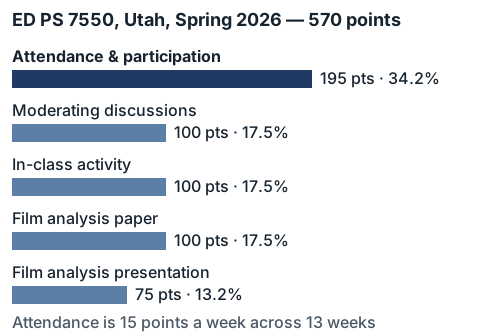
- The biggest line is often participation. In Utah's ED PS 7550 it is 195 of 570 points — 34.2% of the course, more than the paper.
- Timeliness can outrank correctness. One Johns Hopkins course grades its discussion board 45% on timeliness and 15% on correctness, making punctuality worth exactly three times accuracy.
- Read the integrity clause literally. Courses differ on AI, on collaboration and on paid help, and only your syllabus binds you.
- Two courses in one program can define an A differently. A 93 is an A in one Johns Hopkins syllabus and an A-minus in another from the same term.
Convert every policy into points before anything else
One arithmetic move makes a syllabus readable. Multiply the penalty by the assignment's share of the final grade, and you get the number you actually care about.
Cost in final-grade points = penalty rate × the assignment's share of the course.
Georgia Tech's ECE 3030, Section A, Fall 2026 (Prof. Suman Datta), published in the university's own syllabus repository, is a clean case. Its grading policy is four lines: Homework (4 sets) 32%, Midterm 1 20%, Midterm 2 15%, Final Exam 33%. Letter cutoffs are straight: "A: 90.0%", B at 80.0% and below 90.0%.
So 32% divided across four homework sets is 8.0 points of your final grade per set. That number reprices every homework decision in the course. A student sitting on a 95 who never submits one homework set finishes at 87 — a B, on this syllabus's own cutoffs, from one missing assignment.
The late policy: what three days actually costs
ECE 3030 spells its penalty out in three steps: "Up to 24 hours late: A 20% penalty will be applied (score multiplied by 0.80)", "24 to 48 hours late: A 50% penalty will be applied (score multiplied by 0.50)", and "Beyond 48 hours late: A score of zero will be recorded."
Run those against the 8.0 points a homework set is worth. One day late costs 1.6 points of the final grade. Two days costs 4.0. Three days costs the full 8.0.
Now compare two other real policies. Duke's CompSci 590-07, Reinforcement Learning, Spring 2026, taught by Ron Parr, states it in one line: "There will be a 10% lateness penalty per day late." Johns Hopkins Engineering for Professionals publishes an abridged syllabus for every course it runs; 645.662.81, Introduction to Systems Engineering, Fall 2026, taught by Chris Olson, says: "Late assignments will be deducted 5% for every day they are late."
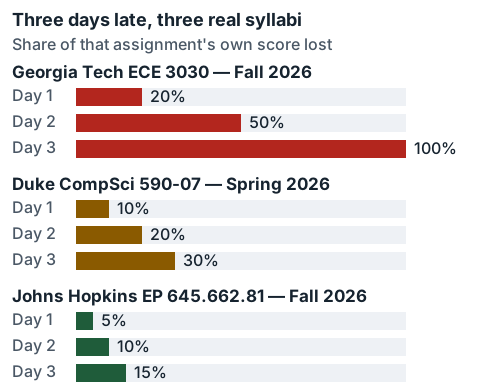
Duke splits its grade 50% homework, 50% project, and lists three required homeworks plus an optional fourth. It does not publish a per-homework weight, so this next number is ours, not Duke's: split evenly across the three required sets, one homework is roughly 16.7 points of the final grade, and three days late costs about 5.0 points — half a letter grade at most US cutoffs. The identical delay in ECE 3030 is a zero.
Two more shapes to recognize.
The unquantified policy. Johns Hopkins EP 605.647.8VL, Neural Networks, Fall 2026 (Mark Fleischer) says only that "Late assignments will be scored low depending on how late the assignment is and any extenuating circumstances." There is no arithmetic to do. A policy you cannot price is a reason to email the instructor before the first deadline, not after you miss one.
The harshest-sounding sentence in the set turns out to be the most forgiving, as long as two 24-hour extensions a semester are enough. 625.609.82, Matrix Theory, Fall 2026 (Treven Wall) reads: "Unless you have a previously arranged extension or there are exceptional extenuating circumstances, late submissions will not be accepted and will receive a grade of zero." Skim past that opening clause and you would never risk a deadline. Read the sentence whole and it points you onward — "For further detail on extensions, please see the Course Policies section of the Syllabus" — where the course grants "two 24-hour extensions on assignments over the course of the semester. These extensions are no questions asked and no explanation needed." The penalty and the allowance that softens it often sit in different sections, and the penalty sentence usually names the one to turn to.
The weighting table: the biggest number is rarely the exam
Most students read the grading table for the exam percentage and stop. Read it instead for the single largest line: that is where your effort earns most.
The University of Utah's ED PS 7550, Social Psychology of Human Diversity, Spring 2026, taught by Sara N. Mathis, publishes its point table in full. It totals 570 points, and the largest entry is not an assignment.
The same reading trick applies to sub-weights hiding inside a category. Johns Hopkins EP 625.661.81, Statistical Models and Regression, Fall 2026 (James Hung) puts 20% of the course on discussion forums, then tells you exactly how that 20% is scored, in three lines: "Timeliness (45%)", "Critical Thinking (40%)" and "Approximate Correctness in your initial response (15%)".
Multiply through. Timeliness is worth 0.45 × 20 = 9.0 points of your final grade. Critical thinking is worth 8.0. Being approximately right is worth 3.0. In that course, posting on time is worth exactly three times what posting a correct answer is worth — and 9.0 points is enough to take a 96 (an A) down to an 87 (a B+) on the syllabus's own scale.
Weighting tables also hide generosity, not just risk. Washington's CSE 160 (Winter 2026) states that "when calculating final course grades, we will treat earning 90% or higher on a homework assignment as equivalent to 100% on that assignment." Matrix Theory reserves 10% of the course grade for "your highest grade across the primary grade categories," so a student whose strongest category is assignments sees it "contribute 40% rather than the usual 30%." Neither rule is advertised anywhere but the syllabus.
Once you know which line is biggest, the rubric for it is the next document to read: the syllabus says what a category is worth, the rubric says how it is scored.
The attendance line, including when there isn't one
ED PS 7550 states the rule plainly: "Each class period absence will result in a loss of 15 points, as will minimal or no active participation." Fifteen points out of 570 is 2.63% of the course grade per absence. The syllabus's A band runs 95–100% and A-minus runs 90–94.9%.
Check that yourself. Two absences cost 30 of 570 points, which caps a perfect record at 540/570 = 94.7% — an A-minus. A student who scores full credit on every assignment in the course and misses two Thursdays cannot earn an A in it. Four absences drop the same student to 510/570 = 89.5%, a B+.
Note the second half of that sentence: "minimal or no active participation" costs the same 15 points as not showing up. In a seminar, being present is not the deliverable.
The opposite case is just as important to read carefully. Georgia Tech's ECE 3030 says: "In-person class attendance is required but will not be checked." Washington's CSE 160 says "Attendance will not be taken and lectures will be recorded, so you will not be penalized for staying home to keep our community safe." Neither of those is an invitation, but both mean the same practical thing — there is no attendance line in the grade, so missing class costs you only what you fail to learn. That changes how you budget a week, and it is a two-sentence check.
The academic-integrity clause: read it exactly as written
This clause varies most between courses and carries the largest consequences. Read it literally.
Washington's CSE 160, Data Programming, Winter 2026 (Ruth Anderson and James Weichert) lists prohibited actions in specific terms. Two of them:
| Prohibited in CSE 160 (Winter 2026) | The syllabus's own wording |
|---|---|
| AI tools | "Using any AI tools to write code, reflections, or any other submitted work on homework assignments, programming practices, or written check-ins." |
| Being walked through | "Having another person 'walk you through' work you submit … This restriction includes classmates, former students, family members or friends, paid tutors or consultants, 'homework support' services…" |
It also requires disclosure of permitted collaboration — "you must specify with whom you collaborated in the header comment in your submission" — and states the penalty: work found in violation "will receive a grade of 0.0", plus loss of the right to resubmit.
Now read a course that draws the line somewhere else. Johns Hopkins EP 645.662.81 runs a traffic-light AI policy: generative AI may be used within stated limits on assignments and discussion boards, and is "not permitted for any quiz." Its rule of thumb: "AI may help present, refine, and check your engineering work; it should not perform the Systems Engineering thinking that produces the work." And the sentence students most often miss: "Disclosure does not make an otherwise prohibited use acceptable." Matrix Theory, from the same program and term, puts its AI use "as a whole" in the yellow category, then narrows it: "the only acceptable use of AI in this course is idea generation for the Application Explorations," and assignments, exams and group activities must be done "without GenAI assistance, including drafting, editing, or revision."
Three courses, three different lines, none of them wrong — and only the one in your syllabus binds you. Our guide to using AI on academic work starts in the same place this one does.
One more detail. ECE 3030 says a suspected violation "will be reported to the Office of Student Integrity, who will investigate the incident and identify the appropriate penalty for violations." The instructor refers; a separate office decides. We have covered what happens after a report separately.
The missed-exam rule is really a paperwork rule
ECE 3030's makeup policy is the clearest example of a policy whose cost is procedural rather than numerical. It requires coordination "at least one week in advance", and states that "If you miss an exam without notifying Prof. Datta, you will receive a grade of 0 (zero) unless you have a legitimate reason for missing the exam." Then the detail that decides real cases: "medical documentation should be submitted to the Dean of Students … and not to Prof. Datta." Makeups "will be arranged within 3 business days of the missed exam."
Sending documentation to the wrong office is not a small mistake there — the midterm is 20% of the grade. CSE 160 handles a bad midterm with no paperwork at all: "If your final exam score is higher than your midterm exam score, then your final exam score replaces your midterm exam score." Two courses, two different answers to the same worry.
Look for the quiet deadlines around exams as well. ECE 3030 states that "any inquiries or disputes regarding the grading of homework or exams must be submitted within one week of the date the assignment was returned." A grade you meant to query in week 12 is not queryable if it came back in week 9.
Check where your letter grade actually cuts
The most surprising thing this reading turned up: two courses in the same graduate program, in the same term, publish different definitions of an A.
| Letter | JHU EP 625.661.81, Fall 2026 | JHU EP 625.609.82 and 645.662.81, Fall 2026 |
|---|---|---|
| A+ | 100–97 | 100–98 |
| A | 96–93 | 97–94 |
| A- | 92–90 | 93–90 |
A 93 is an A in Statistical Models and Regression and an A-minus in Matrix Theory. A 97 is an A+ in the first and an A in the second. Nobody announces this; it sits in a table near the bottom of each syllabus. Copy your own cutoffs down in week one — "about a 93" is not a target until you know which scale measures it.
A twenty-minute pass, in week one
You do not need to read a syllabus twice. You need to read it once with a pen and pull out six numbers.
Write each category and its percentage or point value somewhere you will see again. If the course uses raw points, add them up and check the total matches what the syllabus claims — ED PS 7550's five lines sum to exactly 570, and a table that does not sum is worth an email.
That gives you the final-grade value of one assignment. In ECE 3030 it is 8.0 points. Every later decision in that course is made against it.
Search the document for "late", "extension" and "penalty" separately. The penalty and the extension allowance are often in different sections; reading one without the other gives the wrong answer.
If attendance or participation carries points, work out what one missed session costs as a percentage of the total, then compare it to the width of a letter-grade band. In ED PS 7550 the band is five points wide and two absences cost 5.3.
All of it. Note what it says about AI, about being helped by another person, and about what you must disclose. If a sentence is ambiguous, ask before the first assignment rather than after.
Deadlines, exam dates, and the quiet ones — the grade-dispute window, the withdrawal deadline, the date a topic choice is due. Our guide to keeping track of assignments covers systems that survive week eight.
Do that in week one and the syllabus stops being a wall of text. It becomes six numbers and one paragraph you have actually read — the difference between losing points to a policy and choosing, knowingly, to spend them.
If the real problem is that the workload behind those deadlines has outrun the time you have, treat that as a policy question first. Read your own collaboration clause; the CSE 160 wording above shows how specifically a course can name paid help. Where your course permits outside drafting support, our coursework writing service starts at $7.89 a page — you get a draft to review, revise and decide about, and you submit your own work. Where your syllabus draws the line where CSE 160 does, the honest routes are your instructor, your TA and the campus writing center. Either way, the document that decides it is the one you got in week one.