Live Chat


A discussion board is the written, asynchronous conversation built into an online course. Your instructor posts a prompt, you write an initial post answering it, and then you reply to classmates — on your own schedule, inside a deadline window. Blackboard's own student help puts the trade plainly: course members get "the thoughtful discussions that take place in the traditional classroom, but with the advantages of asynchronous communication," and adds the sentence students actually care about — "Your instructor can also grade your contributions."
That grade is the part every definition skips. So we read four discussion rubrics that two US universities publish openly — one from the University of Georgia, three from Penn State — and pulled out what each scoring band actually demands. The short version: "post once, reply twice" is the row worth the fewest points, and the row most students never open is the one about word count.
- It is an assignment, not a chat room. Blackboard's help says outright that your instructor can grade your contributions; Moodle's documentation says teachers "can choose to grade and/or rate forum posts."
- Four published rubrics, four different scoring sheets. All four score the content of your first post. Three of four score how you engage classmates, three score grammar, and three score post count and timing.
- Word count is a scored row, not a suggestion. In the University of Georgia rubric, an initial post of 75–150 words earns 1 point and 201–300 words or more earns 4–5.
- "I agree" is a named failing state. One Penn State example rubric puts "agrees or disagrees" at 1–2 points and says it "does not enrich discussion."
- There is a federal reason the board exists. US rules define distance education by "regular and substantive interaction," and "Facilitating a group discussion regarding the content of a course or competency" is one of five activities that count.
- Rubrics disagree, so read yours. The Georgia rubric scores no grammar row at all; all three Penn State examples score writing quality in every band.
What a discussion board actually is
Strip away the branding and it is one structure: a topic, a set of first posts under it, and replies branching off those posts. Blackboard's Learn help calls the pieces posts and replies. Moodle calls the whole tool a forum, and its documentation describes it as letting students and teachers "exchange ideas by posting comments as part of a 'thread'." Canvas calls the tool Discussions and each prompt a discussion topic. Same object, four vocabularies.
"Discussion board" is the US classroom term, and it is the one instructors use in syllabi even when the software on screen says something else. If your course guide says forum, discussion topic, or thread, it is talking about the same place. UA Little Rock's Blackboard guide gives a fair inventory of what gets asked of you there: "During your course, you may be asked to use the Discussion Board to introduce yourself, to respond to instructor questions and reply to others, to formulate answers to case studies, or as part of a peer writing and review process." If you are new to the interface itself, our guide to what Canvas LMS is walks through where Discussions sit in the course menu.
The word that matters most here is asynchronous. Nobody is online at the same time; you are writing something a classmate will read tomorrow morning. That is why the medium rewards a post that stands on its own and punishes one that reads like a nod across a table.
Why it carries points at all
There is a regulatory answer and a teaching answer, and the regulatory one is rarely explained to students. Under the US definition of distance education in the Code of Federal Regulations, an online course has to "support regular and substantive interaction between the students and the instructor or instructors, either synchronously or asynchronously." The regulation then lists what substantive means, and it "includes at least two of the following":
- "Providing direct instruction"
- "Assessing or providing feedback on a student's coursework"
- "Providing information or responding to questions about the content of a course or competency"
- "Facilitating a group discussion regarding the content of a course or competency"
- "Other instructional activities approved by the institution's or program's accrediting agency"
Teaching@UW, the University of Washington's teaching resource, reproduces the same five and adds the "regular" half: the interaction must be initiated by the instructor, pertain to the subject, and occur frequently and consistently. The regulation's phrase for that is a "predictable and scheduled basis."
Read the two together and the weekly board stops looking arbitrary. The obligation lands on your school and your instructor, not on you — but a graded, scheduled, subject-matter conversation is the cheapest way an asynchronous course can show it meets the standard. That is why the board reappears every week at the same time instead of when someone feels like talking.
The teaching answer explains what your instructor is watching for. Vanderbilt University's Center for Teaching, in course-design guidance published in 2020, draws a line most rubrics respect: "Assigning points or giving critical feedback on casual social interactions would be counterproductive." Introductions week is usually not where the points are. The content weeks are.
What published rubrics actually score
Here is where the definitional answer runs out. Plenty of US universities publish discussion rubrics in the open, and reading two of them side by side shows how differently the same assignment gets scored.
The Department of Comparative Literature and Intercultural Studies at the University of Georgia lists a "Grading Rubric for Class Discussion" among its student resources; the document it links is a four-row rubric for asynchronous class discussion, each row scored 0, 1, 2–3, or 4–5 points. Hybrid Learning @ Penn State publishes three more in full on the page itself — a 2014 page Penn State still links from its current Discussions guide — introduced as "examples of discussion forum grading rubrics that can be applied or modified to fit your course."
Every one of the four scores the content of your first post. After that they diverge.
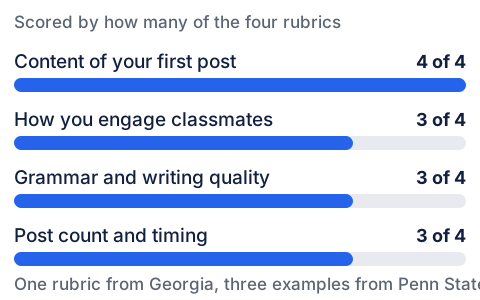
That spread is the practical warning. The Georgia rubric has no grammar row at all, while all three Penn State examples grade writing quality in every band — two of them under a row called "Delivery of Post," down to "Utilizes poor spelling and grammar in most posts; posts appear 'hasty'." One Penn State example scores neither post count nor timing, while the Georgia rubric spends two of its four rows on length and deadlines alone. Habits do not carry from one course to the next.
| Criterion | What the top band asks for | What the band below settles for |
|---|---|---|
| Content of the first post (Georgia) | "Response addresses question with thought, clarity and analysis, showing depth of understanding through application of module content" — plus concepts from outside the course | "Response addresses the question with thought and clarity," applying course readings or lecture content |
| Follow-up posts (Georgia) | References to class content and outside sources, and it "Promotes further thoughtful discussion by asking questions of classmates" | Replies to one or more classmates by the deadline, with references to readings or lecture content |
| Content contribution (Penn State, example 3) | "Posts factually correct, reflective and substantive contribution; advances discussion" | "lacks full development of concept or thought; shows cursory understanding of lesson concept" |
| Learning community (Penn State, example 2) | "Engages in meaningful two-way dialog with one or more classmates, applies classmates' thoughts in posts, builds on discussions" | "frequently attempts to motivate the group discussion; presents creative approaches to topic" |
Notice what separates the top two bands in three of those four rows. Not effort, not length: bringing in something that was not already in the course — an outside source, a real example, a question nobody had asked. It is a specific, repeatable move, and the one most students skip. Our discussion board post examples walk through full posts written to that standard.
The two rows nobody reads: word count and timing
The Georgia rubric is unusually blunt about length. It does not say "be substantial." It sets numbered bands, and the bands are scored.
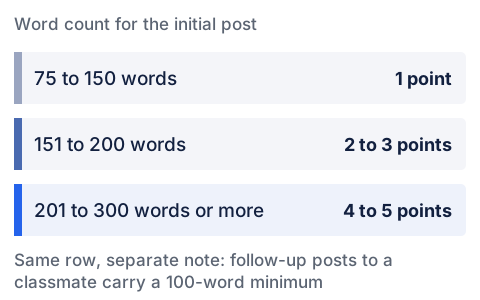
A 140-word post that says everything worth saying still lands in the 1-point band on that sheet. Whether you think that is a good way to grade writing is beside the point — it is what the row says, and it is published where students can read it before they post.
The timing row is stranger, and worth reading closely. Georgia's prints the same descriptor in the 1-point, 2–3-point and 4–5-point columns: "Initial posts by Friday midnight, or earlier, for Thurs. classes, or Wed. midnight, or earlier, for Tuesday classes." The 0-point column holds the follow-up deadline instead. So that row is not a scale at all — it is pass/fail, and the deadline moves depending on which day your section meets.
Two deadlines, not one. Every rubric here splits the initial post from the replies, and Georgia's is the only one of the four that prints dates: replies are due Sunday midnight for a Thursday class, two days after the initial post. Penn State's first example rubric drops a submission from "Average" to "Needs Work" for one reason: the two descriptors are identical except that one ends "Submissions were on time" and the other "Submissions were late."
The reply is where most of the points are lost
The initial post is the part students prepare. The reply is the part they type at the end, and it is the part the rubrics treat most harshly. Penn State's third example rubric grades follow-up postings on a four-step scale, and the descriptors are worth reading in order:
| Band | Follow-up postings, verbatim |
|---|---|
| Excellent (5 points) | "Demonstrates analysis of others' posts; extends meaningful discussion by building on previous posts." |
| Good (3–4 points) | "Elaborates on an existing posting with further comment or observation." |
| Acceptable (1–2 points) | "Posts shallow contribution to discussion (e.g. agrees or disagrees); does not enrich discussion." |
| Unacceptable (0 points) | "Posts no follow-up responses to others." |
"Agrees or disagrees" is a named band, and it is the second-lowest one. That is the single most useful thing in any of these documents. The gap between 1–2 points and 5 points is not politeness or length — it is whether you analyzed what your classmate wrote and then moved the conversation somewhere it had not been.
Georgia's rubric reaches the same place by another route. Its top band for follow-up posts wants references to "class content AND related content from outside sources," and it gives credit to a post that "Promotes further thoughtful discussion by asking questions of classmates." Ending your reply with a real question is, on that sheet, a scored behavior.
The University of Nevada, Reno's University Writing & Speaking Center supplies the restraint: "Good discussion threads should be substantial but concise: convey only the information that is most meaningful and accessible to your classmates." A short reply that names a specific claim, tests it, and asks one question beats 250 words of agreement.
Two replies to the same post, side by side
Both replies below were written for this article — they are illustrative, not real student work submitted to a real course, and the classmate, the reading and the course are invented for the purpose. The rubric language quoted against them is real, taken from Penn State's third example rubric.
Assume a classmate has posted that a public-health campaign in a course reading "worked because it was simple."
Reply A: "Great point, Maya. I agree that simplicity was the key factor here. I hadn't thought about it that way until I read your post. Nice work!"
Reply A is courteous, on time, and worth 1–2 points on that rubric: "Posts shallow contribution to discussion (e.g. agrees or disagrees); does not enrich discussion." Nothing about it is wrong. It simply contains no analysis to score.
Reply B: "Maya, I want to push on 'simple.' The campaign's message was simple, but the reading credits the result to the delivery channel as much as the wording — it ran through clinics people already visited, not through advertising. That distinction matters for the second case in our module, where the message was just as short and the reach was much smaller. If simplicity were doing the work, both should have performed alike. What would make you keep simplicity as the main explanation rather than access?"
Reply B runs 85 words, counted as a word processor counts them — enough for Penn State's sheet, and just short of Georgia's 100-word floor for replies. One reply, two verdicts: that is the argument for reading your own rubric. It names the claim, separates two variables the reading treats separately, connects to a second course example, and ends on a question. Against the same rubric that is the top band: "Demonstrates analysis of others' posts; extends meaningful discussion by building on previous posts." Nothing in it required extra research. It required rereading the classmate's sentence closely enough to find the word that was doing too much work. On a sheet with a 100-word floor the repair is not padding — name the reading and quote the line you are pushing on.
Read your own rubric before you write
Everything above is other people's rubrics, and they disagree enough that guessing is expensive. The rubric your course publishes is usually attached to the discussion itself or sitting in the syllabus.
Rutgers' Learning Centers tells students to "Know what discussion boards are worth," because practice varies: "Some professors use discussion boards as participation points and others may adjust the grading plan to accommodate for the task of posting." St. Petersburg College's library guide agrees that some instructors make discussions "a large part of your participation grade," and that it is "dependent on your professor."
The difference between those two cells is the whole assignment, and it is usually one behavior: cite something outside the course, analyze a classmate's reasoning, or ask a question that opens a new line. If there is a word-count row, treat it as arithmetic rather than judgment — the cheapest points on the sheet.
Initial post and replies almost always have different due dates, and Georgia's timing row shows the date can depend on which day your section meets. The University of Alabama's teaching office advises instructors to "Clarify participation expectations, including frequency of posting, length" — if yours has not, ask.
All three Penn State examples grade writing quality in every band; the Georgia rubric grades none. If your course wants citations in your posts, that is its own set of rules — our guide to writing a discussion post in APA format covers what a reference looks like in a 200-word post.
None of this makes discussion posts fast. It makes them predictable, which is more useful. A student who has read the rubric knows before writing whether this week's points live in length, in citation, in the reply, or in all three.
If the week has genuinely run out from under you, our discussion post writing service prepares a draft to your prompt and rubric and hands it to you. You review it, edit it into your own voice, and post it yourself from your own account — we never ask for your login and we do not post on your behalf. What you submit stays yours to stand behind, which is the only version of this worth anything in a course you have to keep passing.