Live Chat

Proofreading is the last check on a finished file — typos, spelling, punctuation and formatting, with nothing rewritten. Copy editing happens earlier and reaches further: it corrects grammar and usage, makes one style hold across the whole document, and raises questions only the writer can answer. If your sentences are still moving, you need a copy edit. If the file open in front of you is the one you are about to upload, you need a proofread.
That much is uncontroversial. What the ranking pages leave out is that the professional bodies and the university writing centers do not agree on where the boundary sits, and the disagreement lands on grammar — the single most common reason a student goes looking for help in the first place. Below are the published definitions, quoted from the organizations that publish them, the places where they contradict each other, one paragraph marked up twice to show the difference in practice, and a test that ignores job titles altogether.
- Proofreading is the final pass on the file you will submit. Typos, spelling, punctuation, formatting. Every source quoted here puts those there.
- Copy editing is the earlier and wider pass. The Editorial Freelancers Association describes it as correcting "spelling, grammar, usage, and punctuation, checking cross-references, and preparing the style sheets that guide consistency and accuracy across the manuscript."
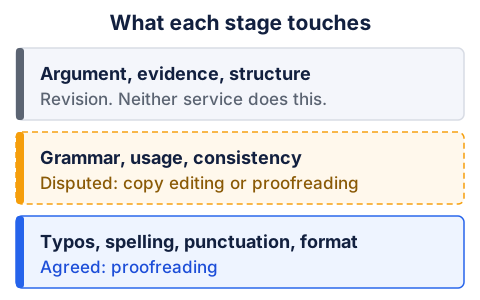
- They split on grammar. The EFA assigns grammar to copy editing. O*NET, UNC, Clemson, Purdue OWL and the University of Kansas all list it under proofreading.
- Neither service repairs your argument. A claim your evidence does not support survives both passes intact.
- Ask what state the draft is in, not which title to hire. Three questions settle it, and they are printed below.
- The integrity line is authorship, not assistance. UNC Greensboro's policy counts it as cheating to "obtain assistance from someone else that goes beyond mere editing to writing of the assignment…"
The definitions, as the organizations actually publish them
Start with the trade body. The Editorial Freelancers Association, a US membership organization for freelance editors, publishes a page of editorial service definitions. On copy editing it says: "Copyediting involves correcting spelling, grammar, usage, and punctuation, checking cross-references, and preparing the style sheets that guide consistency and accuracy across the manuscript." On proofreading it is far narrower: "Proofreaders check for typographical errors and formatting mistakes," and the work is "among the last stages of getting a manuscript ready for publication."
Two things in that pairing matter. Grammar appears in the copy editing sentence and not in the proofreading one. And the EFA's proofreading is defined against a publishing workflow — a proof, meaning a typeset page compared back to the stage before it. Your term paper has no proof. Hold that thought; it explains most of the confusion later.
Now the US government's own taxonomy. O*NET OnLine lists Proofreaders and Copy Markers as occupation 43-9081.00, defined as workers who "Read transcript or proof type setup to detect and mark for correction any grammatical, typographical, or compositional errors" — and then adds an explicit boundary: "Excludes workers whose primary duty is editing copy." Grammar sits on the proofreader's side of that line, which is the opposite of where the EFA put it.
The university writing centers, which is where most students actually land, side with the government rather than the trade body — and they are teaching something different again. A writing center is describing a sequence one writer moves through alone, not a division of labor between people who are paid separately. That is why their pages talk about when to do the work rather than who does it. The table below sets eight published definitions beside each other, each quoted from the page it lives on.
| Who publishes it | What it calls proofreading | What it calls the stage before |
|---|---|---|
| Editorial Freelancers Association (US trade body) | "Proofreaders check for typographical errors and formatting mistakes." | Copyediting: "correcting spelling, grammar, usage, and punctuation, checking cross-references, and preparing the style sheets that guide consistency and accuracy across the manuscript." |
| O*NET OnLine (US Department of Labor) | Detect and mark "any grammatical, typographical, or compositional errors" | A separate occupation. "Excludes workers whose primary duty is editing copy." |
| UNC Chapel Hill Writing Center | "the final stage of the editing process, focusing on surface errors such as misspellings and mistakes in grammar and punctuation" | Editing: "what you begin doing as soon as you finish your first draft" |
| Clemson University Writing Center | "a narrower task concentrated on correcting surface-level errors like grammar, spelling, punctuation, and formatting" | Editing: "a comprehensive review of content, structure, style, and organization" |
| University of Kansas, Wingspan | Its proofreading prompts include "Do the subjects and the verbs agree?" and "Also watch for misspellings and homophones" | "Editing, sometimes called revising" |
| University of Nevada, Reno | "Proofreading takes place when editing is finished." | "Editing begins while you are still working on your first draft." |
| Purdue OWL | "a process of looking for any inconsistencies and grammatical errors as well as style and spelling issues" | Treated as earlier work in the writing process |
| Editors Canada (Canadian, for contrast) | The last of four named stages | Its Professional Editorial Standards "covers the four stages of editing," from structural editing through to proofreading |
The field cannot agree on whether it is one word or two. The EFA writes copyediting. ACES: The Society for Editing is legally "The American Copy Editors Society," two words. Editors Canada writes copy editing. This post uses copy editing as the noun phrase and the one-word form only where the EFA's own label is being reported, because two words is what a US student is most likely to see on a syllabus or an order form. Nothing turns on the choice — a service that spells it the other way is not a different service.
Where the authorities genuinely disagree
Four real contradictions run through the pages above. None of them is a mistake by any single source. They come from two different worlds: book publishing, where the stages are contractual, and college writing instruction, where they are stages of one person's process.
Grammar is claimed by both sides
The EFA lists grammar under copy editing. O*NET, UNC, Clemson, Purdue OWL and the University of Kansas all list it under proofreading — Kansas goes as far as asking proofreaders "Do the subjects and the verbs agree?", which is a textbook grammar check. So if you order a proofread from a publishing-trained editor and expect subject-verb agreement fixed, you may not get it; take the same draft to a campus writing center and that check is explicitly on their list. The word does not tell you what you are buying. The scope statement does.
Proofreading is either inside editing or after it
UNC calls proofreading "the final stage of the editing process" — part of editing. The University of Nevada, Reno writes that "Proofreading takes place when editing is finished" — after editing. Editors Canada treats it as the fourth of four separate stages. Those are three different diagrams of the same work, and a service quoting you for "editing" may or may not have a proofread inside it.
"Editing" sometimes means "revising"
The University of Kansas writes "Editing, sometimes called revising," collapsing two things the publishing world keeps apart. In the professional model they are separate services: the EFA reserves the structural work for developmental editors, "also called 'substantive,' 'structural,' or 'content' editors," who "deal with content, organization, and genre considerations." Ask for "editing" and one provider hears rethink my chapter while another hears tidy my commas.
A student paper has no proof
This is the one nobody says out loud. The EFA's proofreading definition is anchored to publishing: a proof is a typeset page, checked against the stage before it. There is no typesetter between you and your instructor. The closest equivalent in student work is the moment the document stops changing — after the last citation is inserted, the page numbers are right and the file is exported. Proofreading a paper means checking the artifact you are about to hand in, not a stage in someone else's production line. Our companion piece on what proofreading actually is takes that definition apart in more detail.
One paragraph, marked up twice
Definitions argue. A marked-up passage settles it. Below is a 63-word paragraph written for this article — the recycling program, the percentages and the coordinator are invented to carry the demonstration, and none of it should be quoted as fact.
The campus recycling programme was launched in 2021, and it's goals were ambitious. Within two years, participation in the residence halls have risen to 62 percent, up from 41%. Students in halls with a paid coordinator recycled more consistantly than students in halls without one, which proves that staffing is why the program succeeded. A new bin design was also introduced in 2021.
Pass one — a proofread. Three corrections, and nothing else is touched.
programme→ program. A British spelling in a US paper, and inconsistent with "program" in the third sentence.it's→ its. Possessive, not a contraction.consistantly→ consistently. Misspelling.
Pass two — a copy edit. The same three, plus two more corrections and two queries written in the margin for the author to settle.
have risen→ has risen. The subject is "participation," not "halls."41%→ 41 percent. One number style across the document. This is the style-sheet work the EFA names in its copy editing definition, and it is invisible in a single sentence — it only exists across a whole paper.- Query: "proves" overstates what the sentence shows. Halls with coordinators recycled more; that is a correlation, and the paragraph's own last sentence offers a rival explanation. A copy editor flags this and hands it back. Rewriting the claim is the writer's job.
- Query: the unit shifts. Sentence two counts halls, sentence three counts students. Which does the 62 percent describe?
Notice which item is doing the arguing. Under the EFA's definition, changing have to has is copy editing. Under Kansas's and Clemson's, a proofreader does it. That one line is the entire disagreement, made small enough to see. If it matters to you who catches it, write "subject-verb agreement" in your instructions instead of a service name.
Notice too what survived both passes. The paragraph ends by naming a new bin design introduced in the same year — a competing explanation for the whole result — and then does nothing with it. Neither the proofread nor the copy edit repairs that. It is an argument problem, and the fix is a rewrite of the last two sentences by the person who knows the evidence. A draft still in that shape does not need more editing; it needs a stronger outline. If you want to read the correction symbols an editor will use to hand any of this back, our guide to proofreading marks covers the ones that still appear on student work.
The test: what state is the draft in?
Because the job titles are unreliable, judge the draft instead. Three questions, asked in this order, put any paper in the right stage. Stop at the first one you answer yes to.
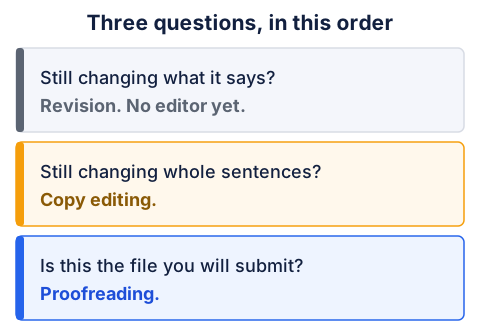
If a paragraph might move, a source might come out, or the thesis might shift, no editing stage applies yet. Every correction made now gets thrown away with the sentence it sat in. UNC is blunt about the sequence: proofread "only after you have finished all of your other editing revisions."
If you would accept a rewritten clause, a cut adverb or a swapped connector, the draft wants a copy edit. This is also the only stage where consistency work is possible, because consistency is a property of the whole document — one spelling of a key term, one number style, one citation pattern.
Final citations in, page numbers right, headings styled, nothing pending. Then it is a proofread, and the deliverable is a clean copy rather than a conversation. Ask for it too early and you pay for corrections to sentences you are about to delete.
The test works because it reads the artifact, not the market. A freelancer, a campus writing center and an editing service will each use these words slightly differently, but none of them can change what state your document is in.
What neither stage will do, and the line you cannot cross
Both services stop at the same wall, for the same reason: past a certain point the words stop being yours.
US institutions draw that line explicitly. UNC Greensboro's academic integrity policy lists it under cheating: to "obtain assistance from someone else that goes beyond mere editing to writing of the assignment or solving of the problem." Read that carefully. Editing is named as permitted. What is prohibited is the point at which assistance turns into authorship.
Universities that run their own editing services police the same boundary. Syracuse University's Graduate Editing Center tells graduate students its editors work on "sentence-level issues of grammar, clarity, and awkwardness/tone," reminds them that "the changes your editor makes to your text are suggestions," and declines to assess "the disciplinary strength of your writing." The documents it will not review include coursework outright.
Rules vary by institution and sometimes by instructor, and a graduate thesis is often governed differently from a first-year essay. Check your own syllabus and your graduate school handbook before you hire anyone; a permission that holds in one department may not hold in the next. Nobody outside your institution can tell you what your institution allows.
The practical version: a legitimate editor corrects errors, points at problems and asks questions. A legitimate editor does not supply the argument, invent the evidence or write the paragraph you could not write. If the returned document contains ideas you cannot explain, the transaction went past editing — and that holds whether the help came from a person or from software, which is the argument we make in detail about using AI to proofread an essay.
The vocabulary, in one place
These are the terms you will meet on order forms and in writing-center handouts, with the sense each one carries in this post.
| Term | What it means here | Where the draft usually is |
|---|---|---|
| Revision | Changing what the paper says: claims, evidence, order, scope. | Still being written |
| Developmental editing | The professional version of revision. The EFA's developmental editors "deal with content, organization, and genre considerations." | Complete but unconvincing |
| Line editing | Sentence and paragraph work. EFA line editors' "main focus is on improving the language and style of the text." | Argument settled, prose heavy |
| Copy editing | Grammar, usage, punctuation, cross-references, and a style sheet that holds the document consistent. | Near-final, sentences still open |
| Proofreading | The final surface check: typos, spelling, punctuation, formatting. | The file you will submit |
| Style sheet | The running record of choices — spellings, capitalization, number style — that keeps page 30 matching page 3. | Built during the copy edit |
| Author query | A margin question an editor cannot answer for you. It is returned, not resolved. | Any stage |
The service name tells you what someone sells. The state of your draft tells you what you need.
How to ask for the right one
Since the labels are unreliable, describe the work rather than naming it. Three sentences are usually enough: what stage the document is in, what you want touched, and what you want left alone. "This is my final file, citations included — please correct typos, spelling, punctuation and formatting only" is an unambiguous proofreading order. "Sentences are still open; please fix grammar and usage, keep terminology consistent, and query anything that overstates the evidence" is an unambiguous copy edit.
Two habits are worth keeping either way. Ask for tracked changes, so you can see every alteration and accept them one at a time — Syracuse's reminder that an editor's changes "are suggestions" is the right posture for any editing you commission. And leave real time between the last content change and the final pass; UNC's page notes that most people give proofreading only a few minutes, which is exactly why so little gets caught.
If you would rather hand the last pass to someone else, our editing and proofreading service works to whichever scope you specify, from $7.89 a page, on the draft you wrote. You get the corrections and the queries back; the decisions, and the submission, stay yours. That is not a limitation of the service. It is the reason the work is worth having.