Live Chat

A master's thesis defense is normally booked for one to two hours, and the stretch where you stand and talk takes 30 to 60 minutes of it. Both halves of that sentence come from graduate programs that publish their own figures, and the distance between them is why the answers you find keep contradicting each other.
Those numbers rarely arrive labeled. A department that says "two hours" is describing the appointment. A department that says "45 minutes" is describing your seminar. A third publishes no number at all, and at that school the defense does not even have to be publicly announced. Same milestone, three honest answers.
What follows is what ten US programs publish for master's thesis candidates, a stage-by-stage breakdown of where the block goes, why the closed portion takes up more of it than the published talk length suggests, and where the master's clock genuinely differs from the doctoral one.
- Programs that publish a total put it between one and two hours. Two hours is the most common booking, and no program in this set publishes a longer one — though SUNY ESF's two hours "may be extended as required."
- Published presentation lengths run 30 to 60 minutes, so a "45 minutes" page and a "two hours" page are usually not in conflict.
- The stage nobody puts a number on is the closed committee examination — and at some schools it may cover your coursework, not only your thesis.
- Format decides the clock more than degree level does. A seminar-plus-closed-exam program fills two hours; a single capped event stops at 90 minutes.
- Master's is not automatically shorter than doctoral. One department caps a thesis at 90 minutes and a dissertation at two hours; two others give both exactly the same two-hour block.
- Pass-rate figures for master's defenses circulate with no named institution or study behind them. Your program's vote rule is published, and it is the number worth knowing.
What ten US programs actually publish
These figures are read from each program's own policy page or handbook. Nothing here is averaged or borrowed from another article.
| Program | What its own policy says | What that number covers |
|---|---|---|
| Texas A&M, Computer Science & Engineering (MS) | "Normally two hours should be reserved for the defense." | The reservation, explicitly |
| SUNY ESF Graduate School | "The defense examination usually lasts two hours, although this time period may be extended as required." | The examination, with no hard stop |
| North Texas, Philosophy & Religion (MA) | Duration "is not to exceed two hours for Dissertations and one-and-a-half hours for Thesis." | A ceiling on the whole public event |
| Nebraska-Lincoln, Nutrition & Health Sciences (MS) | A "45-minute public seminar presentation with 10 minutes for questions," then committee examination — "please allow 2 hours in total." | Talk, questions and total, separately |
| Oregon State, Mechanical, Industrial & Manufacturing Engineering | Two components, a public presentation and a committee examination: "The exam lasts two hours." | The whole examination |
| Arkansas at Pine Bluff, MS Computer Science | A "30~45 minute overview"; "The presentation and questions will last no longer than one to two hours." | Talk plus a combined ceiling |
| Utah, Robotics Center (MS) | "The defense begins with the student's presentation of their MS research for approximately 45 minutes." | The talk only |
| Boise State Graduate College | Public presentation, "Approximately 30–60 minutes, followed by a brief Q&A session," then a private examination. | The public portion only |
| UAB, Art and Art History (MA) | "Budget around 1 ½ - 2 hours for the defense," including the post-defense meeting with your advisor. | The afternoon, not just the room |
| Hawaiʻi at Mānoa, master's Plan A | No length published; the announcement "is not required to be posted and open to the public." | Nothing — no length is published |
Seven of the ten name a total or a ceiling for the whole event, and none of those published figures runs past two hours. North Texas's one-and-a-half hours is the tightest ceiling in the set; Pine Bluff writes its ceiling as a range rather than a single figure; and only ESF leaves the door open, allowing its two hours to "be extended as required." Two more publish only how long you speak. The tenth is the useful outlier: a graduate division that sets a minimum length for doctoral defenses and none at all for master's ones.
Ask one question of every page you land on: is this the talk, the booking, or the examination? A department publishing 45 minutes and a department publishing two hours can be describing an identical afternoon, and neither of them is wrong.
Three formats, and the format decides the clock
Sort them by shape rather than by number and the disagreement collapses. The published policies in this set take three shapes, and which shape your program uses tells you more about your afternoon than your degree level does.
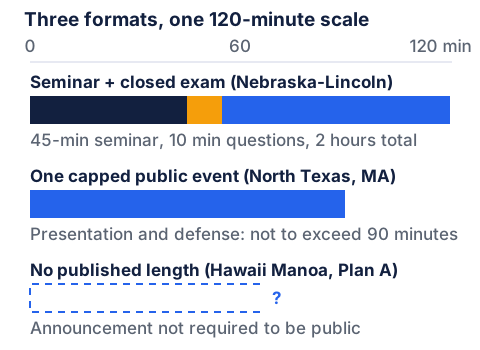
Format one: a public seminar, then a closed examination. This is the two-hour arrangement. Nebraska-Lincoln's MS nutrition policy is the clearest published example — a 45-minute seminar, 10 minutes of public questions, then the committee's own examination inside a two-hour allowance. Boise State and Oregon State's engineering programs publish the same two components, and Texas A&M's computer science MS names the same split from the other side: "The part of the exam that is related to the presentation of the student's research is public (the thesis defense)."
Format two: one capped public event. North Texas runs the presentation and the defense as "a singular public event" and caps the pair at "one-and-a-half hours for Thesis." The committee then "convenes privately to determine the merit of the candidate's dissertation/defense" — a deliberation, and the policy publishes no second round of questions after it. With nothing scheduled to absorb an overrun, the ceiling is the whole story.
Format three: no published length at all. The University of Hawaiʻi at Mānoa defines the final defense as "an oral examination open to the public" and states that it is "required for the dissertation and Master's plan A students" — then publishes a duration for only one of them. The doctoral defense must be announced in the University Events Calendar and "must be one hour or more in length." For the master's Plan A, the announcement "is not required to be posted and open to the public," and Mānoa publishes no duration for it at all. There is no number to plan against here, only your committee's own practice.
Knowing which format you are in is worth more than any average. It tells you whether the questions come from a room or from three people, whether there is a second act after your talk, and whether the published number is a floor or a ceiling.
Where the block actually goes, stage by stage
Programs publish the parts they have to schedule and stay quiet about the rest. Laid out in order, the policies collected here run to seven stages, and only three of them carry a published number of their own.
| Stage | What happens | Published length? |
|---|---|---|
| 1. The committee convenes | UAB's script has your advisor open the defense and ask whether every member has read the thesis. At Penn State's food science program a majority of the committee must already have consented, a week earlier, to the defense going ahead. | No |
| 2. Your presentation | Kent State asks only for "a brief presentation of his or her findings"; UAB's art history guidance leaves it to your advisor whether to ask for a summary at all. | Yes — 30 to 60 minutes |
| 3. Public questions | Nebraska-Lincoln allots 10 minutes. Kent State's advisor may open the floor to non-committee graduate faculty, then to others present, once the committee is finished. | Partly — 10 minutes at one school |
| 4. The closed examination | The actual exam. Only the committee is in the room, and it is what the rest of a two-hour booking is for. | No — nowhere in this set |
| 5. Deliberation, with you outside | The committee settles the outcome and the revision list. | Rarely — "roughly 10-15 minutes" at UAB |
| 6. You are called back | At UT Tyler the committee "calls the candidate back in to review required changes" in the document. The revision list reaches you before the outcome is announced to anyone else. | No |
| 7. Signatures and the advisor meeting | Forms, then the conversation about what happens next. UAB counts this inside its 1½-to-2-hour budget, which is why its figure looks generous. | Only inside UAB's total |
Two things fall out of that table. Your talk is the one stage you can plan to the minute, and the stage with no published length is the one you are actually asking about.
Why a 45-minute talk needs a two-hour room
The gap between the seminar and the booking is filled by an examination that is genuinely an examination — and at the master's level its published scope can be wider than the thesis.
Penn State's food science MS states it plainly: the oral examination "shall cover both course work and the thesis." NC State's graduate school defines the master's final oral exam as a comprehensive one, meant to show "a reasonable mastery of the subject matter of the major and minor fields," which "takes the form of a traditional defense of the thesis in those programs requiring theses." The University of Oklahoma Health Sciences Graduate College says its thesis defense "may be restricted to the defense of the thesis and/or cover the coursework required for the degree."
These policies call it a final examination, not a presentation. At the three schools named just above, that wording is literal: the coursework behind the thesis is in scope too.
Rochester makes the paperwork side of that visible. Before the questioning starts, you leave the room while the committee "reviews your program of study, grades, and decides whether the thesis is acceptable/not acceptable." Then you are "called back into the examining room and questioning will begin," and after the questions you leave a second time while the committee decides the outcome. That is two exits and two returns inside one booking, which is one reason the questioning starts later than the time on the invitation.
Rochester also publishes how the questioning itself is organized: "The committee decides whether members will ask sequential questions or whether each member will be allotted a specific time period for questioning." Those two designs produce very different afternoons from the same policy. Timed rounds carry their own stop; open sequential questioning has none.
The questions that stretch it
No program in this set publishes a length for the committee's questioning. A policy can cap a room booking; it cannot cap a conversation. Anyone quoting you a confident national figure for how long master's committees question a candidate has invented it.
What is knowable is the scope. Kent State's guidelines set the priority outright: "Questions dealing with the substance, meaning and usefulness of the research in the thesis are of greatest priority." Comments about "punctuation, grammatical minutiae, spelling, etc., are out of order" — those are written out and given to you privately instead. So the length of your questioning is set by how well your decisions hold up, not by how clean your formatting is.
UAB publishes the list it tells its master's candidates to prepare for, and it is a good map of where time goes. Among them: why you chose the topic, what the main argument of each chapter is, what your methodology is, what you consider the strongest and weakest aspects of your thesis, and what you would do differently if you wrote it again.
Look at the shape of that list: almost every item asks you to account for a choice rather than to recall a fact. The version that runs long is "Why this method rather than the obvious alternative?" A candidate who chose a survey because it was the fastest instrument available, rather than because the research question needed one, has nowhere to go — and every follow-up compounds. "I don't know, but here is how I would find out" costs you far less time, and far less credibility, than improvising.
Master's and doctoral, side by side on the clock
Much of the defense advice that ranks for this question was written about doctoral candidates, which is worth knowing before you calibrate your expectations against it. The two are separate milestones with separate committees, as our guide to the difference between a thesis and a dissertation sets out, and in US usage a master's produces a thesis while a doctorate produces a dissertation.
On duration specifically, the honest picture is narrower than the folklore. Five institutions in this set publish both levels in one document, which makes the comparison a reading rather than an inference:
| Institution | Master's thesis | Doctoral dissertation |
|---|---|---|
| North Texas, Philosophy & Religion | Not to exceed 1½ hours | Not to exceed 2 hours |
| Oregon State, MIME | MS-thesis exam "lasts two hours" | Same two hours, same two components |
| SUNY ESF | Usually two hours, extendable | Usually two hours, extendable |
| Hawaiʻi at Mānoa | Plan A: no minimum, no public announcement required | "The defense must be one hour or more in length," announced on the events calendar |
| Boise State | "Approximately 30–60 minutes" of public presentation; outcome documented by the "committee chair (for thesis defenses)" | The same presentation figure, with no separate doctoral timing published; outcome documented by "the GFR (for dissertation defenses)" |
So "the master's one is shorter" is true at North Texas, false at Oregon State, SUNY ESF and Boise State, and at Hawaiʻi at Mānoa the comparison runs the other way: the doctoral defense has a published floor and the master's one has no published length at all. What does differ is the committee. ESF adds one faculty member beyond the steering committee for a master's candidate and two for a doctoral one; Rochester's master's minimum is three — your advisor, a second faculty member from your program, and one from outside the department. More examiners, more questions, more clock.
A doctoral dissertation is generally a larger project than a master's thesis, so its examination has more surface to cover — see how long a dissertation actually runs if that is the milestone you are facing.
What makes yours run short or long
Nothing in these policies makes two defenses under the same ceiling run the same length. Most of what decides where yours lands is settled before the day.
Finishes at the short end
- A three-member committee, which is the published minimum at Rochester and Kent State.
- A single capped public event, with no closed round to absorb overflow.
- The thesis reached its readers early — Kent State schedules the defense to allow "a minimum of ten days" for the committee to review it, Penn State requires the thesis to be with the committee two weeks out, and Nebraska-Lincoln wants it with your committee chair by the same point.
- Timed questioning rounds rather than open sequential questions.
- A talk that ends inside its allotted time instead of eating the questions.
Runs to the ceiling
- A separate closed examination after the public seminar, as at Nebraska-Lincoln and Boise State.
- An exam whose published scope includes your coursework, not only the thesis.
- A methods choice you cannot justify, which opens a second line of questioning.
- A committee that disagrees with itself about how large the revisions should be.
- A policy that allows extension — ESF's two hours "may be extended as required."
Edge cases that break the number entirely
Four published arrangements make "how long" the wrong question, and each is real policy at a named school.
The defense that is not oral. The University of Oklahoma Health Sciences Graduate College states that a master's thesis defense "may be oral, written, or a combination of oral and written." A written defense has a deadline, not a duration.
The defense that is paused. If the advisor judges it desirable, or a majority of the committee so moves, Kent State's guidelines let the advisor "recess the oral defense until a time mutually agreeable to the advisor, the student, and the thesis committee." The answer to how long it took is then measured in days.
The non-thesis track. If you are on a project or coursework option, this page is about a different exam. Oregon State's MIME department gives its MS-project exam one to two hours with no required public presentation, and NC State exempts its Option B master's students from the comprehensive oral exam altogether.
The second attempt, where one exists. Arkansas at Pine Bluff allows a second and final defense "at least 30~60 days after the initial thesis defense." SUNY ESF requires unanimous agreement to pass a first defense but allows one negative vote at a second. Oklahoma Health Sciences allows no second attempt at all: "Only one attempt is granted in defending the thesis."
Pass rates for master's defenses circulate widely. Before you believe one, look for the institution or the study behind it — graduate schools publish outcome categories and vote thresholds, not counts. What is published is worth learning: Kent State passes a candidate "with no more than one dissenting vote" and forbids abstentions; Nebraska-Lincoln lets one dissenter file a letter and still approves the degree; NC State requires a unanimous vote. Three schools, three different meanings for the same silence in the hallway.
Getting your program's real number
Everything above is context for the figure that actually governs your defense. Four moves, in this order, will find it.
Search your university's site for "final oral examination" as well as "thesis defense" — the formal name is what the policy uses. This level sets the ceiling, the vote rule and the scope of the exam.
Departments set the format inside that ceiling: how long you speak, whether the seminar is public, whether a closed examination follows. This is where the 45-minute and 30-to-60-minute presentation figures live, and it overrides anything generic.
Is there a closed examination after the public part, and does the exam cover coursework or only the thesis? Those answers turn a ceiling into a realistic finish time, and they decide what you revise for. Chairs answer both in a line.
Your advisor has usually sat through the defenses that came before yours in the same lab or cohort. An observed clock from the last two students beats any published range, including this one.
Then use the number as a rehearsal constraint. Time your talk against the published presentation length, not the total, and leave the remaining minutes where the committee expects to spend them. A talk that runs 55 minutes into a 45-minute slot has already taken time from the part where you are being assessed.
If it is the document rather than the clock keeping you up, that is a different problem with a different fix. Our guide to writing a thesis from blank page to final draft covers the chapter-level work, and if you would rather have a subject-matched writer working alongside you on structure, chapters and revisions, that is what our thesis writing help is for, from $7.89 a page. The defense itself stays yours — and it is far easier to sit through when the two hours are spent on a thesis whose decisions you can explain.