Live Chat


A master's thesis defense deck is sized by one number, and your program has probably already published it: how many minutes you speak before the questions start. Get that number and the slide count is arithmetic. For a 30-minute presentation — the middle of what US programs actually publish — the deck below runs 16 slides and 27 minutes of speaking, with three minutes deliberately unspent.
The number is worth chasing down, because master's programs disagree with each other more than you would expect. The University of Pittsburgh's Chemical and Petroleum Engineering department tells MS candidates their presentation is "usually about 20-30 minutes in length if uninterrupted." The University of Toledo's Department of Environmental Sciences says the presentation should be "between 30 and 50 minutes long." That is a two-and-a-half-fold spread between two US master's programs, and no template straddles it.
Here is the part that surprised us. A master's defense is often a shorter event than a doctoral one, but the presentation inside it is frequently not shorter at all. The University of North Texas Department of Philosophy and Religion runs both degrees off one policy: "the duration for presentation and defense is not to exceed two hours for Dissertations and one-and-a-half hours for Thesis" — and in the same list, "the dissertation defense consists of a presentation of the work by the candidate (10 minutes maximum)." Read those two lines carefully, because they measure different things: ninety minutes is the cap on the whole master's event, while ten minutes is the cap on the doctoral talk. UNT never publishes a length for the master's talk at all. What it does show is that a doctoral presentation can be ten minutes — a fraction of the twenty to fifty minutes the master's programs below ask for. The difference between a thesis and a dissertation is real, but it is not reliably a difference in minutes, and a deck built from PhD advice can end up the wrong size in the wrong direction.
- Ask your advisor for the published presentation length before you open a slide deck. Everything else follows from it.
- Across six named US programs, published master's presentation lengths run from 20 minutes to 50 minutes — the degree does not set the clock, the department does.
- A slide count means nothing without the length it was written for. CSUN's computer science guideline caps a master's defense at 35 slides, and in the same line tells you it is describing a 50-minute defense that includes a live software demo.
- Our rule for turning minutes into slides: hold back 10% of the slot for interruptions, then allow roughly 100 seconds per slide. A 30-minute slot gives 27:00 of speaking and 16 slides.
- Build every slide to survive being interrupted mid-sentence. Two of the programs below say plainly that the committee asks questions during the talk, not after it.
Your program has already published your slide count
Before anything else, get the minutes. Some departments print them; where they do not, your advisor knows. Here is what six US programs publish for a master's thesis defense, in their own words.
| Program | Presentation length | In its own words |
|---|---|---|
| Pitt, Chemical & Petroleum Engineering (MS) | 20–30 min | "usually about 20-30 minutes in length if uninterrupted" |
| UConn, Mechanical, Aerospace & Manufacturing Engineering (MS Plan A) | at most 40 min | "As a guideline, your presentation should be at most 40-minutes long, to leave 20 minutes for questions and for deliberation of the Advisory Committee." |
| Arkansas at Pine Bluff, MS Computer Science & Technology | 30–45 min | "The student will give a 30~45 minute overview of their research and results followed by audience questions." |
| Utah, Robotics Center (MS thesis) | about 45 min | "The defense begins with the student's presentation of their MS research for approximately 45 minutes." |
| Toledo, Environmental Sciences (MS and PhD, one rule) | 30–50 min | "between 30 and 50 minutes long" |
| Cal State Northridge, Computer Science — defense with a demo (faculty guideline, not policy) | about 50 min, talk plus demo | "Total time… Defense with a demo (most common) about 50 minutes, about 35 slides max." |
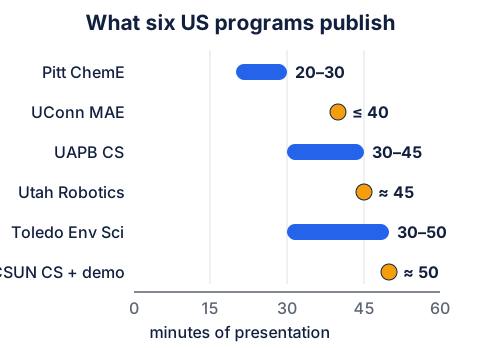
Notice what the Toledo entry does. Its regulations cover the MS thesis and the PhD dissertation together and hand them the same 30-to-50-minute window. A department that sees no reason to shorten the talk for a master's candidate is not unusual, and it is the best argument for asking rather than assuming.
A slide count with no presentation length attached to it is not advice, it is a rumor. The 35-slide cap quoted above comes from a Cal State Northridge computer science guideline written by faculty member Shan Barkataki, dated as a June 2011 draft, and still linked today from his own CSUN course-resource page. It is one committee chair's guidance to his own students, not department policy. Read the line it sits in and the cap makes sense: 35 slides is the ceiling for a 50-minute defense that also includes a live software demo. Lifted away from those 50 minutes, it is a trap.
The deck itself: 16 slides across 27 minutes
This is the whole deck for a 30-minute slot. The last column carries two numbers: how long that slide gets, and in parentheses the elapsed time at which you should already be moving on. The budget is ours — worked out from rehearsal pacing against the published lengths above, not a figure any of those programs prints.
| # | Slide | The one thing it does | Time (at) |
|---|---|---|---|
| 1 | Title | Thesis title, your name, degree and program, committee, date. Nobody reads it; you are speaking over it. | 0:20 (0:20) |
| 2 | The question, in one sentence | What you set out to find out, in language your outside committee member follows without effort. | 1:10 (1:30) |
| 3 | Why it matters here | The practical or scholarly stake. One concrete consequence beats three abstract ones. | 1:10 (2:40) |
| 4 | What is already known | The literature as three or four settled points, not a review. You are establishing the shelf you will add to. | 1:20 (4:00) |
| 5 | The gap | The one thing nobody had measured, compared or read this way. Say it as a sentence, not a bullet list. | 1:00 (5:00) |
| 6 | Questions or hypotheses | Two or three, numbered. The numbers give the committee a handle to grab later. | 1:10 (6:10) |
| 7 | Design | How the study is put together, and why that arrangement can answer question 1. A diagram earns its place here. | 2:00 (8:10) |
| 8 | Setting, sample, materials | Where, who or what, how many, how chosen. Include IRB or permit status if it applies. | 1:40 (9:50) |
| 9 | Procedure | What you actually did, in the order you did it. This is the slide a methods-minded reader waits for. | 1:40 (11:30) |
| 10 | How you analyzed it | The test, model or coding scheme, and why that one rather than the obvious alternative. | 1:30 (13:00) |
| 11 | Result 1 | Your strongest finding, drawn once. Speak the headline; let the chart carry the rest. | 2:30 (15:30) |
| 12 | Result 2 | The second finding, at the same level of detail. | 2:30 (18:00) |
| 13 | The result you did not expect | Whatever went sideways. Volunteering it is worth more than any other slide in the deck. | 2:00 (20:00) |
| 14 | What it means | Findings mapped back onto your numbered questions, then out to the field. | 2:30 (22:30) |
| 15 | Limits and next steps | Say where your evidence runs out, in your own words, first. Then two things you would do next. | 2:30 (25:00) |
| 16 | The answer, restated | Your slide-2 question and its one-sentence answer, plus thanks to the committee. | 2:00 (27:00) |
Twenty-seven minutes of speaking in a thirty-minute slot. The missing three minutes are not slack for a slow start; they belong to the committee, for reasons the next-but-one section gets to.
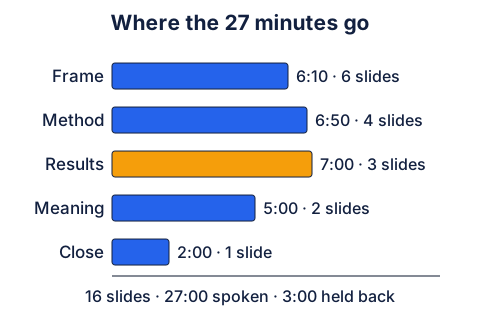
The bars measure minutes, but the interesting number is the slide count sitting next to each one. Six slides share the first 6:10, so the frame moves at roughly a minute apiece. Three slides share 7:00 in the results block, because that is where a master's committee stops listening politely and starts examining.
Three clock readings, instead of a timer
Watching a stopwatch and thinking at the same time is a skill almost nobody has. Memorize three readings out of the table instead:
- 5:00 — you are leaving slide 5. The gap is stated. Still on slide 4 and you are delivering a literature review nobody asked for.
- 13:00 — you are leaving slide 10. Method finished, two-thirds through the deck, with more than half the clock still in hand. That imbalance is deliberate.
- 20:00 — you are leaving slide 13. All three results delivered. Everything after this compresses gracefully under pressure. Method does not.
Arriving at a checkpoint late calls for jumping a slide, not talking faster. Anything you drop from slides 14 to 16 you can say in one sentence from memory; anything you rush in slides 11 to 13 you will be asked to repeat in the closed session anyway.
Rebuilding it for your slot
Two steps, both ours. Hold back 10% of your published slot for interruptions. Then divide what is left by about 100 seconds — roughly what one slide with a single idea costs when you are speaking to people who have already read your thesis.
| Published slot | Spoken budget | Slides | What actually changes |
|---|---|---|---|
| 20 minutes | 18:00 | 11 | Frame drops to 4 slides (fold "what is already known" into the gap). Method to 3. Two results, not three. This is the shape for Pitt's lower bound. |
| 30 minutes | 27:00 | 16 | The deck above, unchanged. |
| 40 minutes | 36:00 | 22 | Procedure splits in two, a fourth result appears, and implications get a slide of their own separate from "what it means." |
| 45–50 minutes | 40:30–45:00 | 24–27 | Add your analysis worked through on one case, and a slide on how you checked your own work. Stay well under CSUN's 35-slide ceiling. |
When the slot shrinks, cut in this order and stop as soon as you fit: the literature beyond four settled points, the agenda slide, the slide about you, every results-chapter table that is not a top finding, and any screenshot of an instrument or survey form. All of it moves to the pile behind slide 16 — what the CSUN guideline calls backup slides, "in anticipation of questions." Assembling that pile is the cheapest preparation in this article.
What four of those slides actually say
A list of slide topics is not a deck. So here are four of the sixteen written out properly — first what goes on the screen, then the words that go with it.
The study behind these four slides does not exist. We wrote it for this article: no such thesis, no such stream, no such dataset, and every number in it is made up. We built it to look like a realistic master's project in environmental science, because slide wording is untestable without a real subject underneath it. Your study goes in its place; the shape stays.
Slide 2 — The question, in one sentence
On the slide:
- Vegetated buffer strips are required along this county's agricultural streams
- The requirement is 30 feet, set in 1998, from studies on much larger rivers
- Does a 30-foot buffer measurably lower nitrate on a stream this small?
What you say, in about a minute: "The rule exists, the rule is enforced, and as far as I can tell nobody has tested it on a headwater stream in this county. That is a small question and a cheap one to answer, which is exactly why it fits a master's thesis."
Slide 4 — What is already known
On the slide: three lines, each one a settled point with a citation after it — buffers reduce nitrate on large rivers; effectiveness scales with width; almost all of the field measurements come from watersheds an order of magnitude bigger than this one.
What you say: "I am not going to review this literature, because it is not in dispute. I am showing you three things everyone agrees on, so that the thing nobody has measured — which is the next slide — lands as a gap rather than an opinion."
This slide is where a master's deck parts company with a doctoral one. You are not being asked to reposition a field. You are being asked to show you know the shelf you are putting your work on.
Slide 7 — Design
On the slide: one map, two sampling points marked upstream and downstream of a single buffered reach, and a note reading "12 paired samples, May–October."
What you say: "Paired upstream-downstream sampling on one reach. The trade-off is worth stating up front: a multi-site design would have given me between-site variation, and I did not have the field time for it. What I have instead is the same water, half an hour apart, which holds almost everything constant except the buffer."
Say the design you could not afford before a committee member has to ask about it. Thirty seconds spent there buys you the credibility to spend two minutes on results.
Slide 11 — Result 1
On the slide: a headline sentence, the chart under it, a caveat line under that, nothing else. The headline: "Median nitrate fell from 4.1 to 2.8 mg/L across the buffered reach." The caveat: "n = 12 paired samples, one reach, one season."
What you say: speak the headline, then orient the room to the chart — axes first, then where to look. Then hand over the awkward part before anyone reaches for it: "Two of those twelve dates run the other direction, and both of them follow heavy rain. That is slide 13."
Three people who already read the thesis are sitting in front of you. The deck exists to tell them which part of it you think matters.
Build it to survive an interruption
This is the design constraint most defense templates ignore, and two of the sources above state it outright. Pitt's guidance says "the committee may interrupt the presentation to ask questions or request a clarification" — which is also why its 20-to-30-minute estimate carries the qualifier "if uninterrupted." The Cal State Northridge guideline is blunter: "It is customary for the committee members to ask questions during the presentation; you can't defer these to the end."
Four consequences for how you build the deck, all of them ours:
- Number every slide. A committee member who wants to go back needs a way to say where, and "the one with the bars" is not it.
- No forward promises. "As I'll show in three slides" collapses the moment you get pulled off track. Say what you know on the slide you are on.
- Every slide self-contained. If a slide only makes sense after the two before it, merge them or rewrite the headline.
- Spend the 10% you held back. Three minutes absorbs two clarifying questions and a projector that will not wake up.
Rehearse the interruption itself. Hand two friends a list of genuine questions and let them cut in whenever they like, then practice picking the thread back up without restarting a sentence. One run like that teaches you more than five clean ones.
The defense is two rooms, and only one sees your deck
Most master's defenses split in half, and the deck belongs to the first half. Toledo describes its defense as "two parts: an initial, public 'presentation' on the research findings followed by a 'defense' of the research", with the presentation open to faculty, students, family and friends. The Robotics Center at the University of Utah runs the same shape and adds that "members of the audience must be allowed ask the student relevant questions" before the closed portion starts.
The second room is not a slideshow. The University of Rochester's Arts, Sciences and Engineering graduate studies office describes it precisely: "You will be asked to leave the room while your committee reviews your program of study, grades, and decides whether the thesis is acceptable/not acceptable." A master's defense is partly an examination of the degree, not only of the document — and no slide helps you there.
Rochester also sets the committee: "A master's thesis defense committee must include your advisor, a second faculty member from your program, and a faculty member from outside of your department." Three people, one of them deliberately an outsider — which is precisely who slides 2 through 5 are written for. And not every program opens the first room at all: UConn's procedures state flatly that "MS thesis defense presentations are not open to the public." If yours is closed, you are presenting to three people around a table, and a deck pitched at a lecture hall will feel odd in that room.
If your thesis is a project with a demo
In computing and engineering, plenty of master's work ends in something that runs. The CSUN guideline is the only document here that budgets for that: about 50 minutes with a demo against about 75 minutes without — a reversal that makes sense once you notice the demo is doing explaining the slides would otherwise have to do. Its warning deserves quoting: "Make sure that everything works. Nothing is more embarrassing than a failed demo."
Three additions to the 16-slide frame, ours. Put a still screenshot of every screen the demo will show into the backup pile, so a frozen laptop costs two minutes rather than the session. Rehearse on the machine and network you will use in that room. And script the demo down one fixed path — improvising a live tool in front of a committee is how five minutes becomes twelve.
Who the deck is really for
Every design choice above traces back to one line of Rochester's committee rule: one of your three examiners comes from outside your department. Your advisor has read the thesis closely and your program colleague knows the subfield. The outsider is the person who has to be carried, and slides 2 through 5 exist for them. Write those four for someone smart who has never met your variables, and the rest of the deck gets easier.
The other constraint is that the closed room examines your program of study alongside your thesis. That is a master's-specific detail with a practical edge: the person who walks into the first room should be someone who can also talk about the two years behind the document, not only the document.
If the document is still the harder half of this — or you cannot get a chapter to compress into two slides — start with what a thesis is and thesis examples by degree level, then the writing process end to end. Our thesis writing service supports master's students through drafting, revision and getting ready to present, from $7.89 a page.