Live Chat

Usually close, rarely finished. A citation generator gets the order of the parts and most of the punctuation right, then fails in a few predictable places: the title, the author of a webpage, numbers that are not page numbers, and the edition of the style. None of that shows at a glance, because a wrong entry looks exactly as tidy as a right one.
We did not want to answer this from memory. On October 8, 2026 we ran the same three journal articles and two webpages through four free generators — the DOI Citation Formatter, ZoteroBib, Scribbr and Citation Machine — and checked every entry against the current pages of APA Style, the MLA Style Center and The Chicago Manual of Style. Each of the four made at least one error a grader could mark. Here is what went wrong, why, and the six checks that would have caught all of it.
- Generators copy, then format. They read what a database or web page says about a source and pour it into a template, so a flaw in that record can come out of every tool that reads it, as the article number did.
- Three of four tools dropped the subtitle of the same 2014 article. None of the three APA entries for a PLOS ONE article wrote “Article” before its article number, as APA 7 requires.
- Automatic capitals break names. ZoteroBib lowercased Instagram, Facebook and YouTube in an APA title, and its own warning tells you to fix proper nouns by hand.
- Check the edition. Scribbr's style list has no Chicago 18th edition, so its entry for a seven-author article followed the 17th and named all seven. The 18th says three names, then “et al.”
- Six checks catch it: style and edition, title, author, date, numbers, and anything you cannot explain.
What we tested, and how
All four tools are free and needed no account for what we did. The DOI Citation Formatter at citation.doi.org turns a DOI into a reference. Its form calls a public address, citation.doi.org/format, so anyone can rerun our requests with the same DOI, the language en-US and one of the styles apa, modern-language-association or chicago-author-date. ZoteroBib comes from the team behind the Zotero reference manager. Scribbr and Citation Machine (“a Chegg service,” in its own logo) both rank on Google's first page for “are citation generators accurate.”
Each source tests something students actually meet:
- Mueller and Oppenheimer (2014), “The Pen Is Mightier Than the Keyboard: Advantages of Longhand Over Laptop Note Taking,” Psychological Science — a title with a subtitle.
- Perifanou, Tzafilkou and Economides (2021), Education Sciences — a title with three brand names in it.
- Snyder et al. (2025), PLOS ONE — seven authors and an article number, e0318239, in place of pages. The Chicago Manual's own quick guide uses this article as an example, so Chicago itself prints the correct entry.
- The World Health Organization's “The top 10 causes of death” and the National Institute of Mental Health's “Anxiety disorders” — the two pages APA Style uses as its examples of a webpage written by an organization and by a government agency.
We entered each DOI or URL exactly, accepted the result without editing it, and recorded it word for word. Outputs are quoted as plain text, without italics. Two limits: five sources on one day is a test, not a ranking, and tools change without notice. Citation Machine also finished only one entry; its second stopped at a screen asking us to view a sponsored message or subscribe.
| What the entry needed | DOI Citation Formatter | ZoteroBib | Scribbr | Citation Machine |
|---|---|---|---|---|
| Mueller (APA 7): the subtitle | Dropped | Kept | Dropped | Dropped |
| Perifanou (APA 7): sentence case, brand names capitalized | Left in title case | Brand names lowercased | Sentence case, names kept | Not run |
| Snyder (APA 7): “Article e0318239” | Missing | Missing | Missing | Not finished |
| Snyder (Chicago 18): three names, then “et al.” | Correct (author-date) | Correct | 17th ed. only: all seven names | Not run |
| WHO page (APA 7): organization as author, dated | No DOI | No author, no date | Date right, author garbled | Not run |
| NIMH page (APA 7): agency as author | No DOI | No author | No author | Not run |
Why the same mistakes keep appearing
A generator does two jobs. It fetches a record — the data a registry such as Crossref holds for a DOI, or the title and tags a web page publishes about itself — and applies a template for the style and edition you chose. Whatever is wrong or oddly filed in the record comes out neatly formatted, and whatever the template cannot judge, such as which capitals belong to a name, it guesses. Then the entry sits in your list, where switching styles can change it again, and where a plain-text copy, like the DOI Citation Formatter’s, arrives with no italics at all.
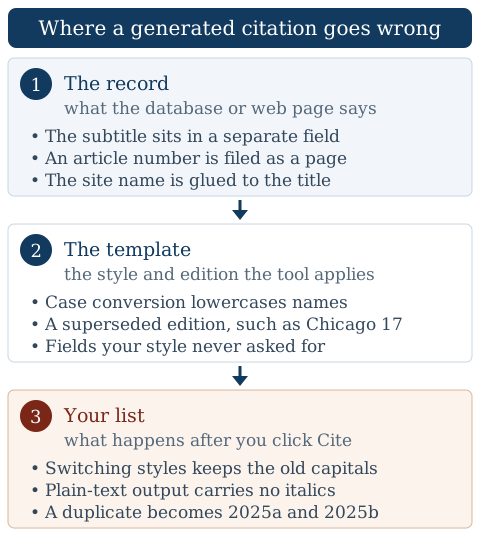
Librarians describe the first stage plainly. Washburn University's citation guide says that “Most databases create citations using the article’s underlying metadata, meaning that citations will be formatted like that metadata.” Purdue's Online Writing Lab warns that generators used unwisely “can introduce systematic errors that the writer isn’t even aware of,” though it calls an error by the generator itself “a rare but real possibility.” In our small test, each of the four tools made at least one.
Most advice on this question stops at a warning like Purdue's. We opened the 24 pages we could reach among the top ten Google results for five searches like “are citation generators accurate.” All six from universities say generators make errors. Only two show a real tool's output and correct it, and the fuller one, by the UIS Learning Hub's writing staff, tested MLA's eighth edition in 2020. None of the 24 mentions the Chicago Manual's 18th edition or article numbers, and only one mentions an organization as a possible author of a webpage: a checklist line saying a website “should have an author or organization.”
Error 1: The subtitle that disappeared
Crossref's record for the Mueller and Oppenheimer article stores the part before the colon as the title and the part after it as a separate subtitle. Three of the four tools printed only the first half. Scribbr's APA 7 entry:
Mueller, P. A., & Oppenheimer, D. M. (2014). The pen is mightier than the keyboard. Psychological Science, 25(6), 1159–1168. https://doi.org/10.1177/0956797614524581
Citation Machine and the DOI Citation Formatter cut it at the same colon. Citation Machine's review screen, shown before the finished entry, already listed the title as “The Pen Is Mightier Than the Keyboard,” so the subtitle was lost at the record stage. ZoteroBib kept it, and its APA 7 entry is correct:
Mueller, P. A., & Oppenheimer, D. M. (2014). The pen is mightier than the keyboard: Advantages of longhand over laptop note taking. Psychological Science, 25(6), 1159–1168. https://doi.org/10.1177/0956797614524581
A subtitle is part of the title. APA's capitalization rules assume it is there: in sentence case you capitalize “the first word of a subtitle.” The fix: compare the title in your entry with the title on the source's first page. If the source has a colon and your entry does not, something was cut.
Error 2: Capital letters a machine cannot judge
APA 7 puts reference titles in sentence case: capitalize the first word, the first word after a colon, and proper nouns, and lowercase the rest. Its sentence-case page applies that to “titles of articles, books, reports, webpages, and other works in reference list entries, even if title case was used in the original work.” Two of our three article records stored their titles in title case, so the template had to convert them. Where the conversion went wrong, it went wrong in both directions.
No conversion. The DOI Citation Formatter's APA entry kept every capital: “The Role of Instagram, Facebook, and YouTube Frequency of Use in University Students’ Digital Skills Components.” In APA, “Role,” “Frequency,” “Digital” and the rest should be lowercase.
Too much conversion. ZoteroBib produced “The role of instagram, facebook, and youtube frequency of use in university students’ digital skills components.” It knows this happens. Switching to APA brings up a warning that reads, in part:
ZoteroBib will convert the titles of entries to sentence case for you, but you’ll need to manually edit some entries to capitalize proper nouns
The conversion also changed the title ZoteroBib keeps. When we then switched the same list to Chicago or MLA, title case returned, but the brand printed as “Youtube.” Scribbr got this title right in APA. Citation Machine's form, prefilled for the PLOS ONE article, offered a hybrid: “Extant life detection using label-free video microscopy in Analog Aquatic Environments.”
Switching a list's style does not redo the capitals. We built a Scribbr list in APA 7 and switched it to Chicago. The existing entries kept APA's sentence case, while an article cited fresh in Chicago came out in title case. Switching back to APA left that fresh entry in title case. If you change styles, re-cite the sources rather than restyling the list.
The fix: after any style change, read every title once. In APA, look for capitals that should not be there; in MLA and Chicago, look for missing ones. In every style, a name, brand, place or acronym keeps its own capitals.
Error 3: The article number that looks like a page
Some online journals number each article instead of giving it pages. The Snyder article is e0318239, and PLOS prints its own citation line as “PLoS ONE 20(3): e0318239.” APA 7's journal-article page has a rule for exactly this:
If the journal article has an article number instead of a page range, include the word “Article” and then the article number instead of the page range.
APA's own example is another PLOS ONE paper: “PLoS ONE, 13(3), Article e0193972.” None of the three APA entries we got for the Snyder article did that; each printed the number bare, where a page range goes. The cause is in the record: Crossref files e0318239 in its page field, and so do the citation tags on PLOS's own article page, so the template formats it as a page.
Snyder, C. D., Bedrossian, M., Barr, C., Deming, J. W., Lindensmith, C. A., Stenner, C., & Nadeau, J. L. (2025). Extant life detection using label-free video microscopy in analog aquatic environments. PLoS ONE, 20(3), Article e0318239. https://doi.org/10.1371/journal.pone.0318239
The fix: if the “page” in your entry is a single number with no range, or starts with a letter, check the article's own citation line.
Error 4: Webpages that lose their author
We gave ZoteroBib and Scribbr the URLs of APA's two example pages. APA's webpage guidance sets the rules they were up against:
- “For a page from an organization’s website without individual authors, use the name of the organization as the author.”
- “For a page on a government website without individual authors, use the specific agency responsible for the webpage as the author.”
ZoteroBib found no author and no date for the WHO page: “The top 10 causes of death. (n.d.). Retrieved October 8, 2026, from https://www.who.int/…” The fact sheet is dated October 2, 2026, directly under its headline. For NIMH it took the title from the browser-tab text, site name and all: “Anxiety disorders—National institute of mental health(Nimh).”
Scribbr found the WHO date but wrote the author as “World Health Organization: WHO,” the exact name the page's own structured data gives its author, so each in-text citation would read “(World Health Organization: WHO, 2026).” For NIMH it put the title where the author goes, making the in-text citation “(Anxiety Disorders, n.d.).” That error repeats every time you cite the page.
World Health Organization. (2026, October 2). The top 10 causes of death. https://www.who.int/news-room/fact-sheets/detail/the-top-10-causes-of-death
National Institute of Mental Health. (n.d.). Anxiety disorders. U.S. Department of Health and Human Services, National Institutes of Health. https://www.nimh.nih.gov/health/topics/anxiety-disorders
Both tools printed n.d. for NIMH, which is right: the page shows only “Last Reviewed: December 2024,” and APA says “Do not include a date of last review in a reference because content that has been reviewed has not necessarily been changed.” ZoteroBib's retrieval date is a judgment call rather than an error; APA reserves retrieval dates for pages “designed to change over time but are not archived,” and its own examples for these two pages carry none.
The fix: ask who is responsible for the page. If no person is named, the organization or agency is the author. Then read the in-text citation the entry produces; if it starts with a page title, the author line is wrong.
Error 5: The edition your generator is using
Style guides change and generators catch up on their own schedule. The Chicago Manual of Style is in its 18th edition, published in 2024. Using the Snyder article as its example, its quick guide says: “For three or more authors, list up to six in the bibliography; for more than six authors, list the first three, followed by ‘et al.’ (‘and others’).” Chicago's own entry:
Snyder, Carl D., Manuel Bedrossian, Casey Barr, et al. “Extant Life Detection Using Label-Free Video Microscopy in Analog Aquatic Environments.” PLOS ONE 20, no. 3 (2025): e0318239. https://doi.org/10.1371/journal.pone.0318239.
ZoteroBib, whose menu names the 18th edition, produced that entry word for word, and the DOI Citation Formatter's author-date entry matched the quick guide's author-date version. Scribbr's menu lists Chicago as “Chicago author-date 17th edition” and “Chicago full notes and bibliography 17th edition,” with 16th-edition variants under “Unverified citation styles”; filtering it for “18th” returned “No results found.” Its bibliography entry for the same article named all seven authors. That was right under the 17th edition, the one Scribbr offers; Chicago's quick guide for it said “If there are four or more authors, list up to ten in the bibliography.” It is not what the 18th edition asks for.
What generators say about themselves also varies. On October 8, 2026, Citation Machine's Chicago page read “Citation Machine® uses the 9th ed. of MLA, 7th ed. of APA, and 18th ed. of Chicago (9th ed. Turabian),” while its own Chicago style guide page said the tool “uses the 8th ed. of MLA, 7th ed. of APA, and 17th ed. of Chicago.” Cite This For Me’s US generator page, “Powered by Chegg,” said “We cite according to the 8th edition of MLA, 6th edition of APA, and 16th edition of Chicago (8th edition Turabian)” — we did not test its output. A Paperpal page titled “Free APA 6th edition (no DOIs, no issue numbers) Citation Generator” ranked fifth on Google for “citation generator accuracy” the same day. For what the current APA and MLA editions look like side by side, see our APA 7 vs MLA 9 comparison.
The fix: find the edition label in the tool's style menu or footer and match it to the edition on your syllabus. If the tool does not offer that edition, build the entry from the style guide's own example.
Error 6: Extra parts nobody asked for
Records carry fields your style's model entries leave out, and some templates print them anyway.
- An editor on a journal article. For the PLOS ONE article, the DOI Citation Formatter and ZoteroBib both printed “edited by Michael Schubert” in their MLA entries: the name PLOS lists as “Editor” beside the article's received and accepted dates. MLA's model journal entry in its Citations by Format guide has no editor element.
- The lookup service as a database. In the slot where MLA's model names the database the article came from (JSTOR, in its example), ZoteroBib's MLA entries put “DOI.org (Crossref)” and the DOI Citation Formatter's put “Crossref.” Those are where the tools looked the article up, not where you read it.
- Letters on a duplicate. When the same article sat in our Scribbr list twice, its APA style labeled the copies 2025a and 2025b, presenting one article as two works.
The fix: you should be able to explain every element. If you cannot say why an editor, a database, a retrieval date or a letter is there, compare the entry with the style guide's example for that source type.
Six checks before you paste
Every error in our test is caught by one of these. Run them as a separate pass over the reference list once the paper is written, the way you would work through a proofreading checklist.
Match the tool's style label to the edition your syllabus names, such as APA 7, MLA 9 or Chicago 18. Set it before you cite; if you change it later, re-cite.
Read the title against the source. Look for a missing subtitle, capitals wrong for your style, and names, brands or acronyms that lost theirs.
Person or organization? For a webpage with no named writer, the organization or agency is the author. If the in-text citation starts with a title, the author line is wrong.
Find the publication or update date on the page itself. In APA, ignore a “last reviewed” date and use n.d. if that is all there is.
Check volume, issue and pages against the article's own citation line. A single number, or one starting with a letter, is probably an article number: in APA 7, “Article e0318239.”
An editor on a journal article, a lookup service as a database, a retrieval date, a stray “a” or “b” after the year. Justify it from the style guide or delete it.
In-text citations need the same read, because a generator cannot see your sentence. Purdue's guide shows the slip: pasting “(Smith, 2015, pp. 122-128)” after a sentence that already names Smith repeats the author and leaves a vague page range. The final read in how to edit your own essay is a good place to check citations in context.
Should you use a generator at all?
Your instructor's rules decide that, and library guides disagree. Arizona State University's says generators “are not 100% accurate” and also that “You are free to use these tools,” adding that you must learn to use them effectively and responsibly. The University of Wisconsin–Madison's business library guide opens with “Do not use citation generators.” Its reasons: they create many errors, and checking their entries is likely to take as much time as writing the list yourself, if not more. The MLA Style Center, in a post written for MLA's eighth edition, put it this way: “Many citation tools generate entries that do not accord with MLA style, so writers are advised to use caution when using these tools and to correct deviations manually.”
Two things hold either way. ECPI University's library states the first: “You are still responsible for ensuring you are using the appropriate format.” The second is that a generator only formats. It cannot write the parts of an assignment that are about the source, which is why an annotation has to come from you; our annotated bibliography examples show that part.
A generator is also not the same as asking an AI chatbot for references. A generator formats a record it looked up or that you typed in, sometimes badly. A chatbot can produce a reference that looks complete and points to nothing; Washburn's guide warns that generative AI “can confabulate citations or apply incorrect style rules.” Either way, the list still needs the checks above.
If you would rather have a second reader do this pass, our editing and proofreading service includes a citation and reference check against the style your instructor named. The six checks work on any generator's output, because the errors start in the same three places.