Live Chat


A formative assignment is one you are given while you are still learning the material, so that you and your instructor can find out what is not working yet — while there is still time to do something about it. The summative assignment is the one that measures what you ended up knowing. Carnegie Mellon's Eberly Center states the split in two lines: the goal of formative assessment is "to monitor student learning to provide ongoing feedback," while the goal of summative assessment is "to evaluate student learning at the end of an instructional unit by comparing it against some standard or benchmark."
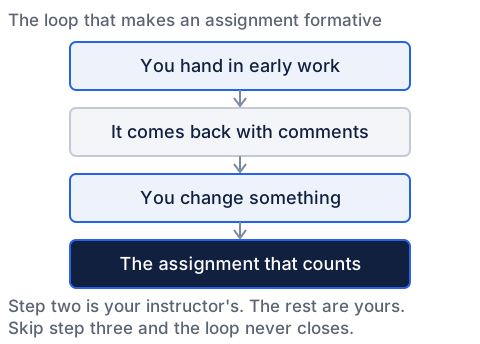
That definition is on a hundred pages. Almost every one of them was written for instructors. Three things those pages do not tell the person actually holding the assignment: US universities do not say the same thing about whether formative work carries points; the word "formative" is not really a description of your assignment at all, but of what happens after you hand it in; and the half of that process that decides whether it was worth anything is yours, not your instructor's.
- Timing is the axis, not difficulty. Formative work happens during learning; summative work happens at the end of it. The same task can be either.
- "Does it count?" has no universal answer. Of seven US teaching centers, four describe formative work as ungraded or near-ungraded, one says it "may or may not be graded," and two point at formative work that carries points. Only your syllabus binds you.
- "Formative" describes the use, not the paper. University at Buffalo: "It is the use of the assessment that makes it formative."
- Skipping it can cost you nothing in points and everything in information. A published Penn syllabus says a missed draft "will not directly affect your grade … you simply lose that opportunity for us to read your work in draft and provide you with feedback."
- The comments on formative work are written to be acted on. Comments on a final grade usually explain the grade instead.
- If your source is British, "formative" is stricter — there it means the assignment does not count toward the final mark at all.
The definition, in the words institutions actually use
Yale's Poorvu Center for Teaching and Learning draws the same line and adds the purpose: formative assessments "are employed while learning is ongoing to collect information on whether course objectives are being advanced and how teaching can be improved," and "often aim to identify strengths, challenges, and misconceptions and evaluate how to close those gaps." Summative assessments, Yale continues, "are almost always formally graded and often heavily weighted, though they do not need to be."
Notice what is not in either definition: the format of the assignment. Nothing there says a formative task is short, easy, in class, or unimportant. Carnegie Mellon's own examples run from "draw a concept map in class" and "submit one or two sentences identifying the main point of a lecture" all the way to "turn in a research proposal for early feedback" — a one-line exit note and a full research proposal, filed under the same heading. What puts them in the same category is when they happen and what they are for.
Northern Illinois University's instructional guide makes the consequence explicit, and it is the most practical sentence in this whole topic: "If … students are allowed to make revisions, the assessment becomes formative, where students can take advantage of the opportunity to improve." The task did not change. The permission to revise it did.
This is why "is this formative?" is usually the wrong question to ask your instructor. The useful question is narrower and they can answer it in a sentence: can I revise this after I get your comments, and does the revised version replace the first one?
Does it count toward your grade? Seven US institutions, three answers
This is the part students actually want to know, and it is the part the definitional pages handle worst — because every one of them hedges, they hedge in different directions, and none of them mentions that the others exist. We opened seven US university teaching centers and compared what each publishes about point value.
| US institution | What it publishes about grading formative work |
|---|---|
| Carnegie Mellon, Eberly Center | "Formative assessments are generally low stakes, which means that they have low or no point value." |
| Indiana University Bloomington, CITL | Its comparison table has one row headed Grading: "Usually not graded." |
| Northern Illinois University, CITL | "These assessments typically are not graded and act as a gauge to students' learning progress." |
| University of Connecticut, CETL | "Often formative assessments are not graded." |
| Ohio State, Teaching and Learning Resource Center | "Formative assessment may or may not be graded, but it should be low-stakes enough to encourage learners to take risks and make mistakes." |
| University of Michigan, Sweetland Center for Writing | Formative feedback comes "typically before it's graded (or for a lower-stakes portion of a grade)." |
| Yale, Poorvu Center | Lists "Homework assignments" and "Weekly quizzes" among its formative examples — tasks that routinely carry points. |
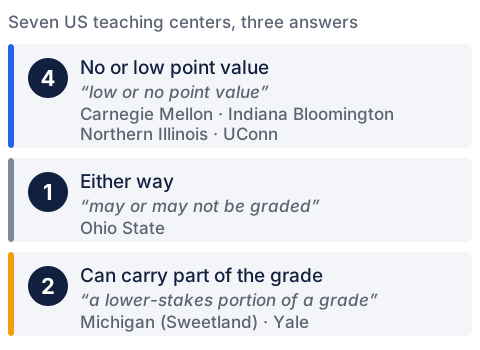
None of these is wrong, and none of them governs your course. Read the hedges and you can see why: generally, usually, typically, often, may or may not. Not one of these pages says formative work never carries points. They differ on what is normal, not on what is possible — which is exactly why none of them can answer the question for you. The document that binds you is your syllabus, and it usually settles the question in its grade-weighting table. Read that table for three things: whether the item appears in it at all, whether it is scored on quality or on completion, and whether a revised version replaces the first score.
"Low stakes" and "no stakes" are not the same thing, and the gap between them is where students get hurt. A draft worth 5% of the course, scored for completion, costs you almost nothing to submit roughly and a full 5% to skip entirely. If the syllabus is silent, ask — and ask before the due date, not afterward.
"Formative" describes the use, not the paper
Here is the idea that reorganizes everything else, and it comes from the people who built the vocabulary. Writing in the journal Educational Assessment in 2006, Dylan Wiliam — then at Educational Testing Service — traced the terms to Michael Scriven, who in 1967 proposed "to use the terms 'formative' and 'summative' evaluation to qualify evaluation in these roles" — the roles being the ongoing improvement of a curriculum, and the final judgment on it. Scriven was writing about programs, not students. Benjamin Bloom applied the split to student learning two years later, and Wiliam quotes him: "While such tests may be graded and used as part of the judging and classificatory function of evaluation, we see much more effective use of formative evaluation if it is separated from the grading process and used primarily as an aid to teaching."
Wiliam's own conclusion is blunter than anything a teaching-center page will tell you: "the term 'formative' cannot be a property of an assessment." Assessments are formative, he writes, "if and only if something is contingent on their outcome, and the information is actually used to alter what would have happened in the absence of the information."
The University at Buffalo's teaching office says the same thing in one sentence: "It is the use of the assessment that makes it formative. If evidence of student achievement is not used to adapt instruction or to give feedback to students to improve their learning, it is summative."
If nobody changes anything because of it — including you — the assignment was formative in name only.
What actually happens if you skip it
There are two answers, and you need to know which one applies before you decide.
If it carries points, skipping it costs you those points. That is the boring case, and the weighting table gives you the number.
If it carries no points, the cost is real and invisible. The University of Pennsylvania's teaching center publishes real syllabus language from its own courses, including an undergraduate English seminar whose policy states it plainly: "In the case of the essay deadlines for the mid-semester or longer essays, this will not directly affect your grade because of the portfolio system; you simply lose that opportunity for us to read your work in draft and provide you with feedback. So, it's always better to hand in something."
Read that from the student's side and it says something uncomfortable. The instructor priced the draft at zero on purpose, so that the only thing you can lose by skipping it is information about your own paper — the exact information you would otherwise have to guess at while writing the version that does count.
A third case shows how seriously some programs take this. In accredited US medical schools, formative feedback is not a courtesy an instructor may or may not offer. The Liaison Committee on Medical Education — the accrediting body for US medical education programs leading to the MD degree — requires it in Element 9.7: a school's curricular governance committee "ensures that each medical student is assessed and provided with formal formative feedback early enough during each required course or clerkship to allow sufficient time for remediation. Formal feedback occurs at least at the midpoint of the course or clerkship." Most undergraduate programs carry no such rule — but where one exists, it exists because somebody decided that finding out late is a safety problem.
The feedback is the payload — here is how to use it
Michigan's Sweetland Center for Writing describes the difference between the two kinds of comments better than anyone, and it is the reason formative feedback is worth more to you than the comments on your final paper. Formative feedback "usually includes recommendations for revision and questions that might help students rethink weaker elements in their current assignments." Summative comments "typically explain the connection between those strengths and weaknesses and the grade the paper has received," and "generally do not include advice about how the student might revise this specific paper."
One set is instructions. The other is a verdict with reasoning attached. The instructions arrive while you can still act on them.
The UNC Chapel Hill Writing Center names the habit exactly: "Many people, when receiving a paper back from their TA or professor, will just look at the grade and not read the comments written in the margins or at the end of the paper." On a formative assignment that is close to throwing the assignment away, because the score was never the deliverable.
UNC again: "If you receive feedback before the paper is due, think about what you can and can't do before the deadline. You sometimes have to triage your revisions." Structural notes — your argument, your organization, your evidence — go first, because everything downstream depends on them. Save sentence-level notes for the pass afterward.
"Feedback that you don't understand is feedback that you cannot benefit from, so ask for clarification when you need it," UNC advises. A comment like "underdeveloped" is not actionable until you know whether it means more evidence, more analysis, or more words. Office hours exist for this; UNC notes those hours "are reserved for your benefit."
If you go to talk it through, UNC recommends waiting 24 hours first, and being clear which meeting you are having: "be prepared to separate the discussion of your grade from the discussion of your development as a writer. It is difficult to have a productive meeting that achieves both of these goals."
One fixed comma helps one paper. "I bury my thesis in the third paragraph" helps every paper you write afterward. Keep a running list from your formative work and read it before you start the next assignment — that list is the only thing that carries forward between courses.
Spotting a formative assignment on your syllabus
The word itself often does not appear. These are the signals that you are looking at one, in rough order of reliability:
- It is due before something else that resembles it. A proposal before a paper, a draft before a final, a problem set before an exam. Proximity plus resemblance is the strongest tell there is.
- The syllabus promises comments, not just a score. Words like feedback, response, conference or review in the assignment description.
- Revision or resubmission is allowed. Per NIU's guide, that permission is what converts a task into a formative one.
- Its weight is small, zero, or completion-based. Check the grade table, not the assignment description.
- It repeats. Weekly quizzes, reading responses and discussion board posts are formative by design — each one is a low-cost reading of where you are.
Two habits make the rest easier. Read the rubric before you draft rather than after you are graded, since a formative assignment is usually scored against the same criteria as the summative one it feeds. And put the draft deadlines on the same list as the final ones — formative dates are the first casualties of a busy week, which is exactly backward. Our guide to keeping track of assignments covers the mechanics.
If the page you are reading is British, the word is stricter
A lot of the writing about "formative assignments" online is UK, and there the term is a formal regulatory category rather than a description of intent. Durham University's assessment policy for its Common Awards programs — a UK source, using UK vocabulary — defines it this way: "Summative assignments are the ones that count directly towards a student's final mark for the module … So formative assignments are ones that do not count directly towards a student's final mark for the module."
Durham then concedes the point Wiliam makes: "Strictly speaking, all assignments are formative, in that they all involve tasks that allow students to develop their skills, understanding, and dispositions." In practice, the policy adds, Durham only calls an assignment formative when it is not a summative one — which makes "formative" the leftover category rather than a positive description.
| Question | Common US practice | UK usage (Durham) |
|---|---|---|
| Does it count? | Sometimes. Institutions differ; the syllabus decides. | No, by definition — it does not count toward the final mark. |
| What decides the label | The purpose and the timing | Whether it is summative; formative is the residual category |
| Words you will see | Grade, course, points, instructor | Mark, module, tutor |
Two practical consequences. If a page tells you flatly that formative work "never counts," check whether it is describing UK regulation rather than your US course. And if your course uses the phrase tutor-marked assignment, that is UK and Open University vocabulary for a particular assignment type — it is a container, and whether any given one is formative or summative comes down to the same two questions as everything else here: does it count, and can you revise it?
What to do with the one on your desk
Answer three questions before you start, in this order. Does it carry points, and how many? The grade table, not the assignment sheet. Can I revise it after feedback? If yes, the first version only has to be good enough to draw useful comments. What is the summative task it feeds? Write the formative one so it stress-tests the part of that task you are least sure about — your thesis, your method, your source base — rather than the part you already know you can do.
Then hand it in, even rough. A rough draft that draws real comments is worth more than a polished one that draws "looks fine," and it is worth far more than an empty submission box.
If the real problem is that you cannot see what your instructor is asking for, get a second reader early. UNC is clear that this is legitimate and that the boundary is your instructor's to draw: "Asking for help on your writing does not equal plagiarism … Check with your professor or TA about what kinds of help you can get legally." Your campus writing center is free and it is the right first stop. If the workload behind the draft has outrun the time you have, our assignment help service can take on the research and structuring, from $7.89 a page — you review what comes back, decide what to keep, and submit your own work. Either way, the version that reaches your instructor should be one you can defend line by line, because the whole point of a formative round is that you are the one who gets to fix it.