Live Chat


The thing that decides how you cite your professor's slide deck is not the file. It is whether the person reading your paper can open the material for themselves. For an ordinary class assignment they can — your instructor and your classmates are inside the same course — so in APA 7 the deck gets a normal reference entry with the site's login address, not the personal-communication treatment most students reach for.
That single condition runs through everything below: PowerPoints, PDF handouts, recorded lectures, Canvas pages, discussion posts, and slides your instructor did not write. APA 7, MLA 9 and Chicago 18 each answer it differently, and one of the three does not really answer it at all. Where a manual is silent, this page says so instead of inventing a template.
- Ask who your reader is, not what the file is. APA 7 says plainly that some works "are recoverable only by certain audiences, which affects how they are cited."
- For a course paper, the reader can reach it. APA's own wording: LMS material is "recoverable by the instructor and fellow students," so it belongs in the reference list.
- Use the login page as the address. Not the long link to the file, which will not open for anyone else.
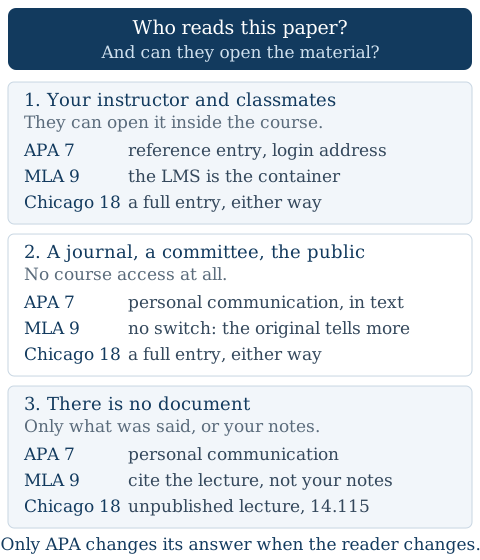
- Only APA has this switch. MLA 9 asks whether the platform published the work or merely passed it along. Chicago 18 names email, texts and direct messages as personal communications, and files lectures under unpublished materials.
- Chicago is where the bad advice lives. Of 21 pages ranking for these queries, not one names the eighteenth edition; four name the superseded seventeenth.
- Your own notes are never the source. MLA is explicit: cite the lecture, not the notebook.
The question is about your reader, not about the file
APA 7 states the principle in one sentence, on a page called Classroom or Intranet Sources: "Some works are recoverable only by certain audiences, which affects how they are cited." It then names the case exactly — a student citing works "from the classroom website or learning management system (LMS; e.g., Canvas, Blackboard, Brightspace, Moodle, Sakai)" — and gives the reason those works are fine to reference: "These sources can be cited in the classroom assignment because they are recoverable by the instructor and fellow students."
Read that reason slowly, because it is the part that goes missing everywhere else. The test is not is this public. The test is can the audience I am writing for get to it. For a paper submitted inside a course, the audience is sitting inside the course. The material is retrievable, and the ordinary reference format applies.
The same page then draws the boundary: "However, if the work is for professional publication or intended for a wider audience who will not have access to these sources (i.e., the LMS or the company intranet), cite the sources as personal communications." A thesis chapter you plan to submit to a journal is that second case. A discussion post for week six is not.
APA 7: two branches, and the one most students get backwards
APA's dedicated page is titled PowerPoint Slide or Lecture Note References, and its guidance sits in the Publication Manual at Section 10.14. It splits the answer in two.
When your reader can reach it
"If the slides come from a classroom website, learning management system (e.g., Canvas, Blackboard, Moodle, Sakai), or company intranet and you are writing for an audience with access to that resource, provide the name of the site and its URL (use the login page URL for sites requiring login)." APA's own example is a deck hosted in a university's Canvas instance, and its address is the login screen:
Mack, R., & Spake, G. (2018). Citing open source images and formatting references for presentations [PowerPoint slides]. Canvas@FNU. https://fnu.onelogin.com/login
The bracketed description does the work that a file extension cannot. Swap it for what your material actually is — [Lecture notes], [Handout], [Video lecture] — and the rest of the pattern holds. APA applies the same treatment to recordings: its Classroom or Intranet Sources page introduces that entry as the format "to cite a recorded lecture or PowerPoint presentation available from a classroom website or LMS for a student assignment."
Copy the address of your school's Canvas or Blackboard sign-in page, not the address bar from inside the module. APA's reason for the rule is on its MOOC page and it is a good sanity check: "Provide a link that will resolve for readers." A long course-scoped link resolves for nobody, including your instructor on a different device.
When they cannot
Then, and only then: "If the audience for which are you writing does not have access to the slides, cite them as a personal communication." (The transposition in that sentence is APA's own wording, not a slip here.) A personal communication is cited in the text and nowhere else — "Because readers cannot retrieve the information in personal communications, personal communications are not included in the reference list; they are cited in the text only." The form is an initial, a surname, the words personal communication, and a date, as in APA's example: (T. Nguyen, personal communication, February 24, 2020).
APA's list of what counts includes "unrecorded classroom lectures," which is the honest answer for a lecture you sat through and did not record.
The condition before the condition
APA adds a step that will improve your paper more than any formatting fix, and only three of the 21 ranking pages we read pass it on. "Use a personal communication citation only when a recoverable source is not available. For example, if you learned about a topic via a classroom lecture, it would be preferable to cite the research on which the instructor based the lecture. However, if the lecture contained original content not published elsewhere, cite the lecture as a personal communication."
The slides page says the same thing about material quoted inside a deck: "If the slides contain citations to information published elsewhere, and you want to cite that information as well, then it is best to find, read, and cite the original source yourself rather than citing the slides as a secondary source." Slide 14 cites a study; go read the study.
MLA 9 has no such switch — it asks a different question
MLA does not sort sources by whether your reader can retrieve them. It asks what the container is. Its answer for a deck posted by your instructor is short: "Cite a slide presentation uploaded by an instructor to a learning management system the same way you would cite any material posted to a website." You "list the author of the presentation and the presentation's title. Then list the name of the learning management system as the container, followed by the publication details," and you may name the format as a supplemental element at the end. MLA's published example:
Carson, Sandy. Introduction to Digital Humanities. Blackboard, uploaded by Carson, 20 Oct. 2019, blackboard.ucla.edu/. PowerPoint presentation.
The container decision has a real edge to it, and it is the rule this whole search result set is missing. MLA's own test: "A website is a container when it is the platform of publication of the particular version of the work you consult. It is not a container when it is a passive conduit providing access to the work." So the LMS is a container when it published the thing — and MLA says exactly when that is: "For some materials, such as lecture slides, lecture videos, quizzes, or other documents created by your instructor, a learning management system will be the original container of the work." But if the platform "merely links to an outside source, such as an e-book, the platform is considered a passive conduit and should not be cited as a container." The journal article your professor uploaded is still a journal article. Canvas did not publish it.
Two more MLA rules students trip on. First, authorship: "be careful not to assume that the instructor is the author; you should only list the instructor in the Author element if you know that they created the materials." Second, your notebook. MLA's newest answer on this, published in June 2026, is blunt: "If you attended a lecture or other type of presentation and took notes that you refer back to in a paper, you should not cite your notes. Instead, cite the presentation itself as the source of the information."
MLA also does something the other two do not — it hands the decision back to your classroom. On a work an instructor uploaded, "you may be asked to cite the digital source or a previously existing version… There may be reasons that one approach or the other works best in your classroom." It even names the reason to prefer original publication details: doing so "can convey more information to readers who lack access to the course materials cited." That is MLA acknowledging the access problem while declining to build a rule out of it.
Chicago 18: name the system first, then check the edition
Chicago runs two systems, and which one you are in changes the answer, so say it out loud before you format anything. In notes-bibliography, personal communications are "usually cited in the text or in a note only; they are rarely included in a bibliography." In author–date, they are "usually cited in the text only; they are rarely included in a reference list." Chicago's free quick guide also tells students to settle this with the instructor: "Students should check with their instructor before deciding which system to use."
Now the part that matters for course material. Chicago does not put lectures in the personal-communication bucket. Its own index files "lectures, papers, and posters presented at meetings" at 14.115, under unpublished and informally published materials — the same family as a thesis or dissertation at 14.113, which Chicago's free guide gives a note and a bibliography entry. So an unpublished class lecture is not stripped of its entry the way an APA personal communication is. What Chicago's index does file as personal communications is private correspondence — and, for anyone citing a course forum, "posts on private electronic forums."
So Chicago sorts by what the item is — a private message or an unpublished work — not by who can reach it. Nothing in Chicago's free guidance makes the reader's access the test at all. That is the cleanest way to see the difference between the three: change your reader, and only APA changes its answer.
Three tests before you copy any Chicago lecture template. Does the page name the eighteenth edition, published 2024? Does it name which of Chicago's two systems it is showing? Does the section number match Chicago 18’s own index — lectures sit at 14.115? The Chicago Manual's own Q&A on citing "information received in an academic class" points at CMOS 14.217 and carries the stamp "[This answer relies on the 17th edition of CMOS (2017) unless otherwise noted.]" You can watch that section move between editions without taking anyone's word for it: the Q&A quotes 14.217's own heading as "Lectures and papers or posters presented at meetings," and Chicago 18's free index files "lectures, papers, and posters presented at meetings" at 14.115.
Chicago's free material does model a lecture, and it is the first place to look. The quick guide files one under video or podcast, in both systems, and points at CMOS 14.167–69. This is the notes-bibliography form:
Oliver, Eric. "Why So Many Americans Believe in So Many 'Crazy' Things." Moderated by Andrew McCall. Virtual lecture, February 23, 2022. Posted March 21, 2022, by University of Chicago. YouTube, 1:01:45. https://youtu.be/hfq7AnCF5bg.
Read the shape rather than the names: speaker, title in quotation marks, the words virtual lecture with the date it was delivered, then who posted it and when, then where it lives. The author–date twin sits on the quick guide's other page and carries the same pointer to 14.167–69. What that entry cannot do is cover a lecture nobody posted — a recording that exists only inside your course, or a class lecture with no recording at all. Chicago's answer for those is section 14.115, and 14.115 is the one piece of prose on this page we could not read: it sits behind the Manual's subscription, and requesting it returns a login page under a browser and a crawler identity alike. Nothing here rests on its wording. The section number comes from Chicago's own free back-matter index, and the entry shape for an unposted class lecture is attributed to Purdue OWL by name, because that is where we read it.
OWL's model is worth having, with one caveat that has to come first: the OWL page carrying it declares in its own metadata that its guidance "follow[s] the Chicago Manual of Style (17th edition), which was issued in 2017" — even though it sits on OWL's eighteenth-edition path, and its lecture section is byte-identical to the copy on OWL's seventeenth-edition path. Six of the eight pages in that guide declare the eighteenth edition. The two that declare the seventeenth are the two that cover lectures and unpublished materials. Knowing that, here is what OWL prints, in OWL's own wording:
N: 1. Firstname Lastname, "Title of Lecture" (medium, sponsorship, location, date).
B: Lastname, Firstname. "Title of Lecture." Medium at sponsorship, location, date.
Those are OWL's placeholders, not a real lecture: medium is the word for what it was (lecture, presentation, address), sponsorship is the department, course or body that hosted it. And OWL's practical note is still the best sentence written anywhere about classroom lectures: "Note that not all lectures have titles — if you are, for instance, citing a lecture given by a professor to his class, there may be no title to provide. In this case, feel free to skip that portion of the citation."
One more piece of first-party Chicago advice, from the free quick guide's web-page section, that saves a lot of formatting: "It is often sufficient simply to describe web pages and other website content in the text." If you mention the Canvas module in passing rather than quoting it, a sentence may be all Chicago wants.
Six things students actually have to cite
Every row below is what the style body itself says, or an honest blank where it says nothing.
| What you have | APA 7 | MLA 9 | Chicago 18 |
|---|---|---|---|
| PowerPoint file in the LMS | Reference entry, [PowerPoint slides], site name, login address | LMS is the container; format as a supplemental element | Treat as unpublished material; entry shape via OWL (see above) |
| PDF handout your instructor wrote | Same pattern; change the bracket to [Handout] or [Lecture notes] | Same; LMS is the original container because your instructor created it | Same as slides; no dedicated Chicago example is published free |
| Recorded lecture in the LMS | Named explicitly by APA: same format as slides, login address | LMS is the original container ("lecture videos") | The free guide models a lecture posted publicly, not one that exists only inside a course |
| Canvas page, module or announcement | No dedicated example; use the webpage category plus the LMS name and login address | Instructor-created, so the LMS is the original container | Chicago's advice is often to describe it in the text instead |
| Discussion post by a classmate | No dedicated example. Recoverable inside the course, so the classroom rule applies | MLA's only direct answer is an eighth-edition page; use the MLA 9 container template | Index files "posts on private electronic forums" as personal communications |
| Slides your instructor did not write | Cite the original source; APA says the same for anything quoted inside a deck | Passive conduit: cite the original container, not the LMS | Cite the work as what it is; the platform is not the publisher |
Two of those rows deserve a sentence more. A course pack of limited circulation is the one unretrievable thing APA gives a full reference entry to: "Use these formats only for material of limited circulation in a course pack — meaning that it is not available except for in the course pack." But "if the material in the course pack is reproduced from another widely available source without any changes, cite that source directly." And a discussion post is the case where the three styles pull hardest in different directions; if that is your assignment, our guide to writing a discussion post in APA format covers the surrounding formatting.
A worked example you can open and check
Most guides show you a made-up professor at a made-up university. Here is a real, permanently public course document instead: the Lecture 1 notes from 6.006 Introduction to Algorithms, taught at MIT in Spring 2020 by Erik Demaine, Jason Ku and Justin Solomon, published on MIT OpenCourseWare. Open it and check every element against the entries below.
APA 7 — the slides-and-lecture-notes pattern, with the full address because this one is public to everyone, not login-gated:
Demaine, E., Ku, J., & Solomon, J. (2020). Lecture 1: Introduction [Lecture notes]. MIT OpenCourseWare. https://ocw.mit.edu/courses/6-006-introduction-to-algorithms-spring-2020/resources/mit6_006s20_lec1/
MLA 9 — built on the shape of MLA's own Blackboard example: author, italicized title of a self-contained work, the site as container, publication details, then the format as a supplemental element.
Demaine, Erik, et al. Lecture 1: Introduction. MIT OpenCourseWare, Massachusetts Institute of Technology, spring 2020, ocw.mit.edu/courses/6-006-introduction-to-algorithms-spring-2020/resources/mit6_006s20_lec1/. Lecture notes.
Chicago 18, notes-bibliography — built on the free quick guide's web-page pattern, since this document is published on a website rather than delivered in a course. The name of the system is the reason there are two lines here: the note is what goes at the foot of the page, and the bibliography entry is what the note is pointing at.
1. Erik Demaine, Jason Ku, and Justin Solomon, "Lecture 1: Introduction," 6.006 Introduction to Algorithms, MIT OpenCourseWare, spring 2020, https://ocw.mit.edu/courses/6-006-introduction-to-algorithms-spring-2020/resources/mit6_006s20_lec1/.
Demaine, Erik, Jason Ku, and Justin Solomon. "Lecture 1: Introduction." 6.006 Introduction to Algorithms. MIT OpenCourseWare, spring 2020. https://ocw.mit.edu/courses/6-006-introduction-to-algorithms-spring-2020/resources/mit6_006s20_lec1/.
If your material lives in Canvas, an entry built the same way is illustrative only — the source is your own course and nobody can verify it from here. Keep the structure, replace the names, and use your school's sign-in address: Instructor, A. (2026). Title of the deck [PowerPoint slides]. Canvas@YourSchool. https://yourschool.instructure.com/login. The names in that line are placeholders, not a real course.
What the pages ranking for this question leave out
We downloaded and read the 21 pages returned by three US searches on this topic in August 2026 — twelve library guides, no two of them from the same institution; the major citation sites; and a competing writing service. They are not bad pages, and more of them ask the right question than we expected to find. But two of the seven checks below come back at zero, and three more at three or fewer.
| Checked across 21 ranking pages | Pages that do it |
|---|---|
| Raise the access question at all | 14 |
| Point at APA's Classroom or Intranet Sources page or Section 8.8 | 2 |
| Say what MLA or Chicago do when the reader cannot reach the material | 3 |
| Distinguish Chicago's two systems for this material | 5 |
| Give a reference-list entry for an LMS page, module or announcement | 0 |
| Address slides the instructor did not write | 3 |
| Name Chicago's current edition anywhere on the page | 0 |
That last row is the one to act on. Twelve of the 21 mention Chicago somewhere on the page, and six of those actually give Chicago guidance for lectures or slides. Four of the twelve name the seventeenth edition — one of them in its own page title, beside a 2026 update stamp. A sweep of all 21 files for 18th ed., 18th edition, eighteenth edition, CMOS 18 and Chicago 18 returns nothing at all. If you are formatting in Chicago from a page you found today, check the edition at the top of it before you copy anything — including from this page.
The failure mode is easy to see once you know the rule. One ranking page tells students that because course material "is not publicly accessible, it qualifies as a personal communication in most academic citation styles." Both halves miss. APA's test is your audience's access, not public accessibility. And the other two styles do not route course material there at all — MLA 9 has no such category, and Chicago 18 files lectures under unpublished materials.
The sixty-second version
A course assignment is read by your instructor and classmates, who are inside the course. A journal submission, a public thesis or a conference paper is not. This decides everything that follows.
A slide deck, a handout, a recording, a page, a post — or a reproduction of something published elsewhere. If it is a reproduction, stop here and cite the original.
Do not assume it was your instructor. If nobody is named, the title moves into the author position in APA, and MLA treats an untitled work by describing it.
APA: author, date, title, bracketed description, site name, login page. MLA: author, title, the LMS as container, upload details, format at the end. Chicago: name your system first, then follow the unpublished-materials pattern.
Open it in a private window. If it lands on a sign-in screen, that is correct. If it lands on an error, you have pasted a course-scoped address that resolves for nobody.
If you want the naming conventions behind all of this — why APA's list is called References and MLA's is called Works Cited — our side-by-side comparison of APA 7 and MLA 9 covers it, and if the LMS itself is new to you, start with what Canvas actually is.
Citations are the part of a paper where small, boring mistakes cost real points, and course materials are the fiddliest sources most students will ever cite. If you would rather hand the formatting to someone who does it every day, Apex Essays offers APA paper writing and formatting help, with writing starting from $7.89 per page at the shortest deadlines and simplest requirements — the final figure depends on your deadline, level and page count.