Live Chat


A term paper is the major written assignment a US course builds toward across a semester. It is handed out early, due at or near finals week, researched from sources you find yourself, and weighted heavily enough to move your final grade a full letter. Most run somewhere between 8 and 20 pages, with undergraduate versions usually at the lower end of that.
Here is the part most definitions leave out. "Term paper" names a slot in the course calendar, not a kind of writing. It tells you when the paper is due and how much it counts. It does not tell you whether you are writing an argument, a literature review, or a report on data you gathered. That comes from the assignment sheet — and misreading it is the most expensive mistake students make on this assignment.
- A term paper is a course's capstone writing assignment: assigned early, due near finals, worth a large share of the grade.
- The phrase describes timing and weight, not genre. The verb on your assignment sheet decides the genre.
- There is no standard length. Most versions land between 8 and 20 pages, with undergraduate ones toward the lower end — and your syllabus overrules every blog, including this one.
- An essay tests what you were taught. A term paper tests what you can find, judge and organize. A research paper adds evidence you gather yourself, from primary sources or data.
- The deadline that actually decides your grade is the topic decision in week 3, not the submission date in week 15.
- On a quarter-system campus you get about five fewer weeks for the same paper.
Why the definitions you find all disagree
Search for a term paper's length and you will be told five to twenty pages, ten to fifteen pages, and 3,000 to 5,000 words — by different guides that all sound equally sure. They are not being careless. They are describing different assignments that happen to occupy the same place in a syllabus.
Think of the term paper as a container the course provides. Three things are always true of the container: it appears early, it comes due at the end, and it carries real weight. What goes inside it changes by department, by instructor, and sometimes by section.
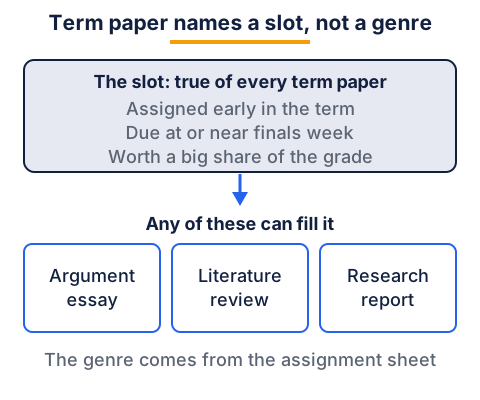
A real example of the container: Roberto Dainotto, Professor of Literature at Duke University, lists just two grade components on the class requirements page for his Fall 2026 courses — attendance and participation at 40 percent, and the term paper at 60 percent — with a length of 8 to 10 pages for undergraduates and 10 to 20 for graduate students. One document, more than half the grade. That weighting is not unusual in an upper-level humanities course.
Meanwhile, in a lab-science course the same slot is often filled by a literature review with no data of your own, and in a policy course it may be a memo with recommendations. Same label. Different paper.
Term paper vs. essay vs. research paper
These three overlap enough that instructors use the words loosely, but they test genuinely different skills. The table below is the distinction that matters when you are deciding how much work a prompt is actually asking for.
| Dimension | Essay | Term paper | Research paper |
|---|---|---|---|
| What it tests | Whether you understood the assigned material | Whether you can locate, judge and organize sources without help | Whether you can produce evidence and defend a method |
| Where the evidence comes from | The course readings, mostly | Sources you find yourself, typically eight to fifteen | Primary data, archives or experiments, plus the existing literature |
| Who picks the topic | The prompt does | You do, with instructor approval | You do, and it has to be a genuine gap |
| Typical length | 3 to 8 pages | 8 to 20 pages | 15 pages upward, sometimes far upward |
| When it is due | Any week of the term | At or near finals week | When the project ends, which may not be a term boundary |
| Grade weight | Often 5 to 15 percent | Commonly a quarter to more than half the course grade | Sometimes the entire course, or a degree milestone |
| Needs a thesis? | Usually | Yes — and this is where most of them fail | Yes, plus a stated research question |
Two consequences follow. First, a term paper can be an essay — a long one, on a topic you chose. Second, a term paper can also be a research paper, if the instructor asks you to collect something. The label does not settle it. For the full process behind the third column, see our step-by-step on writing a research paper; for the bigger sibling assignments further up the ladder, compare a capstone project and a thesis.
The same topic, three different assignments
Reading about the difference is less useful than seeing it. Below, one subject is turned into three assignments. The subject is real: the Servicemen's Readjustment Act of 1944, signed by President Franklin D. Roosevelt and known ever since as the G.I. Bill, which gave World War II veterans money for college, unemployment insurance and home loans. The three prompts and the three sample theses are illustrative — written for this article to show shape, not copied from any course.
As an essay: week 5, 900 words, 10 percent
The prompt: "Using the assigned readings, explain how the G.I. Bill changed access to higher education after 1945."
What you do: nothing outside the reading list. The grade is for whether you read closely and organized clearly. A sample thesis at this scale: The G.I. Bill widened college access fastest for veterans who already met admission requirements, which is why its effects arrived unevenly.
How it fails: you summarize the readings in the order you read them instead of answering the question asked.
As a term paper: assigned week 2, due finals week, 10 pages, 30 percent
The prompt: "Choose one aspect of the G.I. Bill's implementation and evaluate its consequences. Minimum twelve sources, at least six scholarly. Topic approval required by week 3."
What changes: three things at once. You choose the aspect, so a bad choice costs you the whole paper. You find the sources, so library access becomes part of the work. And you have to know what historians have already argued, because your claim has to be a position in a conversation rather than an opinion in a vacuum.
A sample thesis at this scale: Local administration, not the text of the law, decided who the G.I. Bill's housing benefit actually reached. Notice its shape — narrow enough to defend in ten pages, arguable enough that a reader could disagree, and specific enough to tell you which sources you need. Whether it survives contact with the evidence is what the paper is for.
How it fails: the topic stays as broad as the essay's. Ten pages then becomes six pages of background and four pages of argument, and the grader sees it immediately.
As a research paper: a methods seminar, one semester, 25 pages
The prompt: "Produce an original analysis grounded in primary sources."
What changes: you work from primary evidence. That means loan files, county deed records, a university's own admissions records, oral histories — material nobody has already digested for you. The thesis has to say something the secondary literature does not already say, and you have to explain why your method can support it.
How it fails: you pick a question the available archive cannot answer, and you find out in week 9.
These three prompts, page counts and theses were written for this article. Your instructor's version will differ in every particular. Use the shapes, not the numbers.
How to read your own assignment sheet
You cannot know which paper you are writing until you read the verb. Most assignment sheets carry one instruction that decides the genre, and it is usually a single word buried in a paragraph of logistics.
| If the prompt says | You are being asked for | Where the points are |
|---|---|---|
| Discuss, explain, trace, describe | Exposition — organize and present what is known | Coverage and structure; a point of view is a bonus |
| Argue, evaluate, assess, defend, "to what extent" | An argument with a contestable thesis | The claim itself, and how you handle the strongest objection |
| Compare, contrast | A controlled comparison | The criteria you compare on, named up front |
| Review the literature on, survey the scholarship | A literature review | Grouping sources by position, never source-by-source |
| Investigate, measure, test, collect, survey | Original research | The method, and why it can answer the question |
| Apply X to Y | Analysis using a course framework | What the framework explains — and what it fails to explain |
When a sheet uses two verbs ("discuss and evaluate"), the second one normally governs, because it asks for more. If it is genuinely ambiguous, one email in week 2 settles it — and the reply is evidence you can point to later.
Pull four things out of the sheet on the day you receive it: the due date, the verb, the minimum source count, and whether the topic needs approval and by when. Everything else can wait.
What actually goes inside a term paper
Structure follows the genre, so there is no single correct outline. The two patterns below cover most assignments.
The humanities and social-science pattern:
- Title page in the style your instructor named
- Introduction ending in the thesis
- Context or background — the shortest version that makes your argument intelligible
- Body sections organized by claim, not by source and not chronologically by your research
- The strongest counterargument, answered rather than mentioned
- Conclusion that states what follows from the argument
- Works Cited or References, plus any appendix material that would clog the body
The lab and applied-science pattern opens with an abstract and leans on a literature review, but drops methods and results unless you actually collected data. If you did not collect data, do not invent a methods section to look complete — instructors read that as padding.
Whichever pattern applies, build the outline before you draft. Hamilton College's Nesbitt-Johnston Writing Center puts it bluntly in its guide to writing a term paper or senior thesis: "Don't start to write until you have a good outline." If outlining is the part you skip, our walk-through on outlining before you write is built for exactly that habit.
How long is a term paper, and how much does it count?
There is no national standard, and anyone who quotes you one is describing their own experience. Three real numbers, taken from published university pages, give you a sense of scale.
To convert between the two units instructors use, count a double-spaced page in 12-point Times New Roman with one-inch margins at roughly 250 words. A 10-page paper is therefore about 2,500 words — a useful sanity check when a prompt gives you one measure and your document gives you the other.
The weight matters more than the length. A paper worth 15 percent and a paper worth 60 percent deserve very different amounts of your semester, and the syllabus tells you which you have on the first day.
The fifteen-week clock, and why the real deadline is week 3
US semesters are longer than students plan for and shorter than they feel. Marshall University's Fall 2026 academic calendar is a fair standard: 15 weeks of instruction, classes running Monday, August 17 through Friday, December 4, with final exams from December 5 to December 11. Fifteen weeks sounds like plenty. It is plenty — if the topic is settled by the third one. Our guide to writing a term paper turns those weeks into six dated checkpoints, counted backward from the due date.
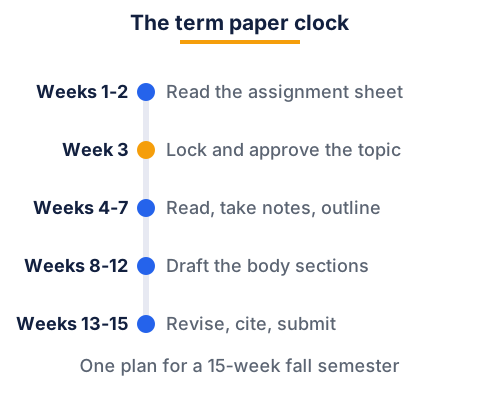
Extract the verb, the source floor, the approval deadline and the due date. Put the due date in your calendar, then put a second entry at the end of week 3 labeled "topic locked." That second date is the one that matters.
Narrow it until it is answerable in the assigned page count, then get approval in writing — an email reply counts. Hamilton's writing center pushes harder than this. Its warning reads: "Big trouble is looming if you don't have a specific topic by the end of the first week." When a paper carries 60 percent of the grade, their version is the safer one.
Take notes you can reuse. Hamilton's other rule is the one that saves people: distinguish "meticulously and systematically" between what you are quoting directly and what you are putting in your own words. Sloppy notes in week 5 become an accidental plagiarism case in week 14.
Start with the section you already have evidence for, even if it belongs in the middle. Waiting until the reading "feels finished" is how four weeks of writing shrinks to four days.
Read the paper against the rubric line by line, fix every citation, then leave one full buffer day. Binghamton University's counseling center guide to term papers recommends the same precaution — keeping "a block of time open around the paper's due-date" — plus a planning rule worth stealing: "double your original guess as to how much time you think you may need."
If a semester-long deadline is the thing you personally lose track of, our systems for tracking assignments and the free tracker templates handle the calendar side so the paper does not surprise you in November.
The versions that do not look like the standard one
On a quarter system, the clock is about five weeks shorter
Compare two Fall 2026 calendars. Marshall's semester runs August 17 to December 4. UCLA's fall quarter, per its registrar's annual calendar, runs instruction from September 24 to December 4. Both finish on the same Friday; one starts just over five weeks later.
The paper does not shrink to match. Everything simply moves up: topic by week 2, sources gathered by week 4, drafting from week 6. Quarter-system students who use semester-paced advice arrive at week 8 with a topic and no draft.
Four more variants worth recognizing
- The take-home final wearing a term paper's clothes. Due during finals week, but the reading list is closed and there is no topic approval. The giveaway is the absence of a source minimum. Treat it as a long essay, not a research project.
- The group term paper. The hard part is not the research, it is the seams. Divide sections early, then budget a full week at the end for one person to rewrite the whole thing in a single voice.
- The summer session. Often six weeks instead of fifteen, and the page count rarely drops. The topic has to be settled in the first few days.
- The milestone-graded online course. The paper is broken into a proposal, an annotated bibliography and a rough draft, each separately graded. The pacing is done for you; the cost is that a missed milestone is a recorded zero rather than a private slip.
Where term papers go wrong, and the fix
The failure that produces most emergency all-nighters is treating the due date as the start date. A term paper assigned in week 2 and begun in week 13 is not a shorter version of the same paper. It is a different, worse paper, because the sources you needed were on interlibrary loan and the topic you chose was never narrow enough.
Four more, with what to do instead:
- The topic is a noun, not a question. "Social media and teenagers" is a subject area. "Whether school phone bans change classroom participation" is a topic, because you could answer it wrong. Rewrite your topic as a question until that is true of it.
- The thesis is a topic sentence. "This paper will examine three factors" announces; it does not claim. If nobody could disagree with your thesis, it is a description. Our thesis statement guide shows the difference in worked examples.
- The sources are not where you thought. Check availability in week 3, not week 12. Interlibrary loan is reliable and slow, and digitized archives often stop short of the decade you need.
- Formatting is left to the last night. Set the citation style when you create the document, not when you submit it. Our guide to term paper format in APA and MLA lays the two layouts side by side, and our comparison of APA 7 and MLA 9 covers the citation differences in more depth.
One more worth naming: writing the introduction first. The introduction is a promise about a paper that does not exist yet, so it is almost always rewritten. Draft it last, and you write it once.
If you are already behind
Triage, in this order. Narrow the question further — a narrower question needs fewer sources and less background, which buys back days. Draft the body before the introduction. Cite as you write rather than reconstructing citations at 3 a.m. And read the rubric before you polish anything, because points sit where the rubric says they sit, not where the writing feels weakest.
If the calendar has genuinely run out, our term paper writing service puts a subject-matched writer on the work from $7.89 a page, with the sources listed so you can check every one. It sits inside our wider academic paper writing service, and what we deliver is a document you review, learn from and submit under your own judgment — you keep control of the topic, the revisions and the final call. If you want to see the standard first, our annotated research paper examples show what a finished one looks like from the inside.
The short version
A term paper is your course's biggest piece of writing, handed to you early and collected at the end, worth enough that it decides how the semester finishes. What it asks for is written on the assignment sheet, not implied by the name. Read the verb, narrow the topic by week 3, and the remaining twelve weeks are enough. Skip either step and no amount of writing skill in week 14 fully makes up for it.