Live Chat

Real doctoral dissertation proposals are published, free, and easy to find. What almost nobody publishes alongside them is the reading — the note in the margin explaining why this paragraph is carrying the document.
So that is what this page does. Three sources of genuine US doctoral proposals are named below; then two individual proposals drawn from them are marked up — a counseling psychology proposal from the University of Nebraska and a geography proposal from the University of Texas at Austin, both published in full and free to read. Work through the examples, then through what each one is doing. The moves transfer to any field; the sentences do not.
- Two published doctoral proposals in unrelated fields spend about half their words on the literature — 52% and 49% by our count of the PDFs, with cover pages and reference lists excluded.
- The Nebraska proposal's problem statement is one paragraph — five sentences, about a hundred words, and each sentence does a different job.
- About 14% of the geography proposal is not about the argument at all. It is evidence that the archives are reachable, the researcher is being trained in the languages, and the travel has a funding plan behind it.
- The two prove feasibility in opposite ways: Lane writes five sections of her own on archive access, methods training, language, timeline and funding; Morales attaches his instruments — consent forms, interview protocols, questionnaires, observation protocol — as appendices B to E.
- The University of Minnesota's Family Social Science program publishes three accepted proposal formats — the first three chapters, an NIH R01 grant structure, or a two-study journal-article format. All three are correct there.
- At the University of Washington Information School, the committee votes Accept, Accept with minor revisions, Accept with revisions, or Reject — and Reject can mean a second defense or dismissal from the program.
- A sample is a structure to study, never text to reuse. Every proposal below is a real document by a named author.
Where to find real doctoral proposals
Skip the template farms. These three sources publish proposals written by named doctoral candidates at named universities, and all three open in a browser without a login.
| Source | What is in it | What it does not give you |
|---|---|---|
| UT Austin, Intellectual Entrepreneurship | More than two dozen full doctoral proposals, grouped into arts and humanities, social science, and science and engineering — theatre, classics, nursing, chemical engineering, kinesiology, educational psychology. | No commentary. The PDFs are posted as-is, with no note on what each was doing well. |
| Yale, Poorvu Center prospectus writing | Model prospectuses as downloadable PDFs under three headings — humanities, STEM and social science — plus a prospectus checklist and a list of the nine parts most prospectuses contain. | No annotation either. Each model is posted under its author, title and department, with nothing said about why that one worked, and the nine-part list is generic by design. |
| Sage, a sample qualitative dissertation proposal | One complete three-chapter proposal by Alejandro Morales, posted by Sage as ancillary material for the textbook Research Design, with the author's permission. The proposal itself ends on page 43; references and five appendices carry the file past 100 pages. | It is offered as a specimen of a qualitative proposal, not as an annotated teaching text. |
Your own department is the fourth source and usually the best one. Approved proposals from your program circulate quietly among candidates, and a graduate coordinator can often point you at two or three. Ask first — a proposal from your own field beats any of the three above.
Two published proposals, two completely different documents
Put the Nebraska proposal and the Texas proposal side by side and the first thing you notice is that they barely look like the same genre.
Alejandro Morales, Language Brokering in Mexican Immigrant Families Living in the Midwest: A Multiple Case Study — a doctoral proposal in counseling psychology presented to the Graduate College at the University of Nebraska in April 2006, supervised by Professor Oksana F. Yakushko. Three chapters, about 12,000 words before the reference list — though the file you download runs past 100 pages, because everything from page 44 on is references and appendices.
K. Maria D. Lane, Doctoral Dissertation Research Proposal: Geographic Representations of the Planet Mars, 1867–1907 — Department of Geography, University of Texas, with a five-member committee named on the cover. Its own timeline puts the proposal defense in the first months of 2003. Eighteen pages, about 4,400 words before the works cited.
| What the part does | Morales, counseling psychology | Lane, geography |
|---|---|---|
| Opens the document | Chapter 1 introduction, running several pages before the problem is stated | A short abstract stating the hypothesis, the sources and the contribution |
| Names the gap | Rationale for Study, then Statement of the Problem | Introduction and Research Question, in under 400 words |
| Positions the work | Chapter 2, Review of the Literature | Theoretical Context, in three named literatures |
| Explains the approach | Chapter 3, Research Methods — case selection, data collection, analysis, validation, ethics | Research Plan and Methodology — three archival controversies, a repository table, interpretation |
| Proves it can be done | By attachment — appendices B to E carry the consent and assent forms, both interview protocols, the questionnaires and the observation protocol (Appendix A, the review approval, is an empty divider page in the posted copy) | By narration — its own sections on preparation, methodological training and language competency |
| Schedules it | Not present | Six dated phases across Austin, Flagstaff, London and Milan |
| Pays for it | Not present | A list of named grants and fellowships with the amounts attached |
Now the part that surprised us. We counted the words in both PDFs, excluding the reference lists, and the proportions land in almost the same place.
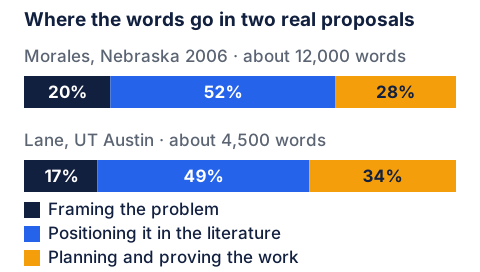
Half of each document goes to establishing that the question has not already been answered. That is not padding. A doctorate has to be original, and “original” is a claim about the state of a literature, which takes pages to support. Do not treat the ratio as a rule for your own program — treat it as a warning about how much reading stands behind a gap a committee will accept.
Both proposals predate the current version of their own programs' rules. If you are still choosing what to propose, start with finding a dissertation research topic; how long a dissertation runs puts the eventual document in scale.
Marked up: a hundred-word problem statement
Morales's Statement of the Problem is a single paragraph on page 9 — five sentences, about a hundred words — sitting immediately before the research questions. Chapter 1 has already run seven pages by that point, and this is where all of it has to come to a point.
“Language brokering is a common practice in immigrant families living in the U.S. The available scholarship in this understudied area has mainly focused on the experience of child brokers. This scholarship also suggests that the primary users of language brokers are parents, yet no studies have included how language brokering affects the immigrant family when the parents’ and broker’s perspectives are incorporated. Given the recent changes in demographics, Mexican immigrant families in the U.S. are increasing at a non-stop rate. Hence, it is necessary to conduct a study that explores the phenomenon of language brokering in this growing group.”
Five sentences, five distinct moves. This is the markup the PDFs never carry.
| Sentence | The move it makes | What the committee loses without it |
|---|---|---|
| 1. The practice is common in the US | Establishes in one line that the practice exists and is widespread | The reader has to take the topic's reality on trust |
| 2. Existing scholarship focuses on child brokers | Summarizes the whole field's current position in a single sentence | The gap looks like ignorance of the literature rather than a finding about it |
| 3. Parents are the primary users, yet no study includes their perspective | Names the gap as a structural omission — the field studies the wrong party | Nothing distinguishes an unstudied question from an uninteresting one |
| 4. The population is growing | Supplies urgency without arguing importance in the abstract | The gap is real but there is no reason to close it now |
| 5. Hence a study of this group is necessary | Converts the gap into a specific study, which the research questions then define | The section ends on an observation instead of a proposal |
Sentence 3 is the load-bearing one. Notice it does not say the topic is under-researched; it says the research that exists asks the wrong people. A gap phrased as an oversight in the field's design is far harder for a committee to wave away than “little research has been done.”
Notice also what is absent. No opening claim that the topic has long been recognized as important. No hedging about the researcher's interest. The section is a short argument with a conclusion, and it stops.
Marked up: questions that name their own evidence
Morales states one central question and three sub-questions: the role of language brokering in Mexican immigrant families in the Midwest, then how families view it, what characteristics brokers have, and what the family dynamics are when parents use a child to translate. Lane's three questions ask how nineteenth-century Mars discourse reflected the social settings of observatories, how the picture of an inhabited planet came to be accepted, and to what extent it challenged assumptions of Western superiority.
Different fields, same test. Each question points at something the proposal has already promised to collect — interviews and observations in one, correspondence and observation logbooks in named archives in the other.
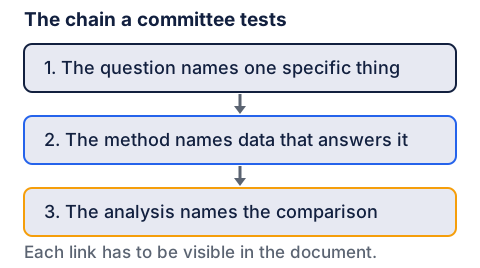
Run the test on your own draft with a pen: for each question, point at the line in your method that produces the answer. If your finger stops moving, the committee's will too.
These are real documents by named scholars. Studying how a paragraph is built is ordinary scholarly practice; reusing its sentences with your own topic swapped in is plagiarism, and it is trivially traceable because both PDFs are indexed. Take the structure, the sequence of moves and the level of specificity. Write your own words about your own study.
The part of a proposal that is not about your argument
Here is the part the sample PDFs bury. After Lane finishes her research plan, the document turns to a question the argument cannot answer: can this person actually do this? Yale's nine-part list mentions preliminary work and a timetable in passing; Lane gives the question five sections of its own.
Preparation to Conduct the Proposed Research reports that she has already contacted librarians and curators, verified the extent and accessibility of their collections, and received support — while stating plainly that contact with the Brera Observatory in Milan has not yet been established. Methodological Preparation names the coursework in archival research and discourse analysis behind the design. Language Competency is the striking one: her sources are partly in Italian and French, so she records that she has begun studying Italian with a focus on reading, aiming for the equivalent of second-year Italian before the Milan trip.
Then a timeline of six dated phases — Austin, Flagstaff, Austin again, London, Milan, Austin — and a list of potential funding sources with named awards and the amounts attached, split into those already applied for and those still to come.
The archival proposal spends its closing pages proving that the evidence is reachable, the researcher is being trained, and the travel has grant applications behind it.
That is roughly 14% of the document by our count, and it carries the entire feasibility case. Note how carefully it is framed. The heading is “Potential Funding Sources,” and the section reports applications made in fall 2002 or planned for spring 2003, with a second list she intended to apply for in fall 2003; no award is reported as already in hand. A committee approving an archival dissertation is authorizing years of travel against collections nobody in the room has seen, and the candidate who has already written to the archivist has answered the question most likely to sink an archival project.
Morales answers the same question in the opposite way, which is why it is easy to miss. His three chapters contain no feasibility section at all — the evidence is bolted on at the back as appendices, and that is what pushes a 43-page proposal past 100 pages. Appendix B carries the informed-consent and assent forms in English and Spanish, C both interview protocols, D the demographic questionnaires and E the observation protocol. It is the interview researcher's version of the same argument: the instruments exist in full, in both languages, and nobody has to take the method chapter on trust.
Read that appendix set closely, though, and notice what the posted copy does not contain. Appendix A is a single divider page headed “Internal Review Approval” with nothing behind it — the approval document itself is not in the file. The method chapter does state that participants will be treated in accordance with the ethical guidelines of the American Psychological Association and the University of Nebraska Institutional Review Board, so the commitment is on the record in the prose. But the one attachment a committee would actually check is the one the specimen does not reproduce. Worth knowing before you treat any downloaded sample as proof of what a complete appendix set looks like.
The equivalent elsewhere is instrument access and shared-facility scheduling in a lab science, or recruitment in interview work — who, from where, and what happens if only nine of the twenty agree. Write it down. Feasibility is the part a committee cannot fix for you.
Lane later published a book on the same subject — Geographies of Mars: Seeing and Knowing the Red Planet, University of Chicago Press, 2011.
What a method section is proving
Morales's Chapter 3 is broken into labeled parts — case selection, data collection, data analysis, validation strategies, ethical considerations, and the role and background of the researcher. Each answers a different objection.
Case selection. Six two-parent Mexican immigrant families, recruited by maximum variation sampling and chosen along two stated dimensions — the gender and the school level of the child who does the translating. The sample is small and says so; what makes it defensible is that the variation is deliberate and named.
Data collection. Separate interviews with parents and with the child broker, stated durations, participant-chosen language, audio recording, plus observations, documents and a reflective journal. A committee reading this knows exactly what will exist at the end.
Data analysis. Transcription first, then coding for meaning rather than line by line, managed in Atlas.ti, with thematic analysis following Braun and Clarke's published steps and cross-case analysis following Stake's merging-findings procedure. Named procedures, not “themes will be identified.”
Validation strategies. Triangulation across the data types, researcher reflexivity, thick description, and two peer debriefers who have already agreed to serve.
Ethical considerations and the researcher's role. Treatment of participants under APA guidelines and the University of Nebraska institutional review board, followed by several pages in which Morales writes that he is himself the child of immigrant parents and was a language broker, and works through how that shapes the study.
The copy Sage posted switches between future and past tense. The case-selection section says six families “will be recruited to participate”; a few pages later the validation section reports that “Credibility for this study was achieved using the validation strategies of triangulation, researcher reflexivity, thick rich description, and peer debriefing.” Whatever produced that in the published version, write yours consistently in the future tense. A proposal describes work you have not done yet, and past-tense sentences about your own results invite a question you do not want at the defense.
Three formats can all be right
Before you copy any structure, check what your program will accept — because more than one answer can be correct inside a single department.
The University of Minnesota's Family Social Science program publishes three. For a traditional volume-length dissertation, the proposal is “the first three chapters: Introduction, Literature Review-Conceptual Framework, and Methodology for the proposed study” — the shape the Morales proposal takes. For a journal-article dissertation, the proposal follows an NIH R01 grant structure instead: a project summary of 30 lines on page 1, a three-sentence project narrative on page 2, one page of specific aims, then a 12-page research strategy, single spaced in 11-point type. A two-study journal-article format is listed third. The program adds that those section heads “can be changed, added, or eliminated,” that they are “offered as guidelines, not requirements,” and that students, advisors and committees are “free to work out the specific details for each dissertation.”
Yale's Poorvu Center says the same thing more bluntly: prospectuses “vary significantly in length and format from one department to the next.” Its generic list runs to nine parts — abstract, background and significance, literature review, preliminary work completed, method or approach, potential limitations, timetable, conclusion, references. Useful as a checklist, useless as a specification.
Two practical consequences. A downloaded sample from another discipline tells you nothing about your own page limit, and the word “proposal” may not even be what your program calls it — Yale's guide, quoted above, says “prospectus” throughout, and Emory's treats prospectus and proposal as the same document. Also keep the degree straight: in US usage a master's ends in a thesis and a doctorate in a dissertation, and the two proposals are not interchangeable. Our explainer on the difference between a thesis and a dissertation sets out the split, and what a dissertation actually is covers the document this proposal leads to.
What the committee votes on
Approval is a recorded decision with defined outcomes, not a conversation that ends in a handshake. The University of Washington Information School publishes its policy, and it is worth reading even if you are somewhere else, because it names what is being decided.
The written proposal “must be submitted to all members of the Supervisory Committee” at least two weeks before the defense date. The document itself “represents a formal understanding between the Supervisory Committee and the doctoral Candidate.” The committee then votes one of four ways: Accept; Accept with minor revisions, approved by a process the chair sets; Accept with revisions, requiring approval by the chair and selected members; or Reject — after which the committee may recommend a second defense following further preparation, or that the student is dropped from the program.
That is one school's policy and yours will differ in the details, so look yours up rather than assuming. What generalizes is the framing: a proposal is a contract about scope. Approval means the committee has agreed that finishing this project earns the degree, which is also why quietly changing the design afterward causes trouble. Candidates who stall between approval and completion are the population behind the phrase all but dissertation.
How to read a sample without copying it
An evening with three PDFs is worth more than a week of template hunting, if you read them in this order.
The Nebraska one is about a hundred words; you will be through it in half a minute. If you cannot locate a problem statement at all in a sample, that sample is not the one to learn from.
Then decide whether it says “nobody has studied this” or “the field has been asking the wrong party.” The second is what you are aiming for.
Find the line in the method that produces its answer. Do this on the sample before you do it on your own draft — it is much easier to see in someone else's document.
Access confirmed, instruments drafted, the ethics review named, training completed, funding applied for. If a sample has no such section, check the method chapter and the appendices — that is usually where the evidence has gone.
Write your own outline against your program's required sections and your own page limit. The sample's proportions are a reference point, not a target.
The distance between reading good proposals and writing one is mostly the middle chapters — the literature that has to be read before a gap can be stated with any confidence. If that is where you are stuck rather than on the format, our dissertation help service works at the proposal stage on the same terms as any draft you would study: original work, delivered to you, for you to review, revise and submit as your own.
Whatever else you take from the examples above, take the specificity. Both proposals name their sources, their procedures and their limits in language a stranger could check. That is what a committee signs off on — not enthusiasm for the topic, but a plan detailed enough to be wrong in public.