Live Chat


A dissertation proposal is the document your committee approves before you are allowed to run the study. It has to establish three things: what you will find out, how you will find it out, and why the answer would be worth having. The guides that rank for this question all list those parts. What they mostly leave out is the order to write them in — and the order that feels natural is the one that makes you write the literature review twice.
Here is how that happens. You draft in the order the document reads: introduction, then literature, then method. Twenty pages in, you finally cost out the study and discover the sample is unreachable, the instrument is licensed, or the archive closes for the year you needed it. The method changes. The question moves with it. And the literature review you already wrote no longer justifies either one, because it was built to argue for a study you are no longer doing.
Put the question and the method first and that collision happens on page two instead of page twenty. Below is that drafting order, the reason each stage sits where it does, and the parts your own department controls — sections, page limits, circulation deadlines, the approval vote — quoted from published US doctoral policies rather than guessed at.
- Draft in five passes: question, method, scope, literature, framing. The finished proposal still opens with the introduction — only the writing order changes.
- Feasibility is weighed alongside the ideas. The University of Washington School of Social Work names four criteria for its doctoral prospectus — relevance, rigor, originality and feasibility — and feasibility is the one a committee cannot fix for you in the room.
- There is no standard length. Published limits at five US programs run from 10 pages to 40, and they are not measured the same way — one is written against single-spaced pages.
- Every program quoted here that sets a proposal circulation deadline sets it at two weeks — four of them, in their own published policies. Look yours up before you plan the last month.
- The approval rule is not universal. At one school a simple majority carries the proposal; at another the vote has to be unanimous.
- At Teachers College and Cal Poly Pomona, IRB submission normally follows the proposal hearing — though Cal Poly Pomona also wants an IRB draft inside the proposal package, which is why the method section has to be written at protocol specificity.
What your committee is actually deciding
A proposal defense is not an exam on your reading. It is a decision about whether a group of faculty will attach their names to a project they may still be signing off on years from now, which makes the reading unusually practical.
The University of Washington School of Social Work states the criteria for its doctoral prospectus plainly. Its supervisory committee weighs the "relevance of the research for the field of social welfare … the rigor of the proposed study; the originality of the research; the feasibility of the overall proposal". The first of those is written for that discipline, and yours will be written for yours. The pattern beneath them is portable, though: three of the four are about the work, and the fourth is about you and your calendar.
The University of Washington Information School frames the outcome rather than the criteria: the proposal, its policy says, "represents a formal understanding between the Supervisory Committee and the doctoral Candidate." That is the useful way to hold it in your head. You are not asking permission to be interested in something. You are proposing terms, and the room is deciding whether it can live with them.
Which is why feasibility does more damage than any other criterion. A committee can help you sharpen a question or tighten an argument in an afternoon. It cannot conjure you a sample, a license, a translator, or an extra funded year.
In US usage a master's student writes a thesis and a doctoral student writes a dissertation, and the two go to different committees under different rules. This guide is about the doctoral document. Some departments still use "thesis" as their in-house word for the doctoral project — Columbia's computer science PhD milestone is headed Thesis Proposal — so read the requirement, not the noun. If the distinction is what brought you here, we cover it in the difference between a thesis and a dissertation.
Draft it in this order, not the order it will be read in
The finished proposal reads front to back: problem, what is already known, what you will do, boundaries, when. Most program documents quoted later in this article follow some version of that shape, though the section names differ and one of them has no literature review section at all. But reading order is a courtesy to your reader, and drafting order is a defense of your own time. They are not the same sequence, and only one of them is optional.
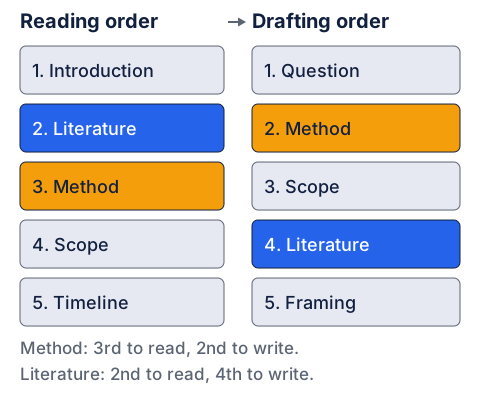
One page: the question, the claim you would be able to make if you answered it, and who would care. No citations yet. If you cannot write the page, you do not have a question — you have a topic, and topics do not get approved.
Sample or corpus, access route, instrument, analysis plan, and the resources each one needs. This is where projects die, so kill them here. If the method cannot be built, the question has to change — and you have lost a page, not a chapter.
Boundaries are easier to write immediately after the method, while you still remember every corner you cut and why. This list is also your negotiating position in the room: a committee that wants to add a second site is arguing with a stated boundary, not filling a silence.
Written fourth, every source you cite is doing one of exactly two things: establishing the gap your question fills, or licensing a choice you already made in the method. Written first, it is a reading list with paragraph breaks.
An introduction promises what the document delivers, so it can only be written accurately once the document exists. Same for the schedule: a timeline drafted before the method is a wish, and a timeline drafted after it is a plan you can defend line by line.
The literature review travels furthest — second to read, fourth to write. But the move that actually saves the rewrite is the method's, from third to second, because feasibility is the constraint most likely to force a change and it is cheapest to hit before you have argued a case in print.
Write the question until it fits on one page
The stalled proposals that reach our editors are usually stalled at the question, not at the writing. The tell is that the candidate can talk at length about the area and cannot finish the sentence "this study will establish whether…"
A workable doctoral question has three properties you can check on paper. It names a population or body of material you can actually reach. It names a relationship or an interpretation that could come out either way — if only one answer is imaginable, you have a demonstration, not a study. And it is small enough that one person can finish it, which usually means it is narrower than the version you are proud of.
The compression test is blunt and it works. Write the question in one sentence. Write the finding you would report if the answer came back the way you expect. Write the finding you would report if it came back the other way. If the second sentence is uninteresting or unpublishable, the question is not yet a question — it is a hope, and the committee will name it as one.
Bring both versions of the finding to your chair before you draft anything else. Thirty minutes there is worth three weeks of prose. If you are still choosing between areas, work through finding a dissertation research topic first — proposal drafting starts after that decision, not during it.
Write the method as if you started next month
The method section is the one part of the proposal that has to survive contact with the actual world, so write it operationally rather than descriptively. "A qualitative interview study of mid-career nurses" is a description. "Twenty-two semi-structured interviews, recruited through two hospital systems where I have a named contact, transcribed and coded in two passes against a codebook drafted from the pilot" is a method.
Work through five things in order, and write down the answer even when it is inconvenient:
- Who or what you will study, and how many. Give a number and a justification for the number.
- How you will reach them. Name the gatekeeper, the archive, the database license, the field site. "I will recruit participants" is not an access route.
- What you will collect. Instrument, protocol, corpus definition, inclusion and exclusion rules.
- What you will do with it. The analysis, specifically enough that a methodologist on your committee could disagree with it.
- What it costs. Money, software, travel, transcription, and above all time. The University of Rhode Island's proposal outline gives this a heading of its own — "Resources Required" — rather than leaving it folded into the methodology section.
The reason this pays off is not tidiness. It is that a method written this way is already most of your review-board application, and that application is a real deadline waiting on the other side of your defense.
The literature review has exactly two jobs
A proposal's literature review is not a smaller version of your dissertation's literature chapter, and treating it as one is a reliable way to make a proposal longer without making it stronger.
In a proposal it has two jobs and no others. The first is to establish the gap: to show that the question has not been answered, or has been answered only under conditions that do not settle it. The second is to license the method: to show that the approach you chose is one this literature already recognizes for this kind of question, or to argue openly for why you are departing from it.
So use a one-line audit. Beside every source in your draft, write "gap" or "method." Anything that gets neither label comes out — not because it is bad work, but because it belongs in the dissertation, where you will have room for it. A section cut this way gets shorter and reads stronger, because what remains is an argument rather than a survey.
The audit also explains why the stage sits fourth. The "method" label cannot be applied before the method exists, so a literature review drafted first can only do half its job — and gets padded to disguise the other half.
The parts your program controls: sections, length, deadlines and the vote
The drafting order is portable. The document specification is not — it is set by your department, and departments disagree with each other far more than the general guides admit. Here is what five published US policies name as the sections of a proposal.
| Program | What it calls the document | Sections it names |
|---|---|---|
| UW Information School (PhD) | Dissertation proposal | Statement of the Problem; Grounding and Rationale; Research Plan — and the policy calls its own list "illustrative only" |
| URI Graduate School (adapted by the English department) | Dissertation proposal | Title of the Study; Statement of the Problem; Justification and Significance; Methodology or Procedures; Resources Required; Literature Cited in the Proposal |
| U Chicago, South Asian Languages and Civilizations | Dissertation proposal | Scholarly problem; theoretical orientation; review of previous scholarly work; provisional outline of the dissertation; plan of research, with archives, sites, timetable and a bibliography |
| Columbia University, computer science (PhD) | Thesis proposal | Problem and background; innovative claims and relation to existing work; at least one initial result mature enough for conference submission; a plan for completing the research |
| Cal Poly Pomona, EdD in Educational Leadership | Chapters 1–3 | The first three chapters of the dissertation itself, plus an IRB draft and a 5–7 minute mock proposal presentation |
Three things worth noticing. Rhode Island's outline never names a literature review — the only literature heading it carries is "Literature Cited in the Proposal," a reference list — so a candidate there who arrives with a standalone review chapter has written the wrong document, and could not fit it inside the 15-page limit anyway. Columbia's computer science program wants at least one initial result mature enough for conference submission — in that department a proposal is partly a progress report, which is a different document from a plan. And Cal Poly Pomona's education doctorate defines the proposal as Chapters 1 through 3 of the dissertation, so nothing you write is throwaway. Those last two programs define the document very differently, and no general guide can tell you which one you are under.
Length varies just as much, and the published numbers are not measured the same way.
| Program | Published limit | What sits outside it |
|---|---|---|
| UW School of Social Work (PhD prospectus) | "a brief document (10-15 pages)" | not specified |
| URI Graduate School | 15 or fewer double-spaced pages, font no smaller than 12 point | appendices and references |
| U Chicago, South Asian Languages and Civilizations | 20–25 pages | bibliography, itself capped at two pages |
| Columbia University, computer science | core limited to 30 pages, with "12 point font, single spacing, 1 inch margins" given as the example formatting | appendices |
| NYU Steinhardt | recommended no longer than 40 pages | appendices and bibliography |
Read the Rhode Island and Columbia rows against each other, because the spread is wider than the page counts make it look. Rhode Island counts double-spaced pages. Columbia counts a 30-page core and illustrates it with single spacing — its policy gives "12 point font, single spacing, 1 inch margins" as an example of the formatting rather than as a rule, but that is the density the limit is written against. On the usual rule of thumb of about 250 words to a double-spaced 12-point page, and roughly double that single-spaced, Rhode Island's ceiling lands near 3,750 words and Columbia's near 15,000. Two policies, a two-to-one gap in pages, and something closer to a four-to-one gap in words. Never size your draft from a number you read on a general guide, including this one — including this table.
One date and one vote are worth looking up this week, because they change how you plan the final month:
- The circulation deadline. Four of the programs here publish one, and all four set it at two weeks. The UW Information School requires the final written proposal to reach every committee member at least two weeks before the scheduled proposal defense date; Columbia's computer science program says the document must be circulated no later than two weeks (14 days) prior to the proposal presentation; William & Mary's School of Education asks for a copy to the chair and committee at least two weeks prior to the scheduled defense of the proposal; and Chicago's South Asian Languages program requires the proposal to be deposited in the departmental office at least two weeks prior to the date of the defense. Check which defense a deadline belongs to before you count backward from it: Cal Poly Pomona's published ten-day review window sits in its final dissertation defense sequence, not its proposal sequence. Either way, your real deadline is the draft date, not the defense date.
- The approval rule. This is the one candidates assume and should not. At the UW Information School the committee chooses among accept, accept with minor revisions, accept with revisions, and reject, and a simple majority vote is required. At William & Mary's School of Education, a unanimous vote of the committee at the proposal defense is required to approve the proposal. Those two rooms are not the same room, and one skeptical member means something very different in each.
Your own program handbook outranks every general guide on the internet, this one included. Where a published departmental policy contradicts anything above, the policy wins. Print it, and read the proposal section before you draft rather than the week you submit.
Where IRB review sits, and how it changes the method section
If your study involves human participants, it needs approval from an institutional review board (IRB) — and at Teachers College and Cal Poly Pomona, the sequence may run in a direction you do not expect.
Teachers College, Columbia University tells its doctoral students that all dissertation research must be submitted to the IRB after successful completion of the proposal hearing, and that human subjects research may not commence until after IRB approval has been received. Cal Poly Pomona's education doctorate works the same way round — the usual process there is to submit the IRB proposal after a successful proposal defense, though the chair may approve an earlier submission — but it also asks for an IRB draft inside the proposal package, alongside Chapters 1–3. NYU Steinhardt draws the line at its widest: approval must be granted before work on the research or data collection has begun, including all pilot studies, trial runs, pretests, and preliminary sampling or surveys.
Three consequences follow, and they are all practical.
The pilot you were planning to run over the summer is data collection. Steinhardt names pilot studies, trial runs, pretests and preliminary sampling explicitly, so a candidate under that policy cannot treat any of them as a warm-up that happens before the paperwork. Read your own board's wording for the same list rather than assuming a pilot is exempt.
Your method section is a first draft of your protocol. Recruitment language, consent, storage, identifiers, withdrawal — write those into the proposal even where your department does not require them, and the review-board application becomes an editing job instead of a fresh one.
The gap between defense and approval belongs on your timeline. If submission only happens after the hearing, then review time sits between your approved proposal and your first participant, and it is not time you control. Put the submission date and a review window in the proposal's own timeline, where the people who know your board's turnaround can correct the estimate.
Why proposals come back, and what fixes them
Revisions are a designed outcome, not a verdict on your prose — of the four options on the UW Information School's ballot, two are forms of accept with revisions. The proposals our editors see come back for four recognizable reasons, and prose quality is rarely one of them.
| What the committee says | What it usually means | The fix |
|---|---|---|
| "Narrow the focus" | The question covers a field, not a study. Nobody can picture the finding. | Run the compression test. Write both possible findings in one sentence each, and narrow until both are worth reading. |
| "How will you actually get this data?" | Feasibility. There is no named access route, gatekeeper or license. | Name the person, the archive or the agreement. If it does not exist yet, say what you will do if it never does. |
| "The literature doesn't lead anywhere" | A survey, not an argument. Sources are summarized in sequence and no gap emerges. | Apply the gap-or-method audit to every citation and cut the rest. |
| "How long is this actually going to take?" | Scope with no floor, and a timeline written as a wish rather than from the method. | Rebuild the schedule from the method's steps, then state in writing what the study will not attempt. |
Every one of the four maps onto a stage in the drafting order above, which is the point of the sequence. It moves the expensive discoveries to the cheap end of the process, when the fix is a paragraph rather than a chapter. The candidates who stall longest are often the ones who wrote beautifully in the wrong order and then could not face unpicking it, which is one of the patterns that shows up behind all but dissertation.
A last pass before you send it
Read the draft once against this list, in this order, before it goes to your committee.
- Can a reader outside your subfield state your question after page two? If not, the introduction is describing an area rather than proposing a study.
- Does every method choice have a reason attached to it? Not a citation — a reason. Citations license choices; they do not make them.
- Does every source do gap work or method work? Anything else is dissertation material.
- Is there a sentence beginning "this study will not"? A proposal with no stated boundary invites the committee to draw one for you.
- Does the timeline include review-board submission and a review window? Review time is the easiest thing to leave off a schedule, and a committee can only correct a date it can see.
- Have you met your program's page limit, its section names and its circulation deadline — the actual published ones, not the ones in a guide?
- Would you be comfortable being held to this for the length of the project? The Information School's phrase is worth borrowing: a formal understanding. Propose terms you can live with.
If it helps to see the shape before you build your own, our companion pieces cover what a dissertation actually is and how long the finished document tends to run. And if the proposal has been sitting at stage one for a month, our dissertation help service works alongside doctoral candidates on question framing, method sections and proposal drafts from $7.89 a page — you keep the project, the committee relationship and the submission entirely in your own hands.