Live Chat


The slow way to write an annotated bibliography is to read everything, then go back and write about each source from memory. You end up reading each one twice, and the second reading is the one that takes the weekend.
The faster way is to take notes shaped like an annotation while you read, so the entry is mostly written by the time you close the article. That is the method below.
The library guides that rank for this assignment are good on the parts of an annotation. Purdue OWL's summarize, assess and reflect is the standard breakdown, and a sound one. Almost none of them covers the reading. Cornell's guide gives it one instruction — "briefly examine and review the actual items" — and that instruction is where the hours go.
- Draft each annotation while reading, using a three-box note template that maps onto the finished paragraph.
- Decide how far to read a source before you start reading it — the abstract is a triage decision, not a warm-up.
- Build the citation first, not last — it takes two minutes and stops the end-of-project scramble.
- Read in a fixed order: abstract, introduction, conclusion, method, then the middle only if it earns it.
- Write the positioning sentence last, once you know what your argument is.
- Budget around eight and a half hours for ten article-length sources, with note-taking running close to twice the drafting.
Before you read anything
Two decisions and one file save hours.
Confirm the style and the length. APA, MLA or Chicago, and how many words per annotation. Both come from your assignment, and both change how you take notes. Writing 200-word annotations when the assignment asks for 75 is a common and painful mistake.
Write your research question at the top of your notes. Every annotation ends by saying what the source contributes to that question. If the question is not written down, that sentence gets vague, and vague is where the points go.
Keep everything in one file. Put four lines at the top: research question, style, words per annotation, number of sources. Build every entry underneath them. That file becomes the page you hand in, so nothing has to be transcribed at the end, and the four lines are there to be reread whenever an entry starts drifting.
The three-box note template
For every source, keep exactly three boxes. They correspond to the three parts of a finished annotation, so nothing gets rewritten.
What does this source argue, in two or three sentences of your own words? Not the topic. The claim. If you cannot write it, you have not found the argument yet.
Method, sample, date, funding, obvious limitation. What would a skeptic say? Two to four sentences.
Which part of your project does this touch, and does it support, complicate or contradict your position? Leave this one until you know.
Three boxes, about a hundred words of rough notes, and the annotation is drafted. Tidying it into prose afterward takes minutes rather than an evening.
Two habits make the boxes work. Write in your own words, and put quotation marks around anything copied verbatim. A phrase you meant to paraphrase can otherwise walk into your draft unmarked, and our guide to keeping research original covers the rest of that discipline. Then keep the boxes ugly. Fragments, arrows and abbreviations are fine; tidying happens once, later.
Richer note systems tend to backfire here. Page numbers, pulled quotations, color-coded tags: all of it feels productive, and most of it produces transcription. Three boxes work because nothing in them fails to become a sentence.
How much of a source to read
Not every source deserves a full read, and deciding that early is a skill rather than a shortcut.
- Abstract — is this actually about your question? Many are not, and stopping here is a legitimate outcome.
- Introduction, last two paragraphs — this is where authors state their claim and map the article.
- Conclusion — what they think they showed, and what they admit they did not.
- Method — the section that fills Box 2. In a humanities piece, read the framing of sources instead.
- The body — only if the source is going to matter, and then only the sections that do.
That order is written for a journal article. A book has different landmarks: the table of contents, the last pages of the introduction, the conclusion, then the one chapter your question touches. A policy or government report: the executive summary, then the methodology appendix, where its limits live.
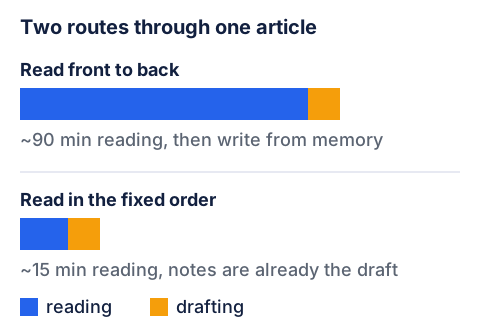
Steps 1 to 4 take about fifteen minutes for a journal article and give you enough for a complete annotation. Reading front to back gives you the same annotation in ninety minutes.
Deciding depth from the abstract
Step 1 is a decision, not a warm-up. How far you read sets what your annotation is allowed to claim, and the third column of the table below is the one no guide writes down.
| What the abstract tells you | How far you read | What the annotation can honestly claim | Rough time |
|---|---|---|---|
| Wrong question, wrong population, or wrong period | Stop here | Nothing — the source does not go on the list | 2 min |
| Right area, but background rather than evidence | Abstract and conclusion | What it argues, and that it is context rather than proof | 5 min |
| Directly relevant to a section you are writing | Steps 1 to 4 above | All three moves, with an evaluation built on the method | 15–20 min |
| Central — your argument leans on it | The whole thing, results included | A specific finding, a disagreement, a comparison with another entry | 45 min+ |
The second row is the one that costs points. Evaluating a study's design after reading only its abstract and conclusion is a claim you have not earned, and an instructor who knows the source sees it in a sentence. Read that far and your honest evaluation is about scope and standing, not design: who wrote it, published where, how recent, how broad.
Build the citation the moment you decide to keep a source, while the tab is still open. Chasing volume numbers and DOIs for twenty sources at the end is the most avoidable hour in the whole assignment.
Two entries, start to finish
Here is the method run on two real sources you can look up and check every line below against. The project: a paper asking why students rate active-learning courses below traditional lectures, and what a department should do about it. Both annotations close on a section of that paper rather than on the source, which is normal in an annotation and unusual almost everywhere else.
Deslauriers, L., McCarty, L. S., Miller, K., Callaghan, K., & Kestin, G. (2019). Measuring actual learning versus feeling of learning in response to being actively engaged in the classroom. Proceedings of the National Academy of Sciences, 116(39), 19251–19257. https://doi.org/10.1073/pnas.1821936116
Fifteen minutes in the reading order above produced these notes, reproduced as written. Nobody needs to read them but you.
Box 1: Claim — students in actively taught sections learned more but rated their own learning lower. Randomized, identical content + handouts both arms, large intro physics classes. Authors read the gap as: the effort active work demands gets mistaken for learning less.
Box 2: Perception is self-reported. One discipline, one institution, intro level. Passive arm taught by experienced, highly rated instructors — makes the comparison harder on the active side, not easier. Jump from this to a general verdict on course evaluations is the discussion's, not the data's.
Box 3: Section 2 — gives the mechanism, not just the correlation. Pair w/ Freeman for effect size. Not a source for a general claim about evaluations.
From the boxes to the paragraph
The three boxes become three moves, in order, with no transitional padding between them.
Deslauriers and colleagues compared what students actually learned against how much they felt they had learned, in large introductory physics classes where content and handouts were identical and students were assigned at random. Students taught actively learned more and rated their own learning lower, which the authors read as the extra cognitive effort of active work being mistaken for poorer learning. The perception measure is self-reported, and the study runs at one institution in a single discipline, so the finding travels less far than the paper's closing discussion of course evaluations suggests. It anchors the second section of this paper because it supplies a mechanism rather than a correlation, with Freeman and colleagues supplying the size of the effect it assumes.
Four sentences: two from Box 1, one from Box 2, one from Box 3. Notice there is no "In this article, the author discusses…" opener. It costs you a sentence and says nothing.
Notice the third sentence too. It disagrees with the paper, mildly, and about scope rather than findings. Box 2 is where that permission comes from: you read the method, so you can say what the method supports. Skip Box 2 and the same sentence is an opinion about a study you skimmed.
The same source, with weaker notes
Grade your notes, not your paragraphs. Here is Box 1 written three ways, and what each version lets you write afterward.
| Box 1 as written | What the annotation can then say | What is missing |
|---|---|---|
| Weak — "About active learning in physics." | "This article discusses active learning in physics classes." | The claim. That sentence is the topic restated, not what the paper found. |
| Better — "Students in active classes learned more but thought they learned less." | An accurate summary and a positioning sentence | How it was shown, so no evaluation is possible |
| Strong — "Learned more, rated learning lower. Randomized, identical content and handouts, intro physics, one institution." | All three moves, with a limitation that names the design | Nothing — this note is finished |
The first two rows both need the source open again, and that reopening is the second reading this method exists to avoid. Checking your own Box 1 before the tab closes is the cheapest quality control in the assignment.
The second entry changes the first
A set of ten is not ten independent jobs.
Freeman, S., Eddy, S. L., McDonough, M., Smith, M. K., Okoroafor, N., Jordt, H., & Wenderoth, M. P. (2014). Active learning increases student performance in science, engineering, and mathematics. Proceedings of the National Academy of Sciences, 111(23), 8410–8415. https://doi.org/10.1073/pnas.1319030111
Box 2 works differently for a meta-analysis: the sample is a set of studies rather than a set of students, so the limits sit in how they were pooled. Here the two headline numbers do not even rest on the same evidence. The score effect comes from 158 of the pooled studies, the failure-rate effect from 67.
Freeman and colleagues pooled 225 studies comparing traditional lecturing with active learning in undergraduate STEM courses, reporting scores higher by 0.47 standard deviations and an odds ratio for failing of 1.95 under lecturing, which they translate as roughly a six percent gain and one and a half times the failure rate. Those two figures rest on different subsets of the studies, and "active learning" covers interventions with little in common, so this is a direction with a size attached rather than a specification. It supports the premise the second section depends on, and sits against Deslauriers, where the same kind of teaching leaves students feeling they learned less.
Writing that closing clause sent me back to the first entry to add twelve words: "with Freeman and colleagues supplying the size of the effect it assumes." They are already in the annotation above, because that is when they were written. Entries that reference each other read as research rather than as a list, and the cheapest moment to add the cross-reference is while the second source is still on screen.
The gate before you close the tab
Six checks, run before the source leaves your screen.
- The citation is built, in the assigned style, in the working file.
- Box 1 names a claim someone could dispute, not a topic.
- Box 2 names at least one specific limit — a number, a place, a date, a design choice.
- Box 3 names a section of your paper, or says plainly that the source is out.
- Anything copied word for word sits inside quotation marks.
- If an earlier entry now needs a clause, it gets that clause now.
None of them takes a minute while the source is open. Each costs twenty minutes to answer once it is closed.
Six mistakes, and where each one actually gets fixed
Mistake
- Paraphrasing the abstract
- Every annotation the same length and shape
- No evaluation, only description
- Sources that all agree
- Citations built at the end
- Notes left in the PDF margins
Fix
- Write Box 1 without the abstract open
- Let importance set length — key sources earn more
- Box 2 is required, not optional
- Include one that complicates your position and say so
- Build each one when you decide to keep the source
- Boxes go in the working file, where the draft is
The last pair is the quiet one. Highlighting inside a PDF feels like note-taking, but nothing you highlight is in your own words, and reopening ten marked-up PDFs to write from them is the two-pass problem wearing a different coat.
If the annotation will not come out
Being stuck is diagnostic. The symptom names the empty box.
| The symptom | The empty box | Where to go back to |
|---|---|---|
| Three sentences of summary, then nothing | Box 3 | Your research question. If it does not name a section this source serves, the source may not belong. |
| Every sentence starts "The author…" | Box 1 | You wrote the topic, not the claim. Reread the last two paragraphs of the introduction. |
| It reads like the abstract | Box 1 | Close the abstract and write the claim from memory. If you cannot, you have not read it yet. |
| You cannot find a limitation | Box 2 | The method section — sample, place, date, design. Most papers name their own limits in the discussion. |
| It runs to 300 words and will not compress | Box 1 is oversized | Cut summary, never judgment. Summary is the part a reader could get from the source themselves. |
In four of those five the repair is upstream of the paragraph. Rewriting the sentence is the one move that never works.
Edge cases the method hits
A book instead of an article. The fifteen-minute estimate does not survive a monograph — the book landmarks listed earlier take far longer to work through. Hold the annotation to what the one chapter you read actually supports. Summarizing a whole book from its introduction is visible as such.
A source you cannot get the full text of. Build the citation, leave the boxes empty, flag the entry and keep moving. What you should not do is fill Box 2 from the abstract, which is the place a study's limitations are least likely to appear.
Your research question changes halfway. Box 3 is the only box affected, which is why it is a separate box. Reread it on every finished entry against the new question; anything that no longer names a section either earns a new sentence or leaves the list.
A source you cannot decide about. Give it fifteen more minutes and a written verdict either way. Entries parked as "maybe" are how a set of ten becomes a set of six the night before.
A source that arrives after you have drafted the set. Write it, then reread the two entries on either side of it alphabetically. Late arrivals are where cross-references go missing, because everything around them was written when they did not exist.
Assembling the page, and the calendar that gets you there
Do the assembly in one pass, when every entry is drafted.
- Alphabetize by author surname, exactly as a reference list.
- Apply the indent rule for your style — in APA 7 the annotation is a new paragraph indented half an inch as a block; in MLA 9 it starts on a new line indented one inch, so it sits deeper than the entry's hanging indent; Chicago indents half an inch, as APA does.
- Double-space everything in APA and MLA, including inside annotations, with no blank lines between entries. Chicago student papers, following Turabian 9, work the other way: single-space each entry and leave a blank line between them.
- Read the whole page once for repetition. If four annotations use the same sentence shape, vary them.
That last check matters more than it sounds. A page of ten identical-sounding paragraphs reads as mechanical even when each one is individually fine.
Working back from the deadline
Word counts are a poor planning unit here, because the writing is the small part. Stages are better. For ten article-length sources at around 150 words each (Cornell's guide puts the usual annotation at about that length), the work comes out roughly like this.
| Stage | What actually happens | Rough time |
|---|---|---|
| Setup | Confirm style, length and source count; research question at the top of the file | 15 min |
| Find and cite | Search, choose, and build each citation the moment you keep a source | 2 hours |
| Read and note | Ten sources through the reading order, three boxes each | 3.5 hours |
| Draft | Boxes tidied into paragraphs, one source at a time | 2 hours |
| Assemble | Alphabetize, set indents and spacing, read the page for repetition | 45 min |
About eight and a half hours, and none of it has to happen at once: three or four sources an evening across three evenings, then a drafting session, then the assembly pass. Sources needing a full read move the middle row and nothing else.
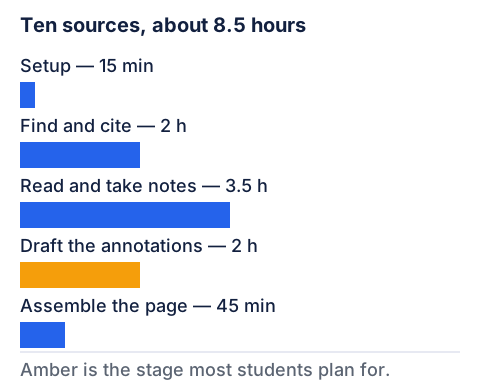
Note-taking runs close to twice the drafting time above, and that is with journal articles. One book can cost as much as five of them, so a reading list heavy on monographs needs its own line in the plan rather than an average.
If it feeds a paper
Most annotated bibliographies are a checkpoint before a research paper rather than an end in themselves. If yours is, treat Box 3 as your outline.
Sort your finished entries by which section of the paper they serve. Any section with one thin source is a section you will struggle to write — and finding that out now, rather than mid-draft, is the entire reason the assignment exists.
That sorted list is already a rough outline; our guide to outlining before you write a word turns it into a working one, and the step-by-step research paper guide picks up from there.
For the finished-entry formatting in both styles, see our APA and MLA comparison. If the reading pile is the real obstacle, our annotated bibliography help reads the sources and writes the evaluative annotations to your brief, from $7.89 a page, inside our paper writing service.