Live Chat

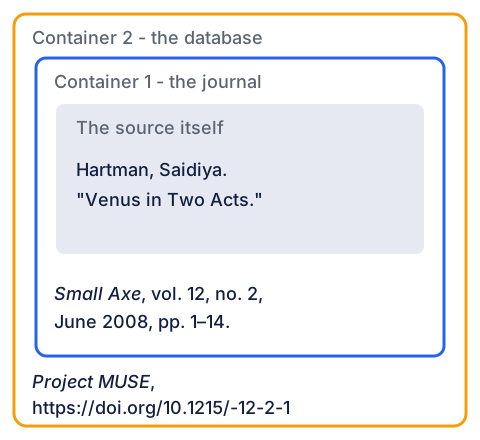
MLA builds every Works Cited entry the same way, whatever the source: author, title of the source, then the container it sits inside — the journal, the anthology, the website — followed by the details of that container.
Once you can see the containers, MLA entries stop being a list of formats to memorize. What follows is one real reading list turned into an annotated bibliography — a book, a journal article and a web article — plus the page layout drawn at the real indent ratio and one annotation shown at three levels of quality, so you can see what a grader is reading for.
- MLA 9 uses containers: the larger work your source sits inside. A journal is a container; a database can be a second one.
- The annotation starts on a new line after the entry, indented one inch — deeper than the half-inch hanging indent, so the two are visually distinct. That inch is where MLA 9 parts company with APA and Chicago, which both indent annotations half an inch.
- Entries are alphabetical by the first element of the entry, and the whole page is double-spaced with no blank lines between entries.
- MLA is author–page in text, so no year appears in your parentheses.
- Annotation length comes from your assignment sheet, not from MLA. Library guides converge on 100–200 words as the working default.
- The MLA Handbook (9th ed., 5.132) tells you what to leave out: annotations should not rehash minor details, quote the author, or recount the steps of an argument.
The container question, asked once per source
Ask: what is this thing inside? A chapter is inside a book. An article is inside a journal. That journal might be inside a database. Each container gets its own run of details, and the entry ends when you run out of containers.
That is why MLA entries for wildly different sources look structurally similar. You are not learning a separate format per source type. You are learning one pattern and asking the same question of each source.
The same question tells you what to italicize. A work that stands on its own takes italics — the book, the journal, the magazine. A work sitting inside one of those takes quotation marks — the article, the chapter, the single web page. Get that relationship right and most punctuation errors disappear.
Three worked entries from one reading list
All three sources are real and belong to one project: an undergraduate paper on archival silence, on why some histories survive in the record and others do not. Look them up and check each entry against the source. They are grouped here by source type so you can watch the pattern change; on the finished page they alphabetize as Hartman, Trouillot, Wulf.
A book
Trouillot, Michel-Rolph. Silencing the Past: Power and the Production of History. Beacon Press, 1995.
Trouillot argues that silences enter history at four moments: when a fact is made, when it is filed into an archive, when it is retrieved as a narrative, and the moment it is given retrospective significance. His central case is the Haitian Revolution, which contemporaries treated as unthinkable and which later histories of the age of revolutions largely wrote out. The book is a theoretical argument illustrated by cases, not an archival study, so it gives this paper its vocabulary rather than its evidence; the four-moment model is the spine of my second section. Where it leaves me stuck is practical — Trouillot explains how silences form but says little about how a reader detects one in a specific document, which is why Hartman is on this list.
Container check: a whole book is not inside anything, so the container slot stays empty. Author, title, publisher, year, and the entry is finished. MLA 9 does not want the city of publication, and it does not want "Print" at the end.
A journal article
Hartman, Saidiya. "Venus in Two Acts." Small Axe, vol. 12, no. 2, June 2008, pp. 1–14.
Hartman asks what a historian can honestly write about people who survive only inside a legal document — the indictment of a slave-ship captain for the murder of two girls — and she refuses both silence and invention. She names her method critical fabulation: telling the story the archive makes impossible while marking, inside the telling, that it cannot be verified. The essay is short and deliberately unresolved, so it offers a stance rather than a procedure. It earns its place here because it turns Trouillot's diagnosis into a writing problem — what do you actually put on the page? — and because the objection Hartman raises against her own method is the strongest objection to my third section.
Container check: the article sits inside the journal. The article title goes in quotation marks, the journal is italicized as the container, and volume, issue, date and page range are that container's details.
Two small things this entry settles. The date is June 2008, not "Jun." — MLA abbreviates every month except May, June and July. And the pages are given in full as 1–14; MLA only drops repeated digits from the second number once you are into three figures, which is why Purdue OWL's example runs pp. 225–50.
If you read that article through a database rather than on the journal's own site, the database is a second container and gets appended after the first container's details:
Hartman, Saidiya. "Venus in Two Acts." Small Axe, vol. 12, no. 2, June 2008, pp. 1–14. Project MUSE, https://doi.org/10.1215/-12-2-1.
Note what happens to the web address. MLA 9 strips https:// from an ordinary URL, but a DOI is written out in full as https://doi.org/ plus the identifier. Those two rules look contradictory and they are the reason so many entries arrive half-corrected.
A web article
Wulf, Karin. "Archival Shouting: Silence and Volume in Collections and Institutions." Perspectives on History, 10 Apr. 2024, www.historians.org/perspectives-article/archival-shouting-silence-and-volume-in-collections-and-institutions-april-2024/.
Wulf turns the usual framing around: instead of asking only what archives leave out, she asks what they amplify, using her own institution's holdings to show how acquisition and cataloging decisions make some voices loud. She writes as a historian who also directs a research library, so the piece carries institutional detail that theoretical work on silence rarely includes. It is a magazine essay rather than peer-reviewed research and it offers no systematic data, which makes it good for framing and unusable as evidence for how common the pattern is. I use it in the introduction to establish that this is a live argument inside the profession.
Container check: the article sits inside the magazine, so Perspectives on History is the container and takes the italics. The American Historical Association publishes it, and its name still does not appear — MLA leaves the publisher element out for periodicals. April is abbreviated to Apr., and the date is written day-month-year.
Add a second container only when the database genuinely hosts the source. Finding the link on Google, or reading a PDF posted to a course site, makes neither of those a container.
Setting the page up so the indents are actually right
The page carries two different indents, and that is the part students get wrong — a formatting problem before it is a citation problem. The entry uses the ordinary half-inch hanging indent. The annotation sits a full inch from the margin, every line of it. Purdue OWL marks that inch as the point where MLA 9 parts company with APA and Chicago, which both indent annotations half an inch.
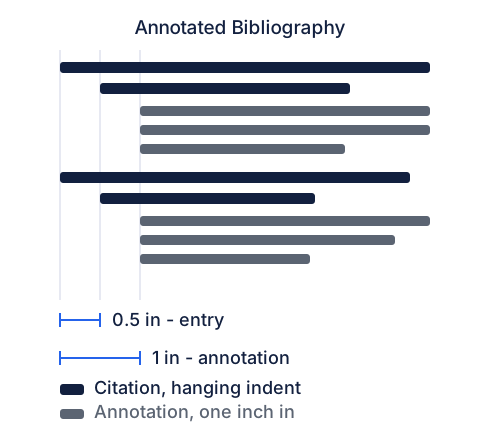
Doing it with the Tab key will not hold: a tab moves one line, not a block, and collapses the moment the text reflows. Set it properly once:
Select the citation. In Word, open the Paragraph dialog and set Special to Hanging, By 0.5". In Google Docs, use Format, Align and indent, Indentation options, and set Special indent to Hanging, 0.5.
Put the cursor in the annotation paragraph. Set Left indent to 1" and Special to None. This is a separate paragraph setting from the entry above it, which is exactly why copying the entry's formatting produces a half-inch annotation.
Select everything, set line spacing to Double, and set space-after-paragraph to 0. MLA runs double-spaced throughout with no extra gap between entries or between an entry and its annotation.
The page is titled Annotated Bibliography, centered, in plain type — not bold, not underlined, not in quotation marks. Entries are alphabetized by the first element, usually the author's surname, or the title when there is no author.
Annotation length, and sometimes indent, get overridden by instructors. If the prompt specifies 75 words, or asks for a half-inch annotation indent to match the entry, follow it. MLA sets the citation format; your course sets the assignment.
The same source, annotated three ways
Rubrics describe the gap between an adequate annotation and a good one; they rarely show it. Here is the Wulf entry above written at three levels, so the difference is visible rather than described.
Wulf's article is about archives and what ends up in them. She is a historian who also runs a library, and the piece was published in a history magazine. It was very useful for my topic.
Wulf argues that archives do not only leave things out; they amplify, and decisions about what to acquire and how to catalog it are what make some voices loud. She writes from the holdings of the research library she directs rather than from a survey of collections, and the piece is a magazine essay rather than peer-reviewed research, so it carries institutional detail but no systematic data.
The strong version is the Wulf annotation printed above. It keeps everything the better one has, then says what that limit means for this writer and what the source is doing in this paper.
| Band | What the grader can tell | What is still missing |
|---|---|---|
| Weak (36 words) | That you have the source in front of you | The argument, any judgment, any connection to your project |
| Better (67 words) | That you read it and can state its claim accurately | Why this source is on the list rather than any other piece on the topic |
| Strong (107 words) | The claim, its limits, and the work the source does for you | Nothing — this is the version most rubrics are describing |
Set the three bands side by side and the three moves an annotation makes separate cleanly: what the source argues, how well it holds, and what it does for your project. The last one carries the difference. An annotation that never says what the source does in your paper is a formatted reading list, and it reads that way from the first line.
Which kind of annotation your assignment is asking for
MLA does not prescribe what an annotation contains. Your instructor does, usually in a single verb on the assignment sheet. Find that verb first.
| Wording on the sheet | What it is asking for | What the annotation must contain |
|---|---|---|
| "Summarize" or "describe" each source | A descriptive annotation | The argument, the scope, the method. No judgment required. |
| "Evaluate," "assess," "critique" | An evaluative annotation | The argument, plus how well the evidence supports it, plus the limits. |
| "Explain how each source supports your project," "reflect" | A reflective annotation | The argument, plus the job the source does in your paper and where it disagrees with your other sources. |
| No verb at all, just "annotated bibliography" | Assume evaluative and reflective | All three moves, in that order — and send a one-line email to ask, since most instructors are happy to settle it in a sentence. |
Sources that break the simple pattern
Seven situations account for most of the entries students get stuck on.
| The source | Where it goes wrong | The MLA 9 shape |
|---|---|---|
| A chapter in an edited collection | The chapter gets italicized | Author. "Chapter Title." Book Title, edited by First Last, Publisher, Year, pp. 00–00. |
| A later or anniversary edition | The edition is dropped, so the page numbers will not match anyone else's copy | The version element sits after the title: Silencing the Past. 20th anniversary ed., Beacon Press, 2015. |
| An article read through a database | The database is written where the journal belongs | Journal details first, then the database italicized as a second container, then the DOI. |
| A source with more than one author | Every name is inverted, or every name is typed out | Only the first author is inverted; a second author follows "and" in normal order. With three or more, give the first author and then et al. |
| A page with no author | Students type "Anonymous" | Start the entry with the title, and alphabetize it by the title's first significant word. |
| A page with no publication date | A date gets invented, or the reader is left unable to find the version you read | Drop the date element and close with an access date: Accessed 4 Aug. 2026. |
| Two sources by the same author | The name is retyped in both entries | Name in the first entry only; in the next, three hyphens and a period, then alphabetize those entries by title. |
The errors graders circle most
- The annotation is indented half an inch, matching the entry, so the eye cannot find where the citation ends. Set that paragraph's left indent to a full inch.
- The annotation is the abstract, reworded. That is the author's summary of their own work, not your assessment of it, and close paraphrase of a published abstract carries a real attribution risk — our guide to reducing plagiarism without changing your meaning covers the fix. Close the abstract and write from your own notes.
- "pp." has crept into an in-text citation. In the text, MLA gives the author and the page number and nothing else: (Trouillot 26).
- The heading says "Works Cited." This page is titled Annotated Bibliography, centered and in plain type.
- Every annotation is the same length and shape. Identical blocks tell a grader you filled a template rather than read each source.
Before you hand it in
- Alphabetized by first element. No numbering, no bullets.
- Entries at a 0.5 in hanging indent; every annotation line at 1 in.
- Double-spaced throughout, no extra space after paragraphs.
- Standalone works italicized; anything sitting inside one of them in quotation marks.
- Titles in title case, principal words capitalized — not APA's sentence case.
- Months abbreviated except May, June and July; dates day-month-year.
- Protocol stripped from plain URLs; DOIs in full as https://doi.org/ plus the identifier.
- Every annotation ends by naming the job the source does in your paper.
- Lengths match the assignment sheet, and vary with how hard you lean on each source.
For the same source types in APA, and where the two styles actually diverge, see our comparison of APA 7th against MLA 9th. If the bibliography is a stage in a larger assignment, our step-by-step research paper guide picks up where this page stops.
If the entries are done but the reading is not, our annotated bibliography service reads the sources and writes evaluative annotations in your required style, from $7.89 a page, inside our paper writing service.