Live Chat

Your assignment says 1,500 words. You are at 1,720, and every page you can find repeats the same reassurance: there is a 10% allowance either way, so relax. That advice has a source, and the source is British. None of the US documents opened for this article sets a percentage tolerance of any size.
What actually happens is decided per institution and per assignment, and it falls into three patterns. So this guide reads real published policies — American and British, each quoted with its institution and term named — and works out what each costs in the units the document itself uses. Where a document says nothing at all, which is the common case, this guide says so.
- The "10% either way" rule is a British convention, not a US norm. It is real and published — in a different assessment system.
- UCL, the institution most often cited for it, says the rule is gone: "there is no longer a UCL-wide policy on over-length submissions."
- There are two different tens. The one students repeat is a 10% allowance on words. UCL's is a cap on the penalty — no more than 10 percentage points off.
- The strongest US rules here punish being short, not long. One University of Florida course records a zero for an under-length assignment and caps the resubmission in proportion to the shortfall.
- Four real documents define "a word" four different ways. One counts your reference list; three do not.
- If you are short, adding words is the wrong fix. The number is a symptom; the argument is the thing to repair.
Three situations, and your assignment is in exactly one
Work out which of these you are looking at first. They behave differently, and most advice online silently assumes the wrong one.
- A hard limit inside the submission form. Application portals and some online forms stop accepting text at the limit. Going over is not penalized because it is not possible — you get truncated instead, usually with no warning.
- A published tariff. A named document states what exceeding the limit costs. Standard across British universities, rare in the US.
- A number with no policy attached. Most course assignments. Nothing states a penalty, so the syllabus and the rubric decide, and length is read as evidence about the work rather than scored on its own.
Two checks settle it. Paste 200 extra words into the submission box — if it refuses them, you are in the first situation. Then search your syllabus and assignment sheet for "word". If the only hit is the number itself, there is no tariff and the rubric is your rule.
The 10% rule is British — and in Britain it is not one rule
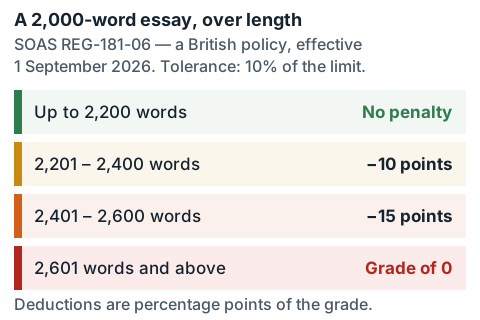
The clearest published version belongs to SOAS University of London. Its policy Word Count Range and Marking of Over-length Coursework (REG-181, version 06, approved 21 May 2026, effective 1 September 2026) states the tolerance in one line: "A student will not exceed the given word count by a total of under or over 10% the given word count figure." It then prices the excess in three bands: more than 10% and up to 20% over costs "10 percentage points", more than 20% and up to 30% costs "15 percentage points", and more than 30% means "The work will be assigned a grade of 0."
Run that against a 2,000-word essay and the thresholds are exact. Up to 2,200 words is free. From 2,201 to 2,400 you lose ten percentage points, from 2,401 to 2,600 fifteen, and past 2,600 the work scores zero.
| British document | Tolerance it states | What exceeding it costs |
|---|---|---|
| SOAS, REG-181-06 (effective 1 Sep 2026) | 10% of the limit | 10 percentage points to 20% over; 15 points to 30% over; a grade of 0 beyond |
| UCL BASc, Faculty of Arts and Humanities | None — the trigger is "by any amount" | "the mark will be reduced by ten percentage points (i.e. 10 marks), but the penalised mark will not be reduced below the pass mark" |
| UCL Philosophy | None stated | "the mark will be reduced by 10 percentage marks, but the penalised mark will not be reduced below the pass mark, assuming the work merited a Pass" |
| University of Sheffield, School of English | 5% above or below — "an essay of 3000 words must be no less than 2850 and no more than 3150" | "Any violation of this word limit will be penalised"; on "excessive violation (e.g. more than 20% deviation)" the work "may be failed and a resubmission required" |
So the 10% rule is real, published, and British. But it is not even one rule in Britain: three institutions, three answers, and Sheffield's is "No more than 5% above or below the word limit". Something that varies this much inside one country is not a fact about essays. It is a local policy that traveled.
The two different tens
UCL is the British university most often cited when a page wants a source for "the 10% rule", and its Academic Manual does contain a ten — just not that one. Chapter 4, section 3.12 of the Academic Manual 2025-26 (the edition UCL publishes as of August 2026) says a word count "may be specified", that it "must specify whether footnotes, bibliographies, appendices, tables, figures etc. are to be included", and then caps what departments may do: "Penalties must not exceed a deduction in marks of 10 percentage points, or one Letter Grade, for that component and must not take the student's mark below the Pass Mark". It adds that "Standardised penalties may be agreed at Faculty, Departmental/Divisional, Programme or Module level."
Read that carefully. UCL's ten limits how much a department may deduct from your grade. It is not an allowance on your words, and the manual never sets one — that decision goes to departments. Two quantities, both written "10%", welded together by the popular rule.
The tolerance and the penalty are different numbers. Confusing them is how a 10-point deduction became a 10% allowance.
UCL's Faculty of Arts and Humanities is blunter still. Its over-length page for BASc students notes: "there is no longer a UCL-wide policy on over-length submissions" — followed by "It is your responsibility to check with each of your teaching departments to determine the over-length penalties for each of the other modules you are taking." The most-cited source for a universal rule has told its own students the rule is not universal, even inside one university.
What US institutions publish is mostly about being short
US institutional documents run the other way. The University of Florida's catalog sets a graduation requirement measured in words: "To graduate, students must complete courses that involve substantial writing for a total of 24,000 words." Courses count as 2, 4 or 6 — at least 2,000, 4,000 or 6,000 words, so four 6,000-word courses cover it. Then the sentence worth reading twice: "It is possible to not meet the Writing Requirement and still earn a minimum grade of C in a class, so students should review their degree audit after receiving their grade to verify receipt of credit for the writing component." You can pass and still not get the credit that counts toward your degree.
UF's ENC 2210, Technical Writing, shows what that looks like. It is a 6,000-word course worth 1,000 points, and its syllabus carries a block headed "Penalties for not meeting minimum word count". An under-length assignment costs the writing-requirement and Composition credit for the whole course, and: "Assignments that do not meet the minimum word count will receive a grade of zero." Short submissions are "tagged as 'missing' until they are resubmitted". Resubmission is allowed "At the instructor's discretion … within one week of receiving feedback or by the end of the first day of end-of-term exams, whichever comes first" — but capped: "The maximum grade an assignment can receive is proportional to the percentage of the word count the initial submission met." The syllabus works its own example, and the two-step arithmetic is what surprises people.
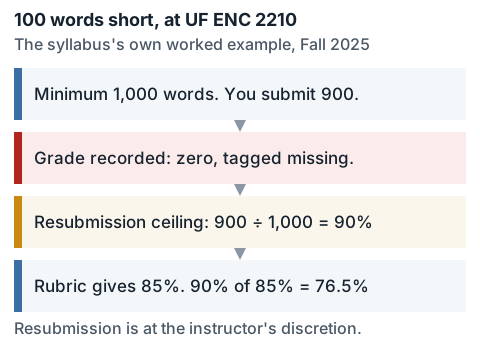
This is not one instructor's quirk: those rules appear word for word in ENC 2210 syllabi from two instructors in two terms, Fall 2025 and Spring 2026. And notice what it does not say. Nothing about being over. The ceiling in that course is silent; the floor has teeth.
Where a US course does price going over, it is usually a rubric line rather than a university policy. MIT OpenCourseWare still publishes the rubric from the Spring 2011 offering of 14.73, The Challenge of World Poverty, which scores 500-word essays out of 10 and ends: "Excess word counts will be penalized by -1 point for every 100 words over the limit." On that scale, 200 words over costs a fifth of that essay's score.
More often it is discretion, exercised in public. A March 2026 post on San José State University's INFO 200 course site — no longer on the live site, so we quote the Internet Archive's copy from April 15, 2026 — records an instructor finding "quite a few papers went over the word count limit", deciding "not to deduct points for going over the word count" that round, and adding that "future assignments will include point deductions if the limits are exceeded". Same limit, two outcomes.
And sometimes the famous US number is not a rule at all. Cornell's Graduate School guide gives the familiar figures — a doctoral abstract that "usually does not exceed 350 words in length", a master's thesis abstract at 600 — while saying its suggestions "are not requirements for submission of the thesis or dissertation". Its separate Formatting Requirements page sets seven requirements, and none is a length. (We have covered how long a dissertation runs separately.)
"A word" means four different things in four real documents
The tolerance argument is a distraction next to this one. Two people can count the same essay and differ by 300 words, honestly, because they count different things.
| Document | Counted | Not counted |
|---|---|---|
| SOAS policy REG-181-06 (British) | "titles, headings, abstracts, summaries, in-text citations (regardless of the referencing style used), figure and table legends, quotations and footnotes" | "acknowledgements, reference list, tables of contents, a list of acronyms, a glossary, a list of tables, or figures" |
| UCL Philosophy (British) | "References and footnotes in the main body of the essay (or which need to be read to understand the content)" | the bibliography and the title or question |
| SJSU INFO 200 research summary assignment (US) | the reference list, inside a 1,000–1,250 band | not specified |
| JFK Library essay contest, 2026 rules (US) | the essay, 700–1,000 words | citations in parentheses, and the bibliography |
The SJSU line runs against the grain: that assignment counts the reference list inside the limit, where both British policies above leave it out. Write 1,250 words of text under the British convention and the reference list then puts you over that ceiling by its full length. Appendices are the other trap, because material moved into one often stops counting — fine when the appendix genuinely holds supporting material, not a way to relocate your argument.
Software disagrees too, and at least one institution says so in writing. UCL's BASc rules allow for "the margin of error of conflicting word counts generated by different software", then bound that allowance: "in no case will discretion be exercised where the count exceeds the maximum set for the assignment by more than 2%." Count it the way your course counts it — and for a second opinion on the raw number, our free essay word counter gives you one.
If you are short, the word count is a symptom
Being under is the question people worry about more, and the published answer is consistent. SOAS: "The word limit prescribed for each piece of assessed coursework is a maximum. Assessments are designed to enable students to achieve excellent marks without writing to the limit. There is consequently no specific penalty for work that is under-length." Then the qualifier that matters: "By exception, under-length work is dealt with by the normal provisions of the marking scheme." UCL Philosophy says it in fewer words — "there is no automatic penalty for under-length essays, providing there is sufficient suitable content."
Read those two clauses together and you have the real answer. Nothing mechanical happens. The scoring happens. A 900-word answer to a 1,500-word question is rarely graded down for the missing 600 words as such. What costs points is the analysis those 600 words would have carried, and the rubric has criteria for that. The MIT rubric above puts both facts on one page: its over-length penalty is arithmetic, while its bottom band describes an essay of "much less than 500 words" and explains itself as "No evidence of comprehension of reading materials, only restates a few facts." The length was never the finding.
Which is why padding is the wrong response, and a losing one. Restating your thesis in the conclusion, widening a quotation, adding an adjective to every noun — all of it produces the same argument in more words, and the criteria the work is scored against do not reward volume. If you are 400 words short, ask which of these is missing: a counter-argument you have not answered, a second piece of evidence for your weakest claim, or the paragraph saying why any of it matters. Your rubric usually names the gap outright.
One exception is worth checking for: where a minimum is written into a policy, as at UF, being short is mechanical. No amount of quality in 900 words changes what that document says about 1,000.
Find your own rule in five minutes
You do not need to know what any other university does. You need a few lines out of your own documents, all findable before the deadline.
Check the assignment sheet and the syllabus. If they disagree, the assignment sheet usually governs — but that is worth one email rather than an assumption.
"1,500 words" is ambiguous. "No more than 1,500" is a ceiling, "at least 1,500" a floor, "1,000–1,250" a band with two edges. The UF case above shows how sharp a floor can be.
Footnotes, in-text citations, quotations, headings, tables, the reference list, appendices. If the document does not say, ask in writing so the answer is on the record.
Search for "word", "length", "limit" and "penalty" separately. If no sentence names a consequence, there is no tariff and the rubric decides — the most common outcome, and it makes the fix editorial rather than arithmetic.
A form that caps you at the limit will cut the end off your conclusion without saying so. Finding that out at 11:58 p.m. is a different problem from finding it on Tuesday.
A section-by-section word budget set while you outline is the only reliable way to land near a number. Cutting 500 words from a finished draft is work; not writing them is free.
If your draft is short because the argument is thinner than the assignment needs, and the time to fix that properly has run out, treat it as a workload problem rather than a word-count one. Read your own collaboration and integrity clause first: courses differ on outside help, and only yours binds you. Where your course permits drafting support, our assignment writing service starts at $7.89 a page and gives you a draft to review, revise and decide about before you submit anything. Where it does not, your instructor, your teaching assistant and the campus writing center are the routes that exist. Padding 900 honest words up to 1,500 is not one of them.