Live Chat

Every ADHD study guide describes the same moment: you are at the desk, the timer is running, the phone is in another room. That advice works — once you are there. Getting there is the part that breaks, and almost nothing is written about it.
So this guide is organized by assignment rather than by tip. It covers the four things you are actually assigned — a long reading, a problem set, a first draft, an exam three weeks out — and for each one it names the point where attention breaks and what to do at that exact point. There is also a method for repairing your own time estimates using your own numbers, plus the accommodation rules that change the week you start college.
One boundary before anything else: this is study strategy. Diagnosis, medication and treatment are conversations for you and a clinician, and nothing here replaces that.
- Starting is a separate skill from working. Write down the first physical action, not the subject.
- Turn a reading into questions from the headings first, so each answer is a legitimate place to stop.
- A six-problem set is six tasks, not one long one. Set all six up, then solve all six.
- Draft from claims, not topics, out of order, and never break the draft to hunt a page number.
- Self-testing beats rereading, and it produces a score, so you can see whether the hour worked.
- Measure your own time multiplier for two weeks instead of accepting a generic "add 20 to 30 percent."
- In college, nobody comes looking for you. You have to request accommodations yourself, and they do not apply backward.
Why the usual advice misses the assignment
The standard list — Pomodoro, quiet space, break big tasks down, color-code, body doubling — is written for study time in general. A specific assignment is not general, and it does not fail in a general way.
When a real assignment falls apart, it usually fails at one of three points.
- Entry. The gap between deciding to work and physically starting. This is where hours disappear, and a timer does nothing for it, because the timer starts once you are already sitting down.
- The estimate. You built the week on a number, and the number was wrong by a factor you have never measured.
- The finish line. "Study biology" has no end, so nothing you do inside it registers as progress.
Nearly all of the advice optimizes the hour you spend working. The expensive one is the hour before it.
The estimate problem has real evidence behind it. A meta-analysis by Marx and colleagues in the Journal of the American Academy of Child & Adolescent Psychiatry (2022) pooled four different timing paradigms — discrimination, estimation, production and reproduction — and found consistent deficits in people with ADHD across all four, including 26 time-reproduction studies covering 2,364 participants. Read that as an argument for measuring instead of guessing, not for trying harder.
The second piece of evidence changes what you do inside the session. Dunlosky and colleagues reviewed ten common study techniques in Psychological Science in the Public Interest (2013) and rated practice testing and distributed practice as high utility, while rereading, underlining and mnemonic devices came out surprisingly low. That matters more here than it does for the average student, because rereading is exactly what you fall back on when you are tired and cannot face building a quiz. It feels like studying and produces very little.
The 90-second start
This runs before any of the four assignments below. It takes about a minute and a half and it is the same five moves every time.
"Study chemistry" is not a task; it is a category. "Open pset4.pdf" is a task. Whatever you write on the list has to be something you can literally open.
One line, verb plus object, small enough to be slightly embarrassing: type the six problem numbers into a blank document. Not "start the problem set." The point is that no decision is left to make when you sit down.
"After I put my dinner plate in the sink, I open the file" beats "I'll do it tonight." That is an if-then plan, and there is evidence behind it. Gawrilow, Morgenroth, Schultz, Oettingen and Gollwitzer taught mental contrasting with implementation intentions to sixth and seventh graders. Two weeks later, parents rated their children's self-regulation higher after MCII than after a learning-styles session, and the benefit was strongest for the children at risk for ADHD. That sample was schoolchildren rather than undergraduates, and the outcome was a parent's rating rather than a grade — so treat it as a reason to try the technique, not proof it transfers exactly.
Decide when the session ends and put an alarm on it. An open-ended session is the one you either avoid entirely or lose four hours to.
Finish the session halfway through something and type the next line you were about to write. Tomorrow's entry cost drops to nearly zero, because tomorrow's first action is already on the screen.
Step five is the one people skip and the one that pays most. Ending a session at a clean stopping point feels tidy and makes restarting hard, because you are back to facing a blank next step.
Four assignments, four different failure points
The generic advice treats all study time as interchangeable. It is not. Each of these breaks somewhere different.
A long reading you need to remember
The failure mode is specific: you reach page eight, realize you cannot say what page three argued, and go back. Now the chapter costs double and you have not finished it either way. Rereading is also among the techniques the evidence rates lowest, so the recovery move makes the problem worse.
Do this instead. Before reading a word of body text, spend five minutes turning every heading and subheading into a question. A 32-page chapter with six headings gives you six questions. Now you are not reading 32 pages; you are answering six questions, and each answer is a legitimate place to stop.
Heading: Durkheim on anomie. Question: What does Durkheim mean by anomie, and what does he say produces it? Heading: Critiques of the strain model. Question: Who argues the strain model is wrong, and on what grounds? You now have a target and a stopping point instead of 32 undifferentiated pages.
When the chapter is done, close it and write the six answers from memory before you check anything. That is practice testing — the high-utility technique — applied to a reading rather than to an exam, and it takes about ten minutes. The gaps you find are your notes.
A problem set that eats an evening
A problem set looks like one enormous task with a finish line you cannot see. It is not. It is six independent tasks that happen to share a file, and if you re-sequence it that way, both the entry cost and the invisible-progress problem go away.
Run it in two passes. In pass one you set up all six problems and solve none of them: for each one, write out what you are given, what you are being asked for, and which method applies. Twenty to thirty minutes. In pass two you solve them, in the order you already set them up.
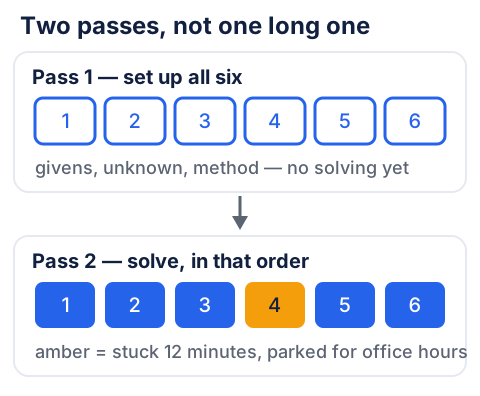
Three things change. You pay the entry cost once instead of six times. You finish six setups in the first half hour, which is the only reliable way to make a long task feel like it is moving. And you find out on Monday which problem you cannot do, while office hours still exist — rather than at eleven o'clock the night before.
Set a stuck cap of twelve minutes per problem. Twelve minutes without forward movement, you mark it, write one line about where it broke, and go to the next one. Grinding on a stuck problem is where a set quietly doubles in length.
A draft with no visible end
Two things make essay drafting hostile: the blank page, and the fact that a 1,200-word essay has no internal milestones. You can work for forty minutes and have no evidence that anything happened.
Outline in claims, not topics. "Section 2: causes of the Dust Bowl" gives you nothing to type. "Section 2: federal relief arrived after the migration had already started" gives you a first sentence, because it is already an assertion you have to defend. Our guide to outlining an essay covers the mechanics; the ADHD-relevant part is that a claim outline removes the decision you would otherwise have to make at the top of every section.
Then three rules for the draft itself:
- Write out of order. Start with the section you have the most to say about. Introductions are the hardest paragraph in the essay and there is no reason to face one first.
- Never leave the document to find a citation. Type
[CITE — author, page?]and keep going. Opening a database mid-sentence costs you the thread, and recovering the thread is the expensive part. Do one lookup pass at the end. - Give every section a word budget. 250 words for section two is a finish line. "Write section two" is not.
An exam three weeks out
Distance is the problem here, not difficulty. An exam three weeks away generates no urgency, so preparation starts the night the urgency finally arrives.
Build the test instead of reviewing for it. Take the learning objectives on the syllabus, the problem sets, and any study guide, and convert them into questions — the same week you cover the material, not the week of the exam. By exam week you own a question bank you can test yourself against rather than a pile of notes you can reread.
Then space it: three 40-minute passes on three separate days beat one two-hour pass, both because distributed practice is one of the two high-utility techniques and because 40 minutes is a much smaller thing to start. Score each pass. A number that moves from 11/20 to 16/20 is feedback; an hour of highlighting is not.
Stop guessing how long things take
The standard advice is "add 20 to 30 percent to your estimate." That is somebody else's number. Given how consistently the timing research finds estimation errors in ADHD, the better move is to measure your own — and it takes two weeks of one extra line per task.
Before each task, write your estimate. When you stop, write the actual. Nothing else. After two weeks you divide. Three rows from a sample log look like this:
| Task | Estimated | Actual | Ratio |
|---|---|---|---|
| Reading, chapter 7 | 60 min | 105 min | 1.75 |
| Problem set 4 | 90 min | 150 min | 1.67 |
| Essay introduction (400 words) | 30 min | 75 min | 2.5 |
| Average multiplier | 1.97 |
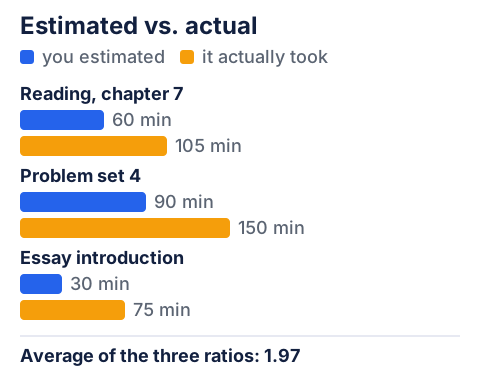
A multiplier near 2.0 is not a character flaw; it is a planning input. It means the four-hour Saturday you sketched is really an eight-hour Saturday, and you can decide that now rather than discovering it at 6 p.m.. Two practical notes on running the log:
- Record the actual before you stand up. Reconstructed times are guesses, and guessing is the thing you are trying to fix.
- Split the multiplier if the numbers split. Writing tasks often run a much worse ratio than reading or problem sets. If yours do, keep two multipliers, not one.
Feed the result into whatever you already use to plan the week — a tracking system you will actually maintain, or one of these assignment tracker templates if you would rather start from something built.
Accommodations: what changes the day you start college
This is the section the ranking pages leave out, and for a lot of readers it matters more than any technique above. More than half of US adults with an ADHD diagnosis — 55.9 percent, in CDC data published in MMWR in October 2024 — received that diagnosis at age 18 or older. If yours arrives during a degree, you meet this system for the first time with no high-school experience of it to fall back on.
The system also inverts between high school and college.
| Question | High school | College |
|---|---|---|
| Who identifies the disability? | The district has to find and evaluate you | Nobody. You tell the school. |
| What counts as documentation? | Your IEP or 504 plan | Current documentation from a qualified professional; an IEP alone is generally not enough |
| Who keeps it running? | The team, once it is written | You — at most schools, a fresh request each term |
| Can it be applied backward? | The plan runs continuously once written | No. An adjustment applies from the date it is approved, never to a test you have already taken |
That first row is the one that catches people. The Department of Education's Office for Civil Rights states the position plainly in its pamphlet Students with Disabilities Preparing for Postsecondary Education: Know Your Rights and Responsibilities: a postsecondary school is not required to identify you as having a disability or to assess your needs, so you have to inform the school and ask.
It is equally worth knowing what an accommodation is not. Under 34 CFR 104.44, a college modifies academic requirements as necessary — but requirements it can demonstrate are essential to the instruction, or to a directly related licensing requirement, are not treated as discriminatory and do not get modified. Extended time on an exam, yes. A lower bar on the exam, no — the standard you are assessed against does not change. Typical adjustments named in the OCR guidance include priority registration, a reduced course load, course substitutions, note takers, recording devices and extended testing time.
What registering gets you
- Extended exam time, a low-distraction testing room, or both
- Note takers or permission to record lectures
- Priority registration — real leverage if your attention is better at 10 a.m. than at 8 a.m.
- A named staff member who can talk to an instructor on your behalf
What it costs you
- Current documentation, which may mean paying for an evaluation
- Weeks of lead time — this is not a same-week process
- Paperwork every term at most schools, plus sending letters to each instructor
- Nothing is automatic; an approved accommodation you never book does nothing
The most common way an accommodation gets wasted is scheduling. Many testing centers need several days' notice to seat you, and the deadline is often earlier than the exam date you have in your calendar. Ask for the booking window in week one and put those dates in with the exams themselves.
What still goes wrong in week three
Systems built in week one collapse in week three with impressive reliability. These are the four usual causes.
Hyperfocus aimed at the wrong task. Three hours rebuilding your notes app is not studying, and it is unusually hard to interrupt because it feels productive. The fix is procedural: choose the target before you sit down, write it on paper next to you, and set an alarm for the end of the session rather than only for breaks.
Body doubling that turns into conversation. Working alongside someone does help. Working alongside a friend who talks is a two-hour social event with textbooks present. Agree on silence, phones face down, and talking only at the break.
A system that only survives good weeks. If your plan needs 90 focused minutes a day, the first bad week ends it and the guilt makes restarting worse. Build the version that runs on 20 minutes, and treat 90 as the good day rather than the baseline.
The Sunday plan. "I'll do it all Sunday" fails twice: it is one enormous entry with no visible end, and it puts every assignment on the single day most likely to be eaten by something else. Split it across three shorter sessions and the odds change completely.
And sometimes none of this applies, because the week has already gone. Two assignments overdue and a third due Friday is a scope problem rather than an attention problem, and the ADHD-specific trap is spending the evening building a recovery plan instead of doing the smallest overdue thing. Pick the one item that unblocks a grade, do that first, then email each instructor a date you can actually hit — before the deadline, not after it. If the pile is genuinely bigger than the hours left, our writers can take a piece of the backlog and hand it back for you to review and submit, from $7.89 per page. And if the smallest overdue thing turns out to be a whole essay, run that night in hour-by-hour blocks rather than one open-ended session.
Then, once the fire is out, go back to the top of this page and start with one thing: the first physical action, written down the night before. Everything else here is built on that.