Live Chat

These three are not competitors, and you are almost never choosing between them in the abstract. They are the same piece of work at three moments. A research question is what you set out to answer, written before you know the answer. A hypothesis is a testable prediction — a sentence you could turn out to be wrong about, which names what "wrong" would look like. A thesis statement is the arguable claim your finished paper defends, worked out last even though it appears on page one.
So the useful question is not "which is better" but "which stage am I at" — and then, which one this assignment wants. That second answer depends on your discipline and your prompt, not on a universal rule, and no page currently ranking for this comparison assembles the evidence for it.
One clarification first, because the vocabulary collides. A thesis statement is one sentence inside a paper of any length. A thesis, in US usage, is a master's degree document, and its doctoral equivalent is a dissertation. Three objects, two of them sharing a word.
- They are stages, not rivals. Question before the research, hypothesis before the data, thesis statement after the analysis.
- Only a hypothesis can be shown false by a measurement. UNC's Scientific Reports handout: "most hypotheses contain both an independent and a dependent variable."
- A thesis statement is your question, answered. University of Maryland Global Campus: it "Is often your research question reworded as a statement with a position."
- The discipline usually decides. The University of the South: "In the humanities, your main idea will typically result in a thesis statement… In the sciences, you will often articulate your main idea as a testable hypothesis."
- Neither is automatic. UMGC lists "Is not always required when writing a research paper" among a thesis statement's three defining traits, and an exploratory study often needs no hypothesis.
- When the prompt does not say, ask. UNC: "When in doubt, ask your instructor if the assignment requires a thesis statement."
The three, side by side
Read down the "when you write it" row first. That row is the whole distinction; everything else follows from it.
| Aspect | Research question | Hypothesis | Thesis statement |
|---|---|---|---|
| What it is | An open query that focuses the project | A prediction about a relationship between variables | A claim you will defend with evidence |
| When you write it | Before the research | Before you collect the data | After the analysis, then moved to the front |
| Form | A question, ending in a question mark | A statement, often "if… then" or "when x, then y" | A statement, usually one sentence |
| What makes it good | Clear, focused, concise, complex, arguable | Testable, and specific about which variable moves which | Disputable, specific, supported by the paper that follows |
| How it fails | Answerable with yes, no, or a quick lookup | No measurable variables, so no result could refute it | States a fact nobody would argue with |
| Where it appears | Introduction, or a proposal's opening section | End of the Introduction, before Methods | Usually the end of the first paragraph |
Every row comes from a named US source. The five criteria for a research question — "clear," "focused," "concise," "complex," "arguable" — are George Mason University's Writing Center, on a page its research-based-writing index still links and which carries a last-updated stamp of 8 August 2018. The variable requirement and the hypothesis's placement are UNC Chapel Hill's Scientific Reports handout, which lists a lab report's Introduction as "the purpose, the scientific literature relevant to the subject, the hypothesis, and the reasons you believed your hypothesis viable." The disputability test is UNC's Thesis Statements handout; the first-paragraph placement is Purdue OWL.
The same topic, written all three ways
A table gives you the categories. It cannot show how one sentence becomes the next, so here is a single project in all three forms.
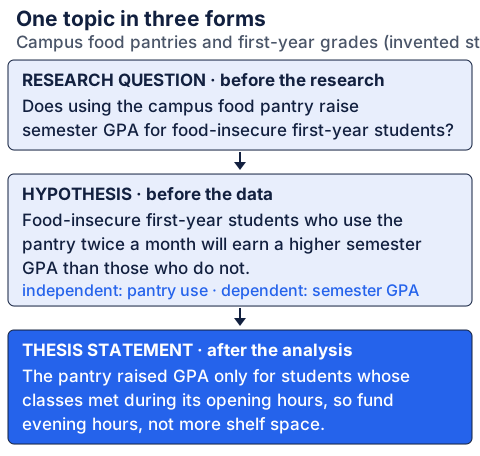
The study in this section does not exist. There is no dataset, no college and no finding here — the food-pantry result is invented for this walkthrough so you can see what a thesis statement looks like once a question has actually been answered. Nothing in this section is a claim about food pantries, food insecurity or grades. Only the shape of the three sentences is the point.
As a research question: Does using the campus food pantry raise semester GPA for food-insecure first-year students? Notice what is missing — no prediction, no direction, no position. It meets George Mason's "complex" test because it cannot be closed with a yes or no.
As a hypothesis: Food-insecure first-year students who use the pantry twice a month will earn a higher semester GPA than those who do not. Now there is a direction and two named variables: "The independent variable is what you manipulate to test the reaction; the dependent variable is what changes as a result of your manipulation." Direction is the part students drop. UNC labels "there is a significant relationship between the temperature of a solvent and the rate at which a solute dissolves" as not a hypothesis, and "as the temperature of a solvent increases, the rate at which a solute will dissolve in that solvent increases" as one. A relationship is not enough; you have to say which way it runs.
As a thesis statement: The pantry raised GPA only for students whose classes met during its opening hours, so fund evening hours, not more shelf space. This could not have been written at the start. It is narrower than the hypothesis, it takes a position a reasonable reader could contest, and it commits the paper to defending a specific recommendation — UNC's standard exactly: a thesis statement "makes a claim that others might dispute," and it "directly answers the question asked of you."
A thesis statement is not a thesis
- A thesis statement is a single sentence stating a paper's central claim. A three-page response paper has one. So does a 200-page dissertation.
- A thesis, in US academic usage, is the capstone document of a master's degree.
- A dissertation is the equivalent at the doctoral level. British and Australian universities frequently reverse those two labels, which is why so much online advice contradicts itself. If you study in the US, use the US convention.
Our guide to what a thesis actually is covers the degree document; everything in this article is about the sentence. The slippage is not a student invention, either. The Richard G. Trefry Library at American Public University System warns in a FAQ last updated 15 April 2022 that "In some disciplines, the hypothesis is referred to as a thesis statement! This is not accurate but within those disciplines it is understood that 'a short, direct sentence that summarizes the main point' will be included." So read your prompt for what it wants the sentence to do, not for the label on it.
Which one does your assignment actually want?
This is the question most comparison pages answer in a single line, if at all, and the honest answer is that it depends on your discipline and your specific assignment. There is no universal rule, and a page that gives you one is oversimplifying.
The disciplinary pattern is real, though. The duPont Library at the University of the South, in a guide last updated 10 September 2025, splits it in two sentences: "In the humanities, your main idea will typically result in a thesis statement which will guide your paper. In the sciences, you will often articulate your main idea as a testable hypothesis." The sentence right after it cuts against reading that as two separate worlds — the guide adds that "Each way of articulating your main idea requires a slightly different approach, but both types of main ideas require two decisions on your part," and then names the same two decisions for both.
The social sciences sit between them. USC Libraries' Organizing Your Social Sciences Research Paper, updated 11 August 2026, describes their introduction as "stating the purpose of the work in the form of the research problem supported by a hypothesis or a set of questions." That "or" is doing real work: the field accepts either framing. Also worth noticing is what USC's anatomy of a social-science introduction never mentions — a thesis statement.
| If your assignment is… | It most likely wants… | Because |
|---|---|---|
| A lab report or experimental write-up | A hypothesis | The Introduction states it and the Discussion evaluates it; without one, the Results have nothing to speak to |
| A literature paper, history essay or argumentative essay | A thesis statement | There is no variable to measure, only an interpretation to defend |
| A research proposal, or the opening of an empirical study | A research question — plus a hypothesis if you are predicting an outcome | You are describing work you have not done yet, so you cannot state a finding |
| A social-science term paper | Either a research question or a hypothesis; check the prompt | The field's own style guidance accepts both framings |
| An exploratory or qualitative study | A research question, and often no hypothesis at all | There is nothing to predict from yet, which is the point of the design |
That last row earns its own sentence, because students routinely invent a hypothesis they do not need. USC defines an exploratory design as one "conducted about a research problem when there are few or no earlier studies to refer to or rely upon to predict an outcome," and notes that such research "is often used to generate formal hypotheses" rather than to test them. If the literature gives you nothing to predict from, a prediction is not rigor — it is decoration.
Texas A&M's Writing Center states the underlying difference cleanly in its Hypotheses guide: "Because hypotheses are formed from a basis of knowledge about the topic you are researching, a hypothesis is distinct from a research question, which can be posed with only subjective preconceptions or even without any inkling as to what data might show." A question may come from curiosity. A hypothesis has to come from something you already know.
When the prompt is silent, these sources converge on the same unglamorous instruction. George Mason's hedge is mild — "you may want to discuss your ideas for a research question with your professor." UNC is blunter, and explains the silence: "The assignment may not explicitly state that you need a thesis statement because your instructor may assume you will include one. When in doubt, ask your instructor if the assignment requires a thesis statement." Your rubric is the other place to look, since it usually names the thing it is scoring — reading a rubric properly often answers this before you have to email anyone.
Three checks that identify the sentence in front of you
If you have already written something and cannot tell what it is, test it rather than classify it. The three checks below are ours — a working summary of the definitions above, not a published test from any institution.
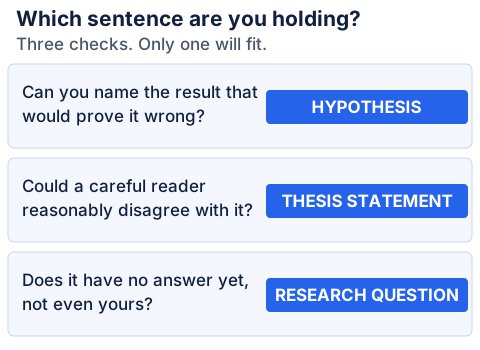
Can you name the result that would prove it wrong? If you can describe a measurement that would refute the sentence, it is a hypothesis. Texas A&M's framing: "You either show it to be verifiable, in which case you accept it, or to be falsifiable, in which case you reject it."
Could a careful reader reasonably disagree with it? If no measurement settles it but an informed person could argue the other side, it is a thesis statement.
Does it have no answer yet — not even yours? Then it is a research question, and the work has not started.
Sentences that fail all three are the useful diagnosis. "This paper will examine the causes of student food insecurity" fails every one: nothing could refute it, nobody would dispute it, and it asks nothing. That is a topic announcement wearing the costume of a thesis statement. If that is what you have, our thesis statement templates and examples are the next step.
"Proved," "disproved," and the trap in between
One last trap is a vocabulary one, and two authoritative pages appear to contradict each other on it. The APUS library FAQ describes a hypothesis as "a statement that can be proved or disproved" — a fair account of what kind of claim it is. But UNC's Scientific Reports handout steers students away from those exact words in a write-up: "you may want to say that the hypothesis was 'proved' or 'disproved' or that it was 'correct' or 'incorrect.' These terms, however, reflect a degree of certainty that you as a scientist aren't supposed to have." UNC's replacements are "supported," "indicated," and "suggested."
Neither page mentions the other, and read together they are right about different things. A hypothesis must be the kind of claim that evidence could overturn; that is what makes it a hypothesis rather than an opinion. Your Discussion section still should not announce that you proved it. Keep the logic strict and the write-up modest.
Turning a question into a hypothesis into a thesis statement
This sequence is genuinely ordered, and skipping the first step is the most common way a research paper goes wrong. City Colleges of Chicago devotes a whole library guide to the reason, updated 30 June 2026: starting from a thesis statement "presupposes that you already know enough about your topic to have not only a well-informed opinion, but the most up-to-date and expert opinion possible on the matter," and it "builds your own biases into your search and limits your findings only to the ones you expected to find in the first place."
Turn the assigned topic into an open "how" or "why" question. If the prompt is not phrased as one, UNC suggests rephrasing it: "'Discuss the effect of X on Y' can be rephrased as 'What is the effect of X on Y?'" That rewritten question is what your thesis statement will eventually answer.
Texas A&M's condition is the gate: a hypothesis is formed "from a basis of knowledge about the topic you are researching." If the reading gives you no basis, you have an exploratory project — skip to the last step with the question intact.
Name what varies and what you will measure as a result, and say which direction you expect. Then check that some possible result would refute it. If nothing could — if every outcome is compatible with the sentence — it is not yet a hypothesis, and rewriting it usually means being more specific about what you are comparing.
Write the answer as a position rather than a summary — UMGC's phrasing is the cleanest description of the move: a thesis statement "Is often your research question reworded as a statement with a position." Then move it to the front, where UNC and Purdue OWL both expect to find it, typically closing your first paragraph.
Purdue OWL's refinement: an analytical paper "breaks down an issue or an idea into its component parts"; an expository one "explains something to the audience"; an argumentative one "makes a claim about a topic and justifies this claim with specific evidence." One finding, three different sentences.
What to do with your assignment sheet today
Find the line in the prompt that names what you are supposed to produce, and read it for the verb rather than the noun. If it says test, predict, measure or compare groups, it wants a hypothesis. If it says argue, analyze, interpret or take a position, it wants a thesis statement — UNC's list is nearly identical: "When an assignment asks you to analyze, to interpret, to compare and contrast, to demonstrate cause and effect, or to take a stand on an issue, it is likely that you are being asked to develop a thesis and to support it persuasively." If it says investigate, explore or propose, it wants a research question, and possibly nothing else.
If the prompt names none of those, check the rubric, then ask — that is not a failure of preparation, it is what UNC and George Mason both explicitly advise. Once you know which sentence you owe, our walkthrough of how to write a research paper step by step covers building the rest of the paper around it.
And if the harder problem is the research rather than the sentence, our research paper writing service works alongside you — sharpening the question, checking whether a hypothesis is genuinely testable, and drafting sections you review and revise as your own. The argument stays yours, because it has to be.