Live Chat


Almost every page of "winning scholarship essays" has the same two holes in it. You cannot check who wrote the essay, and you are never told what it was scored against. So you read a nice piece of writing and learn nothing about why it beat everything else in the pile.
This post fills both holes. The examples below were written for this article, so you know exactly where they came from. And each one is read back against a scoring rubric a real school published in full — two of them, both linked below, one of them current and one of them dated, which turns out to matter. You get the essays, the rubric wording they answer, and the sentence in each draft that is there to answer a top-band descriptor rather than the one below it.
Every essay and paragraph on this page was written for this article by our editorial team. None of them is a student's work, none of them was submitted anywhere, and none of them won anything — no essay here is presented as a real applicant's. The students in them are invented. Do not submit any of this text as your own. Copy the structural moves; write your own sentences about your own life.
- Scholarship essays are scored against criteria, and some providers publish the exact sheet. Minneapolis College prints its Essay Grading Directions on the same page as the application; the National University of Natural Medicine published a 2024-25 scoring rubric with the points printed on every cell.
- Writing craft is the smaller part of the score. "Organization, Spelling, Grammar, Word Count" is one of Minneapolis College's three 10-point criteria, so 10 of a 30-point maximum; Conventions and Mechanics is 10 of the 50 NUNM prints. That leaves roughly two-thirds to four-fifths of both sheets for what you actually say.
- Both sheets climb on detail, not on polish. Minneapolis College moves you from "Does not provide any details or examples" to "minimal details or examples" to "detailed examples." NUNM moves from "Does not include details" to "significant and relevant details." Nothing in either ladder rewards a better sentence.
- The failures are named out loud. NUNM's lowest band for essay content reads, in part, "Uses cliches and generic statements. Poses questions or provides dictionary definitions."
- Nobody can promise you a score. A rubric is applied by a person reading a stack of applications. What a rubric does give you is the vocabulary your reader has in front of them.
What a scholarship reader is actually scoring
Start with the document your reader is holding, because it is published more often than applicants expect. Some community colleges, foundations and university departments publish the reviewer rubric alongside the application, and two of them are worth reading in full before you draft anything.
Minneapolis College prints its "Essay Grading Directions" straight onto its scholarships page, where the application is. Three criteria — "Academic and Career Goals," "Barriers to Persistence and Demonstration of Financial Need," and "Organization, Spelling, Grammar, Word Count" — each scored in four bands: 0-2, 3-5, 6-7 and 8-10 points. The college prints no grand total, but three criteria topping out at 10 each comes to 30.
The National University of Natural Medicine publishes a sheet that does print its total. Three criteria, three bands each — Strong, Developing, Inadequate — and it ends with a printed "TOTAL" out of 50. Conventions and Mechanics is worth 10 at Strong; "Focus, clarity, originality of essay content and development of prompt" is worth 20; "Dedication/commitment and/or leadership in the area of the essay prompt" is worth 20. One caveat we would want stated if we were reading this page rather than writing it: that file is NUNM's 2024-25 sheet, and it is no longer linked from the university's own scholarships page. We quote it as a 2024-25 document, not as this year's.
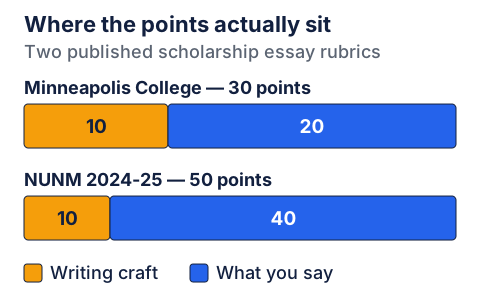
That split is the single most useful thing on either sheet. A polished, error-free essay with nothing specific in it is scoring inside a 10-point row and leaving 20 or 40 points untouched. It also explains how a carefully proofread application can still score badly. Clean prose does not earn its own line anywhere on either sheet.
Read the rubric before you read any example, including these. An example is only instructive once you know which cell it is trying to land in. If you have never taken one apart, our guide to reading a rubric line by line covers the mechanics.
One honest limit before the examples. We are not scoring these drafts and neither should anyone else — a rubric is applied by a person, and no page on the internet can tell you what a committee will decide. What follows is narrower and more useful: which descriptor each paragraph was written to answer, quoted from the sheet.
Example 1: a barrier, a money problem and four goals, 572 words
This one is built for the Minneapolis College rubric, because all three of its criteria are scored out of the same piece of prose. We did not have to invent the prompt either: on the same page, the college answers "What should I write in my essay?" with three instructions — "Tell us about your short term and long term goals," "Tell us about personal, financial or any other challenges you are experiencing," and "Review the essay rubric above to understand what reviewers are looking for." That third line is the whole argument of this post, printed by the college itself.
The draft below was written for this article by our editorial team. The student does not exist, the essay was never submitted, and it did not win a scholarship.
Written for this article. Not a real applicant's essay, not a winner, not for submission.
The transmission in my car failed on a Tuesday in October, and it took eleven days to find a reliable way back to campus.
I live twenty-three miles from my college, in a township with no bus route. In those eleven days I missed three anatomy labs and the practical that ran in the second of them. Anatomy lab is the one course I could not make up, because the stations are set up for a week and then broken down for the next unit. I finished the term with a C-minus in a class I had been carrying at a B-plus through midterms. The nursing program screens at a 3.0. I finished the year at 2.87.
The repair quote was nine hundred and forty dollars and I had two hundred. I work twenty-four hours a week at a pharmacy, and after rent and utilities that leaves me forty to eighty dollars in a good month, so the transmission went onto a credit card at twenty-six percent and I am still paying it down. It is also why I am on the college's tuition payment plan and why I skipped the summer microbiology section that would have put me a term ahead.
What I did afterward is the part I would want a reader to weigh. I could not fix the transmission, so I changed the schedule instead. I moved both lecture courses online for spring and kept only the section that needs a physical room. I traded shifts at the pharmacy where I work so my Tuesday and Thursday mornings are clear. I asked a classmate who lives four miles from me whether she wanted a standing carpool, and we now split gas two ways instead of each of us guessing.
My short-term goal is arithmetic. I need to retake anatomy and earn an A, finish microbiology and statistics by next spring, and raise my cumulative average from 2.87 to at least 3.2 before the nursing application closes in February. That is fourteen credits across two terms while working twenty-four hours a week. I have already registered for eleven of them. My short-term career goal sits in the same window: I am one exam from the pharmacy technician certification my employer pays for, which moves me from the front register to the counter — a raise, and two years of patient contact before I ever apply to nursing.
My long-term goal is a bachelor's degree in nursing and a job in a rural emergency department, and I picked that for a reason I can defend. The pharmacy I work at is the only one within nine miles. A good share of my shift is spent explaining discharge instructions that somebody forty minutes away wrote too quickly. I want the license that lets me answer those questions at the other end of the drive.
The qualities I will need are not mysterious to me, because the transmission already tested two of them. The first is planning far enough ahead that one failure cannot take a whole term with it, so I now keep a two-week buffer on every assignment and a backup ride for every lab day. The second is asking for help earlier than feels comfortable. I waited more than a week before telling my instructor why I was absent, and by then the practical was gone. The nursing sequence does not leave room for me to make that mistake twice.
Barriers and financial need: the criterion with two halves
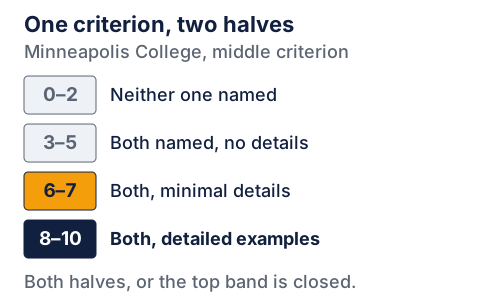
This is the row applicants lose points on without noticing, because its name is doing more work than it looks like it is. Minneapolis College's 3-5 and 6-7 bands both require "at least 1 personal and 1 financial challenge that negatively impact the applicant's ability to prioritize their education." The 8-10 band asks for "1 or more personal and 1 or more financial challenges … and includes detailed examples of these challenges."
Two separate demands sit in that sentence. The first is coverage: name a personal barrier and a money problem. A moving essay about a car breaking down, with nothing about what it cost, has answered one half of a two-half criterion and cannot reach the top band however well it is written. That is why the draft above spends its third paragraph on the repair quote, the credit-card rate, the payment plan and the microbiology section that got skipped.
The second demand is detail, and above zero it is the only thing that moves: "Does not provide any details or examples" at 3-5, "Provides minimal details or examples" at 6-7, "includes detailed examples" at 8-10. Note also that the rubric ties both halves to one test — whether they "negatively impact the applicant's ability to prioritize their education" — so a hardship with no stated consequence for schooling is doing less than it looks like it is doing.
Academic and Career Goals: four goals, not two
The first criterion is a counting exercise before it is a writing one. Its 3-5 band asks for "at least one short-term and one long-term academic goal and 1 short-term and one long-term career goal" — four goals, and most drafts supply two. The top band, 8-10, wants those four "identified and explained," with "adequate examples of the skills, strengths, and/or personal qualities needed to achieve goals," and it adds a requirement that is easy to read past: the essay must include "the applicant's skills, strengths and/or qualities that will contribute to their success." Not the qualities the goal demands in the abstract. Yours.
So the draft carries all four. Short-term academic is the anatomy retake and the 3.2 by February; long-term academic is the nursing degree; short-term career is the pharmacy technician certification that is one exam away; long-term career is the rural emergency department. All four are explained rather than just named — the long-term pair carry a reason, and two of them carry a number or a date, which is what "explained" looks like to a reader with thirty of these to get through. "I want to become a nurse and help people" is the same goal with the scoreable part removed.
That last requirement is what the final paragraph is for. It names two of the applicant's own qualities and immediately proves each from the story already told. Planning ahead is evidenced by a two-week assignment buffer and a backup ride. Asking for help early is evidenced by its own failure — the applicant waited more than a week and lost the practical. Naming a quality costs a sentence; evidencing it is what the top band is buying.
Organization, spelling, grammar and word count: one row for all four
Minneapolis College bundles four different things into its last criterion, and the top band spends most of its words on the least glamorous ones: "Essay is well organized and contains appropriate transitions. Ideas are frequently linked to supporting points. There are no significant spelling and/or grammatical errors, and the word count is adequate."
"Ideas are frequently linked to supporting points" is the part you can plan for. The draft earns it structurally rather than with connectors: paragraph one is the incident, two is the academic damage, three is the money, four is the response, five and six are the four goals, and seven is the qualities, which link back to four. Read only the first sentence of each paragraph and the argument still runs in order — a faster self-check than any transition checklist.
The other half of that row is proofreading and length, and it is worth knowing that the college scores "the required word count" without printing a number on this page. That figure lives in the application form, which is the only place it is safe to read it from.
Example 2: a 286-word commitment essay, against a 50-point sheet
NUNM's rubric rewards something different: not persistence through hardship, but demonstrated commitment. Its top band for the third criterion asks for "significant and relevant details, which may include examples from lived experience," and for examples that "clearly show the individual's character, direction, thoughts, and leadership."
The prompt here is ours too, not NUNM's: in 300 words or fewer, describe your commitment to the field you plan to enter and what you have done to demonstrate it. Again, this draft was written for this article. It belongs to no real student and has never been submitted anywhere.
Written for this article. Not a real applicant's essay, not a winner, not for submission.
Every other Saturday since sophomore year I have stood in the same creek with a meter and a clipboard, and that is the least interesting part of why I want to work in water quality.
I joined the county's volunteer monitoring program because it was the only science thing within biking distance. Training took four hours: how to calibrate a dissolved-oxygen probe, and how to log a reading you do not like without rounding it. The second lesson is the one that stuck. In my third month I recorded a phosphorus spike below a culvert and assumed I had contaminated the sample. I ran it again the next week and got the same number. It turned out to be a failed septic line on a property upstream, and the county had it repaired by spring.
Nobody in that story is a hero. What it taught me is that the useful work here is mostly repetition done carefully by people nobody is watching, and that one reading is worthless while forty readings are evidence.
Since then I have recruited five other volunteers, two of whom are now certified to calibrate the probes themselves. I also rewrote our site's data sheet so the columns run in the order you actually take the measurements. Our sheets used to come back with blanks in them. This year they do not. The county coordinator now sends new volunteers to my Saturday before she sends them anywhere else.
I want to study environmental science because I have already spent two years on the unglamorous end of it and did not get bored. I know what the field asks of a person on a cold Saturday in February, and I keep showing up.
Here is the draft laid against all three of NUNM's criteria, using the sheet's own wording. The right-hand column is what the draft was built to answer — not a score, because we cannot award one.
| NUNM criterion | Strong band | What this draft does about it |
|---|---|---|
| Conventions & Mechanics, Followed Instructions | 10 pts | 286 words against a 300-word cap. The sheet penalizes a count "much greater than or lower than specification," so the draft sits just under the ceiling rather than at half of it. |
| Focus, clarity, originality of essay content and development of prompt | 20 pts | Both halves of the prompt are answered — the commitment, and what was done to demonstrate it. The originality is in the phosphorus reading, which is a story only this applicant can tell. |
| Dedication/commitment and/or leadership in the area of the essay prompt | 20 pts | Leadership appears as five recruited volunteers, two new certifications, a rewritten data sheet, blanks gone from the sheets, and a coordinator who routes newcomers to this site. No sentence claims the word "leader." |
That last row is the one worth stealing. NUNM's descriptor asks for examples that "clearly show the individual's character, direction, thoughts, and leadership" — it does not ask you to assert any of the four. The draft never uses the word leadership, and it gives a reader five separate places to point at it.
Example 3: the same claim, written the way a rubric calls inadequate
NUNM's lowest content band is unusually specific about how essays fail, which makes it easy to demonstrate. It reads: "Little evidence of thought and insight. Essay prompts not adequately addressed or reflected upon. Uses cliches and generic statements. Poses questions or provides dictionary definitions. Ideas not developed. Does not include details."
Below are two openings on the same subject — leadership — written for this article to sit at opposite ends of that criterion. Neither is a real applicant's writing. The first was built deliberately to trigger every clause of the Inadequate descriptor.
Both paragraphs written for this article as demonstrations. Not student work.
Version A — 91 words, built to hit the Inadequate descriptor
What does it mean to be a leader? Leadership, by definition, is the act of guiding a group toward a common goal. Ever since I was young, I have been passionate about helping others and making a difference in my community. Leadership is not about a title; it is about action. Through my involvement in various clubs and organizations, I have learned the value of teamwork, dedication, and perseverance. I believe that with hard work, anything is possible, and I am excited to take the next step in my educational journey.
Version B — 80 words, same subject, same student
In March I took over our robotics team's parts inventory, because we had bought the same forty-dollar gearbox three times. I built a spreadsheet, wrote a one-page checkout rule, and made myself the person who says no. We spent about three hundred dollars less this season than last, and I am no longer anybody's favorite person in the shop on a Thursday night. That trade is the part of leading I did not expect, and I would make it again.
Version A is longer and carries less. Line by line it hits the descriptor: it poses a question, it provides a definition, it opens on a childhood-passion cliche, it names three abstractions ("teamwork, dedication, and perseverance") without one instance of any of them, and it closes on a sentence that would fit any application in the country.
Version B contains one month, one object, one dollar figure, one rule, one result and one admission that the result was unpleasant. It never claims a quality. A reader scoring "character, direction, thoughts" has something to point at in every sentence.
The rhetorical opening question is everywhere in scholarship-essay samples online, and one published rubric names it as a failure. If your draft opens by asking the reader something, that is the first sentence to cut. Our roundup of essay hooks that actually work has openings that do the same job without the question mark.
The four moves both rubrics keep paying for
Read the two rubrics side by side and the same four demands surface, in different vocabulary. None of them is about style.
| The move | The rubric wording that buys it | What it looks like above |
|---|---|---|
| Answer every half of every criterion | "at least 1 personal and 1 financial challenge" (Minneapolis College, 3-5 band and up) | The transmission, and the nine hundred and forty dollars it cost |
| Evidence the quality you claim | "adequate examples of the skills, strengths, and/or personal qualities needed to achieve goals" (Minneapolis College, 8-10 band) | A two-week buffer and a backup ride, offered as proof of planning |
| Use lived experience rather than assertion | "examples from lived experience" (NUNM, Strong band) | The phosphorus spike, re-run a week later |
| Obey the instructions exactly | "word count is much greater than or lower than specification" (NUNM, Inadequate band) | 286 words against a 300-word cap |
The fourth is the cheapest score on any sheet and the easiest to lose by accident. NUNM even specifies the header — "the title, word count AND essay question in correct font type and spacing" — which means a fifth of that rubric's total sits in a row you can damage with the wrong file format, before anyone reads a sentence.
Find the rubric you are actually being scored against
The two sheets above are examples, not your criteria. Rubrics vary — one weights financial need heavily, another does not score it at all — and writing to the wrong one is an expensive mistake. Four steps, in order:
Search the provider's site for "rubric," "scoring" or "selection criteria." Start on the page that holds the application, not in a search engine — Minneapolis College's criteria are printed on that page itself, under "Essay Grading Directions."
A search turns up scoring rubric PDFs that still load perfectly and are years out of date. The test is not whether the file opens, but whether the provider's own page still links to it. An older Minneapolis College rubric PDF is still sitting on the college's server with four criteria and five bands; the page above shows three criteria and four bands. Trust the page, not the file.
Where no rubric is published, the prompt is the rubric. A prompt asking for a barrier, a short-term goal and a long-term goal is three scored items, and an essay that answers two of them has left a third of the prompt on the table. Read the criterion names the same way — "Barriers to Persistence and Demonstration of Financial Need" is two requirements wearing one label.
Ask whether reviewers use a scoring sheet, whether it is public, and whether the copy online is current. The answer is often yes, and asking costs one message.
Then do the boring thing: write the criteria down the left side of a page, draft, and check that every criterion has a paragraph pointing at it. Both rubrics above spend two-thirds to four-fifths of their points on content, so a missing criterion costs far more than a clumsy sentence does.
How to use these examples — and what you must not do with them
Take the structure. The first draft moves incident, academic damage, financial damage, response, short-term goals, long-term goals, qualities-with-evidence. That order works for any hardship prompt, and it keeps the money paragraph from turning into the whole essay. The commitment draft moves opening image, origin, the moment that changed something, what you did with it, why the field. Also portable.
Do not take the sentences. Submitting any part of this page as your own work is plagiarism under every US institution's academic-integrity policy, and a scholarship application is a document you sign. The details that make these drafts work — a transmission, a phosphorus reading, a gearbox bought three times — cannot be borrowed anyway, because they only carry weight if they happened to you. For more annotated models in the same family, our personal statement examples are broken down the same way, and how to write a personal statement covers the drafting sequence.
Then give the draft a pass you did not budget for. Read the rubric, list its criteria, write badly, and go back to add the consequence clause to every claim you made. That pass is what the top band of both rubrics is actually asking for. If the deadline has already closed that window, our admission essay help starts at $7.89 per page and begins with the rubric and your own material, not a template.