Live Chat


A rubric is the grading sheet your instructor will use on your work, handed to you before you start. It breaks the assignment into the things being graded — argument, evidence, structure, citations — and describes what each one looks like at every level.
Which makes it the most underused document in a course. Students skim it for the word count and close it. The rubric is telling you, in advance and in writing, exactly how the points will be split. Read properly, it takes most of the guesswork out of a piece of coursework.
- A rubric has four parts: criteria, levels, scores and descriptors — plus, usually, weights.
- Read the top band first. It describes the finished piece you are being asked to produce.
- Weights are a time budget. One band of improvement on a 40% criterion is worth four times the same move on a 10% one.
- Verbs matter: describe, analyze and evaluate are different tasks, and confusing them is the usual way points go missing.
- The middle band on every row is not a top grade. Ask whether the total is your raw score or gets converted.
- Grade your own draft against the rubric before you submit. Ten minutes catches what rereading never does.
What a rubric actually contains
Whatever it looks like, a rubric is built from the same handful of parts. Northern Illinois University's Center for Innovative Teaching and Learning names four: criteria, levels of performance, scores, and descriptors.
Criteria are the rows — the separate things being judged. A coursework essay might be graded on argument, use of sources, structure, and citations. Each row is scored on its own, which means a brilliant argument cannot rescue a missing reference list.
Levels of performance are the columns — also called bands or ratings — labeled A to F, or exemplary to unsatisfactory, or 4 to 1. Scores are the numbers attached to them; descriptors are the sentences inside each cell. Most rubrics add a fifth part that list leaves out: weights. If they are not shown, ask — a rubric without weights is much harder to plan against.
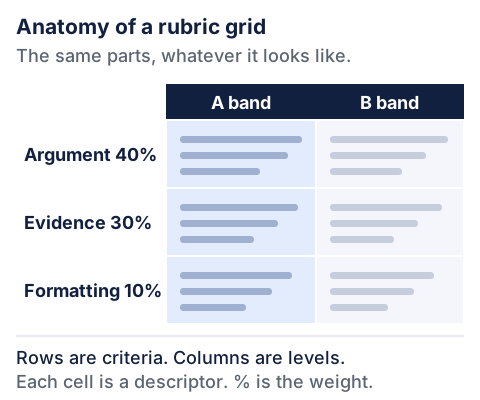
Criterion: Use of evidence (30%)
A band: "Claims are consistently supported by relevant scholarly sources, integrated into the argument rather than appended to it."
B band: "Most claims are supported by appropriate sources, though integration is sometimes uneven."
The gap between those two is not the number of sources. It is integration — whether the evidence is doing argumentative work or sitting there as decoration. That is a concrete instruction about how to write your paragraphs, and it is easy to miss on a skim.
Analytic, holistic, and single-point rubrics
Three shapes cover almost everything you will be handed.
An analytic rubric is the grid above, and most coursework uses it. A holistic rubric gives one overall judgment instead — no rows, just a paragraph describing an A, another for a B. Those turn up on shorter pieces, reflective writing, and discussion board posts. You cannot trade a weak area against a strong one on a holistic rubric, because nothing is scored separately.
A single-point rubric is the one students meet without knowing its name. It prints only the target column — what meeting the standard looks like — with blank space either side for the grader to note what fell short and what went beyond. The format was popularized by Jennifer Gonzalez at Cult of Pedagogy in 2015, and it gives you the least to plan against but the most useful feedback afterward.
| Shape | How to spot it | How to plan against it |
|---|---|---|
| Analytic | A grid: criteria as rows, scored columns, usually weights. | Turn each row into a checklist line; budget time by weight. |
| Holistic | No grid. One paragraph per grade level. | Underline every noun and verb in the top paragraph — those are your criteria. |
| Single-point | One column of standards, blank columns either side. | Treat that column as the pass line, then ask what "beyond" looks like. |
Read the top band first, then read the gap
Most students read a rubric top to bottom, left to right, and take in very little. Read it a different way.
Start with the highest band and read across every criterion, ignoring the rest of the grid. That is a description of the finished piece your instructor wants, written by the person who will grade it.
Then read the band immediately below, and watch what changed. Descriptors are usually written by editing the band above, so the words that appear, disappear or soften between two adjacent cells name exactly what separates good work from excellent work here. In the evidence row above, three pairs of words carry the whole gap: consistently versus most, relevant scholarly versus appropriate, and integrated versus sometimes uneven.
Only then look at the lower bands, and only to check what you are avoiding.
The verbs tell you what kind of thinking is graded
The verb in a criterion tells you what kind of thinking is being assessed. Treating these as interchangeable is the most common reason a well-written piece of coursework underperforms.
- Describe — say what something is. The lowest demand.
- Explain — say how or why it works.
- Compare — set two things side by side on the same terms.
- Analyze — break it into parts and show how they relate.
- Evaluate or critique — judge it against criteria, and defend the judgment.
- Synthesize — combine several sources into a position that is yours.
If the rubric says evaluate and your draft only describes, you can write beautifully and still land mid-band. The fix is structural rather than stylistic: you need a paragraph that weighs something, not another that reports it.
Highlight every verb in the rubric before you plan, then check that your outline has a section doing each one. That is the highest-value five minutes in the whole assignment.
One criterion, three drafts
Advice about "integration" only helps once you have watched it happen. Here is that evidence row — worth 30% — applied three times to one passage of an introductory psychology paper on obedience. The paragraphs were written for this article; the two studies in them are real: Milgram (1963) in the Journal of Abnormal and Social Psychology, and Burger (2009) in American Psychologist.
"Milgram's obedience study is very famous and has been discussed by many psychologists. It showed that people will obey authority figures. Burger also did a study on obedience. Both studies are important to psychology."
Why it sits low: no citations, no numbers, no claim under test. Both sources are named rather than used, and clean sentences will not lift the row.
"Milgram (1963) reported that 65% of participants continued to the maximum 450-volt level. Burger (2009) ran a partial replication and found obedience rates only slightly lower. Both suggest that obedience to authority is durable."
Why it sits mid-band: real citations, specific figures, accurate summary — but the sources sit side by side and the last sentence adds them up. Reporting, not arguing.
"Burger's (2009) partial replication is usually read as confirming Milgram (1963), and its headline result supports that: obedience rates were only slightly lower. But Burger stopped the procedure at 150 volts on ethical grounds, while Milgram reported 65% of participants continuing to 450 volts. The two studies therefore measure different decisions — one refusal point, versus a refusal repeated to the maximum. Burger shows that obedience still begins the same way; he cannot show that it still ends the same way."
Why it reaches the top band: the sources are put against each other, the difference between them is the student's own observation, and the closing claim is one the evidence has earned.
Between the second version and the third, no source was added — no third study, no extra reading. What changed is that the evidence became the reason for a claim instead of the decoration around one.
Where the points actually sit
Almost no rubric guide tells students this part, and it changes how you spend an evening. Take a common setup: four criteria, four levels, 100 points, the top level earning the full weight and the levels stepping down evenly.
| Criterion | Weight | Top band | One band down |
|---|---|---|---|
| Argument | 40% | 40 | 30 |
| Evidence | 30% | 30 | 22.5 |
| Critical evaluation | 20% | 20 | 15 |
| Formatting | 10% | 10 | 7.5 |
| Total | 100% | 100 | 75 |
Two things fall out of that arithmetic, and neither is visible in the descriptors.
First, the middle is lower than it feels. One band below the top on every row — a paper with nothing actually wrong with it — totals 75. If that is your raw score, it is a C. Plenty of instructors do not treat it that way: some scale the total, some set the second band as full credit. You cannot tell from the grid, so ask early.
Second, a band is not a fixed amount of grade. Moving up one band on the 40% row is worth 10 points. The same move on the 10% row is worth 2.5. Both take an evening.
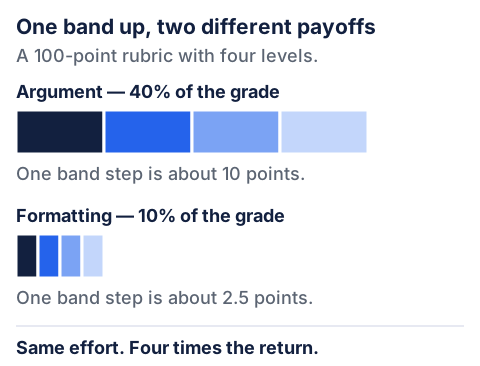
So the last hour before a deadline belongs to the heaviest row you are not yet at the top of. Fixing citation format on the lightest row feels productive because it is finishable. It is worth a quarter of what tightening the argument is worth.
Turn the rubric into a checklist you can work from
A rubric is written in assessment language, not instructions. Converting it is a mechanical job, and it is what makes the document usable.
One line per criterion — the target in your instructor's words rather than your memory of them.
"Claims are consistently supported by relevant scholarly sources" becomes "every claim in the body has a citation, and each one is a journal article or book, not a website."
This is your time budget. A criterion worth 10% does not deserve an evening.
Every criterion needs a section, a paragraph, or a habit you apply throughout. Our guide on how to outline an essay covers the mechanics; the rubric supplies the headings.
Go line by line against the finished draft and give yourself a band on each. Be harsh. The gaps are the points you were about to lose.
Step four is where the method earns its keep. Lay the rubric rows against your outline and one usually has nowhere to go — most often the evaluation row, because "weigh two positions and pick one" is not a topic and suggests no heading. An outline built from the subject never grows that section on its own.
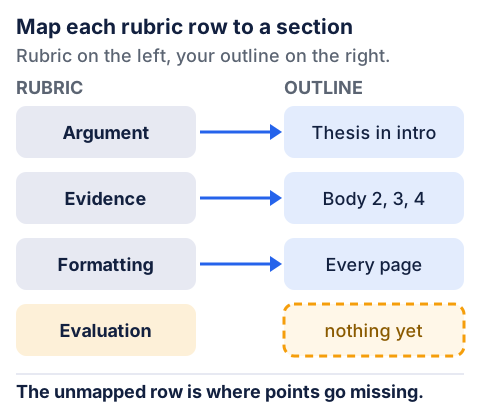
That row needs a line you can act on: three body paragraphs put two sources against each other and say which is stronger, and why — not one paragraph per source. The rubric wording is something to agree with; that version rules out the structure most students default to.
Where students still lose points with the rubric open
Having the document is not the same as using it. These patterns show up in graded feedback again and again.
| What went wrong | The tell in the feedback | The fix |
|---|---|---|
| Outlined from the topic, not the criteria | "Interesting, but not quite what was asked" | Map every row to a section before drafting |
| Described where the rubric said evaluate | "Needs more analysis"; "too descriptive" | Add paragraphs that weigh two things and choose |
| Spent the evening on the lightest row | Immaculate formatting, mid-band argument | Budget hours by weight, not by what feels finishable |
| Read the top band as a length target | "Repetitive"; "padded" | Bands describe quality, not word count |
| Missed a criterion completely | One row scored at or near zero | Count your sections against the rubric's rows |
Three edge cases are worth knowing before they surprise you. Some rubrics carry a gate row — citations, word count, an honesty declaration — scored pass or fail rather than banded, where failing caps the whole grade. Group assignments often add an individual-contribution row, so a strong team product does not carry you. And a top band written in purely relative language — "exceeds expectations", "outstanding" — carries no information. That is a question for office hours, not something to interpret.
What the rubric does not decide
Fixed by the rubric
- What is being judged
- How the points are split
- What each level looks like
- Which skills must appear somewhere
Still your call
- The shape of the argument
- How many paragraphs, in what order
- Which sources you choose
- Which course framework you apply
"Well organized" does not mean five paragraphs. Formatting rules — citation style, margins, title page — usually live in the syllabus or the brief rather than the rubric, and our guide on how to format a college essay covers that side. A rubric also cannot tell you what your instructor personally values. If a course spent three weeks on one framework, use it, whether or not a criterion names it.
It happens more than it should — a brief asking for 2,000 words and a rubric describing a report structure, or two documents naming different citation styles. Do not pick one and hope. Ask, in writing, and keep the reply. Graders are used to the question.
Plenty of assignments arrive with no rubric, and you can reconstruct most of one. Underline every verb in the brief. Check the syllabus for the department's generic grade descriptors, which most publish and few read. Read the feedback on your last piece for the course; it tells you what this instructor notices. Still unsure what carries the most weight? Ask which two things matter most.
Grade your own draft, then read the rubric that comes back
Rereading your own draft mostly catches typos, because you already know what you meant. Scoring it against someone else's criteria makes you read as a grader instead of an author. Six questions:
- Point at the sentence that satisfies each criterion. If you cannot point, it is not there.
- Give yourself a band on every row and write the reason in four words.
- Check the heaviest row first. Is it genuinely top band, or only not-bad?
- Count your sections against the rubric's rows. Nothing unmapped.
- Check each criterion's verb against what your paragraphs actually do.
- Fix the highest-weighted row you scored below the top. Then stop.
Then read the rubric again once it is graded — the most useful document you will get all term, and the one most students close after checking the total. In Canvas and most other course platforms, the graded rubric shows the band chosen on every row plus any comment attached, so you can see which criterion cost you and how much.
Keep those row scores across three assignments in one course. One low row is a bad week; the same row low three times is a skill you have not built yet, and it belongs at the top of the next checklist. On longer work — a case study paper, a report with a formal structure — run the check at the halfway point too, because criteria that seemed obvious while planning go quietly unmet by page ten.
If the workload has genuinely stopped being survivable, our coursework writing help works the same way this article does: your writer starts from the rubric you upload, maps every criterion to a section, and checks the finished draft against it before delivery. Pricing starts at $7.89 a page.