Live Chat

Most reflection papers fail in the same place. The writer describes what happened, describes it well, and never gets to why it mattered. The paper reads like a diary entry with better punctuation, and the grade reflects that.
Getting from description to analysis is the whole skill. This guide is built around that one move: what the levels above description are, what each adds to the same moment, and how to lift your draft up a rung.
- A reflection paper is analysis of an experience, not a record of it.
- Reflection rubrics grade in levels, and in the four-level scheme below, plain description is level one — defined as not reflection at all.
- Budget roughly one part description to three parts analysis. Most drafts invert it.
- First person is expected here, unlike most academic writing — but "I felt" is a starting point, never the evidence.
- Connect the experience to course concepts by name; that link is usually where the grade is decided.
- Honest difficulty beats a tidy success story.
What the assignment is actually asking for
The University of Southern California's research guide defines reflective writing as identifying, questioning, and critically evaluating a learning opportunity, then describing how that produced new understanding of the course content. The most useful part of that page is its list of what a reflective paper is not: not a mind dump, not a research paper, not a book review, not an all-inclusive meditation.
Those four negatives are the fastest sanity check on a draft. Highlight every sentence that only reports — what you did, what the reading said, what the schedule was. If most of the page lights up, you have written a summary with feelings attached.
The positive test is shorter: a reader should be able to point at the place where your thinking changed, and at the evidence that changed it.
The move that decides the grade
Your instructor is grading against some scheme, whether or not the rubric reaches you. Which scheme depends on the program — DePaul University's Teaching Commons gives faculty two models for assessing reflection: Hatton and Smith's (1995) four progressive levels, and Ash and Clayton's (2004) guided process, built for service learning, which is not a ladder of levels at all. This guide works from the Hatton and Smith four, because its levels name the exact step most drafts miss. Level one is defined there bluntly: it "is not reflection, but simply describes events that occurred with no attempt to describe 'why.'"
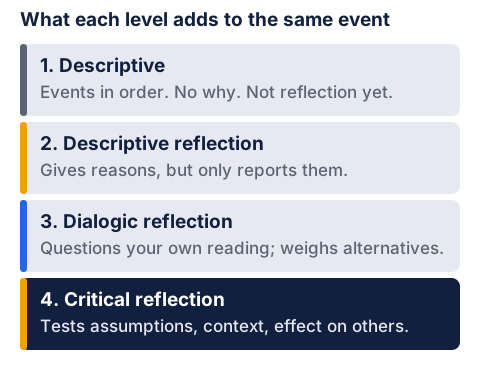
Here is one moment written at each level. The event never changes; the thinking does. The scenario is written for this article, not a real patient.
"During my placement I was asked to explain a care plan to a patient who did not speak much English. I used simple words and spoke slowly. The patient nodded and I moved on to the next task."
"I used simple words and spoke slowly because her English was limited. She nodded, so I was satisfied she had followed it, and I moved on because the unit was busy and two other patients were waiting."
"I used simple words and spoke slowly, and the patient nodded. Afterward I realized nodding was not comprehension — I had checked whether I felt understood, not whether she had understood. My confidence came from my own performance, not from any evidence about hers."
"Afterward I realized nodding was not comprehension. This is the failure the teach-back method exists to prevent: without asking her to restate the plan in her own words, I had no evidence at all. It also shows why interpreter provision is a safety issue rather than a courtesy — the course framed it as a rights question and I had filed it as an administrative one. That filing cost me nothing. If she had followed the plan incorrectly, the consequence would have landed on her, and my confidence would have been the reason."
Level 2 is the rung that trips people up. It has reasons in it, it sounds thoughtful, and it is still reporting: every reason is accepted, not examined. DePaul's wording for it is exact — description that "includes reasons, but simply reports reasons." Most drafts returned as "too descriptive" are sitting here, not at level one.
Level 3 turns the question on the writer. Level 4 adds what the scheme calls critical: context, and the effect on somebody other than you. It is not more eloquent than level 3 — it is more uncomfortable.
Level 4 lands on something real. Teach-back — Tool 5 in AHRQ's Health Literacy Universal Precautions Toolkit, now in its third edition — asks the patient to restate the plan in their own words. A nod answers a different question. Naming the method that explains your specific error beats a paragraph of general regret.
The three questions underneath most models
Reflective models multiply endlessly, and most of them are asking these three things, broadly in that order.
The event, briefly and factually. Short. This is context, not the paper.
What did it reveal — about the situation, your assumptions, the gap between theory and practice? This is the largest part.
What changes as a result. Something specific you will do differently, not a resolution to "be more aware."
Those three questions come from Terry Borton's 1970 framework, developed for professional practice by Driscoll (1994) and by Rolfe, Freshwater and Jasper (2001). If your brief names another model, use its vocabulary — instructors look for it — but map it onto this spine where it fits.
| Model | "What happened?" | "So what?" | "Now what?" |
|---|---|---|---|
| Gibbs (1988), six stages | Description, Feelings | Evaluation, Analysis, Conclusion | Action plan |
| Kolb (1984), four stages | Concrete experience | Reflective observation, Abstract conceptualization | Active experimentation |
| Rolfe, Freshwater and Jasper (2001), three stages | What? | So what? | Now what? |
The alignment in the last three columns is ours, not something the authors published — but it is why a Gibbs paper and a Kolb paper look alike. Both spend one or two stages on the event, two or three on the thinking, one on what changes. Schön's split between reflection in action and on action describes when you reflect, not a structure.
One paragraph per Gibbs stage, with the stage name as a subheading, is the most common way a model makes a paper worse: Feelings swells and Analysis ends up as long as Description. Use the model to check coverage, then write in proportion.
Which kind of reflection you have been set
Most guides assume you are on a placement. Plenty of reflection assignments are not. USC's guide splits them in two — reflection on course readings and on course experiences — and a third kind arrives at the end of a term, when you reflect on your own work. Each changes what counts as "the event."
| Assignment | What you describe | Where the analysis attaches | The failure mode |
|---|---|---|---|
| A reading, film or lecture | One passage or claim, quoted or paraphrased briefly | What you believed before, and what the text did to that belief | Summarizing the reading |
| An experience: placement, lab, service learning, group project | One short moment — minutes, not weeks | The gap between what the course taught and what actually happened | Narrating the whole placement |
| End of course or portfolio | Two or three pieces of your own work, with dates | How your thinking changed, evidenced by the work itself | Listing everything you did |
The portfolio version has its own trap. "I have grown as a writer" is unfalsifiable; "my week-two paragraph gave three reasons and cited none, my week-nine paragraph gives one and defends it" is the same claim with evidence under it. Quote your own earlier work.
Choosing the moment
The instinct is to pick the day everything went well. That is usually the weakest choice, because a success that confirmed what you already believed has little to analyze.
The best material is a moment where something surprised you, where expectation and outcome came apart, or where you acted and only later understood why it was wrong. Discomfort is analytically rich. Smoothness is not.
Pick a small moment, not a whole placement. Five minutes examined closely beats six weeks summarized. Scope is the most common structural mistake in reflective writing.
When nothing went wrong
Nothing has to have gone wrong. What you need is a moment you cannot fully explain, and three usually exist: a time something worked and you are not sure why; a time you were right for the wrong reason; and a question you decided not to ask. The last is richest, because the decision not to ask is yours and it has a motive.
Bringing the course in
A reflection paper is coursework, so it is assessed partly on whether you connect experience to what you were taught.
Name the concept explicitly. Not "I thought about communication," but "this is what the course called a closed question, and it produced exactly the problem the reading predicted." That does two things at once: it shows you understood the concept, and it shows the concept doing real work.
There is a one-step test for whether a concept earns its place: delete its name from the sentence. If the sentence still says the same thing, the concept was decoration.
Where your course expects citations, cite. Reflective writing being personal does not exempt it from referencing — a model you name needs a source like anything else. Reflection papers are often set in APA, and our guide to writing a short assignment in APA format covers those mechanics.
Length, proportion and a word budget
Reflection papers are usually shorter than essays — often 500 to 1,500 words, with the brief setting the real figure. Proportion matters more than the total: a short opening naming the moment, a brief description, a long analysis tied to course material, and a short action specific enough to check.
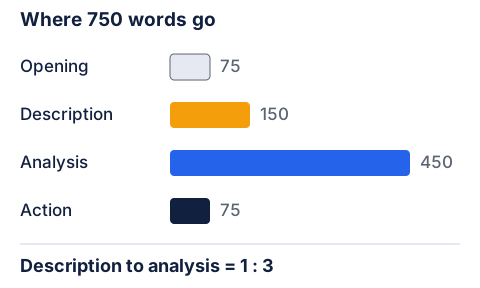
Scale it to your own count: at 500 words that is roughly 50 for the opening, 100 for the description, 300 for the analysis and 50 for the action. Where a brief gives a percentage split, follow that exactly.
Write the description last if you can. Drafting it first almost always makes it run long: the event is what you remember most clearly and it takes no thinking to produce. Outlining before you draft makes the ratio a decision rather than an accident.
Writing in first person, properly
You are allowed "I" here, and you should use it. What you are not allowed is for "I" to replace evidence.
"I felt the meeting went badly" is a report of a feeling. "I felt the meeting went badly, and looking at my notes the reason is that I answered three questions before anyone finished asking them" is analysis. The feeling is the starting point, not the conclusion.
Watch the tense too: description in past, analysis in present. "I assumed she understood" — then — "this shows how easily confidence substitutes for evidence." The shift signals that you have moved from event to thinking.
Hedge honestly rather than defensively. "I think the group went quiet because the task was unclear" is fine if you then say what would tell you whether that is true. "Perhaps, in a sense, it could be argued" is not hedging.
What the comment on your draft actually means
Feedback on reflective work is famously vague, because the fault is usually structural rather than local. Here is the translation.
| The comment | What it usually means | The repair |
|---|---|---|
| "Too descriptive" | You gave reasons but never questioned them — level 2, not level 1 | Take your longest paragraph and add a sentence starting "What I assumed was…" |
| "Where is the course content?" | No concept named, or a concept named but doing no work | Name it, then show it explaining something you could not explain without it |
| "This reads like a diary" | Feelings are stated as conclusions rather than as evidence | After each feeling, add the observation that produced it |
| "Your conclusion is generic" | The action point could have been written by someone who was not there | Replace it with one change bounded by a number or a date |
| "Needs more critical distance" | Every judgment in the paper is about other people | Ask why you acted as you did, not why the situation was as it was |
| "Unsupported" | Claims about what happened with nothing observed behind them | Quote your own notes, a date, or a sentence somebody actually said |
Edge cases most guides skip
The brief bans first person. Some business and engineering courses want third person, or "the author". The analytical move does not change; only the pronoun does. "This raises the question of whether…" carries the weight of "I wonder whether…"
It is a group or team reflection. Reflect on your own decisions. The group is context, not subject, and a paper that grades your teammates reads as deflection. The strongest line is usually about a moment you deferred to someone and should not have.
It is a weekly journal. Journals are graded on the arc. Entry eight should not read like entry one — reference your own earlier entry and say what you now think was wrong with it.
There is no obvious concept to name. In a general-education course, a term from a lecture slide counts, and so does the reading's own vocabulary. If the author has a name for what you experienced, use it and cite them.
Confidentiality. On placement-based reflections, never use real names of patients, clients, students or staff. Most programs require this and some fail work that breaches it — check your handbook before you write.
The tidy ending. "I learned a lot and will be a better practitioner" says nothing. If your conclusion could be pasted into any reflection by any student, rewrite it as one concrete change.
The last pass before you submit
Read the draft once with this list in hand. Every item costs points and takes minutes to fix.
- Description under a quarter of the word count — count it if you are unsure.
- At least one course concept named, surviving the deletion test.
- One sentence where your thinking visibly changes, with its evidence beside it.
- Every feeling has an observation attached — something you saw, heard or wrote down.
- The action point is checkable: a number, a date, or a named situation.
- No real names, and no detail that identifies someone indirectly.
- Tense discipline: past for the event, present for the analysis.
- Nothing in the conclusion that could belong to another student's paper.
Our nursing reflective essay examples show the same move in short clinical extracts, with what each one demonstrates.
If the deadline has stopped working, our coursework writing help handles reflective assignments to your brief and your reflective model, description short and analysis carrying the piece, from $7.89 a page.