Live Chat


A tutor-marked assignment (TMA) is a piece of coursework on a distance-learning course that a named human tutor grades by hand and sends back with written comments, instead of a machine scoring it. It has a published deadline, a fixed share of the course result, and — the part most students underuse — a feedback sheet attached to the grade.
It is not American vocabulary. The Open University in the UK runs a policy under that exact name; the same term turns up in IGNOU's assignment booklets in India and in the Arab Open University's examination bylaws — with different rules attached in each. So if you have hit "TMA" in a handbook, a syllabus, or a forum thread, you are almost certainly reading a document written inside one of those systems. This guide says which rule belongs to which institution, because the answer changes your deadline, your grace period, and how much of your grade is on the table.
- "Tutor-marked" is a contrast, not a description. It separates work a person grades from work software grades. The Open University's paired term is the interactive Computer-Marked Assignment (iCMA).
- Three systems, three sets of rules. On most OU modules, TMAs are due at 12:00 noon UK time with a grace period to 23:59. IGNOU assignments carry 30% of the course result. Arab Open University TMAs are worth a minimum of 20 marks out of 100.
- A TMA can be formative or summative, and the OU says so explicitly: "two types of TMAs and iCMAs" — formative scores that "do not count towards your final module result," and summative scores that do.
- Missing one is usually a zero, not a gap at both the OU and the Arab Open University, the latter with a seven-calendar-day grace on a valid excuse.
- The feedback exists for the next TMA. OU tutors "usually aim to mark and return your TMA within ten working days" of the cut-off date.
- Every one of these systems requires the work to be your own — in each institution's own published words, quoted below.
What "tutor-marked" is actually distinguishing
The phrase only makes sense next to its opposite. Distance-learning universities run two kinds of graded task, and the name of each one says who does the grading.
The Open University's TMA and iCMA Policy — version 2.2, effective 1 July 2025, and still the copy its Help Centre publishes — puts the pair together in one sentence: "The most common continuous assessment tasks are Tutor-Marked Assignments (TMAs) and interactive Computer-Marked Assignments (iCMAs)." The iCMAs are the auto-graded ones: "iCMAs are marked automatically," the policy says, and they are "online assignments made up of a series of questions."
TMAs are the written work. The same policy describes them plainly: "For most modules, you are required to submit written assignments to your tutor. TMAs are usually essays or short-answer questions. They can also include other types of tasks like reports, speaking assignments, or PowerPoint slides."
So a TMA is not a special genre of writing. It is an ordinary essay, report, or problem set, defined by who reads it. Before you go hunting for a "TMA format," there isn't one beyond what your own course specifies. What there is is a rulebook about deadlines, weighting, and feedback — and that rulebook is institution-specific.
Whose term is it, and whose rules are you reading?
Most explanations of the term skip the detail that decides everything: whose rules they are describing. That matters, because these three systems disagree on nearly every number. Here is what each one publishes about itself.
| System | Where | What it publishes about TMAs |
|---|---|---|
| The Open University | United Kingdom | TMAs and iCMAs together make up "continuous assessment." Weighting is set per module by that module's assessment strategy, and feeds an Overall Continuous Assessment Score (OCAS), "a score out of 100." |
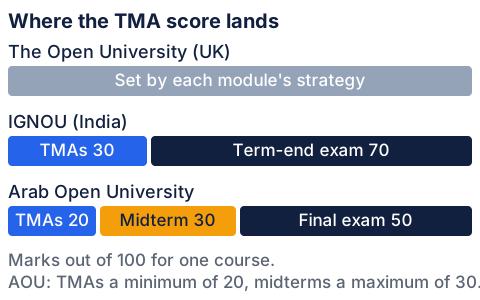
| IGNOU | India | "In the final result, assignments of a Course carry 30% weightage while 70% weightage is given for term-end examination." Three TMAs for a six-credit course, two for a four-credit course. |
| Arab Open University | Headquarters in Kuwait, branches across the Arab world | Course total is 100 marks, "evenly distributed between results of continuous assessment and final examination." Within that half, "Tutor-Marked Assignments (TMAs) constitute a minimum of 20 marks" and midterms a maximum of 30, leaving 50 for the final exam. |
The IGNOU figures come from a current assignment booklet — BPAS-186, for the July 2026 and January 2027 sessions. The Arab Open University figures come from its Degree Award Examination and Assessment Bylaws, approved by University Council No. 82 in October 2024 and still listed on the university's regulations page.
Check the cover of whatever document you are reading, not its file name. One IGNOU booklet published as BEGC-113-BAEGH-2026.pdf is headed "For July 2025 and January 2026 Sessions" — the previous cycle. Distance-learning handbooks are reissued for every presentation, and the deadline inside an old one is simply the wrong deadline.
Formative, summative, or both?
Both, and the Open University says so in as many words. Its policy states there are "two types of TMAs and iCMAs," then defines each:
- Formative assignments — "Any scores you get from formative assignments do not count towards your final module result." The glossary adds the catch: a formative assignment "could still be compulsory, and you might not pass a module if you do not submit it."
- Summative assignments — "Scores for these assignments count towards your final module result." The glossary version: "An assignment where the score counts towards the overall module result, in contrast to a formative assignment."
So "is a TMA formative?" has no general answer. Your module's assessment strategy answers it for your module, and that document is the only place the answer is binding. In practice most TMAs are summative — IGNOU's carry 30% of the course result, the Arab Open University's a minimum of 20 marks — but at the Open University the label belongs to the individual assignment, not to TMAs as a class.
What every TMA carries regardless of label is the teaching function. The Open University puts both jobs in one line: "Your assignments serve two purposes: to help you learn, and to enable us to ensure you have met the module learning outcomes." A summative TMA is still trying to teach you something on its way to the gradebook.
The TMA cycle, stage by stage
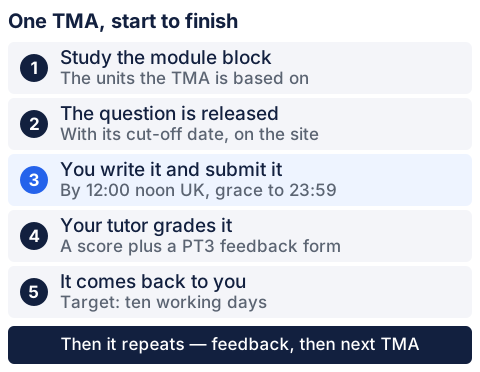
One TMA is a five-stage loop, and the stage students skip is the last one. The sequence below is The Open University's, drawn from its policy; the shape is close enough at IGNOU and the Arab Open University that the habit transfers.
TMAs are tied to specific units of the module, not to the module as a whole. The question is written to test that block, so answering it well is mostly a matter of having read the right chapters rather than the most chapters.
The Open University publishes the question and its deadline on the module website: "The submission cut-off date given on the module website is the last date by which each TMA should be submitted." IGNOU prints the questions and the last date for submission in the booklet itself.
At the OU that means uploading through StudentHome — "TMAs must be submitted online via a link on your StudentHome page" — and waiting for the on-screen receipt. At IGNOU it can still mean paper: "You must obtain a receipt from the Study Centre for the submitted assignments and retain it."
A person reads it. The OU returns a score plus a separate file: "there will be a separate Assessment Summary/TMA form (PT3) file which will contain your tutor's comments," and the tutor "will typically also add comments to your TMA" itself.
This is the stage the cycle exists for. Tutors "usually aim to mark and return your TMA within ten working days of the cut-off date." What you do in the days after that is what makes the next TMA better.
Deadlines, grace periods, and what a late TMA costs
This is where reading the wrong institution's rules gets expensive. The three systems set deadlines on completely different scales — one to the minute, one to the calendar month.
| Rule | The Open University | IGNOU | Arab Open University |
|---|---|---|---|
| Deadline | 12:00 noon UK local time on the cut-off date (most modules) | A single date per session — 31 March 2027 for the July 2026 intake | A due date set by the branch |
| Grace | 12 hours, to 23:59 the same day | Not published in the booklet | Seven calendar days, on an accepted excuse |
| Late without an extension | "may not be marked and you may not get a score" | Submitting on time is what makes you eligible to take the term-end exam | "the student shall receive a zero (0) mark" |
| Extensions | Tutors "can agree an extension of up to 21 days" | Not published in the booklet | By valid excuse, decided by the University |
Two details in that table are easy to misread. The Open University's grace period is not a soft extension — the policy is explicit that it exists "to help you in case you experience technical problems which may delay your submission," and work that arrives after 23:59 "may not be marked." And IGNOU's generous-looking window comes with a hard consequence attached: "you need to submit all the assignments within the stipulated time for being eligible to appear in the term-end examination." Miss it and you are not taking the exam that carries the other 70%.
One qualifier belongs on the OU row, and it is the kind that only shows up if you open every file on the policy page. Alongside the policy the OU publishes an addendum for modules piloting a new submission service — DD126, B293 and K220 from the October 2025 presentation, with a longer list phased in during 2026. On those modules the noon rule is replaced outright: the deadline is 23:59 UK time and "No grace period will be applied," TMAs go through the module website rather than the online TMA/EMA service, and a draft you leave unsubmitted "will be automatically submitted for marking as your final submission." Everything else in the policy still applies to them. Check your own module website before you plan around noon.
One more OU line is worth internalizing if you tend to submit early hoping for an early reply: "Early submission of a TMA does not mean an early return of score and feedback." The ten working days run from the cut-off date, not from your upload. If you are juggling several courses with different cut-off dates, a single tracked list beats memory — our free assignment tracker templates are built for exactly that kind of staggered calendar.
How a TMA score reaches your final result
A TMA score is almost never taken at face value. It is weighted, pooled with your other assignment scores, and only then combined with an exam or end-of-module task. At the Open University the arithmetic is stated directly: "The score you receive for an assignment is multiplied by the weighting (of that particular assignment) to produce the score that will count towards your continuous assessment." Those weighted scores build the OCAS — the Overall Continuous Assessment Score, "a score out of 100." Skip one and the policy is blunt: "You will be given a zero score for any assignment you do not submit."
There is one relief valve, and most students have never heard of it. The OU operates substitution: "Substitution is where a low or zero tutor-marked assignment (TMA) score is automatically replaced with a higher score, calculated based on scores from your continuous assessment." You do not apply for it — "There is no need to ask to have scores substituted. Substitution only takes place if it is to your advantage." But do not plan around it, because the same policy adds that "a small number of modules permit substitution," and your assessment strategy is where you find out whether yours is one of them.
If you think a score is wrong, there is a route and a clock. The OU asks you to email the tutor who graded it "within 14 calendar days of the date your score was returned"; the Arab Open University returns a decision on a reconsideration request "within two weeks (14 calendar days)." Neither promises a higher number — the OU says outright that "a query or subsequent appeal will not necessarily result in an increase to your original score."
The stage everyone skips: using the comments before the next TMA
The single most useful sentence in the OU's policy is buried in a section about delays: "If you have not received your comments within three weeks from the cut-off date of your TMA and you need your tutor's comments to enable you to begin your next TMA, please ask your tutor to send a copy of them direct to you."
Read what that assumes. The university's own procedure takes it for granted that your tutor's comments on TMA 02 are an input to TMA 03 — enough of an input that it tells you to chase them. Most students treat the PT3 form as a receipt for a grade they have already looked up. It is meant to be a brief.
A workable habit, in five moves:
- Read the PT3 before the score sinks in. Open the feedback form first, not the number. Once you know the grade, everything the tutor wrote reads as a justification of it rather than as instructions.
- Separate one-off corrections from repeat patterns. A misread date is a one-off. A note that you describe rather than analyze, appearing across two TMAs, is what is actually costing you the grade.
- Turn the pattern into one sentence you can check against — something like every paragraph must end with a claim, not a summary. That is checkable on the next draft. Analyze more is not.
- Reread the grading criteria with the comment beside it. Tutor comments usually paraphrase a criterion you missed, and seeing them together tells you which one. Our guide to reading a rubric unpacks the standard structure.
- Put that sentence in the outline for the next TMA, not in your notes — the point of intervention is before you draft. Our essay outlining guide covers where a constraint like that belongs.
If comments have not arrived and the next cut-off is closing in, ask. The policy invites it, and the request is routine.
Reading a TMA handbook as a US student
Distance-learning documents from these systems use British and Commonwealth academic vocabulary throughout. None of it is difficult; it is just unfamiliar, and a couple of the terms mean something different in US usage.
| In the handbook | What it means |
|---|---|
| Tutor | The instructor who teaches and grades your module — closer to a US instructor of record than to a peer tutor in a campus tutoring center. |
| Mark / marked / marker | Grade, graded, grader. "A mark of 62" is a score of 62. |
| Module | A course. "Presentation" is the run of that course in a given year. |
| Cut-off date | The submission deadline, often with a time of day attached. |
| Continuous assessment | Everything graded during the course, as opposed to the final exam. |
| Programme | Program — a degree or qualification, not a single course. |
One conversion is worth doing carefully. Open University scores are reported on its own bands rather than a US letter scale, and its published undergraduate scale has a pass mark of 40, with 55 to 69 recorded as a pass. Read a 55 as a US percentage and you will give yourself a bad afternoon for no reason.
Every one of these systems requires the work to be yours
Distance-learning students get targeted harder than most by services promising finished assignments, so it is worth quoting what the institutions themselves require — in their own words, not ours.
The Open University: "when you start to write your assignment you must make sure this is entirely your own work, and you should not share your work with other students." IGNOU, in the booklet that sets the questions: "It is important that you write the answers to all the TMA questions in your own words."
The Arab Open University goes furthest, listing in its bylaws what counts as cheating and plagiarism. Alongside "verbatim copying of printed or Internet material" submitted "as part of TMAs without proper academic documentation," it names one more category outright: "Using paid or unpaid material prepared for the student by individuals or firms."
That last clause is the one to check before you buy anything, and it is not the same rule everywhere. Where your institution's policy reads like the Arab Open University's, buying prepared coursework is a disciplinary matter regardless of who wrote it or how it was cited. Your own handbook, not a blog post and not a vendor, is the document that settles it.
One OU rule also surprises people, because it removes an obvious source of help: "Unless it has been specifically agreed, please do not send your tutor a draft of your assignment for checking." Your tutor grades the submitted version; they are not a proofreader for the draft.
What is left is still substantial, and it is the kind of help that leaves the work yours: study groups, your university's own academic-skills service, model answers you read rather than reuse, and outside support with research direction, structure, and feedback on a draft you wrote. Paid help is a separate category, and it is the one Article 12 above is written about — so it is the one to check your handbook on before you spend anything. Our assignment help researches and writes to a brief and explains the reasoning behind it; what a paid draft may legitimately be used for is set by your institution's rules and not by us, and a service that tells you otherwise is guessing at rules it has not read. Nobody can tell you in advance what a tutor will conclude about a piece of work either, and a service that claims otherwise is selling something it does not control.
The honest summary of a TMA is a short one. It is coursework a person grades and comments on, worth a known share of a known total, due at a published time. The rules around it differ by institution, so read your own — and the comments that come back are not the end of that assignment, they are the first instruction for the next one.