Live Chat

There is no standard scholarship essay format. There is the formatting instruction printed on the application in front of you, and it is the only one that counts. Six US scholarship and essay-award programs, checked against their own published pages, want six different things — and on the single most-repeated rule in every format guide online, spacing, not one of the scholarships among them asks for the double-spacing every guide prescribes.
That is not the answer page one gives. The format posts ranking for this search agree with each other: 12-point Times New Roman, double-spaced, one-inch margins, a header with your last name. Follow that on a Mensa Foundation application and it is thrown out before a reader sees it — not because the essay is bad, but because Mensa takes plain text and no name. Here is what the providers publish themselves, and what to do when yours says nothing at all.
- Spacing is not settled, and double-spacing is not the scholarship default. The Benjamin A. Gilman International Scholarship requires essays "no more than one page single-spaced," Pierce College requires "single-spaced," and Wake Tech's Foundation requires nothing at all. The one "double-spaced" rule in this comparison belongs to a 5,000-word academic essay contest, not to a scholarship application.
- Length is measured in three different units. Words at Gilman (500) and Mensa (550), characters at the Truman Scholarship (2,000, 1,700 and 1,500 per question, and "All character limits include spaces"), pages at Pierce College (one, plus a 400-word cap).
- "No maximum" is a real instruction. Wake Tech's Foundation states essays "must be at least 200 words … but there is no maximum word limit," and that "There are no requirements for font size, margins or spacing." No ceiling is not an invitation, though — the same page says the most successful essays run "about one page in length."
- Three of the six forbid the header page-one advice tells you to add. Wake Tech: "Do not include your name anywhere in your essay." Mensa bars any identifying information. UNL's Wilbur Gaffney award goes further still — not in the file, and not in the filename.
- The file type is part of the format. Word or PDF only at Wake Tech; the Davidson Fellows application states in capitals that Google Docs are not accepted.
- A plain-text box keeps your words and your paragraph breaks. Nothing else. No bold, no italics, no indents, no spacing at all.
Six providers, six different formats
Every rule below is quoted from the provider's own application instructions, not from a scholarship blog. Read the columns down and the pattern is the absence of a pattern.
| Provider | What it caps | Spacing and font | How the essay arrives |
|---|---|---|---|
| Mensa Foundation college scholarship | "550 words or fewer" | None possible — "Submit in English as a plain-text entry (no formatting or markup)" | Typed or pasted into the online form |
| Benjamin A. Gilman International Scholarship | 500 words per essay (300 for the two supplemental awards) | "no more than one page single-spaced, with 1-inch margins, and using Times New Roman 12-point font" | "Compose your essays first in a word processing program, and then upload the file" |
| Harry S. Truman Scholarship Foundation | Characters, per question: 2,000 / 1,700 / 1,500. "All character limits include spaces" | Not specified | "all materials must be submitted on-line" |
| Wake Tech Foundation scholarships | "at least 200 words … but there is no maximum word limit" | "There are no requirements for font size, margins or spacing" | "either a Word document or as a PDF. No other formats are accepted" |
| Wilbur Gaffney Award, UNL English — a departmental contest for a scholarly essay, not a scholarship | "5,000 words or less" | "12 pt font," "black text," "double-spaced," 1" margins | PDF or Word upload, 20 MB limit |
| Pierce College scholarships | "should not exceed one typewritten page," 400 words | "single-spaced," "no less than 10-point font" | Typed, with the application |
Among the five scholarships, the word caps run from 400 to 550 — except that Wake Tech has no ceiling at all and Truman is not counting words in the first place. The 5,000-word row is a contest for an academic critical essay rather than a scholarship, and it earns its place by showing how fast the rules move when the document changes. One provider publishes formatting requirements specifically to say it has none, and one cannot accept formatting at all. There is no version of "the scholarship essay format" that satisfies this table.
The provider's instructions are not a starting point you then improve on. They are the format.
Length: the number is only half the instruction
Length is the rule providers state most often, and the unit changes underneath you. Gilman and Mensa count words. Truman counts characters. Pierce counts a page and words. Wake Tech sets a floor and no ceiling.
Character-counted applications are the ones that catch people out, because a word count tells you almost nothing about whether your text will fit. In ordinary US student prose a word runs to roughly six characters once you count the space after it — our own rule of thumb, measured across our published articles, not a published standard. Close enough to plan with, never close enough to submit on.
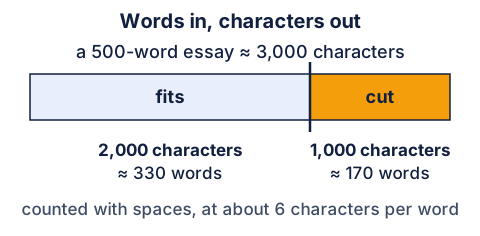
Two consequences. Do your final trim inside the box when the application counts characters, watching the counter as you go. And treat an essay written to a 500-word prompt as unusable in a 2,000-character box until you have cut about a third of it — plan that cut rather than discovering it at 11:50 p.m.
Page limits behave differently again. Pierce College caps the essay at one typewritten page and 400 words, so both have to hold and the tighter one wins. Gilman pairs a 500-word cap with one single-spaced page, which is why that single-spacing is not a style preference — it is what makes 500 words fit the page. Two limits are usually one limit expressed twice.
Gilman states the consequence in plain language: "Applications with essays exceeding the stated word limit may be deemed ineligible." Not marked down — ineligible. If a provider publishes a cap, treat it as the hard edge of the assignment, not a target to hover near.
Spacing and font: where the standard advice breaks
The near-universal advice online is 12-point Times New Roman, double-spaced. One of the pages currently ranking for this search, Scholarships360, recommends "size 12 font," "Times New Roman or Arial," and "double spaced." The University of Florida College of Medicine's financial aid office says the same in its own scholarship essay guidance: "Double-space the essay, and provide adequate margins (1″-1 1/2″) on all sides." That page also advises you to "Mail your applications in early," which tells you what era of submission the advice was written for. To its credit, Scholarships360 adds the rule that actually governs: "The first rule of the scholarship essay format is following all of the rules that the scholarship application states."
Now put that beside Gilman: "no more than one page single-spaced." Beside Wake Tech: "There are no requirements for font size, margins or spacing." Beside Mensa, where the entry is plain text and spacing is not a setting that exists.
Not one of the five scholarships checked here asks for double-spacing. The single "double-spaced" requirement in the table belongs to the Wilbur Gaffney award — a departmental contest for a 5,000-word critical essay, where double-spacing is the ordinary academic convention. Advice written for term papers does not transfer to a one-page scholarship essay just because both are called essays.
So the default is not double-spaced. The default is whatever the provider wrote down, and nothing at all when they wrote nothing down. Three cases, and they cover every application you will meet:
- The provider specifies. Match it exactly, including the font name and the margin measurement. This is the easiest case and the one people override with habit.
- The provider says it does not care. Pick something ordinary and legible — 11 or 12 point in a standard face — and spend the effort somewhere else. Nobody is scoring your kerning. Wake Tech publishes its scoring split: "70% on content" and "30% on technical details like grammar, spelling and punctuation." Neither share is formatting.
- The provider is silent. Use the academic default your school already uses for papers: 12-point, double-spaced, one-inch margins. It is unremarkable, which is the point. Our guide to formatting a college essay sets out that baseline in full.
Your name, a header, a title: what belongs at the top
This is where generic advice does real damage, because three of the six programs explicitly forbid the thing the format guides tell you to add.
Wake Tech: "Do not include your name anywhere in your essay." The Wilbur Gaffney essay contest at UNL goes one step further: "Do not put your name anywhere in the submitted file or the filename." Mensa's rule is the broadest of the three — "Do not include your name, address, or any other identifying information in your essay" — and the Mensa Foundation says in its own essay tips that its judges "reject hundreds of essays every year because the writer included their name or other identifying information."
The reason is blind review. The application already knows who you are; the essay is scored without that context so a reviewer who happens to know you cannot be swayed by it. An MLA-style header with your last name defeats the whole arrangement, and the fix is to delete it, not to shrink it.
Search your finished file for your name, your high school, your hometown and your employer — then check the filename and the document properties, which carry your name over from whatever template you started in. "Do not put your name anywhere in the submitted file or the filename" is a two-part instruction, and the second part is the one people miss.
Titles are the mirror image: almost never required, and always paid for out of your word count. Scholarships360 calls a title "very optional," and none of the six providers checked here asks for one inside the essay. The Gaffney contest collects the title as a separate form field, which is where it belongs. Page numbers are the same — pointless on a 400-word essay that fits on one page. If the instructions do not ask for a title, a header or page numbers, assume they are not wanted. Our guide to formatting a personal statement covers where headers do still earn their place.
The file itself is part of the format
An essay that does not upload is an essay that does not exist, and the failures here are dull, mechanical and completely avoidable.
Wake Tech: "either a Word document or as a PDF. No other formats are accepted." The Gaffney award takes .pdf, .doc or .docx up to 20 MB. Pages, ODT and Google's native formats are not on either list.
The Davidson Fellows application states it in capitals: "GOOGLE PRODUCTS ARE NOT ACCEPTED, THIS INCLUDES GOOGLE DOCS AND VIDEOS." Writing in Google Docs is fine. Submitting the link, or a file the portal reads as a Google format, is not. Export to PDF or .docx and upload that.
Wake Tech: "If there is more than one period in the document file name, you will get an error message, and your essay will not upload." Letters, numbers and underscores. One period, in front of the extension.
Gilman asks for exactly this: "Please preview your essays once you have uploaded them into the application to ensure the correct file was uploaded." It takes ten seconds and it is the only way to catch the wrong draft, a blank PDF, or a file that uploaded to the wrong slot.
Where you get the choice, submit a PDF. It looks on the reviewer's screen the way it looked on yours; a .docx does not guarantee that across different versions of Word.
What survives a plain-text box
Some scholarship applications never take a file at all. You type or paste into a box in an online portal, and Mensa states the constraint outright: "Submit in English as a plain-text entry (no formatting or markup)."
Plain text means what it says. Your words arrive, your paragraph breaks usually arrive, and everything else is discarded on the way in.
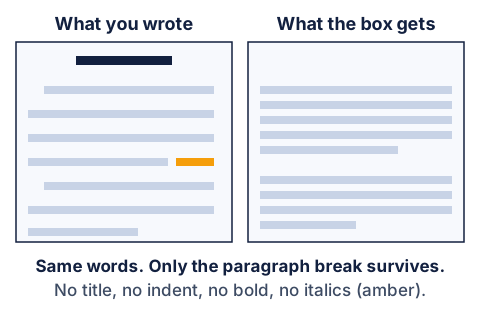
What that means in practice, before you paste:
- Mark paragraphs with a blank line, not an indent. A tab or a first-line indent either vanishes or arrives as stray whitespace. A blank line between paragraphs reads correctly in every box.
- Rewrite anything that leans on italics. A book or journal title set in italics arrives as an ordinary phrase. Name it as a title in the words themselves — "in her memoir," "in the journal" — rather than reaching for underscores or all-capitals, which read as errors.
- Watch the punctuation your word processor invented. Curly quotes, em dashes and ellipses can arrive as question marks or boxes in older portals. If the preview mangles them, retype them as straight quotes and hyphens.
- Paste, then proofread the box, not your draft. The version that gets scored is the one sitting in the box.
- Check the counter after pasting. Some boxes count characters, some count words, and a few silently stop accepting text at the limit.
Pull the format spec out before you draft
Formatting is cheap to get right at the start and expensive to retrofit at midnight. Before writing a sentence, read the application once with only this in mind and write down five answers:
- The limit and its unit. Words, characters, pages — and whether spaces count.
- Spacing, font and margins, or "not specified" written out, so you know it was checked rather than skipped.
- Whether your name may appear in the essay, in the file, or in the filename.
- The delivery method: file upload with an accepted-formats list, or a plain-text box.
- How many separate essays there are. Gilman requires four, each with its own cap. A single long piece is not a substitute for four short ones.
If those answers are not on the provider's page, check the downloadable application, the FAQ, or the portal itself — the counter in the box is an instruction too. If they are still missing, email and ask. A question about the word limit is an ordinary email to receive.
If the application tells you nothing
Some applications genuinely say nothing about format, and you still have to decide. Use the plain academic default: 12-point in a standard face, double-spaced, one-inch margins, no title, no header, exported to PDF and named with your name and the scholarship's. Aim for 500 to 650 words — our own default, not a published one — unless the page suggests otherwise. Unremarkable is the goal — the essay should be the part a reviewer notices.
Then re-read the application before you submit, because the instruction you missed is almost never in the essay prompt. It is in the eligibility paragraph or the small print under the upload button.
If the writing rather than the margins is what worries you, start with how to write a personal statement and come back here for the mechanics. And if the deadline is close, our admission essay help works alongside you on the draft — tightening it to the provider's exact limit and checking it against their published instructions before you upload. You review it, you revise it, you submit it. It stays your essay, which is the only version worth sending.