Live Chat


Every US policy quoted in this post that puts a number on the whole defense lands between 90 minutes and three hours, and two hours is the most common figure. You hold the floor alone for roughly 20 to 60 minutes of that. Those two numbers are not in conflict. The presentation is usually the only stage your program puts a published limit on. Everything around it — arrivals, the chair's opening, public questions, a closed round with the committee, and the vote you wait outside for — fills the rest of the booking.
That is why the answers you find vary so wildly. One page says 45 minutes and another says three hours, and both are quoting something real: one is timing your talk, the other is timing the room. This post separates the stages and attaches each one to a named institution's own published policy, so you can work out the shape of your own defense rather than someone else's.
- Two hours is the common booking. The University of Washington Information School publishes a single sentence on it: "A typical dissertation defense will take two hours." Portland State's Graduate School tells students to schedule two to three.
- Published presentation limits range from 20 to 60 minutes across the US policies quoted below — a threefold spread between real programs, not a disagreement about facts.
- The questioning block is the part that stretches. It is also the part almost no policy puts minutes on — Georgia Southern publishes four rounds of questions and no clock at all.
- You leave the room at least once. Portland State allows 10 minutes just for the room to clear before the committee deliberates and votes.
- The voting rule sets the length of your wait. Unanimity takes longer to reach than a simple majority, and graduate schools genuinely differ on which they require.
- Only your own graduate school and program bind you. Every number here belongs to somebody else's policy; use them as context for reading yours.
Why published defense lengths differ so much
The variation is not sloppiness. Different programs are regulating different things. A humanities department may define the whole event as a colloquium and never cap the talk inside it. A professional doctorate may cap the talk tightly because the committee has already read and annotated the manuscript, so the presentation is there to show you can speak to the work rather than summarize it. Georgia Southern's Ed.D. in Educational Leadership says exactly that. Its defense guidelines — which the program itself calls "descriptive, not prescriptive" — record that the presentation "is not to substitute for the committee's reading," since members have typically "not only read the document but also written feedback on it," and then state the consequence: "In this sense, the presentation should be no longer than 20 minutes."
Here is what a set of US programs actually publishes. Every figure below is quoted from the institution's own page.
| Program (its own published guidance) | Your presentation | Time set aside for the whole defense |
|---|---|---|
| Georgia Southern University, Ed.D. in Educational Leadership | "no longer than 20 minutes" | Not stated; "Time spent on each segment varies" |
| UT Chattanooga, Learning and Leadership doctoral program | A "25-30 minute oral defense" that "may not exceed 35 minutes" | 90 minutes |
| University of Arizona, Lunar and Planetary Laboratory | "30–45 minute presentation" in the public section | Not stated; a closed section follows |
| Boise State University Graduate College | "Approximately 30–60 minutes, followed by a brief Q&A session" | Not stated; a private examination follows |
| Portland State University Graduate School | 30–40 minutes in its example agenda; "should not exceed 60 minutes" | "Defenses should be scheduled for 2 to 3 hours" |
| University of Chicago, Computer Science | "a 45-50 minute talk" | Not stated; public then private questioning follows |
| UC San Diego, Department of Literature | Not separately capped | A "two-hour colloquium" open to the public |
| University of Washington Information School | Set by the committee in consultation with you | "A typical dissertation defense will take two hours" |
| UT Austin, Oden Institute (CSEM PhD) | Not stated | "2 hours should be sufficient," but book a 3-hour room |
Two of those documents cover master's defenses in the same breath, and what they do not say is worth noticing. Portland State and Boise State each write one policy for theses and dissertations, and neither publishes a different length for the two: Portland State's 2-to-3-hour booking and Boise State's 30-to-60-minute presentation are stated once, for both milestones. The distinction Portland State does draw is about audience — "Dissertation defenses are open to the public," while "Thesis defenses are open to the University faculty and may be open to the public at the department's discretion." A larger audience is more people who might ask a question, but no policy we found turns that into published minutes, so treat "a doctoral defense runs longer" as an assumption rather than a rule. If you are working out which milestone you are actually facing, our guide to the difference between a thesis and a dissertation sorts the two apart.
Where a two-hour defense actually goes
Portland State is unusual in publishing a step-by-step example agenda rather than a single number, so it is the cleanest place to see the clock broken up. Its "Example structure of a defense" runs in seven steps, quoted here in full:
- "Allow 10-15 minutes for attendees to arrive. Allow at least 15 minutes for all committee members to arrive."
- "Committee chair makes introductions and directs the defense meeting."
- "Student presents for 30-40 minutes. (Individual programs may have specific requirements about presentation length.)"
- "Questioning and discussion session. This session may be held publicly with all attendees and/or privately with only the student and the committee. (Depending on departmental practice, there may be both a public and private questioning and discussion session.)"
- "Allow 10 minutes for the student and everyone except the committee members to leave the room."
- "Committee members deliberate and discuss the result of the defense. Each committee member votes on the defense. (Votes will be captured via the GO-17 form.)"
- "Student is called back to the room to receive the result of the defense and any revisions required by the committee in order to give final approval to the thesis or dissertation."
Only three of those seven steps carry a number, and the first is stricter than it looks: the 10-to-15-minute allowance is for the audience, while the committee gets "at least 15 minutes" of its own. Subtract that quarter of an hour, the 30-to-40-minute presentation and the 10 minutes to clear the room from a two-hour booking, and roughly an hour is left for the one step Portland State never times — the questioning.
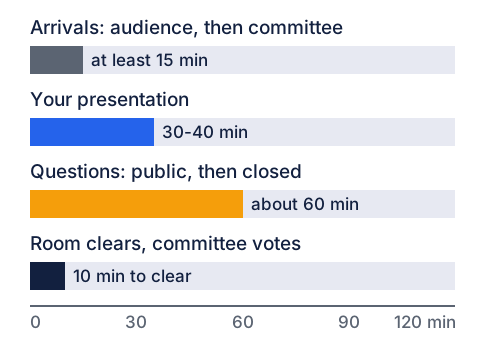
Notice what that arithmetic does to the stage students rehearse hardest. Your talk is roughly a quarter to a third of the room time. The block you cannot script is the largest one — and it is the one Portland State declines to time, saying only that "The actual length of the defense will depend on how long each step takes."
The stage that happens before you are called in
Most guides start the clock when you begin speaking. Some US policies start it earlier, in a meeting you are not necessarily part of.
The University of Washington Information School's PhD policy is explicit: "The Supervisory Committee will meet initially in private, with or without the Candidate present. The Chair announces when the Candidate and the public may join the Committee for the defense." So before a single slide appears, your committee has already convened. The policy does not say what it discusses there, and it does not promise you a seat: whether you are present is the committee's call, and the Chair decides when you and the public come in.
No policy we found puts minutes on that pre-meeting. It matters for a different reason: by the time it happens, the shape of the exam should already be settled, and you should already know it. The same UW policy states that "Prior to the defense, the Supervisory Committee will decide on the elements of the defense," and that "The Chair should inform the candidate of these elements at least one month prior to the defense." The list is specific — "length of candidate presentation; schedule of questioning by the Committee; schedule of questioning by the public; order of questioning, that is, whether the public questions first or members of the Committee question first," and so on.
If your chair has not volunteered that schedule, ask for it by name: how long you present, who questions first, whether there is a closed round, and how long the room is booked. At UW's iSchool that briefing is the chair's stated responsibility a month out. Elsewhere it is simply a question nobody thought to answer.
The questioning block is the one that varies
Programs that publish a Q&A length are rare. Programs that publish the shape of the questioning are not — and the shape tells you more than a number would.
Georgia Southern's Ed.D. guidelines go furthest, laying out a suggested four-round sequence: "Questions pertaining to the topic, theoretical lens, literature/research"; then "the research design, feasibility of the research, methodology, data analysis"; then "linking candidate's research to educational practice"; then "Additional questions not answered through Rounds 1-3." Four rounds, one committee, no clock. The page attaches no minutes to any of them and says only that "Time spent on each segment varies" — which is as close to a published answer as this stage gets in any policy quoted here.
The University of Chicago's Computer Science department describes the standard shape: "Typically, the student gives a 45-50 minute talk about their work followed by a public question period and then a private question period. All faculty are invited to stay for the private part of the exam." The University of Arizona's Lunar and Planetary Laboratory graduate guidebook splits the same way — a public section with a "30–45 minute presentation in which you outline the key aspects of your work," then a closed section in which "your dissertation committee grills you yet again." Boise State's Graduate College lists a public presentation, then a private examination with only you and the committee, then deliberation.
The practical consequence is that the open question period and the closed one are different events with different clocks. Public questions tend to be broad and generous; they come from people who came to hear about the work. The closed round is the examination. It is where a committee tests the choices you made — why this sample, why this method, why you read that literature the way you did — and it runs until the committee is satisfied, not until a timer expires.
The stage you can control is the shortest one. The stage that decides the outcome has no published length.
This is also the honest answer to "how long will the questions last?" Nobody can tell you, because the length is a function of how many questions your committee still has after reading the document. That is the mechanism, and it is worth more than a folk number.
How long you wait while the committee deliberates
Portland State's 10-minute allowance is for clearing the room, not for the deliberation itself. The deliberation ends in a vote, and how long it takes depends on what the graduate school requires the committee to reach. Those requirements are not the same everywhere, and they differ more than the single word "vote" suggests.
| Graduate school or program | What the committee has to reach | Published outcome labels |
|---|---|---|
| UT Austin, Office of Graduate and Postdoctoral Studies | "All decisions—with the exception of 'fail'—must be unanimous" | Pass · Re-defend · Fail |
| UW–Madison Graduate School (policy UW-1211) | "no more than one dissenting vote"; "A missing signature is considered a dissent" | None published — the policy states only the threshold to pass |
| Georgia Southern University, Ed.D. in Educational Leadership | Scales with committee size: "In committees of 3 members, a unanimous vote should be achieved. In committees of 4 members, there can be one dissenting vote." | Pass · Fail (a second defense follows, 2–6 months later) |
| University of Washington Information School | "In all cases, a simple majority vote is required" | Accept · Accept with revisions · Reject |
| UNC School of Medicine, GMB PhD program | "a Pass from a majority of committee members" | Pass, with revisions the committee may require |
| UT Chattanooga, Learning and Leadership | Majority; "two or more members of the Committee found substantive problems" triggers a re-examination | Pass · Re-examination · Failure |
A committee that needs unanimity has to talk until it has it; a committee that needs a simple majority can stop sooner. Georgia Southern's guidelines show what reconciling a split committee involves: where members find it difficult to agree, the chair "should make every effort possible to moderate the discussion and help get committee members to a common consensus," and the Doctoral Program Director or the Associate Dean of Administration and Faculty Affairs can be brought in to moderate further. That is the real variable behind your wait — the threshold your graduate school set, not how well you did.
A long wait is also not automatically bad news. The vote itself is the quick part — Portland State captures it on the GO-17 form, UW–Madison on a signed warrant — and Portland State's agenda puts discussion before it: committee members "deliberate and discuss the result of the defense," and only then does each one vote. That discussion is what you are waiting through, and it has to settle more than a yes or no. At UW's iSchool the chair, "in consultation with the Committee, prepares a written description of the required revisions and designates which Committee members must review the revisions," then "distributes the written description to the Candidate and the Committee within 24 hours of the dissertation defense"; a copy goes to Student Services for the student's permanent academic record.
Do not read a defense's length as a verdict, in either direction. No US graduate school we could find publishes a pass rate, a typical deliberation time, or any rule connecting the two. The closest any of these pages comes is Boise State's Graduate College, and it offers reassurance rather than a statistic: "While most students pass their defense, it is possible to receive a failing decision." Claims of the form "if they call you back quickly, you passed" have no published source behind them. Your school's own outcome labels — printed in its policy or your program handbook — are the only reliable guide to what can happen next.
When the defense is not one continuous session
The two-hour picture assumes a single block. Several real policies break that assumption, and each one changes the answer to "how long."
- The public talk and the examination can be separate events. In the UNC School of Medicine's GMB PhD program, "the defense is a private meeting between the student and the dissertation committee," with the public presentation traditionally given immediately before it. Other arrangements are allowed with committee approval, but "the two components must be held within 30 days of one another." Under that policy your defense can span a month.
- You may be asked to leave twice. The same UNC policy notes that the committee "may ask the student to leave the room prior to the defense," and then asks you to leave again while it deliberates.
- A missing committee member stalls the clock. Portland State requires that "the student and committee must wait at least 15 minutes for them to join the meeting," and adds: "In the meantime, the committee chair should contact the Graduate School … for options in case the member cannot be located." Nothing else begins while that wait runs.
- Remote and hybrid formats add setup. Portland State permits defenses "in-person, remotely via videoconferencing (e.g., Zoom), or in a hybrid format"; UC San Diego's Department of Literature lists the same three. Connection checks and screen sharing eat into a fixed booking.
- The room booking is not the defense. UT Austin's Oden Institute advises CSEM doctoral students that "2 hours should be sufficient," while suggesting "a 3-hour time slot when making your room reservation" for set-up and overrun.
The four things to pin down for your own defense
Every figure in this post is someone else's policy. These are the steps that turn them into yours, in the order worth doing them.
Search your graduate school site for "final oral examination" or "dissertation defense" plus "policy." That page sets the outer limits: how long the session is booked for, the notice period and the voting rule. UW–Madison's, for instance, is a numbered policy document.
This lives one level down, in the department or program handbook, and it is the number that differs most. Among the programs quoted above that publish one, it ranges from 20 to 60 minutes.
Presentation length, order of questioning, whether there is a closed round, and who is invited. UW's iSchool treats this as a briefing the chair owes you a month out; treat it as a question you are entitled to ask anywhere.
Follow the Oden Institute's logic and reserve more room time than the session needs. Overruns land in the questioning block, which is the stage nobody can time in advance.
What the timing tells you about the day
A dissertation defense is short in the only stretch you rehearse and long in the stretch you cannot. Budget your preparation the same way. An hour spent anticipating closed-round questions is worth more than a fourth pass over slide transitions, because the closed round is where the clock genuinely runs.
It also helps to know where the defense sits in the wider timeline. The document itself has its own conventions on how long a dissertation runs, the milestone as a whole is covered in our plain-English guide to what a dissertation is, and if you are stalled before you ever reach a defense date, what "all but dissertation" means is the honest description of that stage.
If the delay is the writing rather than the defending, our dissertation help service works with doctoral candidates chapter by chapter — research support, structure, and revision on your own draft, which you review and submit yourself. The defense stays yours. It should.