Live Chat

There is a method for math word problems, and it has two moves. First decide what kind of situation the paragraph is describing. Then decide which quantity in that situation is missing. Those two answers together tell you the operation. Everything after that is arithmetic you already know how to do.
What the method is not is the keyword chart — altogether means add, less than means subtract, of means multiply. That chart has been measured against real test items, and the numbers are not close. What follows shows you where it breaks, on problems worked all the way through so you can see the wrong answer beside the right one, and then gives you the procedure to use instead.
- Across state-test problems that require working out an operation for yourself, keywords pointed to the correct one less than half the time on single-step problems and under 10% on multi-step ones.
- The failure is structural, not sloppy: the identical word more appears in a problem solved by addition and in a problem solved by subtraction, and both are printed in the Common Core's own glossary.
- It gets worse, not better, as the math gets harder — it is the same surface reading that shows up in the classic college algebra reversal, where students write the equation in the order the words appear.
- The replacement is two questions: what situation is this, and which part of it is unknown. The situation gives you the relationship; the missing piece gives you the operation.
- Keywords are still useful for understanding a problem. They are only dangerous when they are tied to an operation without reading the rest of the sentence.
What the research actually found
In 2022, Sarah Powell, Jessica Namkung and Xin Lin published an item-by-item study of the keyword strategy in The Elementary School Journal. They took 747 released items from the PARCC and Smarter Balanced assessments across grades 3 through 8 and sorted the 690 that required reading, classifying 476 of the 690 (69.0%) as directive word problems and 214 (31.0%) as routine word problems
— routine meaning the kind where you have to work out an operation for yourself. Then they checked, for every routine problem, whether the keywords inside it pointed to the operation that actually solved it.
The headline result is in their abstract:
For single-step routine word problems, we determined keywords featured within the problem led to a correct problem solution with less than a 50% match rate. For multi-step routine word problems, the match rate was less than 10%.
Their own conclusion on that evidence: These low match rates indicate that keywords are an ineffective word-problem strategy that educators should avoid.
Two details make that figure worse rather than better. The researchers coded generously — if a problem held several keywords and any one of them happened to point the right way, they scored it a match. And they did not subtract the errors students make even after choosing the right operation, so, in their words, our match rate percentages present the best case scenario
.
Now the honest half. Keywords are not useless everywhere. They are close to reliable on the two simplest problem types and fall apart from there. The rates below are the paper's, counted across single-step problems that contain a keyword at all — about 11% of them contain none.
| Problem situation | What it describes | Match rate when a keyword is present |
|---|---|---|
| Total | Two or more parts combine into a whole | 81% |
| Difference | Two amounts compared for a gap | 69% |
| Comparison | One amount is some number of times another | about 56% |
| Product of measures | Two measures make a third, different unit (area) | about 56% |
| Change | A starting amount grows or shrinks | under 30% |
| Equal groups | A group repeated a number of times | under 30% |
| Ratios or proportions | A relationship between quantities, scaled | under 30% |
On multi-step problems the picture collapses. Across total, difference, change, equal groups and ratios, the match rate falls below 10%, and for comparison problems the authors record that we noted keywords as never matching for word problems with the comparison schema
— zero, across the seven multi-step problems in the set that involved a comparison. The one survivor is product of measures, and only just: keywords matched on 2 of the 7 problems in that schema. Those are thin bases, and the authors say so themselves: Difference (n = 11), comparison (n = 7), and product of measures (n = 7) schemas occurred with little frequency within multi-step word problems.
None of this is new. The authors quote Sandra Marshall's 1995 assessment, which had the shape of it already: the keyword approach works moderately well for students so long as they are confronted only with very simple problems, that is, those requiring only one arithmetic operation
, and then breaks down, usually because problems require several operations to be carried out and because keywords occur less frequently in the problem text
. The 2022 study is what put numbers on it.
The same word, two different operations
You do not have to take the statistics on faith. The clearest counterexample sits in a document every US math teacher has on a shelf: the glossary of the 2010 Common Core State Standards for Mathematics, whose Table 1 sorts addition and subtraction problems by situation. In its Compare row are these two problems, printed a few inches apart.
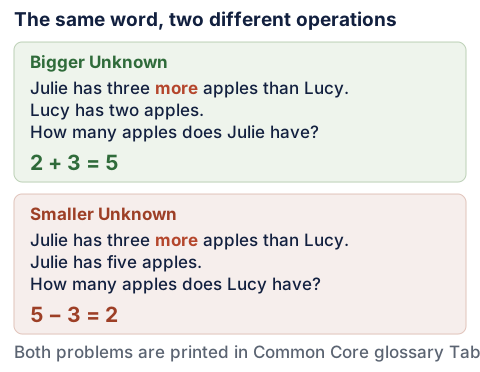
The word more is in both. In the first, the missing quantity is the larger one, so you add: 2 + 3 = 5. In the second, the missing quantity is the smaller one, so you subtract: 5 − 3 = 2. The vocabulary did not change. What changed is which part of the situation was left blank.
The standards say so themselves, in a footnote attached to that table: For the Bigger Unknown or Smaller Unknown situations, one version directs the correct operation (the version using more for the bigger unknown and using less for the smaller unknown). The other versions are more difficult.
That is the standards document conceding that the keyword steers you correctly in exactly one of two arrangements — and the word itself says nothing about which one you are looking at.
The trap is not the word. It is the assumption that a word can tell you an operation without telling you where the blank is. Any comparison sentence — more than, less than, fewer than, times as many — can be run in either direction, and the direction is set by which quantity the question asks for.
Why college makes this worse, not better
If the keyword habit only cost a few points in fourth grade it would not be worth an article. The same way of reading a sentence shows up in college algebra, where it produces one of the most-studied errors in mathematics education.
In 1982 John Clement published a study of a task that looks trivial. Students were asked to write an equation for the statement There are six times as many students as professors at this university.
, using S for the number of students and P for the number of professors. The correct equation is S = 6P. As Ventura-Campos and colleagues summarize Clement's finding at the top of their 2022 Scientific Reports paper, an open-access brain-imaging study of the reversal error, The most common incorrect answer among first-year engineering college students was P = 6 · S
— backwards.
Researchers working from interview protocols identified two error processes behind that task. The first is word-order matching, and the definition should look familiar by now. In a synthesis of the translation literature, Michael Bossé and colleagues put it plainly: In word order matching, the student simply assumes that the order of key words in the problem corresponds to the order of the symbols appearing in the equation.
They add that Clement (1982) referred to this approach as a syntactic strategy, because it does not depend on the meaning of the expression.
The second process cuts against the argument of this article, and it belongs here for that reason. In static comparison, the same authors write, the process does consider the meaning of the expression and entails realizing that there are more students than professors but not knowing how to express this relationship.
That student has read the situation correctly and still cannot write the equation down — a different failure, with a different fix, and not a case of taking an operator off the surface at all. It is word-order matching, not static comparison, that the rest of this article is tracing.
That is the keyword chart, grown up — and that is our reading rather than a published finding. The keyword research cited here never mentions the reversal error, the reversal research never mentions keyword charts, and we found no study testing whether one trains the other. What the two have in common is the reading: both take the operator off the surface of a sentence instead of off the situation underneath it. Here is what that costs on a problem you might actually be assigned.
Problem. A lab section has 3 times as many students as it has microscopes. There are 42 students. How many microscopes are there?
Take times as an instruction to multiply and you have two numbers and an operation: 42 × 3 = 126 microscopes. Which would mean the lab has three microscopes for every student, in a sentence that just told you the opposite. Read the situation instead — students is the bigger quantity, and it equals 3 lots of the microscope count — and you get 42 = 3m, so m = 14 microscopes. Check it: 3 × 14 = 42.
The newest work in this line is not about college students at all. A 2026 study in Learning Disability Quarterly by Alison Hardy, Grace Douglas and colleagues, with Powell as senior author, looks specifically at problems containing more that are not solved by adding, in 112 third graders from one US school district. Its abstract states that although students are often taught to look for keywords, this strategy is erroneous
, and that it is worst on what the literature calls inconsistent problems — ones where the relational word points away from the operation. That abstract is all we could read; the full article sits behind a publisher block, so nothing else from it is claimed here.
The method: situation first, unknown second
Here is the procedure. It is five steps, and steps 2 and 3 are the two that actually do the work — they are the pair that the Common Core's tables are built out of, with the situation running down the side and the position of the unknown running across the top.
Not x. Write m = the number of microscopes or p = the number of pages printed. The unit does real work: it is what tells you later whether an answer of 242.5 can exist. The Standards for Mathematical Practice ask for exactly this — considering the units involved
and attending to the meaning of quantities, not just how to compute them
.
Parts combining into a total. Two amounts compared. A starting amount changed. A group repeated. A rate applied. A relationship scaled. Use the plainest description you can, and do not look at the numbers yet. This is the step the keyword chart replaces, and replacing it is the whole error.
Every situation has slots: a total problem has two parts and a total, a comparison has a bigger amount, a smaller amount and a multiplier. Ask which slot the question wants. The situation gives you the relationship; the blank slot gives you the operation. A total problem with the total missing is addition. The same problem with a part missing is subtraction.
Write it in the order the situation runs, never the order the sentence runs: part + part = total, setup + rate × quantity = bill, smaller × multiplier = bigger. Then drop in your numbers and your named unknown. This is what makes word-order matching impossible — there is no left-to-right sentence left to copy.
Not into your equation, which will agree with itself. Put the number into the words of the problem and ask whether the sentence is now true. 3 times as many students as microscopes, 42 students, 14 microscopes — true. 126 microscopes — false on sight. That is a translation check, and it catches translation errors; checking your arithmetic is a separate discipline with its own tools.
A two-step problem, worked both ways
Multi-step problems are where the keyword approach drops under 10%, so this is the case worth seeing in full.
Problem. A print shop charges a $25 setup fee plus $0.40 per page. A student's total bill was $97. How many pages did she print?
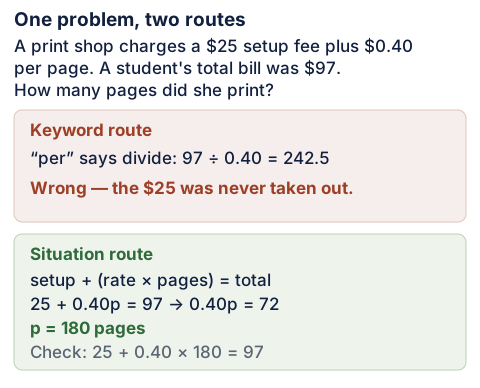
The keyword route. The sentence carries three signals. Plus says add, per says divide, total says add. They cannot all be right, and a student who picks the one nearest the question divides: 97 ÷ 0.40 = 242.5 pages. Nothing about that number announces itself as wrong — it is not negative, it is not absurdly large. It is simply the answer to a different problem, one in which the setup fee does not exist.
The method.
- Unknown: p = the number of pages printed. Pages come in whole numbers.
- Situation: a fixed charge plus a rate applied to an unknown quantity, adding up to a total. Two parts combining into a total, where one of the parts is itself a rate times a count.
- Blank slot: the total is known ($97) and the fixed part is known ($25). What is missing is inside the variable part.
- Relationship: setup + (rate × pages) = total, so 25 + 0.40p = 97.
- Solve: 0.40p = 97 − 25 = 72, so p = 72 ÷ 0.40 = 180 pages.
- Read it back: a $25 setup fee plus 180 pages at $0.40 is 25 + 72 = 97. True.
Notice which step did the work. It was not the algebra — the algebra is one subtraction and one division. It was naming the situation as fixed part plus variable part, which is what forced the $25 into the equation instead of leaving it on the page.
A problem with no keywords in it at all
The other failure mode is quieter: plenty of problems contain no operation words for a chart to find. The method does not care, because it was never reading words for operations in the first place.
Problem. A chemistry lab needs 600 mL of a 20% acid solution. The stockroom has a 10% solution and a 25% solution. How much of each should you use?
- Unknown: x = milliliters of the 25% solution. Then 600 − x = milliliters of the 10% solution, because the two volumes have to make 600.
- Situation: two parts combining into a total — twice. The volumes combine into a total volume, and the acid in each part combines into the total acid.
- Blank slot: both parts are unknown, but they are linked, so one variable covers both.
- Relationship: acid from the strong solution + acid from the weak solution = acid in the mixture, so 0.25x + 0.10(600 − x) = 0.20 × 600 = 120.
- Solve: 0.25x + 60 − 0.10x = 120, so 0.15x = 60 and x = 400 mL of the 25% solution, leaving 200 mL of the 10%.
- Read it back: 0.25 × 400 = 100 and 0.10 × 200 = 20, so the mixture holds 120 mL of acid in 600 mL, which is 120 ÷ 600 = 0.20, or 20%. True.
There was no altogether, no left, no in all. There was a situation with slots in it, and the slots are what you fill.
What to do with the chart you already memorized
Not throw it out. Demote it. Powell's team draws a careful line that is worth borrowing, and draws it with the problem Diana and Ben have 12 pencils altogether. Diana has 9 pencils. How many pencils does Ben have?
One student uses altogether as an operation. The paper describes what happens: A student using the keyword strategy would note altogether means to add, and the student would add 12 plus 9 for a problem solution of 21.
There are twelve pencils in the problem. The answer is twenty-one.
A second student uses the same word as information — it tells them 12 is the total, and that they have been given one of the parts. They write 9 + __ = 12 and answer 3. The researchers are explicit that this is a different act: This second student did not tie the keyword to a specific operation so this student did not use the keyword strategy; instead, this student used a keyword (and other textual clues) to deepen the understanding of the problem.
So the rule is not ignore the words. It is: let a word tell you what kind of situation you are in, and never let it tell you what to do with the numbers. Altogether and in all usually flag a total. Left and remaining usually flag a change. Each and per usually flag equal groups or a rate. All of that is useful for step 2 of the method. None of it survives step 3, because step 3 is where the operation is actually decided.
When the setup is the part you cannot get
If you can do the algebra and still stall at the translation, the fix is practice at naming situations, not more practice at solving equations you were handed. Take five problems you have already gotten right and, without solving anything, write one sentence for each saying what kind of situation it is and which slot was blank. Ten minutes of that does more than another page of drills.
It also helps to know what is being graded. Whether the credit sits with the setup or with the final number is a question the rubric for the assignment answers, and it is worth reading before you decide where to put your effort. And if the real problem is four problem sets landing in one week, the bottleneck is scheduling rather than math, and a system for tracking what is due is the cheaper fix.
When a set is genuinely beyond the time you have, that is what our math homework help at Apex Essays is for: our writers work the problems and hand you the full setup and solution, line by line, so you can see how the relationship was built. You review the work and submit your own. That is what a worked solution is for — not a number to copy, but a translation you can watch happen.