Live Chat


A dissertation defense is the final oral examination of a completed doctoral dissertation. Your committee reads the document first, then meets with you to question it. You answer, you step out of the room, and the committee votes on whether the dissertation and your account of it are both acceptable.
That second half is the part most descriptions leave out. The University of Texas at Austin states the standard in one line: a pass "requires that both the defense and the document (dissertation or treatise) are acceptable." Two objects on the table. One vote.
Past that point, US graduate schools disagree about nearly everything — whether the public may attend, how many dissenting votes a pass survives, whether the examination and the presentation even happen on the same afternoon. What follows is the pattern most programs share, with each likely departure named against a school that publishes it in policy.
- A dissertation defense is the final oral examination for a doctorate, held after the committee has read a complete draft.
- The committee judges two things at once: the document, and your command of it. Both have to clear.
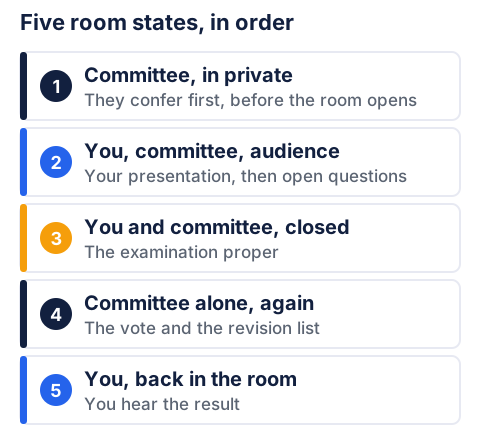
- The session runs through five room states, and the one that decides your outcome is the one you are not in.
- Vote arithmetic is local, not national — unanimity at UT Austin and NC State, one dissent permitted at Wisconsin, a simple majority in some programs.
- An outside member sits on the committee at many universities, under a different name at each. They are there for the fairness of the process, not for your topic.
- Defense pass rates are folklore. Graduate schools publish outcome categories, not frequencies.
What a dissertation defense actually is
Start with what it is not. It is not a lecture, and it is not the first time anyone sees your work. Every voting member has a copy in advance — the University of North Carolina at Charlotte, for instance, states that the dissertation "should be submitted to the committee for final review at least two (2) weeks prior to the date of the final defense." The room is not discovering your research. It is deciding what to do about it.
The scope of the exam is usually wider than the document. The University of Wisconsin–Madison files the event under its formal name, Dissertation Defense (Final Examination), and defines it in a sentence: the defense "encompasses a student's dissertation and area(s) of study." Your chapters are on the table, and so is the field they sit in. A question about a method you did not use is fair game if that method belongs to your area.
So the honest one-sentence definition is longer than the usual one: a dissertation defense is the meeting where a committee tests whether a finished doctoral dissertation is acceptable scholarship and whether the person who wrote it can account for the choices inside it.
One vocabulary point, because the two words are not interchangeable in US graduate study. A doctoral candidate defends a dissertation; a master's candidate defends a thesis. Different degrees, different exams, and often different rules on the same campus. Portland State University's procedures page splits them at the door: "Thesis defenses are open to the University faculty and may be open to the public at the department's discretion. Dissertation defenses are open to the public." Everything below describes the doctoral event; our guide to the difference between a thesis and a dissertation covers the rest of the split.
Who is in the room, and what each person is doing
Your chair runs the meeting. Not the graduate school, not the loudest questioner. The University of Texas at Tyler puts the duty on one person: "The responsibility for the defense belongs to the dissertation committee chair." The chair decides when questions start, when they stop, and when the room clears.
Your committee members vote. There is no national committee size — each graduate school sets its own, so the only number that means anything is the one yours publishes. The University of Washington requires a doctoral supervisory committee to "include a minimum of four members," at least three of them Graduate Faculty with a Doctoral Endorsement. These are the people who have read the document closely enough to have marginalia.
One member is often an outsider, and students routinely misread them. This person is appointed from outside your program to watch the process rather than the scholarship. At Washington the role is the Graduate School Representative, a voting member of the committee who "represents the broad interests of the Graduate School with respect to high standards of scholarly performance" — who "may have a scholarly area that differs from that of the student's dissertation project," and who may not hold an appointment in your unit or your chair's department. Boise State University describes the behavior you will actually see: the Graduate Faculty Representative "typically does not ask technical questions and focuses on ensuring fairness and adherence to procedure."
| University | What they call the outside member | What the published policy says the role is |
|---|---|---|
| University of Washington | Graduate School Representative (GSR) | A voting member who must "attest to the validity of examinations" and "ensure that the student is treated in an unbiased manner" |
| Boise State University | Graduate Faculty Representative (GFR) | "Typically does not ask technical questions and focuses on ensuring fairness and adherence to procedure" |
| UNC Charlotte | Graduate Faculty Representative | Named among the members who "must attend the defense" |
| North Carolina State University | Graduate School Representative | Present with the advisory committee for deliberation and decision, "if one has been appointed" |
Everyone else is audience, where an audience is allowed at all. The NC State Graduate School requires for every doctoral final oral examination that "the presentation of the dissertation be open to the university community" and that "any member of the university community is allowed to ask questions of the candidate," after which "the questioning phase may continue with a closed session in which the advisory committee questions the candidate." Audience questions shape the hour. They do not touch the vote: when the outcome is settled, "only the advisory committee and the Graduate School representative, if one has been appointed, are present."
The session, in the order it happens
Most guides describe the defense. Portland State publishes an agenda for it, item by item, down to "Allow 10 minutes for the student and everyone except the committee members to leave the room." Set that beside the University of Washington Information School's policy and Boise State's description, and seven moves emerge between the three. No one school lists all seven — which is the point. Yours will run some of these and skip others.
Before anything public happens, the committee confers. The UW Information School writes it into policy: the supervisory committee "will meet initially in private, with or without the Candidate present," after which "the Chair announces when the Candidate and the public may join the Committee for the defense." You may be in the room for this and you may not — the policy allows both. Either way, the committee's first conversation about your work that day happens before the room opens.
Introductions, then the shape of the session — who may ask questions, in what order, and how long you have. None of it should be news to you. The UW Information School has its committee fix those elements before the defense and puts a deadline on telling you: "The Chair should inform the candidate of these elements at least one month prior to the defense." If nobody has, ask.
Length is set locally and varies widely. Portland State's example agenda has the student presenting for 30 to 40 minutes and states that the presentation "should not exceed 60 minutes"; Boise State describes roughly 30 to 60 minutes. Treat the number your chair gives you as binding, not the number you read online.
Who is allowed to ask is a local rule, and the two ends of it are both published. NC State opens the floor: "any member of the university community is allowed to ask questions of the candidate." UT Tyler keeps it with the committee — "Faculty who are not members of the committee may not question" — and personal guests attend as observers who "may not ask questions." UT Tyler is also blunt about interruptions ("Questions should be held to the end") and tells its committees to probe methods, findings, applications and your broader knowledge.
Many programs then clear the room and run a private round with the committee alone. Boise State lists exactly who stays: "you and your defense committee members (chair, committee members, GFR for dissertation defenses, and possibly an external evaluator)." This closed round is the examination in the strict sense, and it is where the hard questions usually land.
You leave; the committee deliberates and each member votes. None of the graduate-school policies cited at the foot of this page publishes how long that wait runs — what they publish is the block it sits inside: Portland State tells programs "defenses should be scheduled for 2 to 3 hours," and the UW Information School says "a typical dissertation defense will take two hours." What is being settled is not only pass or fail but the revision list, and who will sign off on it.
Portland State's agenda ends here: the student "is called back to the room to receive the result of the defense and any revisions required by the committee in order to give final approval to the thesis or dissertation." Write the revisions down in the room. Memory after a defense is unreliable.
What the committee is deciding, and the arithmetic behind it
The vote is not a grade. It is a decision between a small number of named outcomes, and the names differ by campus. UT Austin's three are the clearest published set. Pass requires that the defense and the document are both acceptable. Re-defend "indicates that the committee is not satisfied with the dissertation or with the oral examination, but believes that rewriting may make it acceptable." Fail "indicates that at least one member of the committee has decided that the dissertation is unsatisfactory and may not be rewritten."
Read that last definition twice. At UT Austin a fail is a one-member decision, because the page also states that "All decisions—with the exception of 'fail'—must be unanimous." Elsewhere the arithmetic is looser. This is the single most consequential thing that varies between US graduate schools, and almost nothing written for a general audience says so.
| Graduate school | Outcome names it publishes | What it takes to pass |
|---|---|---|
| UT Austin | Pass / Re-defend / Fail | Unanimous — every decision except "fail" must be unanimous |
| NC State University | Unconditional pass / Conditional pass / Failure | "A unanimous vote of approval of the advisory committee" |
| UW–Madison | None named — the pass is recorded by signatures on the warrant | A student "may receive no more than one dissenting vote"; "a missing signature is considered a dissent" |
| UW Information School | Accept / Accept with revisions / Reject | "In all cases, a simple majority vote is required" |
| UNC Genetics & Molecular Biology | Pass or not | "A Pass from a majority of committee members" |
The committee is not deciding whether you are clever. It is deciding whether this document can sit in the library with the university's name on it.
Defense pass rates are the most confidently repeated unsourced numbers in graduate study. US graduate schools publish outcome categories and voting rules; across every graduate-school policy cited at the foot of this page, not one publishes how often each outcome occurs. The furthest any of them goes is qualitative — Boise State writes, "While most students pass their defense, it is possible to receive a failing decision," and then spends the section on what to do if you are the exception. If a page tells you what percentage of candidates fail, ask which university counted, and over what years. Absent an answer, the number is decoration.
The questions committees open with — and where they go next
The published guidance says what the questions are for rather than what they are. UT Tyler tells its committees to explore methods, findings, applications and the candidate's broader knowledge, and warns that questions "may range quite broadly, from very specific to very general." Wisconsin's "dissertation and area(s) of study" wording says the same thing from the policy side.
One real example is worth more than a generic list. Writing in Inside Higher Ed on 11 March 2021, Jason H. Moore — who says he has "personally been involved in more than 40 dissertation defenses" — describes the one question he puts to every candidate: "how would this work be different if you were to conduct it a decade from now?" His reason is his own, not ours: "a big part of scholarly success is being able to see into the future and to anticipate what is next," which is "where innovation and impact come from." Note two things. It is not a question about your data at all. And Moore is explicit that it is not scored: "I do not ask this question to put the student on the spot or to challenge them," and "the answer they give does not ever sway my decision." He asks it, he says, because his intention is that it "will be memorable for the student throughout their career."
The table below is our own, built from the patterns above rather than quoted from any single source: the questions that recur, what each is testing, and the answer that reads as weak from the other side of the table. The first two are the ones to have ready cold; the rest tend to arrive once the discussion is running.
| The question | What it tests | Where the answer usually goes wrong |
|---|---|---|
| "In two or three minutes, what does this add?" | Whether you can state the contribution without the scaffolding around it | Reciting the chapter order instead of the claim |
| "Why this design, and not the obvious alternative?" | Whether the method was chosen or inherited from your advisor | Listing the method's virtues without naming what it cost you |
| "Which of your findings surprised you?" | Whether you read your own results or only confirmed your hypothesis | Naming a result that surprised nobody, including you |
| "Who in the field would disagree, and what would they say?" | Command of the area of study, not just the document | Naming a critic without being able to state the criticism |
| "What is the weakest part of this dissertation?" | Calibration — whether your sense of the work matches theirs | Claiming there isn't one, or volunteering a flaw nobody had noticed |
| "Where does the field go from here?" | Forward view — the question Moore describes asking, and says he does not score | Treating it as small talk at the end of the hour |
The question a candidate genuinely cannot answer is almost never about the data. It is about a decision made eighteen months earlier and never written down: why the sample was cut at that point, why two interview questions were dropped after the pilot, why one archive was left out. The result is documented. The reasoning lived in a conversation. Keep a running decision log through the project — date, decision, alternatives considered, reason — and that entire category of question stops being dangerous.
"I don't know" is a complete sentence in a defense, provided the next one is useful. "I don't know — that would need a subgroup analysis I didn't run, and here is what I'd expect it to show" reads as calibration. Improvising an answer to a question you cannot answer reads as something else, and the person across the table has heard both many times.
Where the format varies most
Open or closed. Some universities make the whole thing public, some open only the presentation, and some keep the defense itself private. The Genetics and Molecular Biology curriculum at the University of North Carolina at Chapel Hill runs the private model: "In GMB, the defense is a private meeting between the student and the dissertation committee," with a public research presentation traditionally given immediately beforehand.
One session or two. The default in that same UNC policy is back-to-back: "traditionally," the public presentation comes immediately before the private defense. Splitting them is possible but not casual — any other arrangement "must be approved by the committee, but the two components must be held within 30 days of one another." A public talk and a closed examination two weeks apart can still be one defense. Three months apart cannot.
One defense or two. Many doctoral programs examine the proposal as well as the finished dissertation. The UW Information School runs a separate proposal defense as a scheduled, announced public event with its own four outcomes, well before the dissertation defense. If someone tells you their defense went badly, ask which one they mean.
The calendar around it. Lead times are policy, not courtesy. UNC Charlotte puts the dissertation with the committee two weeks ahead and the defense "announced online at least two weeks prior to the defense date." Miss a scheduling window and the date moves, whatever the state of the document.
Search your own graduate school's site for "final oral examination", not "dissertation defense". Policy libraries file the event under its exam name — Wisconsin's policy is titled "Dissertation Defense (Final Examination)", and NC State calls it the "final oral examination" — while the friendlier phrase usually lands you on a departmental blog post. Your program's page overrides the graduate school's only where the graduate school says it does.
What happens after the vote
A pass is rarely the end of the paperwork. At UT Austin a committee may require revisions "which will be checked by the entire committee or by the supervising professor only" — a choice that "should be agreed upon at the time of the defense and communicated with the student," along with "the length of time allowed for submission of the revised dissertation." Until those revisions have been reviewed, the supervisor "should wait to sign the Report of Dissertation Committee." NC State formalizes the same idea as a named outcome, conditional pass: you passed, on terms the committee defines, and "the examination is not complete until all conditions have been satisfied."
Signatures are the mechanism, and they can be a trap. Wisconsin's rule that "a missing signature is considered a dissent" means a committee member who simply never gets around to signing has voted against you. Chasing signatures is part of finishing.
If the vote goes against you, the retry rules are strict and specific. At NC State, "No re-examination may be given until one full semester has elapsed and only one re-examination is permitted." UNC Charlotte's limit is blunter: "No student is permitted to take the final examination more than twice." Neither school leaves this to the department's discretion.
After that, the deadline that actually governs your graduation is the deposit date for the term, not the defense date — Boise State puts it plainly: "the advisor-approved version of your thesis or dissertation must be submitted by the published deadline in order to graduate that semester." Candidates who defend in good time and then let revisions drift are how all but dissertation status happens to people who were nearly finished.
If the document is not ready for a defense yet
The defense examines a finished dissertation, which means the honest preparation question is usually about the document rather than the presentation. If the argument still changes shape every time you reread chapter four, no amount of slide practice fixes what the committee will ask.
Our plain-English guide to what a dissertation is covers the structure, and how long a dissertation runs gives real length ranges by field. If you want a researcher to read the full draft and pressure-test the argument before your committee does, that is what our dissertation support service is for — from $7.89 a page, working on your draft, with the research and the submission staying yours.
Sources
- The University of Texas at Austin, Office of Graduate and Postdoctoral Studies — Evaluation Decisions for Doctoral Defense (Pass / Re-defend / Fail; unanimity except "fail"; revision review).
- University of Wisconsin–Madison Policy Library — UW-1211, Graduate School: Dissertation Defense (Final Examination), last revised 3 September 2025 (scope of the exam; no more than one dissenting vote; missing signature as dissent).
- North Carolina State University Graduate School — Oral Examination Information (the three required elements of the doctoral final oral examination — presentation open to the university community, questioning open to any member of it, closed session and deliberation; unanimous vote; unconditional and conditional pass; one re-examination after one full semester).
- University of Washington Information School — Dissertation Defense Policy & Procedures (private opening meeting; elements of the defense fixed in advance with one month's notice to the candidate; a typical defense of two hours; Accept / Accept with revisions / Reject; simple majority) and Proposal Defense Policy & Procedure (a separate announced public defense with four outcomes).
- University of Washington Graduate School — Policy 4.2, Supervisory Committee for Graduate Students (minimum of four members; the Graduate School Representative's role and eligibility).
- Portland State University Graduate School — Oral Defenses of Theses and Dissertations (the numbered meeting agenda; presentation length and the 2-to-3-hour block; who thesis and dissertation defenses are open to).
- Boise State University Graduate College — What to Expect at Your Thesis or Dissertation Defense (public presentation of roughly 30-60 minutes, private examination, deliberation; who stays for the private round; the GFR's role; "while most students pass their defense, it is possible to receive a failing decision").
- The University of Texas at Tyler — Guidelines for the Conduct of a Dissertation Defense (the chair's responsibility; who may and may not question; scope and timing of questions).
- UNC Charlotte Graduate School — Final Defense (two-week committee copy and announcement; Graduate Faculty Representative attendance; no more than two attempts).
- University of North Carolina at Chapel Hill, Genetics and Molecular Biology Curriculum — Dissertation and Defense Policy (private defense with a public presentation; 30-day separation; majority pass).
- Jason H. Moore, "A Question for the Defense", Inside Higher Ed, 11 March 2021 (more than 40 dissertation defenses; the decade-from-now question; why he asks it and why it does not affect his vote).