Live Chat


Preparing for a doctoral defense is four separate jobs, and the talk is only one of them. You reread your own dissertation the way a stranger would. You write out answers to the questions your own decisions invite. You get people who have not read it to ask those questions to your face. Then you rehearse. Four weeks is enough if the jobs run in that order, because each one produces the material the next one tests.
What the reassurance-style guides skip is that your document leaves your hands before any of that begins. Cornell's Graduate School tells candidates to complete the draft six weeks before the final examination. The University of Texas at Austin asks for a complete copy in every committee member's hands four weeks ahead. Penn State and Syracuse both say two. After that date your committee is reading a version you can no longer change, so every remaining repair has to be made out loud.
One scope note. In US graduate study a master's candidate defends a thesis and a doctoral candidate defends a dissertation, and the two events are not run at the same scale — our guide to the difference between a thesis and a dissertation explains why. Everything below is written for the doctoral defense.
- Count backward from the document deadline, not the defense date. Among the programs quoted below, delivery to the committee falls between 10 business days and four weeks out; Cornell instead sets a completion milestone six weeks out.
- Two of the seven carry an explicit cancellation clause. Syracuse says a defense may be canceled if all committee members do not have the document in time; Maryland's computer science program says the same about a missed scheduling form or public announcement.
- Four weeks, four jobs, in sequence: read cold, write answers, get questioned by outsiders, rehearse.
- Questions come from the decisions you made — scope, sample, method, what you left out — not from the results you reported.
- A mock defense is only worth the afternoon if someone in it has not read the dissertation.
- The revision clock is short. Duke gives 30 days after a successful defense to file the final version, or the term deadline if that comes first; Cornell allows 60.
Count Backward From the Document Deadline, Not the Defense Date
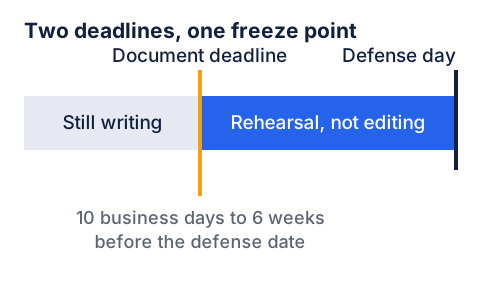
Start the count from the defense date and you will begin a month late. The date that structures your last two months is the one your graduate school sets for finishing the document and putting it in front of the committee. Everything before it is writing. Everything after it is talking.
These are seven US programs' own published requirements. They do not agree with each other, and the disagreement is the useful part.
| Graduate school or program | The document deadline | Paperwork deadline |
|---|---|---|
| Cornell University | Draft complete six weeks before the final examination | Final version filed within 60 days of the exam |
| UT Austin | A complete copy to each committee member four weeks before | Request for Final Oral Examination two weeks before |
| University of Georgia (Philosophy) | Department states Graduate School policy gives the committee at least three weeks to read and evaluate | Announcement from the graduate coordinator's office two weeks before the exam |
| Syracuse University | Copies to every examiner two full weeks before | Request for Examination three weeks before |
| Penn State | Chair and student both responsible for the copy two weeks before | Exam scheduled with Graduate Enrollment Services two weeks before |
| Duke University | Initial ProQuest submission and committee copies two weeks before | Committee confirmed or updated 30 days before the defense |
| University of Maryland (Computer Science) | Distributed to the committee 10 business days before | Scheduling form plus a public announcement |
Read the middle column carefully, because three different rules live in it. Five of these programs set a delivery deadline — the copy has to be in committee hands somewhere between 10 business days and four weeks out. Cornell sets a completion milestone instead, telling candidates to have the draft finished six weeks before the exam. Georgia's philosophy department states it as a reading window: whenever you hand the document over, the committee is entitled to three weeks with it. Averaging any of it gives you a number that is nobody's rule. Find the sentence in your own graduate handbook and calendar that date first, because it is the last day the document is yours. Read the wording too: every one of these except Cornell's is phrased as a floor — “at least” two weeks, “at least” four. That matters because your preparation starts the day the document leaves your hands, so a program whose floor is two weeks is not offering you a schedule, only a limit. Hand it over ahead of that floor and the preparation time is yours.
Two of the schools above say out loud what happens if these deadlines slip. Syracuse: “Your defense may be canceled if all committee members do not have a copy of your thesis/dissertation in time.” Maryland's computer science program: “Failure to complete this form or ensure a public announcement may result in the cancellation of your defense.” A missed form is the one way to lose a defense date without anyone reading a word you wrote.
If funding, a visa, or a job start date depends on which term you graduate in, do the arithmetic from the conferral deadline instead, working backward: final submission window, defense date, document deadline, and the preparation weeks that sit between the last two. This is where a finished dissertation can still cost you a term — the administrative half of the problem behind all-but-dissertation status.
Four Weeks, Four Jobs
The order matters more than the hours. Rehearsing a talk before you have answers is how a candidate ends up presenting beautifully and then stalling on the fifth question.
Read the whole document in one pass over no more than three days, as a hostile stranger rather than its author. Log every soft spot: page, sentence, the question it invites, the honest answer. A long list is a sign of honest reading rather than bad writing — the soft spots you skip past are the ones that get asked about. Then reread the eight or ten sources you lean on hardest — your committee has read those too, and misquoting one under pressure is a self-inflicted wound.
Build the question set first (the next section is a starting one), then write full prose answers to the fifteen hardest. Writing them out is the whole point; you will not use the sentences verbatim, but you find out fast which answers you do not actually have. Cut each to about 90 seconds spoken, then say it aloud, because a paragraph that reads well often collapses in the mouth.
Run the mock defense described below, then repair the answers that failed rather than the slides — redesigning the deck is tempting precisely because it feels productive and is not. Every question you could not handle goes into the defect log, and you find those answers this week instead of the last one.
Run the full talk to time, aloud and standing, in the room or on the platform you will actually use. Confirm who chairs, who attends remotely, whether the first portion is public. And stop editing the document. Your committee is reading the copy it already has, and a page number that no longer matches creates confusion in the one meeting where being clear is the entire job.
Four of the seven programs above leave you exactly that if you deliver on the deadline instead of ahead of it. Halve each job rather than dropping two of them. The instinct is to keep the reading and the rehearsal and skip the middle — but the middle is where the answers get made. A three-day cold read, four days of written answers, one mock defense, three days of rehearsal is a real compression. Cutting the mock defense is not compression, it is deletion.
Where the Questions Actually Come From
It is tempting to prepare content. The questions go to decisions. You are unlikely to be asked to recite chapter four; expect to be asked why you looked there, why that way, and why you believe what you concluded. That makes the question set predictable a month out, because every question has an address somewhere in your own document.
Five places in your own document generate the questions worth preparing for. Work through each with the dissertation open, and write your field's version of the questions in the last column.
| Where it comes from | What the committee is testing | Rehearse against these |
|---|---|---|
| The one claim in your abstract | Whether you can state a contribution without hedging | “In one sentence, what does the field now know that it did not know before?” · “What would have to be true for that claim to be wrong?” |
| The decisions in your methods chapter | The roads you did not take | “Why this sample rather than the obvious one?” · “What would the alternative design have shown, and why did you rule it out?” |
| Your own limitations section | Whether you can concede without collapsing | “Which of these limitations actually threatens your conclusion?” · “What would it take to rule that one out?” |
| Your committee's own scholarship | Whether you know where you sit in the literature | “How does this sit alongside the account you cite in chapter two?” · “Whose work would have to be wrong for yours to hold?” |
| The study after this one | Whether you think like a researcher rather than a student | “Given funding and three years, what is the next study?” · “What did you leave out, and was that a choice or a constraint?” |
Then add your committee. Skim what each member has published recently, because questions arrive from wherever the reader lives: a methodologist presses the sampling frame, a theorist presses the framing, and whoever sits furthest from your subfield — an outside member or a dean's representative, if your program seats one — asks the plain question the insiders stopped noticing years ago. Prepare for that last one specifically; a question with no jargon in it is the hardest kind to answer badly.
Answer in three moves. One: the direct answer, one sentence. Two: the evidence or reasoning, two or three sentences. Three: the limit — what your answer does not cover, and where in the document the detail sits. Stopping there invites a follow-up you can also handle, which is a far better position than a four-minute answer that wanders somewhere nobody asked about.
The question you cannot answer
It will happen, and it is not the disaster it feels like. Committees are testing whether you know the edge of your own evidence, so a clean statement of that edge scores better than a guess dressed as an answer. Have the script ready, because you will not compose it under adrenaline.
Name what you do know: “My data covers the 2019 to 2023 cohort, so I can speak to that period with confidence.” Name precisely what you do not: “I have not tested whether the pattern holds before the policy change.” Say what would settle it: “The registry runs back to 2011, so that comparison is the first thing I would run.” Written for this article, but the shape transfers: boundary, gap, next step. Guessing past the boundary is the version that costs you.
Run the Mock Defense Like an Exam, Not a Seminar
A mock defense staffed by lab mates who have read every draft rehearses the talk and skips the exam. They share your assumptions, follow your shorthand, and ask questions you already answered in chapter three. Build it deliberately instead.
- Two or three questioners, not eight. A larger panel turns into a seminar and the questioning goes shallow.
- At least one person who has not read the dissertation, working from your abstract alone.
- At least one person from outside your subfield, who will expose every place you are asserting rather than explaining.
- Send your question set in advance and ask each of them to add three questions that are not on it.
- Full talk to time, no stopping, then a questioning block — give it at least half an hour, or match whatever your program schedules for the examination itself — then feedback, in that order. Pausing to fix a slide destroys the only chance you get to test your own pacing.
Give your panel something to score against, or the feedback arrives as “that was good, maybe slow down.” This sheet is ours; hand each questioner a copy and ask them to score the answers, not the slides.
| What the panel scores | Strong version | Weak version |
|---|---|---|
| The first sentence | Answers the question asked | Restates the question, or starts with background |
| Evidence | Points to a specific chapter, table or appendix | “I think I show that somewhere” |
| Concession | Names a real limit and keeps the argument standing | Defends every sentence, or gives the whole claim away |
| Length | Under two minutes, then stops | Runs on until interrupted |
| Not knowing | “I don't know” with a boundary and a next step | Speculation delivered in a confident voice |
| Tone | Treats the question as interesting | Treats the question as an attack |
Watch the recording once, and watch the questions rather than the talk. You already know how the talk goes. Note every moment you began a sentence before you knew where it ended, and every answer that ran past two minutes. Both habits are fixable in a week, and both are worth fixing before the room is real.
The Last Week: Test the Room, Leave the Document Alone
The final seven days have one narrow job — make the delivery boring so the thinking can be interesting. That means logistics, timing, and refusing a long list of things that feel like preparation.
Worth the hours
- The full talk aloud, to time, standing up
- Room, projector, adapters, and the remote link, tested once each
- A one-page crib sheet you will probably never look at
- Rereading your defect log and your abstract
- Sleep, on the two nights before
Not worth the hours
- One more analysis “just to be safe”
- Redesigning the deck, especially 48 hours out
- Editing the document your committee already has
- Memorizing a script word for word
- New literature you cannot integrate in time
Keep the crib sheet to one page: your contribution sentence, the top five entries from the defect log, the three or four numbers you would hate to misquote, and the page numbers of your key figures. Its real value is that writing it forces you to decide what matters.
If anyone attends remotely, check what your graduate school actually permits before you plan around it, because permission and advice are two different documents. At the University of Maryland, remote participation is not the default: its standing policy requires the candidate, the chair (or a co-chair) and the dean's representative to be in the examination room, lets other committee members join from a remote site only with the Graduate School's advance permission, and puts the request in the chair's hands rather than yours. Maryland announced the return to in-person defenses from August 30, 2021, so the widely circulated remote-defense advice on its site was written for the emergency policy, not for a normal semester.
Within those limits, two of Maryland's points are worth stealing. The first is the interruption rule: the dean's representative is responsible for ensuring that remote participation was uninterrupted or, if it was interrupted, that the defense was paused until all remote participants were fully restored — a protection for the committee member whose connection drops, not for yours, since under that policy you are in the room. The second is that the heavy items on Maryland's practical checklist are addressed to your advisor, not to you: Maryland tells advisors to settle the platform in consultation with the student but to create and share the invitation themselves, to host the meeting, to be the point person for any technology difficulties, and to hold a back-up phone number for every required participant — for troubleshooting only, because Maryland's own guidance says Graduate School policy does not allow participation by phone. Your own list is shorter: practice on the chosen platform, run a trial, share your slides with your advisor, and settle in advance how you will step out while the committee deliberates.
In the last 48 hours, add nothing. If your program lets you sit in on someone else's defense earlier in your candidacy, do it — watching the shape of the session from the back of the room settles the nerves in a way reading about it does not.
Plan the Week After the Defense, Too
It is easy to let preparation stop at the vote, which leaves you unready for the part that decides when you actually graduate. The revision clock starts the moment you walk out and it is short: Duke's Graduate School requires the final version within 30 days of a successful defense or by the established final submission deadline, whichever comes first, and Cornell allows 60 days after the final examination. Neither window is generous if the list includes re-running an analysis.
Three things make that stretch survivable, and all three are decided in the room.
- Ask for the revision list in writing. Your recall of the deliberation will be worse than you expect.
- Ask what “minor” means to this committee before you leave. A revision described casually can turn out to mean new analysis, and finding that out halfway through a 30-day window is avoidable.
- Ask who signs off — the chair alone, or the full committee. That single answer changes the schedule more than the length of the list does.
Then treat the revision weeks like any other deadline: known tasks, known reviewer, the standard you have met since your proposal. If the list lands on top of a new job, a move, or a teaching load — the usual timing — a structured second pair of hands helps, and our dissertation help is built for exactly that stage.
None of this preparation is glamorous. You reread your own work honestly, write down the questions it invites, let strangers ask them, and practice saying true things in ninety seconds — counting back from the document deadline rather than the defense date. If you are earlier in the process, our guides to what a dissertation is and how long a dissertation runs cover the ground before this one.
Sources
- Cornell University Graduate School — Understanding Deadlines and Requirements (six-week draft, 60-day final submission).
- The University of Texas at Austin, Office of Graduate and Postdoctoral Studies — Oral Examinations (four-week committee copy, two-week Request for Final Oral Examination).
- University of Georgia, Department of Philosophy — Dissertation and Dissertation Defense: “Current Graduate School policy requires that your Committee must have at least three weeks to read and evaluate the completed dissertation.” The three-week rule is stated by the department; we could not find it published on the Graduate School's own pages, so treat it as the philosophy program's requirement unless your department says otherwise.
- University of Georgia Graduate School — Scheduling Oral Comps & Dissertation Defenses (the announcement comes from the graduate coordinator's office at least two weeks prior to the exam).
- Syracuse University Graduate School — Thesis/Dissertation Defense Checklist (two full weeks for committee copies, three-week Request for Examination, cancellation warning).
- Penn State Graduate School — GCAC-607 Dissertation Procedures (two-week copy, two-week scheduling).
- Duke University Graduate School — Theses and Dissertations (committee confirmed 30 days ahead, ProQuest initial submission two weeks ahead, final version within 30 days after the defense).
- University of Maryland, Department of Computer Science — Steps to Graduation: Checklist for Ph.D. Students (10 business days, scheduling form and public announcement).
- University of Maryland Graduate School — Remote Defense Request (candidate, chair and dean's representative in the examination room; other members remote only with advance permission obtained by the chair; the dean's representative ensures remote participation was uninterrupted or the defense was paused until all remote participants were fully restored).
- University of Maryland Graduate School — Advice for Remote Dissertation/Thesis Defenses — guidance issued alongside the emergency remote-defense policy; the back-up phone number and host/technical point person items appear in the section addressed to advisors, and the page states that “Graduate School policy does not allow for participation via phone.”
- University of Maryland Graduate School — Resumption of In-Person Thesis and Dissertation Defenses (“Starting on August 30, 2021, all thesis and dissertation defenses must occur fully in person unless an exemption has been granted.”).
Policies differ by institution and get revised. Every figure above is quoted from the named school's or department's own published page as checked in August 2026, and your program's graduate handbook is the authority for your own defense.