Live Chat

An APA 7 reference list is alphabetical by the first element of each entry, and that first element is usually the first author’s last name. APA states it in one line on its Reference List Setup page: “Alphabetize references according to the first word of the reference (usually the last name of the first author).” That sentence settles most of a list. It settles none of the entries students actually get wrong.
The hard cases are ties — the same author four times, two of those from the same year, an agency instead of a person, a work with no author at all. This guide works through each one, names the edition and the source behind every rule, prints a full ordered list built only from sources you can open yourself, and is honest about the two places where the free guidance on this topic does not agree with itself.
- Alphabetize letter by letter, and ignore spaces and punctuation. “Nothing precedes something” is APA’s own phrase for the result: Anders lands above Anderson.
- Same author, several works: oldest first, with n.d. at the top of that author’s run and in press at the bottom.
- A single-author entry goes above the same author with coauthors, even when the coauthored work is older. This is where a word processor’s sort button gets it wrong.
- The a and b after a year are assigned from the finished list, not from the order you cited things. Get the direction backwards and your citations point at the wrong entry.
- A group author files under the first significant word of its full official name — American Psychological Association under A, never APA.
- APA’s free reference-list guidance covers ordering on a single page. The detail sits in a paid book, which is why the pages restating it disagree.
The base rule, and where APA’s free guidance stops
APA’s Reference List Setup page, stamped Date created: October 2024, is the only page in APA’s free reference-list guidance where ordering is covered. It gives the alphabetizing sentence quoted above, adds that “when a work has no author, the title is the first element of the reference, and so the reference is alphabetized by the title,” then points readers at “additional guidelines” for three situations. All three of those links lead to in-text citation pages rather than ordering pages — though one of them, on works with the same author and date, carries a single sentence about where the year letters come from, quoted further down. Past that page and that sentence, APA’s free material on ordering is one blog post from 2022.
The rest is in the book. APA’s own page names the location: reference list setup “is covered in the seventh edition APA Style manuals in the Publication Manual Sections 2.12 and 9.43 to 9.49 and the Concise Guide Sections 1.12 and 9.42 to 9.48.” Both of those are books you buy. Its free handout Creating an APA Style Reference List Guide (7th Edition, last updated February 2022) goes no further than “Order references alphabetically, usually by the first letter of the first author’s last name.”
So most of what follows reaches you through a guide restating a book you cannot open. Where that is the case, this page names the guide and the section it keys to.
We could not open the Publication Manual for this article, so nothing here is quoted from it at first hand. Every section number below — 9.44, 9.46, 9.47 — comes from a university guide that keys its own statement to that section, and the page numbers come from Royal Roads University’s citation FAQ, which quotes the Manual with page cites.
Letter by letter, and the things you ignore
APA alphabetizes letter by letter, which means the comparison runs straight through a name and treats spaces and punctuation as if they were not there. The University of Lethbridge’s APA 7 guide, keyed to Section 9.44, puts the two halves together: order “alphabetically by the first word of the reference entry,” and “disregard spaces, punctuation marks, and anything in parentheses or square brackets.”
The consequence has a name. Royal Roads University quotes the Manual directly: “APA Style for alphabetizing names, ‘nothing precedes something’” (APA, 2020, p. 303). A name that runs out of letters comes before any longer name that starts the same way.
| Comes first | Comes second | Why | Published by |
|---|---|---|---|
| Anders, Y. J. | Anderson, E. L. | “Anders” ends; nothing precedes something. The initials never enter it. | University of Lethbridge |
| Brown, J. R. | Browning, A. R. | Same rule, on the pair most guides use to teach it. | Tilburg University |
| Williams, B. | Williams-Johnson, A. | Nothing precedes something: short names “precede longer names with which they share all their letters,” even though A comes before B. | Royal Roads University |
| O’Connor, G. | Oetman, H. | Drop the apostrophe and compare oc against oe. | Scribbr |
| Bloom, S.-J. | Bloom, S. P. | Same surname, so the initials decide; the hyphen is ignored. | Scribbr |
| Camp H. G. | Campbell A. T. | Nothing precedes something again, this time across a space. | Scribbr |
None of these are pairs we invented; each is the worked example the named guide publishes. Two people with the same surname and different initials are separated by those initials, earliest letter first — Royal Roads keys that to page 303 as well, with Ling, A. before Ling, B.
The same author, more than once
Once the surnames match, dates take over. Lethbridge, keyed to Section 9.46: repeat “the author’s surname and initials in every entry,” then arrange them “chronologically by date (n.d. coming first).” Never replace a repeated name with a dash or a ditto mark. Scribbr adds the other bookend: a work marked in press goes last, after every dated work.
So one author’s run reads: n.d., then oldest to newest, then in press.
Then comes the rule that catches almost everybody. Lethbridge again, still under 9.46: “one-author entries should come before multiple-author entries beginning with the same first author” — and the guide adds that this holds even when the multi-author work was published first. Two real books make the point:
Thaler, R. H. (2015). Misbehaving: The making of behavioral economics. W. W. Norton.
Thaler, R. H., & Sunstein, C. R. (2008). Nudge: Improving decisions about health, wealth, and happiness. Yale University Press.
The 2015 book sits above the 2008 book. Solo entries first, then the coauthored ones, and only then does the year matter. Sort that pair with Word’s A-to-Z button and it will put 2008 first every time.
Scribbr states the next step, and Purdue OWL’s author page states it independently: “If the first author is the same, but subsequent authors are different, order the references based on the second author’s last name. If the second author is the same, then order on the third author, and so on.” Years do nothing until every name matches.
Same author, same year: what decides which one is “a”
Two works by one author in one year cannot be told apart by (Adams, 2019), so APA adds a lowercase letter. The letter is the part that goes wrong, and it goes wrong in a specific direction.
APA’s own page on citing works with the same author and date is explicit about where the letters come from: “These letters are assigned when the references are placed in order in the reference list (alphabetically by title, following the guidelines in Section 9.47).” Read that backwards and you have the error — the letters do not come from the order you happened to cite the works in your paper. They come from the finished list.
But “alphabetically by title” is the last rung of a ladder, not the whole of it, and that is the piece the ranking pages leave out. Purdue OWL’s Reference List: Author/Authors page spells out the earlier rungs and flags them as new: “first check to see if they have more specific dates (this recommendation is new to APA 7). Works with only a year should be listed before those with a more specific date. List specific dates chronologically.” Only then, “if two works have the same publication date, organize them in the reference list alphabetically by the title of the article or chapter.” EasyBib, independently, states the same order and shows it working.
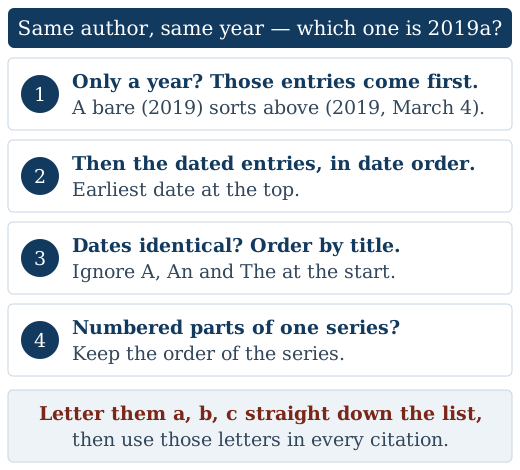
Work the ladder in order, and stop at the rung that separates them.
If one entry carries just a year and the other carries a month and a day, the year-only entry goes first. Nothing else is consulted.
Two entries with full dates are ordered earliest first. The titles never come into it.
Now, and only now, alphabetize by title, ignoring “A,” “An” and “The” at the start of either one.
If the works are labeled Part 1 and Part 2 and share a date, Purdue OWL says to keep them in series order rather than alphabetical order.
Only after the run is in order do you attach a, b, c down it, and then carry the same letters into every in-text citation.
Here is why the ladder is worth knowing. Two posts on APA’s own blog carry the same byline, Adams, A., and the same year: The “issue” with issue numbers in journal articles, published 1 October 2019, and Book and book chapter references: No location required, published 8 October 2019. Apply the popular half-rule — alphabetize by title, ignoring “The” — and Book and book chapter… becomes 2019a. Apply the ladder and the 1 October post is 2019a, because both entries carry full dates and rung two never reaches the titles. The two published versions of the rule give opposite answers on the same real pair. The ladder is the one to follow, because it is the only version that tells you what to do when the dates differ.
One more detail APA publishes and almost nobody repeats: undated works by the same author take the letter with a hyphen. APA prints the in-text form itself — (Dreschke, n.d.-a, n.d.-b). And whatever precision the reference entry carries, the citation shows only the year and the letter: APA notes you “use only the year with a letter in the in-text citation, even if the reference list entry contains a more specific date.”
No author, group authors, articles and numerals
When nobody is credited, the title moves into the author position and the entry alphabetizes from there. Royal Roads University quotes the Manual: “move the title of the work to the author position (followed by a period), before the date of publication” (APA, 2020, p. 289). APA’s own style team quotes the next step from page 306 of the same book — “alphabetize the entry by the first significant word of the title (i.e., ignoring the words ‘A,’ ‘An,’ and ‘The’ at the beginning of the title).” A work actually bylined Anonymous is a different case, and Tilburg University’s guide states it in one line: “Works authored by ‘Anonymous’ are placed under A.”
The same three small words drop out of an organization’s name. APA’s style team answered exactly this question on the APA Style blog in February 2022: “We ignore the three nonsignificant words (‘a,’ ‘an,’ and ‘the’) at the beginning of an author name for the purposes of alphabetizing.” Its example places The Smithsonian Institution in the S range, between Raskin and Steinbeck. The word stays in the entry; it just does not count.
Group authors otherwise behave like surnames, with two conditions. Spell the name out — Royal Roads quotes page 268: “spell out the full name of a group author in the reference list entry.” And file it under the first significant word of that full name, which means the American Psychological Association sits under A and not under the initials your paper may use in text. A title that opens with a numeral sorts on the number as a word. Scribbr states the rule and works it: “If the title starts with a numeral, alphabetize it as though it were spelled out” — so its own example, 10 ways to increase your productivity, is ordered on the T of Ten.
Word and Google Docs both sort a list A to Z on the literal characters. They will file 10 ways… at the top, keep The in play, and put a coauthored 2008 entry above its author’s solo 2015 one. An automatic sort is a starting point, not a finished reference list.
Prefixes and particles: where the free guides stop agreeing
Two rules live here, and only one of them is settled.
Mc, Mac and M’ are ordered exactly as spelled. Library catalogs once filed Mc as though it were Mac; APA does not. Tilburg University’s APA guide gives the pairs: MacArthur precedes McAllister, and MacNeil precedes M’Carthy once the apostrophe is dropped. Scribbr, Bibliography.com and Tilburg all state this identically, and nothing we opened contradicts it.
Particles such as de, van, von and la are a different story. APA’s free 7th-edition materials do not mention them at all — not on the Reference List Setup page, and not in the one blog post APA has published about alphabetizing. The free guides fill the gap, and the four that address it give three different answers.
| Source | What it says about particles |
|---|---|
| USC Libraries and UT Arlington, on pages headed APA 7th Edition | Alphabetize such surnames “according to the rules of the language of origin” — a decision handed back to the name, not a rule. |
| Tilburg University | “Surnames with particles (e.g., van, de, van de(r), von) are alphabetized by the particle.” |
| Bibliography.com | “If the prefix is commonly part of a surname, use it for alphabetizing.” |
| AllCitations (August 2026) | Follow “the form the author uses,” and match the form printed on the work you are citing. |
Only the bottom two rows rank on the ordering queries; the university guides came from a separate search for a first-party statement none of them turned out to carry. The top row needs a warning, and you can repeat the check in two minutes. USC publishes two APA guides. The 7th-edition one carries that seven-bullet ordering list. USC’s own 6th-edition guide, at a different address and titled Sample Reference Page — APA Style 6th Edition, carries the identical block, whitespace aside — sitting beside the 6th-edition rule about which cities may be listed without a state, a rule APA 7 removed. UT Arlington’s page reproduces the same bullets and still writes “Retrieved from” in its examples, though APA’s own DOIs and URLs page says “it is not necessary to include the words ‘Retrieved from’ or ‘Accessed from’ before a DOI or URL.” The particle bullet is sixth-edition text sitting under a seventh-edition heading, so treat it as a guide’s wording rather than as verified APA 7 guidance.
What to actually do, then: alphabetize the name the way it is printed on the work you are citing, keep the author’s own capitalization, and be consistent across the list. If a name genuinely could go two ways and the grade turns on it, that is a one-line email to your instructor, not a guess.
A worked reference list, with the rule behind every line
Every entry below is a real source you can open. Nine are APA Style blog posts, and each of those prints its own APA-format citation on the page, so the wording is APA’s and not ours. Two more are APA’s Manual and handout, one is APA’s published Wikipedia example, and two are trade books. The a and b letters are ours — letters belong to the list that contains the works, not to the works themselves, which is exactly what the rule means.
| # | Entry | The rule that put it there |
|---|---|---|
| 1 | Adams, A. (2019a, October 1). The “issue” with issue numbers in journal articles. APA Style. | Adams sorts above American: ad before am. Within Adams, the earliest date leads. |
| 2 | Adams, A. (2019b, October 8). Book and book chapter references: No location required. APA Style. | Same author, same year, both fully dated, so rung two decides — not the title. |
| 3 | Adams, A. (2022, March 15). How to cite a work with a nonrecoverable source. APA Style. | Chronological within one author’s run. |
| 4 | Adams, A. (2025, August 7). How to cite unpublished works. APA Style. | Chronological. |
| 5 | Adams, A. (2026, May 13). We do not decide your source types. APA Style. | Chronological. Rows 3 to 5 each carry a different year, so none of them needs a letter. |
| 6 | American Psychological Association. (2020). Publication manual of the American Psychological Association (7th ed.). | Group author under the first significant word of its full name, so A — never the initials. |
| 7 | American Psychological Association. (2022). Creating an APA Style reference list guide. | Same group author, later year. |
| 8 | The Beatles. (2022, February 8). In Wikipedia. | No author, so the title leads — and “The” is ignored, filing it under B. This is APA’s own published example. |
| 9 | Lee, C. (2020, February 19). A tale of two reference formats. APA Style. | L after B, before M. The “A” opening the title is irrelevant here; the author leads. |
| 10 | McAdoo, T. (2019, November 7). How many names to include in an APA Style reference. APA Style. | L before M puts it here, then chronology. Mc files at m-c-a, as spelled — the old library habit of filing it as Mac would not move it in this list, which is why the rule is easy to miss. |
| 11 | McAdoo, T. (2021, July 7). Why titles have sentence case capitalization in APA Style references. APA Style. | Chronological. |
| 12 | McAdoo, T. (2022, February 23). How to alphabetize “a,” “an,” and “the” in APA Style references. APA Style. | Chronological. |
| 13 | Thaler, R. H. (2015). Misbehaving: The making of behavioral economics. W. W. Norton. | T last. The solo entry leads its author’s run. |
| 14 | Thaler, R. H., & Sunstein, C. R. (2008). Nudge: Improving decisions about health, wealth, and happiness. Yale University Press. | Coauthored, so it follows the solo work despite being seven years older. |
In a submitted paper each of those would carry its DOI or URL and a half-inch hanging indent; the addresses are left off here so the ordering column stays readable on a phone. If you want to see a finished list in position at the back of a whole paper, our APA research paper examples show it in context.
Three in-text citations your reference list decides
Reference lists are usually treated as the last job. Three of APA’s own rules quietly make that impossible, because each one depends on what else is in the list rather than on the source in front of you.
- The year letters. Already covered: APA says they “are assigned when the references are placed in order in the reference list.” Until the list is ordered, (Adams, 2019a) is a guess.
- Initials on same-surname first authors. APA: “if the first authors of multiple references share the same surname but have different initials, include the first authors’ initials in all in-text citations, even if the year of publication differs” — giving (J. M. Taylor & Neimeyer, 2015; T. Taylor, 2014). You cannot know a citation needs initials until you see both entries side by side.
- The expanded “et al.” form. When two works with three or more authors shorten to the same citation, APA tells you to “write out as many names as needed to distinguish the references,” producing Kapoor, Bloom, Montez, et al. (2017) and Kapoor, Bloom, Zucker, et al. (2017). Again, the trigger is a collision between two entries.
Build the reference list first, order it, then go back through the paper. Doing it the other way around is how citations end up pointing at the wrong entry, and it is not the kind of error a spellcheck finds.
The two-minute check before you trust any APA page
On 22 August 2026 we pulled the US results for apa reference page order and how to alphabetize apa references, from DuckDuckGo and Bing, which returned the same set. That is 17 unique pages, and we opened and read every one. The rules are not missing from those results — several pages cover them well. What is missing is narrower, and more useful to know.
| Across the 17 ranking pages | Count |
|---|---|
| State that a lowercase letter marks same-author, same-year works | 6 of 17 |
| Say what decides which work gets the letter a | 4 of 17 |
| State the date rung — year-only entries first, dated entries chronologically, titles only as a last resort | 0 of 17 |
| Say anything at all about de, van, von or la | 2 of 17, disagreeing with each other |
| Key an ordering rule to a Publication Manual section or page number | 4 of 17 |
The page holding the top spot on the alphabetize query answers the letter question with “order works by that lowercase letter,” which is true and circular. One page gets close to the date rung without stating it: Bibliography.com says the letters are assigned “based on the alphabetical order of the title or by month and days added after the year,” and its worked example does put the year-only entries above the dated ones. But it offers those two tests as alternatives and never says which one wins, which is the whole of the rung. The two pages that state it outright — Purdue OWL’s author page and EasyBib — rank on neither query.
So here is the habit worth carrying away, and it costs one scroll. Look for the edition and the date on any citation page before you believe it. If the page names no edition, that silence is your answer. If it names an edition, check whether the details match: a book reference carrying a city of publication, or a URL introduced by “Retrieved from,” is sixth-edition formatting no matter what the heading says. That single check is what turned up the particle problem above, on two university guides, in a few minutes.
Ordering rules are learnable in an afternoon. The paper the list belongs to is the part that takes the term. If that is where you are stuck, our APA writing help starts at $7.89 per page — a floor rather than a flat rate, since length, level and deadline all move it — and the work is delivered to you to review and submit. Writing in a different style this term? Our APA 7 and MLA 9 comparison lays the two source lists side by side, and if the assignment asks for annotations under each entry, start with how to write an annotated bibliography.