Live Chat


A thesis proposal example is a finished, approved plan for a master's thesis — the question, the background that justifies it, the method, and the schedule — read so you can see the shape of the document before you write one. The trouble with the samples posted online is that they arrive without their rules. You get a PDF and no explanation of why the literature review dwarfs the method, why the method reads like an instruction manual, or why there is a section headed "projected results" for a study that has not happened yet. This guide gives one complete proposal with the format rule written beside each part, plus what four named US programs put in writing.
- In US usage the master's document is a thesis and the doctoral one is a dissertation. Check the degree and the country before you copy anything: the UCF example set that ranks for this phrase is undergraduate honors work, and British universities file the taught master's project under dissertation, so UK material arrives under both search terms.
- There is no universal length. MIT EECS gives a rule of thumb of 8–12 pages for an MEng or SM proposal, while pointing MEng students on the same page at a departmental guideline of 1,500–2,500 words; Cal Poly Pomona's MS in Computer Science asks for a literature survey of "at least fifteen pages" on its own.
- About a quarter background, three quarters plan: MIT EECS advises spending "about 25% of your proposal on background and 75% on what you propose to do and a timeline to completion." It is the only published figure on proportion in this set, and worth measuring your draft against.
- Where a Texas State thesis involves human subjects, the graduate catalog requires IRB exemption or approval before the proposal form goes to The Graduate College, with the letter included — so that step comes before proposal approval, not after.
- One calendar rule quietly sets your graduation date. In Texas State's MA in Rhetoric and Composition: "You may not submit a thesis proposal and final thesis during the same semester."
What a Sample Proposal Teaches, and Where It Misleads
Samples are excellent at form and unreliable at authority. Read a few and you stop guessing about heading depth, tense, and how much detail a method section carries. What you cannot see is whether the sample had any standing with the people who will read your draft. Two mismatches cause most of the trouble.
The degree level. The Burnett Honors College at the University of Central Florida publishes a set of thesis proposal examples that surfaces in US results for this phrase — and those are undergraduate proposals, written for its Honors Undergraduate Thesis program. UCF says plainly what they are for: "These examples should be used for reference only and not necessarily as templates."
The country. British universities call the master's project a dissertation — the University of Edinburgh's School of Social and Political Science publishes its MSc guidance under the heading "Guidelines for writing a master's dissertation" — so a good deal of the free material you will meet under either phrase is UK master's work written to a different standard. Our guide to the difference between a thesis and a dissertation sorts out which word means what, and thesis examples by degree level shows how far the finished documents diverge.
The Skeleton Underneath Every Version of the Format
Programs disagree about section names and lengths, but they ask the same document to do the same job. The clearest published statement of that job comes from Texas State University's MA in Rhetoric and Composition, which defines a thesis proposal as "a persuasive document designed to convince readers that the research you propose is timely and relevant, that you have chosen an appropriate methodology for addressing the research question, and that you have a clear plan for completing the project." The same page lists what that requires: identify the project, establish its need and significance, review the relevant literature, discuss the methods, and provide an overview of thesis chapters.
The University of Wisconsin–Milwaukee Department of Communication publishes a five-part outline for its MA proposals — background and rationale, methodology, an outline of projected results, potential conclusions and implications, and a working bibliography — with a caution worth taking seriously: "This sample outline may not be appropriate for some studies."
Neither of those two sources says how the pages should be divided. Only one published source in this set puts a number on proportion, and it is worth borrowing whatever your field: the MIT EECS Communication Lab advises, "Try to spend about 25% of your proposal on background and 75% on what you propose to do and a timeline to completion." Applied to the top of its page range for a master's-level proposal — twelve pages — that is about three pages of context and nine pages of plan.
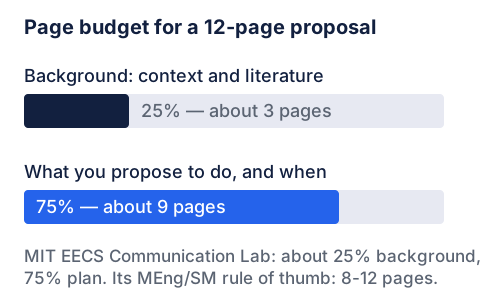
That ratio is the most useful thing to carry into a first draft. The background section writes itself, so it grows; the method requires decisions, so it stalls. A proposal that is half literature review has usually not been thought through — it has been read up on.
A Worked Master's Thesis Proposal, Annotated
Everything in the boxes below is written for this article — not a real student's proposal, not a real study. The imagined project is an MA thesis in communication planned across two semesters: a content analysis of the letters and emails US community colleges send students placed on academic probation. It is kept deliberately modest in scale because the timetable further down runs twenty-six weeks and the whole study has to finish inside it.
Title page, title, and abstract
Title: Warning or Welcome? Stance and Required Action in Academic Probation Notices at 60 Public Two-Year Colleges
Abstract: Students placed on academic probation receive a notice before they receive advice, and for many the notice is the only communication they read. This study asks what those notices do: whether they frame probation as a sanction or as an offer of support, and whether they name a specific required next step. Using a stratified sample of 60 public two-year colleges, I will collect probation notice templates from institutional websites and from advising offices, and code each for stance, required action, and named point of contact. I will code the full sample, with a second coder independently coding a 20 percent subset to establish reliability. Frequencies and cross-tabulations will show how stance and required action co-occur, and whether the pattern differs where probation triggers a mandatory advising hold.
The format rule. The abstract moves from the situation to the question, then to data, method, and analysis — in the future tense, claiming no findings. The title names the constructs being measured and the corpus they are measured in, which lets a reader who never opens the document say what the study is.
The title page is also a signature page in some programs. Cal Poly Pomona's format for a thesis proposal gives signature lines to a thesis advisor and possible committee members, who attest the work is "adequate in depth and scope to serve as the culminating experience for the Master's Degree in Computer Science." What they approve is scope, not prose.
Introduction and statement of the problem
Academic probation is a status change that colleges deliver in writing. Research on probation has concentrated on what happens after the notice — advising caseloads, registration holds, persistence — and treats the notice itself as a neutral trigger with a date attached. It is not neutral. A message that opens by naming a policy violation and a message that opens by naming an available advisor ask different things of the same student on the same afternoon. What those notices actually say, across institutions, has not been described.
The format rule. Three moves in five sentences: the territory, the limit of what is currently known, and the specific unanswered question. Note what is missing — the phrase "there is a gap in the literature." A gap is not a finding; naming what has been studied and what has been assumed instead is. MIT EECS sets a related bar among its criteria for a successful proposal: "answer the Heilmeier questions to concretely explain what you are trying to do and how you will achieve it." If a reader needs your method section to work out what you are trying to do, the introduction is not finished.
Literature review
Three bodies of work meet in this study. Research on probation outcomes measures what happens to students after the status is applied, and treats notification as an event rather than a text. Research on institutional communication and student belonging shows that the wording of routine administrative messages is read by students as a statement about their standing. Content-analytic work on university messaging supplies the coding conventions this study will follow, but has examined recruitment and crisis communication far more than sanction messages. The first two literatures rarely cite each other, and neither has looked at the document itself.
The format rule. A proposal's literature review is an argument that ends at your question, not an inventory of what you have read. The paragraph above does one job: it explains why the question is open. Every sentence in it would carry citations in a real proposal — they are omitted here because inventing sources to decorate an example is worse than leaving the citation slots empty.
Length is where programs part company hardest. Cal Poly Pomona's MS in Computer Science asks for a literature survey of "at least fifteen pages reflecting enough serious review of the topic to establish credibility for the proposal." MIT EECS budgets all background at roughly a quarter of an 8–12 page document — and on the same page sends MEng students to a departmental guideline of 1,500–2,500 words for the whole document. Two live numbers on one page, and nothing on it converts one into the other; MIT's own instruction for exactly that situation is the sentence to remember: "Always be sure to follow the most up-to-date department guidelines."
Research questions and hypotheses
RQ1. What stance — sanction-framed, support-framed, or mixed — do academic probation notices take?
RQ2. How often do notices name a specific required next step, and how often do they name a person or office to contact?
H1. Notices from colleges where probation triggers a mandatory advising hold will more often be support-framed than notices from colleges where it does not.
The format rule. Each question is answerable by the method described in the next section, and the hypothesis names both sides of the comparison it predicts. Read your own draft the same way: for each question, point at the sentence in the method that produces the answer. A question beginning "to explore the experiences of" has no such sentence, which is why committees stop on it.
Method
Sampling. Sixty public two-year colleges will be drawn from a national directory, stratified by enrollment into three bands of twenty.
Materials. For each college I will collect the current probation notice template, first from the college website and, where it is not posted, by written request to the advising office. Colleges supplying nothing within four weeks will be replaced from a reserve list, and the replacement rate will be reported.
Coding. Each notice will be coded on three variables: stance (sanction / support / mixed), required action (named / not named), and point of contact (person / office / none). A second coder will code a 20 percent subset; agreement will be reported as Krippendorff's alpha, and if it falls below the threshold set in the codebook, the codebook will be revised and the subset recoded.
Analysis. Frequencies for each variable, a cross-tabulation of stance against required action, and a test of H1 comparing the two hold conditions.
The format rule. Cal Poly Pomona's handbook asks the methodology section to describe how the research goal will be achieved, in enough detail for a reader to judge feasibility. The working version of that standard: a stranger in your field should be able to run the study from this section alone. Notice that every predictable failure has a stated response — colleges that do not reply, coders who do not agree. That is the difference between a plan and a hope, and it is the part a committee tests hardest.
A method section is approved when a reader can picture the work happening, not when they agree the topic matters.
Projected results and analysis
If stance and required action are independent, notices will spread evenly across the cross-tabulation, and the practical reading is that colleges attach next steps regardless of the tone they take. If they are not independent — if the support-framed notices are also the ones naming a next step — the practical finding is that tone and usefulness travel together and cannot be separated in revision guidance. If H1 is not supported, the mandatory-hold policy is not reaching the wording of the message it triggers, which is worth reporting in its own right.
The format rule. UWM's Communication outline calls this an "Outline of Projected Results," and the wording matters: you are outlining what each possible result would mean, not predicting the one you want. Write the paragraph for the outcome that disappoints you as carefully as the one that pleases you. If you cannot say what a null result would mean, a committee will conclude — usually correctly — that the analysis cannot produce an interpretable answer either way.
Timeline, chapter map, and references
Timeline. Weeks 1–3: IRB determination requested; sampling frame built. Weeks 4–9: notices collected, reserve list worked, codebook finalized. Weeks 10–12: reliability subset coded and alpha reported. Weeks 13–18: full sample coded. Weeks 19–22: analysis and Chapter 4 drafted. Weeks 23–26: Chapter 5 drafted; complete draft to the committee six weeks before the defense date.
Chapter map. Chapter 1, introduction and problem; Chapter 2, literature; Chapter 3, method; Chapter 4, findings; Chapter 5, discussion and implications for practice.
The format rule. MIT EECS calls the timeline a required component of almost any project proposal, one that "should show that you have thought through the overall project goals and how to achieve them in accomplishable steps." A timeline made of terms rather than tasks does not show that; one whose last two entries are drafting chapters does.
The chapter map is easy to leave out, and two of the four programs in the table below require it outright: Texas State's MA in Rhetoric and Composition asks for "an overview of thesis chapters," and Cal Poly Pomona lists a "Tentative Table of Contents for the Thesis." Four lines answer the question every committee member is holding: what does the finished thesis look like if this plan works? The bibliography at this stage is a working one — UWM heads that item “Working” Bibliography of Sources & Materials, quotation marks and all — evidence that you know the conversation you are entering, not the reference list of a thesis that does not exist yet.
Where Published Requirements Actually Differ
Four US programs, four sets of rules for the same document, each published on the program's own site.
| Program | What it requires in the proposal | Its stated length rule |
|---|---|---|
| Texas State University, MA in Rhetoric and Composition | Identify the project, establish need and significance, review the relevant literature, discuss methods, and give an overview of thesis chapters | No proposal length stated; the finished thesis is "60-75 pages in length, excluding the bibliography and any appendices" |
| Cal Poly Pomona, MS in Computer Science | Signed title page, table of contents, introduction, literature survey, research goal, methodology, evaluation of results, tentative table of contents for the thesis, tentative timetable, references | Literature survey alone: "at least fifteen pages" |
| MIT EECS (MEng and SM) | Title and abstract, an introduction that motivates the work, related or preliminary work, proposed future work with a timeline, references | Rule of thumb "8-12 pages for an MEng or SM proposal"; departmental MEng guideline of 1,500-2,500 words; about 25% background, 75% plan |
| UW–Milwaukee, MA in Communication | Background and rationale, methodology, outline of projected results, potential conclusions and implications, working bibliography | No length stated; the outline "may not be appropriate for some studies" |
Reading down that middle column is the fastest cure for template anxiety. A rhetoric proposal argues; a computer science proposal specifies; an EECS proposal budgets its pages. A sample from the wrong row teaches the wrong instinct about how much detail is enough.
Your program handbook outranks every sample and every guide, this one included. Settle four things from it before you draft: required sections, length, who signs, and the deadline the signatures have to land by.
The Sequence Rules That Cost People a Semester
Format questions get the attention; scheduling questions cause the damage. Three published rules, in the order they bite.
Texas State's graduate catalog requires that for research involving human subjects, "the student must obtain exemption or approval from the Texas State Institutional Review Board prior to submitting the proposal form to The Graduate College. The IRB approval letter should be included with the proposal form." Note that exemption is also a determination the board makes — deciding for yourself that your study is exempt is a different and expensive thing.
The Texas State catalog spells the chain out: after the proposal form is signed you collect "committee members' signatures, the graduate advisor's signature and the department chair's signature," and only then submit the form with the proposal attached "to the dean of The Graduate College for approval before proceeding with research on the thesis." Two more signatures stand between your committee and the dean, and each link has its own turnaround. The committee itself is three approved graduate faculty at minimum, a majority from the student's own program; in the MA in Rhetoric and Composition, a thesis director and two readers.
Texas State's MA in Rhetoric and Composition states it flatly: "You may not submit a thesis proposal and final thesis during the same semester." That fixes your earliest graduation date months before you write a word of your findings chapter.
Deadlines inside a timeline are usually relative rather than fixed, which makes them easy to miss. Cal Poly Pomona's format page asks for a first thesis draft "at least six weeks prior to the defense" and a final draft "at least two weeks prior to the defense" — two dependent deadlines counted backward from one date you do not fully control. The same page then sets the defense "no later than the tenth week of the quarter in which you plan to graduate," wording that predates the campus's own move from a quarter calendar to a semester calendar in fall 2018. That is the wider lesson: a published deadline is a date to confirm with your graduate coordinator, not a date to build a timeline on.
How to Read a Sample Proposal in Thirty Minutes
Most students read a sample the way they read a finished article — start to finish, absorbing tone. That teaches almost nothing. Read one as an editor instead, in this order.
Undergraduate honors, master's, and doctoral proposals differ in the methodological detail expected. If none of the three is stated, stop reading.
Compare the result to the 25/75 split above and to your handbook. That one measurement says more about the document's shape than reading it does.
Set them side by side. If the second does not obviously answer the first, the sample is not a model, whatever else it does well.
Non-response, attrition, access refused, a coder who quits. Yours needs that sentence too.
Section names, length, order, who signs. The handbook wins every conflict, and each one you catch now is a revision round avoided.
Ask your advisor for two approved proposals from your own program as well. Programs that publish them — Texas State's MA in Rhetoric and Composition posts a sampling of proposals written by its own students — are showing you the standard your readers apply, which no general sample can.
What No Sample Can Supply
An example solves uncertainty about form. It cannot settle the two things a committee is deciding: whether the question is worth a year of your life and theirs, and whether the method you named can answer it. Once you can state the question in one sentence and point to the sentence in your method that closes it, the document arranges itself and the format questions turn out to be small.
If the topic is still a subject area rather than a question, our walkthrough of how to write a thesis covers that move, and what a thesis is explains where the proposal sits in the degree. If the draft has been stuck at the method section for a month — the usual place — a second opinion from someone who has written one costs less than a lost semester. Apex Essays' thesis writing help starts at $7.89 per page and works from your question and your handbook rather than a template. You keep control of the project, and what you submit stays yours to review and revise.
Read a couple of proposals, mark them up the way this guide marks up the extracts above, then close the tabs. The example has done its job the moment format stops being the thing you are worried about.