Live Chat

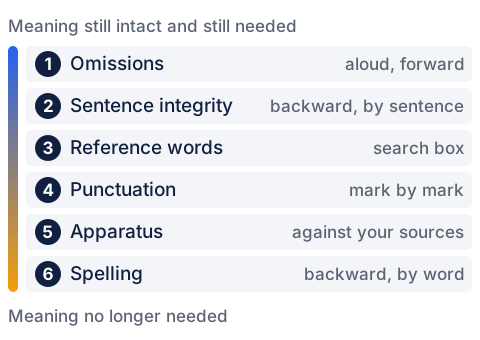
Proofread in six passes, in this order: omissions, sentence integrity, reference words, punctuation, apparatus, spelling. One error type per pass. Spelling goes last, not first, and it is the pass that finds the least.
The order is the checklist. Most proofreading checklists are a pile of error types with no sequence attached, so you watch for all of them at once and catch a fraction of each. The University of North Carolina at Chapel Hill Writing Center names that failure exactly: "If you try to identify and revise too many things at once, you risk losing focus, and your proofreading will be less effective." The fix is not a longer list. It is a running order, with a reason behind every position and an honest account of what each pass cannot see.
- Six passes, one error type each. Omissions, sentence integrity, reference words, punctuation, apparatus, spelling — in that order. The sequence is ours; no writing center publishes it.
- Two US writing centers publish the ordering principle. UW–Madison: "check separately for each kind of error, moving from the most to the least important." UNC: "Proofread for only one kind of error at a time."
- Spelling is the last pass, not the first. UW–Madison's handbook says to "End with a spelling check" — and it is the only pass that works better once the meaning is gone.
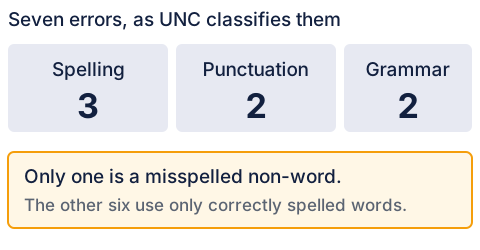
- Most errors are spelled correctly. UNC leaves seven errors in its own handout on purpose. Only one of the seven is a misspelled non-word.
- Every pass is blind to something. Reading aloud cannot hear a comma. Reading backward cannot see a pronoun with no clear antecedent.
- Out of time? Run passes 1, 5 and 6, and know what you gave up. That is triage, not the checklist.
Why the order does the work
The six-pass sequence is ours, not an institution's. No source we found publishes this running order, and it is not anyone's official method. The writing centers quoted throughout supply the principle — one error type per pass, most important first — and the individual techniques; assembling those into this sequence, and setting out what each pass is blind to, is our own editorial work. Two structural reasons put the passes where they are, and neither is a matter of taste.
Repair order. A fix made early must not be undone later. Correct a comma inside a sentence you then split in half and you did the work twice — and rewriting a sentence drops fresh typos into it. So structure settles before punctuation, and punctuation before spelling. Anything that changes words happens before the pass that inspects words.
Instrument order. Each pass uses a different instrument: your ear, the shape of one sentence, the search box, the marks themselves, your source list, and finally bare letters with the meaning stripped out. Those instruments run from most meaning-dependent to least. You can strip the meaning out only once, so every pass that needs it intact runs first.
The University of Wisconsin–Madison Writing Center is the one source we found that publishes an ordering rule at all, rather than a bare list: "If you tend to make many mistakes, check separately for each kind of error, moving from the most to the least important, and following whatever technique works best for you to identify that kind of mistake." Its own illustration runs backward sentence by sentence for fragments, then forward for subject-verb agreement, then a search for "this," "it," and "they" to trace pronouns. And it names the endpoint without hedging: "End with a spelling check, using a computer spelling checker or reading backwards word by word."
Spell-check is the pass most students run first. It belongs last, and it finds the least.
Three conditions before the first pass
These are conditions, not steps. If one of them is false, the six passes below are wasted motion.
- Revision is finished. UNC is blunt: "You should proofread only after you have finished all of your other editing revisions." UW–Madison agrees — "Don't make corrections at the sentence and word level if you still need to work on the focus, organization, and development of the whole paper, of sections, or of paragraphs." If the argument might still move, proofreading is paint on a wall you may knock down. Our guide to what proofreading actually is draws that boundary in more detail.
- There is distance between writing and reading. UW–Madison: "Set your text aside for a while (15 minutes, a day, a week) between writing and proofing." The reason is mechanical. Fresh from writing, you recite the draft from memory instead of reading it, and your memory has no typos in it.
- You have a list of your own recurring errors. Purdue OWL's "Proofreading: Where Do I Begin?" treats it as a prerequisite: "Have a list of what to look for … You can get this list from previous assignments where your instructor(s) noted common errors you make."
Sources disagree on medium, so choose deliberately rather than by default. UW–Madison says "Work from a printout, not the computer screen," and Purdue OWL agrees. UNC declines to prescribe: "Some people like to work right at the computer, while others like to sit back with a printed copy that they can mark up as they read." If you go with paper, the standard proofreading marks keep your annotations readable when you transfer them back.
The six passes, in running order
Each pass has one job. Mark what you find and keep moving — stopping to fix is how a pass turns back into the everything-at-once read that does not work.
This pass finds the words that are not there. Your eye supplies a missing "a" or "the" without telling you; your mouth cannot. It also catches doubled words, a verb that vanished when you rewrote the subject, and sentences that ran out of air. Purdue OWL: "Reading a paper aloud encourages you to read each word and can help you notice small mistakes." Read at the speed you would speak, not the speed you can skim.
Start with the last sentence and work toward the first. Stripped of the pull of your own argument, each sentence has to stand alone, which is exactly the test for a fragment or a run-on. UW–Madison prescribes this move by name. UNC offers a mechanical version: press return after every period so each sentence begins its own line, then read the lines. Watch long subjects — that is where agreement breaks.
Search for this, it, its, they, their, which, who. Reading is the wrong instrument here: you know what you meant, so your eye fills the referent in silently. A search does not. UW–Madison: "Search for 'it,' for instance, if you confuse 'its' and 'it's;' for '-ing' if dangling modifiers are a problem; for opening parentheses or quote marks if you tend to leave out the closing ones." At each hit, name the noun the word points at. If you cannot name one in about three seconds, replace the pronoun with the noun.
UNC's technique turns reading into counting: "Circle every punctuation mark. This forces you to look at each one. As you circle, ask yourself if the punctuation is correct." This is the pass for comma splices, apostrophes, and quotation marks or parentheses opened and never closed. It runs after the sentence pass because punctuation is a function of sentence structure — settle the sentence, then punctuate the sentence you actually kept.
Citations, reference entries, numbers, names, heading levels, figure and table numbers, your instructor's name, the title, the file name. None of it is prose, so rereading never finds it; it is a cross-check done with your source list open beside the draft. Purdue OWL's APA reference-list rules, revised for the 7th edition, give the rule that catches the most: "Each source you cite in the paper must appear in your reference list; likewise, each entry in the reference list must be cited in your text." Purdue OWL's MLA in-text citation page adds the test for the other direction: "whatever signal word or phrase you provide to your readers in the text must be the first thing that appears on the left-hand margin of the corresponding entry on the Works Cited page." Margins, spacing and headers belong here too — check them against our guide to formatting a college essay.
Last, because it is the only pass that works better once the meaning is gone. UNC: "Start with the last word on the last page and work your way back to the beginning, reading each word separately. Because content, punctuation, and grammar won't make any sense, your focus will be entirely on the spelling of each word." Run a spell-checker as well. Then keep reading, for the reason set out below.
What each pass cannot see
This is the part checklists leave out, and it is why a single careful read-through never works. Every technique buys its sensitivity by giving something up.
| Pass | What it catches | What it is structurally blind to |
|---|---|---|
| 1. Omissions (aloud, forward) | Dropped words, doubled words, a lost verb, a sentence with no end in sight | Homophones — their and there sound identical out loud. Punctuation, which is silent. |
| 2. Sentence integrity (backward, by sentence) | Fragments, run-ons, comma splices, subject-verb agreement across a long subject | Anything spanning two sentences: pronoun reference, tense drift, a transition that no longer fits. |
| 3. Reference words (search box) | its / it's, a floating this, an unclear they, an unclosed parenthesis | Every word you did not think to search for. This pass is exactly as good as your list. |
| 4. Punctuation (mark by mark) | Commas, apostrophes, quotation marks and parentheses opened and never closed | The words themselves. You are looking at marks, and marks are all you will see. |
| 5. Apparatus (against your sources) | Citation and reference mismatches, wrong years, misspelled author names, heading levels | All prose. A sentence can be nonsense and still pass this one. |
| 6. Spelling (backward, by word) | Misspelled non-words | Correctly spelled wrong words — which, as the next section shows, is most of them. |
One paragraph, carried through all six passes
Here is a short paragraph written for this article and seeded with exactly one error per pass. It is illustrative — nobody submitted it as real coursework — but the errors are the ordinary kind, and the point is which pass owns which.
Before: "The advice in these handouts, taken together, suggest that students treat proofreading as single event rather than a sequence. Its a habit formed early, and it is rarely corrected. As the Writing Center notes, most people devote only a few minutes to proofreading (Chapel Hill). That matters becuase the errors that survive are the ones a reader notices first, they are also the cheapest to fix."
Read it once, the way most students proofread, and you will probably catch one or two things. Run it through the passes and every error has an owner.
| What is wrong | The error | Pass that owns it |
|---|---|---|
| "as single event" | A missing a. Your eye inserts it; your mouth stumbles. | 1 — read aloud |
| "The advice … suggest" | Subject-verb agreement, broken across a long subject. | 2 — sentence integrity |
| "Its a habit" | Its for it's. A search for "it" lands on it; reading does not. | 3 — reference words |
| "notices first, they are also" | A comma splice joining two full sentences. | 4 — punctuation |
| "(Chapel Hill)" | The in-text signal word is not the name the source is filed under — exactly the mismatch Purdue OWL's rule is built to catch. | 5 — apparatus |
| "becuase" | A genuine misspelling — a non-word. | 6 — spelling |
Six errors, six passes, and only the last one is visible to a spell-checker. That ratio is the argument for the whole method. Corrected: "The advice in these handouts, taken together, suggests that students treat proofreading as a single event rather than a sequence. It's a habit formed early, and it is rarely corrected. As the Writing Center notes, most people devote only a few minutes to proofreading (UNC Writing Center). That matters because the errors that survive are the ones a reader notices first; they are also the cheapest to fix."
The errors that survive a spell-checker
UNC's handout does something almost no other writing-center page does: it leaves errors in itself on purpose, and publishes the key. The handout says so at the top — "we have left seven errors (three spelling errors, two punctuation errors, and two grammatical errors) in the text of this handout" — and a companion key page marks each one in red.
We opened the key and counted. Of the seven, exactly one is a misspelled non-word: proccess. The other six are built entirely from correctly spelled English words and punctuation marks — including two of the three that UNC itself files under spelling: to where too belongs, and your where you're belongs. Both are real words, and that is UNC's point: when a writing center sits down to hide seven realistic errors in its own text, six of them turn out to be things a dictionary lookup cannot see.
That is why the spelling pass is last and short. UNC states the limit directly: "spell checkers will not catch misspellings that form another valid word. For example, if you type 'your' instead of 'you're,' 'to' instead of 'too,' or 'there' instead of 'their,' the spell checker won't catch the error." UW–Madison adds the class that slips through even more quietly: "a spelling checker won't catch mistakes with homonyms … or certain typos (like 'he' for 'the')."
Grammar tools have a wider blind spot than spell-checkers and a louder voice. UNC: "These programs work with a limited number of rules, so they can't identify every error and often make mistakes. They also fail to give thorough explanations to help you understand why a sentence should be revised." Treat a suggestion as a question to answer, not an instruction to accept — and check your instructor's or program's policy on editing tools before you use one, because policies differ and the rules that bind you are your own school's. We map where that line sits in can AI proofread your essay.
The three-pass version, for when you are out of time
Six passes on a 1,500-word paper is a real block of time, and deadlines are real too. UNC allows for it: "If you're short on time, you may wish to prioritize. Make sure that you complete the most important editing and proofreading tasks." Here is a defensible triage, with the cost of it stated.
- Keep pass 1 (aloud). Highest catch rate per minute, and it finds what a reader trips over first: missing words and sentences that collapse.
- Keep pass 5 (apparatus). Its errors cost the most. A citation that does not match its reference entry is an accuracy problem, not a typo, and it is the one class here a grader can check mechanically.
- Keep pass 6 (spelling), but keep it to two minutes. Run the checker, accept the true catches, then read the title and first paragraph backward.
- Drop 2, 3 and 4 knowingly. You are accepting the risk of a fragment, a floating pronoun and a comma splice. They cost less than a broken citation, and they are the passes that most need the time you do not have.
One more option is free. Purdue OWL's closing instruction is to bring in another reader after you have made your own corrections: "Have a friend look at your paper after you have made all the corrections you identified. A new reader will be able to help you catch mistakes that you might have overlooked." Do your passes first — a second reader spends their attention badly on errors you could have found yourself.
The checklist that gets shorter
The six passes are fixed. The list you carry into pass 3 is not, and that is the part that should change every semester. All three writing centers quoted here converge on the same instruction: keep a record of what you actually get wrong. UNC frames it as pattern-spotting — "Keep an eye out for patterns of error; knowing what kinds of problems you tend to have will be helpful" — and Purdue OWL as bookkeeping: "Keep track of errors that you make frequently."
So read your graded papers for the marginal notes, not just the grade. After three or four assignments you will have five or six habits that are demonstrably yours, and pass 3 becomes five targeted searches instead of a general hunt. That is the version of this checklist worth owning: not longer, but sharper, and aimed at you rather than at everybody.
If a particular paper matters more than the practice this week — a graduate application, a capstone, a chapter going to your advisor — a second set of trained eyes is a reasonable thing to buy. Our editing and proofreading service works on your draft rather than replacing it: we mark what needs fixing, explain why, and hand it back for you to approve and submit. Afterward the corrections are still yours to learn from, which is the only way the list above ever gets shorter.