Live Chat


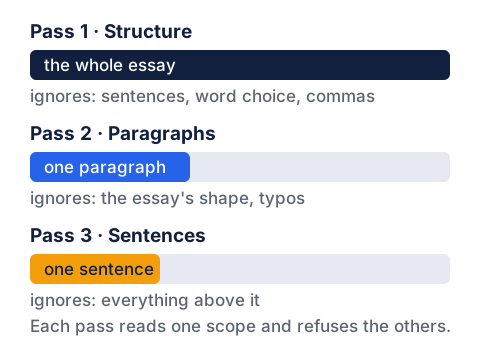
Edit your own essay in three separate passes — structure first, then paragraphs, then sentences — and refuse to fix anything that belongs to a later pass. The order is the technique. Everything else is housekeeping.
That rule sounds arbitrary until you know what you are fighting. Self-editing is hard not because you lack the judgment to spot a weak paragraph, but because you cannot see the draft in front of you. You read what you meant, and the page quietly supplies the rest. Every method below works the same way: it makes your own text look unfamiliar for long enough that your eyes have to land on the words that are actually there.
Most advice on this topic merges two different jobs into one. The University of North Carolina at Chapel Hill Writing Center draws the line in a single sentence: "Editing and proofreading are two different stages of the revision process." Merge them and you spend the last hour before a deadline moving commas around inside a paragraph that should have been deleted.
- Three passes, in order: structure, paragraph, sentence. Each pass reads one scope and deliberately ignores the others.
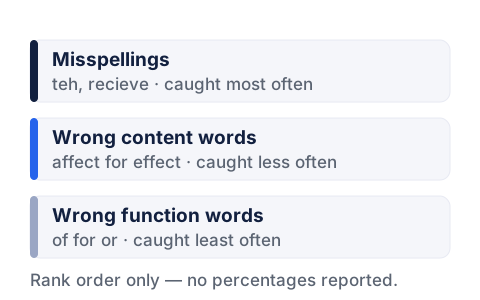
- The errors that survive are the ones that are still real words. In a 2023 eye-tracking study, wrong words were detected less often than misspellings, and wrong function words least of all.
- Time on the page is the lever you actually control. In the same study, the students who made more fixations and spent more time were the ones who detected more errors.
- Reading aloud, reading backward, and changing the font all do one job: they stop your eye from skimming a page it already knows.
- Wait first. UNC's advice is to "put the paper aside for a few hours, days, or weeks"; Purdue's is to walk away for "a day or two, a week, or even 20 minutes."
- Structure problems cannot be proofread away. UNC puts it bluntly: proofreading a draft with a weak thesis is "putting a band-aid on a bullet wound."
Why your own draft is invisible to you
The usual explanation is that your brain autocorrects your own writing. That claim gets repeated everywhere without a source, and the best recent test of it is more careful than the folklore.
In 2023, Alexander Burgoyne and five colleagues published two eye-tracking experiments in Psychological Research under the title "Revisiting the self-generation effect in proofreading." They set out to test the popular claim directly: is it harder to find mistakes in your own text than in someone else's? Their abstract reports the result plainly: "Experiment 1 failed to reveal a self-generation effect," and Experiment 2, which used a study task to force overfamiliarity with the writer's own text, produced only "a weak but non-significant self-generation effect."
So the "your own writing is special" story is shakier than advertised. Two other findings in the same paper are solid, and far more useful to you at 1 a.m. with a draft open.
The first is about which errors get missed: "word errors (i.e., wrong words) were detected less often than non-word errors (i.e., misspellings), and function word errors were detected less often than content word errors." Read that as a ranking of what survives a read-through. A misspelling is not a word, so it looks wrong and your spell checker underlines it. Affect written for effect is a word. Of written for or is a word. Nothing flags them, and your eye slides over them.
The second finding is the one behind every technique in the next section: "Students who made more text fixations and spent more time proofreading detected more errors." That is a correlation rather than a demonstrated cause, and the same abstract reports that fluid intelligence predicted proofreading performance too — so time on the page is not the only thing separating one reader from another. It is, however, the part you control. Reading aloud, reading backward, printing the draft and changing its font are not superstitions. They are all crude ways of forcing your eye to stop on words it would otherwise skip.
UNC's writing center says the honest version of this in one line: "It's hard to edit or proofread a paper that you've just finished writing." That handout then makes the point at your expense: it announces at the top that it has "left seven errors (three spelling errors, two punctuation errors, and two grammatical errors) in the text of this handout" — and at least one of them is a real word sitting where a different real word belongs.
Five ways to make your draft look unfamiliar
These are not five separate rounds. They are tools you reach for inside the three passes below, and each one earns its place by slowing your eye down.
Wait — a day if you have one, twenty minutes if you don't
Familiarity fades with time, and nothing else you do restores that as cheaply. UNC's editing handout is unromantic about it: "Put the paper aside for a few hours, days, or weeks. Go for a run. Take a trip to the beach." Its revising handout sets a realistic floor — "The Roman poet Horace thought one should wait nine years, but that's a bit much. A day—a few hours even—will work." Purdue OWL goes lower still: walk away "for a day or two, a week, or even 20 minutes."
Read it aloud, at speaking pace
Silent reading lets you sample a sentence and guess the rest. Speech does not allow that. UNC's reason is mechanical: reading out loud "forces you to say each word and also lets you hear how the words sound together." Purdue adds what it surfaces: "run-on sentences, awkward transitions, and other grammatical and organization issues that you may not notice when reading silently." If a sentence makes you run out of breath, it is too long. If you stumble over it, so will your reader.
Change what the page looks like
Your memory of the draft is partly visual: this paragraph starts halfway down page three, that quotation sits near the top. Break the picture and the memory loses its grip. UNC's suggestion is to alter the text itself: "Altering the size, spacing, color, or style of the text may trick your brain into thinking it's seeing an unfamiliar document." Printing it, switching to a serif font, or reading it on your phone all do the same job.
Read the last pass backward
This one is only for pass three, and only for spelling. UNC describes it exactly: "Start with the last word on the last page and work your way back to the beginning, reading each word separately." It works because it destroys meaning. With no sentence to predict, you cannot skip ahead to the end of a phrase, which is the whole reason wrong-but-real words survive a normal read.
Hunt one kind of error at a time
Trying to catch everything at once means catching very little. "Proofread for only one kind of error at a time," UNC advises, because "it's easier to catch grammar errors if you aren't checking punctuation and spelling at the same time." Purdue's version is about pace: "Don't rush. Many mistakes in writing occur because we rush. Read slowly and carefully to give your eyes enough time to spot errors." That principle scaled up is the three-pass order itself.
The three-pass order, and what each pass ignores
The passes run from the largest scope to the smallest, and the reason is economics. A paragraph you delete in pass one is a paragraph you never polish. Do it the other way round and you spend your best attention on sentences that will not survive.
| Pass | What you read | What you are hunting | What you deliberately ignore |
|---|---|---|---|
| 1 · Structure | The whole essay, one paragraph label at a time | Paragraphs in the wrong order, paragraphs doing two jobs, missing steps in the argument, a thesis the essay does not actually defend | Every sentence. Word choice. Commas. Typos you can see from here. |
| 2 · Paragraphs | One paragraph, start to finish | A claim in the first sentence, evidence that is introduced and then discussed, a link back to the paragraph before | The essay's overall shape, settled in pass 1. Spelling. Punctuation. |
| 3 · Sentences | One sentence at a time, out loud | Wordiness, buried verbs, vague subjects, wrong-but-real words, and sentence-level grammar and punctuation | Everything above sentence level. If pass 3 makes you want to move a paragraph, write a note and finish the pass. |
Keep a scrap file open called later. When a pass-three read makes you notice a structural hole, put one line in that file and keep going. The discipline is not stubbornness. It protects the pass you are actually in from collapsing into an anxious re-read of the whole essay.
Pass 1: structure — read the essay, not the sentences
This pass answers one question: does the essay make the argument its thesis promised, in an order a reader can follow? UNC's revising handout is direct about why it comes first: "if your ideas are predictable, your thesis is weak, and your organization is a mess, then proofreading will just be putting a band-aid on a bullet wound." Its instruction for this stage is short: "At this stage, you should be concerned with the large issues in the paper, not the commas."
The most reliable way to see structure in your own draft is to stop reading it as prose. Purdue OWL's reverse-outlining exercise is two steps per paragraph. In the left margin, "write down the topic of each paragraph. Try to use as few words as possible." In the right margin, "write down how the paragraph topic advances the overall argument of the text."
Then read only the margins. The left column tells you "if each paragraph is focused and clear." The right column tells you "if each paragraph fits in the overall organization of your paper." Purdue attaches a hard test to both: "If you can't complete each step in 5-10 words, the paragraph may need to be altered."
That test is the point. A paragraph you cannot summarize in ten words is usually doing two jobs, and the fix is to split it or cut one of them. If you built a plan before drafting, this is where you compare the two; our guide to outlining an essay covers the forward version of the same exercise.
Pass one ends with paragraphs moved, merged, split or deleted — and not a single comma touched.
Pass 2: paragraphs — one job each
Now read one paragraph at a time and ask what it does for the reader. Four checks cover most of it:
- The first sentence makes a claim, not an announcement. "In this paragraph I will discuss the setting" announces. "The setting does the work the narrator refuses to do" claims. Only the second gives the rest of the paragraph something to prove.
- Every quotation is introduced and then discussed. A quotation dropped between two of your own sentences leaves the reader to guess what you saw in it. Lead in, quote, then say what it shows, in your words, not a restatement of it.
- The paragraph connects to the one before it. A reader should never have to reconstruct why this comes next; that link is the job of a bridge sentence.
- Nothing in the paragraph belongs somewhere else. If two sentences argue a different point, they are a different paragraph, often one you already wrote further down.
Pass two is also where padding dies. Sentences that summarize what you just said, or preview what you are about to say, feel like structure and are actually filler. Cut them here, before you spend pass three polishing them.
Pass 3: sentences — out loud, one at a time
Only now do you read for the words themselves, aloud and slowly. Four things to look for:
- Wordy openers. "Due to the fact that" is "because." "In order to" is "to." "It is important to note that" is nothing at all.
- Buried verbs. "Chopin makes the placement of this line after…" hides a verb inside a noun. "Chopin places this line after…" puts it back to work.
- Missing actors. "The reader is not being asked to choose" hides who is doing the asking. Name the agent (the writer, the narrator, the study) unless your field's convention says otherwise.
- Wrong-but-real words. Affect and effect, their and there, of and or. These are the ones the study above found were caught least often, and the ones a spell checker has nothing to flag.
Mechanics (citation format, heading levels, page numbers, the reference list) are a separate job again, and one worth doing after this pass rather than inside it. Proofreading is the final surface read, and it works best once the sentences underneath it have stopped moving.
One paragraph, carried through all three passes
Here is what the discipline looks like on a real body paragraph. Watch what each pass changes, and more importantly what it leaves alone.
The paragraph below was written for this article as a realistic first-year draft. It is not a real student's work. The quotations inside it are real: both come from Kate Chopin's short story "The Story of an Hour," first published in Vogue on 6 December 1894 and long out of copyright.
In this passage, we can see that Chopin is showing us how Mrs. Mallard reacts to the news of her husband's death. Her sister Josephine tells her, and she cries in her sister's arms, and then she goes upstairs to her room alone and sits down by the open window. "And yet she had loved him — sometimes. Often she had not." This shows that she is conflicted. Due to the fact that Chopin makes the placement of this line come after the spring imagery and not before it, the reader is not being asked to choose between grief of relief, and that is the affect the story is going for. Also the ending is ironic because the doctors think she died of happiness and they are wrong about which happiness it was.
Pass 1 changes two things. The last sentence argues about the story's ending, which is a different paragraph's job, so it moves out. And the paragraph's actual claim, that the grief and the relief happen together, is buried in the second-to-last sentence, so it gets stated at the front where a reader can use it. Nothing else is touched.
Chopin puts Louise's grief and her relief in the same moment rather than one after the other. In this passage, we can see that Chopin is showing us how Mrs. Mallard reacts to the news of her husband's death. Her sister Josephine tells her, and she cries in her sister's arms, and then she goes upstairs to her room alone and sits down by the open window. "And yet she had loved him — sometimes. Often she had not." This shows that she is conflicted. Due to the fact that Chopin makes the placement of this line come after the spring imagery and not before it, the reader is not being asked to choose between grief of relief, and that is the affect the story is going for.
Pass 2 rebuilds the middle. The announcement sentence goes. The plot recap becomes evidence: Chopin's own words instead of a summary of them. The quotation gets a lead-in. And "This shows that she is conflicted," which shows nothing, is replaced by a sentence that actually reads the line. The final sentence is left exactly as it was, wording and all.
Chopin puts Louise's grief and her relief in the same moment rather than one after the other. The story gives her the conventional collapse first — she "wept at once, with sudden, wild abandonment," in her sister's arms — and then sends her upstairs alone to a window full of spring. Only after that does the narrator concede what the collapse had covered: "And yet she had loved him — sometimes. Often she had not." The hedge in "sometimes" carries more weight than the sentence around it. Due to the fact that Chopin makes the placement of this line come after the spring imagery and not before it, the reader is not being asked to choose between grief of relief, and that is the affect the story is going for.
Pass 3 reads it aloud. Every change below is a sentence-level change, and every one of them was invisible to the two passes before it, because those passes were not looking.
| Before | After | What kind of change |
|---|---|---|
| "Due to the fact that Chopin makes the placement of this line come after the spring imagery and not before it" | "Placed after the spring imagery rather than before it" | 21 words down to 9, and a buried verb ("makes the placement of") put back to work |
| "the reader is not being asked to choose" | "the line refuses to make the reader choose" | The sentence gets an actor; who is doing the refusing is now on the page |
| "grief of relief" | "grief or relief" | Function-word error. Both are real words, so nothing underlined it |
| "the affect the story is going for" | "the effect the story is built on" | Wrong content word, plus a vague verb replaced |
| "Only after that does the narrator concede what the collapse had covered" | "Only then does the narrator concede what the collapse concealed" | Two words shorter, same meaning |
Chopin puts Louise's grief and her relief in the same moment rather than one after the other. The story gives her the conventional collapse first — she "wept at once, with sudden, wild abandonment," in her sister's arms — and then sends her upstairs alone to a window full of spring. Only then does the narrator concede what the collapse concealed: "And yet she had loved him — sometimes. Often she had not." The hedge in "sometimes" carries more weight than the sentence around it. Placed after the spring imagery rather than before it, the line refuses to make the reader choose between grief or relief — and that refusal is the effect the story is built on.
Notice where of for or and affect for effect were finally fixed. They sat untouched through two complete passes. That was not an oversight. Under this order they were never in scope until the final read, and they belong to exactly the class Burgoyne's group found students detect less often than misspellings: real words in the wrong place. A writer editing everything at once usually looks straight past them while thinking about the paragraph.
The point of the order is not tidiness. It is that you get one genuinely fresh look at your own draft, and structure deserves it more than commas do.
What self-editing cannot do
Three passes will lift a draft a long way. They will not do everything, and knowing the boundary saves you from re-reading one paragraph twelve times for no return.
You cannot test your own clarity. If a sentence has two possible readings, you already know which one you meant, so the ambiguity is invisible to you by definition. You also cannot supply the reader's ignorance: the background you left out is background you happen to have. Both problems need a person who was not inside your head while you wrote: a classmate, a tutor at your campus writing center, or an instructor in office hours. Reading the draft to someone else and watching where they frown finds things no solo pass will.
Software has a narrower use than its marketing suggests. A grammar checker matches patterns; it does not know what you were trying to say, which is why it is fine on a missing comma and useless on a paragraph in the wrong place. It is also worth knowing where your own institution's line sits on using these tools at all; we cover that in can AI proofread your essay.
And sometimes the honest answer is that the draft is finished but the deadline is not, or the essay matters enough that a trained second reader is worth paying for. Our editing and proofreading service exists for that case: a professional editor works on the draft you wrote, tells you what changed and why, and leaves the argument yours. Whichever route you take, run pass one yourself first. Structure is the part nobody else can fix without rewriting your essay for you.