Live Chat

Peer editing is one job done in a fixed order. Read the whole draft before you write a single note, comment on the argument first, and leave the commas alone until the argument is settled. Then write a comment your classmate can act on: one that names a place in the draft, says what happened to you as a reader there, and stops short of rewriting the line for them.
Most peer-review advice is written for the instructor setting up the exercise, not for the student sitting in front of a classmate's essay with no idea what to type. So this is the reviewer's protocol: what to ask before you read, what each pass looks for, what a usable comment looks like next to a useless one on the same sentence, where commenting stops and doing your classmate's assignment starts, and what the writer does with the pile afterward.
- You are a reader, not a grader. The Washington University in St. Louis Center for Teaching and Learning makes it one of the four strategies its peer-review approach is built on: "Define the role of the peer-reviewer as that of a reader, not an evaluator."
- Read once with your hands off the keyboard. The Purdue OWL is blunt: "try to read the paper once without making a single comment."
- Budget about 25 minutes for a three-page draft — WUSTL publishes 15 minutes of reading (twice through) plus 5 to 10 minutes of writing comments.
- Argument before sentences. Purdue's higher-order concerns — thesis, audience, organization, development — come ahead of grammar. A comma fixed inside a paragraph that gets cut is 30 seconds gone.
- Three moves make a comment usable: describe what you read, evaluate it against what the draft promised, suggest one next step.
- Flag it; do not fix it. The University of Rochester lists "Unauthorized editing or revising of another student's work" as giving unauthorized aid, so the safe default is a margin comment, not a rewritten sentence.
Your job is reader, not grader
The most common way a peer review goes wrong is that the reviewer promotes themselves. They start assigning a grade in their head, then hedge and soften, and produce three pages of "this is really good, maybe add more detail?" The Washington University in St. Louis Center for Teaching and Learning heads that off in the fourth of its four peer-review strategies: "Define the role of the peer-reviewer as that of a reader, not an evaluator." Its worksheet advice goes further — "Do not replicate the grading criteria… Your students will not necessarily be qualified to apply these criteria effectively."
Cleveland State University's open first-year writing textbook — the interactive 2nd edition — says it to the student directly. In the chapter on responding to other people's drafts, Emilie Zickel writes: "You don't need to take on the role of a 'grader'. That isn't the role of the peer reviewer." Then the practical half: "You don't need to correct things. Instead, try to help the writer identify areas for revision or editing."
That is liberating. You do not have to decide whether the essay deserves a B. You have to report what a real reader experienced — where you understood, where you got lost, where you started arguing back. The writer cannot get that anywhere else, because they already know what they meant.
Ask two questions before you read a word. First, what stage is this draft at? The Purdue OWL notes that if your partner already knows the conclusion is missing and plans to write it tomorrow, "you can save some time and energy telling them they don't have a conclusion." Second, what does the assignment weight? If the rubric gives argument 40 points and mechanics 10, spend your attention accordingly — and if the grid you were handed is hard to read, our guide to what a rubric is works through a real one.
Do the passes in this order
The order is the part that gets skipped, and skipping it is why so much peer feedback arrives as a scatter of comma notes. Purdue OWL's page on higher order and lower order concerns sets the priority: the "Higher Order Concerns (HOCs)" are "the 'big picture' elements such as thesis or focus, audience and purpose, organization, and development," and only "after you have addressed these important elements" do you turn to "Lower Order Concerns (LOCs)" — sentence structure and grammar.
The first item below happens before the clock starts; the other three are the 25 minutes in the figure.
One message, one minute. What stage is the draft at, what is already known to be missing, and is there a section they are worried about?
The OWL's reason is practical: if you comment before reading the entire paper, "you may find yourself making detailed comments that get addressed in later paragraphs." Read for one thing — can you say, in a sentence, what this essay argues?
Now mark. Underline the thesis, or write "couldn't find it." Then jot each paragraph's topic in the margin; that list is the fastest way to see a paragraph doing two jobs or none. If it surprises you, outlining an essay is the shape the writer was aiming at.
Turn the marks into sentences, then close with a paragraph of overall impressions. The OWL calls this step "Sum up," because feedback "spread out across many pages" leaves the writer asking "where do you even start, and what is important?"
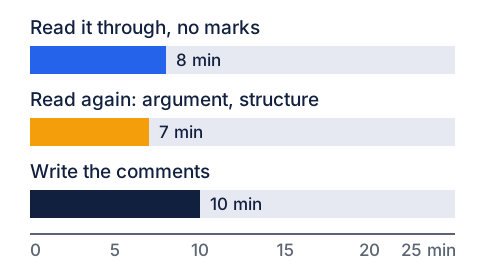
Fifteen of those 25 minutes are reading. Only the last block produces anything the writer ever sees, which is the opposite of how it feels while you are doing it.
The order also buys you a reason not to touch the sentences yet. Sentence-level work belongs at the end, once nothing else is going to be cut; that is the proofreading and copy-editing stage, and it is not what a mid-draft peer review is for. Purdue names one exception: if errors are dense enough that "readers may not move far enough into your work to get to your thesis statement," it says to address them first. Between classmates that is worth doing once, as a pattern, rather than as fifty corrections.
The same sentence, commented two ways
This is the part no rubric teaches. The left column is a sentence from a draft; the middle is the comment students actually write; the right is the comment the writer can do something with on Sunday night.
Every draft sentence below was written for this article, for an imagined first-year essay arguing that a city should expand its bus network. None comes from a real student's paper, and no comment is quoted from a real review.
| In the draft | Comment that helps nobody | Comment the writer can use |
|---|---|---|
| "Public transportation is an important issue in America today." | "Great opening!" | "I finished this sentence still not knowing what you were going to argue. I got a topic where I expected a claim about buses." |
| "The bus system is underfunded, which is unfair to riders." | "Awkward." | "I stopped at 'unfair.' Unfair compared with what? I couldn't tell whether riders pay too much or wait too long, and the rest of the paragraph assumes I picked one." |
| "Studies show that expanding bus routes increases ridership." | "Citation?" | "I wanted to know which studies and where they came from. Your whole third section rests on this sentence, so it is the one I would most want to be able to check." |
| Paragraph 4 opens: "Another problem is that buses are often late." | "Transition needed." | "'Another problem' told me we were still listing problems, but this paragraph argues for a fix. I read the first three lines twice working out which one it was." |
| "In conclusion, the city should expand the bus network because it is the right thing to do." | "Weak conclusion." | "This is the first time 'the right thing to do' appears — the essay argued cost and access. I got to the end unsure which reason you want me to leave with." |
| "Their are three main reasons the council should act." | Silently changing it to "There." | "Typo in 'Their' — flagging rather than fixing it so you catch the pattern yourself. Bigger thing: only two of the three reasons show up before the conclusion." |
Three habits sit under all six of the right-hand comments. Each names a location — this sentence, paragraph 4, the third section. Each reports an effect on a reader instead of issuing a verdict: "I stopped at 'unfair,'" "I read the first three lines twice," "I got to the end unsure." And each leaves the writing to the writer. Not one supplies a replacement sentence.
"I was confused here" is worth more to a writer than "awkward," because only one of them can be located, and only one of them is a fact.
The three moves inside a comment that works
Those habits describe what a good comment does. There is also a name for how one is built. The Purdue OWL teaches it as "describe, evaluate, and suggest," crediting it to "the writing researchers at Eli Review (2014)": "1. describe what they are reading and understanding from the text, 2. evaluate how well the text is working based on the rubric, assignment sheet, or class material, and 3. suggest next steps for improvement." Putting the three together, the OWL says, helps your partner "connect your feedback to the class rather than 'opinion.'"
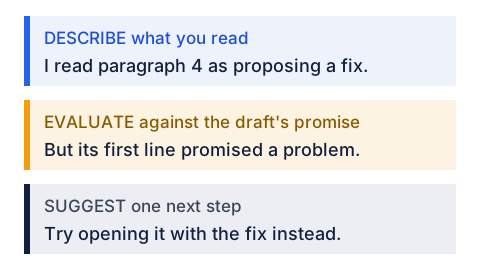
Describe is the move people drop, and it is the load-bearing one. Telling a writer what you understood their paragraph to be doing is the only way they find out it is doing something else. A verdict cannot do that job, however politely it is phrased.
Swap the "you" sentence for the "I" sentence
Cleveland State's chapter lists the phrasings to retire — "You need more____", "You should fix", "To make the paper better, you need to____" — and the objection is not that they are rude. "These types of phrases are telling the writer what to do and/or simply offering judgment. They are 'you' statements, not 'I' statements." Every one of them converts. "You need more" becomes "paragraph 2 didn't convince me on its own — I wanted one more example before you moved on," which says the same thing and hands back a decision instead of an order.
The same chapter warns about the opposite failure — the review so brief it reads as contempt. Comments should be "honest, accurate, detailed, and descriptive," because "brief or vague responses risk sounding like insults."
Where commenting stops and doing the assignment starts
A classmate commenting on your draft is ordinary coursework. A classmate rewriting your draft is a second author on an assignment that was supposed to have one.
The University of Rochester's academic honesty policy puts the specific act on its list. Under "Giving Unauthorized Aid," one named example is "Unauthorized editing or revising of another student's work." The load-bearing word is unauthorized: a class that runs peer-review workshops has authorized the commenting, and your instructor decides how far that permission runs. The University of North Carolina at Chapel Hill Writing Center says the same to students who are unsure: "Asking for help on your writing does not equal plagiarism, but talking with classmates about your work may feel like cheating. Check with your professor or TA about what kinds of help you can get legally."
The test is simple: after your comment, who wrote the sentence? If the answer is you, you have crossed from reviewing into writing, and only your instructor can say whether that was allowed. Rewriting a classmate's paragraph "to show them what I meant" is the most common way a well-meaning reviewer creates a problem for the person they were helping — that sentence usually survives into the submitted draft.
Professional writing centers hold the same line, which tells you it is workable rather than pedantic. UNC's Writing Center describes its own practice this way: "We don't edit, proofread, or otherwise write on students' drafts; rather, we teach students to identify and address problems themselves." If a trained coach with a fifty-minute appointment declines to write on the draft, a classmate with 25 minutes can decline too.
Two habits keep you useful on the right side of it. Point at the problem instead of solving it. And when you genuinely have a phrasing in your head, offer it as a question — "would 'because fares rose' work here?" leaves the decision, and the authorship, with the writer.
The workshop: what to say when the writer is sitting there
Written comments and spoken feedback are different performances, and the second is where reviewers go soft. WUSTL's schedule for a 90-minute class gives each group "5-10 minutes to a 'discussion' of each paper," and its warning is the useful part: reviewers "who wrote detailed and constructive comments on the worksheet" often give "only cursory responses when speaking to the writer."
- Start by reading your written comments out loud. WUSTL suggests exactly this for reviewers who find speaking uncomfortable, and notes the side effect: it "can produce the added benefit of helping the reviewers clarify their written comments."
- Let the writer stay quiet. In WUSTL's structure "the writer of the paper should not speak during this discussion, except perhaps to ask a clarifying question." A writer who explains what they meant has just canceled the only test that mattered — whether the draft said it without them in the room.
- Push each other for the location. WUSTL gives instructors two prompts to use when a comment stays vague: if a student says "I was confused by the third paragraph," ask "Can you tell the writer where you got lost?" or "What word or phrase confused you? Why?" Those work perfectly well between classmates with nobody circulating.
One more line from the same page, for reviewers writing on a draft whose author is not present: construct your comments "as if the writer were indeed in the room, listening." Students are consistently harsher on paper than in person, and the version you would say to someone's face is usually the more accurate one anyway.
What the writer does with the comments
Getting reviewed is a skill too, and the damage happens afterward — the writer changes everything they were told to, or nothing. Sort the comments into three piles before touching the draft, and work the piles in this order.
Fix these first and fast. They are free.
The valuable pile, and the easy one to dismiss. A reader who misunderstood your paragraph is evidence that the paragraph can be misunderstood. You do not have to accept the diagnosis to accept the symptom.
Say why, in one line, in your own notes. UNC is explicit that this pile exists: "Just because someone says to change something about your paper doesn't mean you should… Don't follow those suggestions blindly. Talk about them, think about other options, and decide for yourself whether the advice you received was useful."
Then work down, not across. The same UNC handout is realistic about a deadline: "You sometimes have to triage your revisions," and if two other papers are due, "you may have to decide that your thesis or your organization is the biggest issue and just focus on that." Same priority order as the review itself.
The ownership does not move either. "Ultimately, the paper you will turn in will be your own," the handout says. "You have the final responsibility for its form and content. Take the responsibility for being the final judge of what should and should not be done with your essay." That is the reason a peer editor comments rather than rewrites: the final judge has to have something of their own left to judge.
Reviewing is the half students underrate
If peer review feels like a tax on your time, the half you are discounting is the half you are doing. Most research on feedback has examined what students gain from receiving it, and far less has looked at what they gain from producing it. Nicol, Thomson and Breslin's study of student peer review in Assessment & Evaluation in Higher Education (2014) set out to examine that second half. It reports that "producing feedback reviews engages students in multiple acts of evaluative judgement, both about the work of peers, and, through a reflective process, about their own work," and that it "shifts control of feedback processes into students' hands, a shift that can reduce their need for external feedback." Their conclusion goes further: "the capacity to produce quality feedback is a fundamental graduate skill."
So run the protocol properly even on a draft you do not care about: two questions, one clean read, one working read, ten minutes of writing, three moves per comment, no rewritten sentences. Both of you leave with something.
If the draft in front of you is your own and it needs a second reader rather than a classmate, our editing and proofreading service works the way a good peer does — comments and revision suggestions on your writing, from $7.89 per page, with you deciding what changes and doing the submitting. The same question applies to us as to a classmate: check what outside help your course allows before you use any of it, ours included.