Live Chat


For a 20-minute slot, a doctoral defense deck runs about 12 to 15 slides — and that number is arithmetic, not taste. It falls out of one figure your program has already published: how many minutes you get to talk before the questions start. The University of Pennsylvania's English department opens its public hour with a 20-minute presentation. Clark Atlanta University's humanities guidelines give the candidate 20 to 30 minutes. Valdosta State's College of Education tells its doctoral candidates the presentation "should be no longer than 30 minutes." Neil Rowe's outline for doctoral defenses, published on the Naval Postgraduate School faculty site in 2009, describes a presentation "no longer than 45 minutes" and totals its section-by-section slide counts at 15 to 42.
So the honest answer to "how many slides" is another question: how many minutes, and from whom. Everything below is built for the most common case, a 20-minute talk. You get the whole deck slide by slide with a minute budget, the wording that goes on five of those slides, the things committees do not want to see, and the same structure rebuilt for four other shapes of doctoral work — three-article, qualitative, humanities monograph, and theoretical or computational.
One boundary first. This is the doctoral defense. A master's thesis defense carries a different burden of proof — Rowe's outline names thorough validation as "the key feature distinguishing Ph.D. dissertations from Master's theses" — so the deck for one is not the deck for the other. The difference between a thesis and a dissertation shows up in the room as much as on the page.
- Get your presentation length from your chair before you build anything. The University of Washington Information School's policy says the chair should tell the candidate the presentation length at least one month before the defense.
- A 20-minute talk fits 13 slides comfortably at 19:30, leaving thirty seconds of slack. Longer slots scale the middle, not the frame.
- Three pacing checkpoints beat a stopwatch: be done with slide 5 at 5:00, slide 8 at 10:00, slide 10 at 15:00.
- Findings get the most time per slide — two slides and five minutes. That section survives every cut.
- The first things to cut are the literature review, the chapter-by-chapter agenda slide, and your own biography — that last one against a published university outline rather than with it, and we say why.
- Build a second, unshown deck of detail slides. A Carnegie Mellon University Libraries guide to defense slide design puts it plainly: focus on the big picture, "you can put the details in your backup slides."
Your slide count is a division problem
Ask your chair two things: how long you present, and whether the committee questions you first or the public does. Both are ordinary administrative facts, and some programs commit to supplying them. The University of Washington Information School's dissertation defense policy says the chair "should inform the candidate of these elements at least one month prior to the defense" — the elements being the length of the candidate presentation, the schedule of questioning by the committee and by the public, and "whether the public questions first or members of the Committee question first."
Then divide. A slide with one idea on it and something to say about it takes 60 to 90 seconds. A findings slide with a figure you have to walk the room through takes closer to two and a half minutes. A title slide takes twenty seconds because you are talking over it while people settle. Multiply out and a 20-minute slot lands at 12 to 15 slides, a 30-minute slot at 18 to 22, a 45-minute slot in the range Rowe's outline names. The per-slide timings are ours, and so are the three counts they produce — rehearsal arithmetic worked out from the published minutes above, not a count anyone else publishes. The universities above publish the clock; of the sources here, only Rowe's outline puts a number on the deck.
Slide counts found online are attached to different clocks. "15 to 42 slides" is sound for a 45-minute presentation and unusable in a 20-minute one. Never take a count without the presentation length that came with it.
The 13-slide deck, with a minute budget
Here is the whole thing. The last column gives each slide's own time and, in parentheses, the clock reading when you should be leaving it. Every slide has exactly one job, which is the actual discipline — a slide with two jobs is two slides you have not written yet.
| # | Slide | What it has to do | Time (at) |
|---|---|---|---|
| 1 | Title | Dissertation title, your name, degree, committee, date. You talk over it while the room settles. | 0:20 (0:20) |
| 2 | The problem, in one sentence | The thing that is wrong or unknown in your field, stated so a non-specialist gets it. Not your topic — the problem. | 1:00 (1:20) |
| 3 | Why it is still open | What the field already tried and why that was not enough. This is your literature review, compressed to the gap. | 1:20 (2:40) |
| 4 | Research questions | Two to four questions, numbered. The numbers are the point — the committee will cite them back at you. | 1:00 (3:40) |
| 5 | What I claim | Your contributions as claims, not activities. "I show that X" beats "I examined X." | 1:20 (5:00) |
| 6 | Design | The shape of the study and why that shape answers those questions. One diagram if you have one. | 2:00 (7:00) |
| 7 | Sample and data | Who or what, how many, how selected, what you collected, IRB status where it applies. | 1:30 (8:30) |
| 8 | Analysis | What you did to the data and why that procedure, not another one. | 1:30 (10:00) |
| 9 | Finding 1 | Your strongest result, as one figure or table with the headline read out loud. | 2:30 (12:30) |
| 10 | Finding 2 | The second result, including anything that came out against your expectation. | 2:30 (15:00) |
| 11 | What it means | Findings mapped back onto the numbered questions, then onto the field. | 2:00 (17:00) |
| 12 | Limits and next work | The boundaries you already know, named before anyone names them for you. | 1:30 (18:30) |
| 13 | Contribution restated | The claim from slide 5 in one line, plus thanks to the committee. | 1:00 (19:30) |
Nineteen minutes thirty in a twenty-minute slot. The half-minute of slack is deliberate: it absorbs the technical fumble at the start, or the committee member who interrupts on slide 7 to ask about the sample.
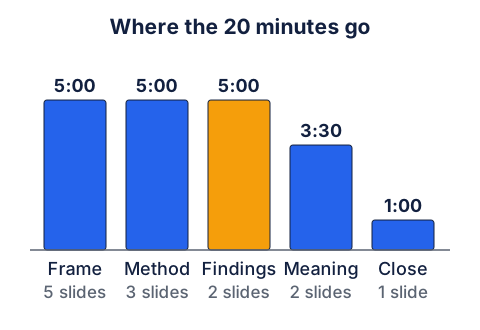
Read it as minutes per slide, not minutes per phase. The opening five move at roughly a minute apiece because none of it is news to the committee — they read the dissertation. The two findings slides get two and a half minutes each because that is where you are actually being examined.
Three checkpoints instead of a stopwatch
Nobody can watch a timer and think at the same time. Memorize three readings instead — the first three of the four phase changes in the chart above:
- 5:00 — leaving slide 5. Frame done. If you are still on slide 3, you are over-explaining the literature and you will lose the findings.
- 10:00 — leaving slide 8. Method done, halfway through the clock, halfway through the deck.
- 15:00 — leaving slide 10. Both findings delivered, with four and a half minutes of material left and five minutes on the clock.
If a checkpoint arrives and you are behind, the recovery is always the same: skip forward, do not speed up. A rushed findings slide is worse than a skipped design slide, because the committee can read your design chapter and cannot read your voice.
What the slides actually say
Slide topics are easy to list and hard to write. So here are five of the thirteen written out in full — the on-slide text, then what you say over it. Valdosta State's guidance draws that line explicitly: "Except for things like the research questions, do not just read the slides. Your oral presentation should explain or expand on what is on the slides."
The study below is invented for this article. There is no such project, no such dataset, and the numbers are illustrative. It is a plausible mixed-methods education dissertation, used so the slide wording has something concrete to sit on. Substitute your own study; keep the shape.
Slide 2 — The problem, in one sentence
On the slide:
- At our study site, 4 in 10 fall entrants do not return the following fall
- Advising is the standard response — and advisors here carry caseloads in the hundreds
- What reaches a student who never books an appointment?
What you say over it, in about a minute: "The attrition point is not the classroom, it is the summer. Students leave between terms, quietly, and the intervention we rely on requires them to initiate contact with an advisor they have never met. My dissertation asks what happens when the contact goes the other direction."
Slide 5 — What I claim
On the slide:
- Claim 1: Scheduled advising texts raised fall-to-fall persistence by 3.5 points (61.4% vs 57.9%)
- Claim 2: The effect concentrated in students with no prior advising contact
- Claim 3: Interviews explain why — the texts worked as permission, not as information
What you say: "Three claims, and the third is the one I want to defend hardest, because it is the one the quantitative strand could not have produced on its own." Then stop talking and let them read it. This is the slide the committee will return to, so it earns its silence.
Slide 6 — Design
On the slide: one diagram — two cohorts across two academic years, the intervention term marked, the interview sample drawn from the treated cohort, arrows showing which strand feeds which claim.
What you say: "Explanatory sequential, and I want to be direct about why. A randomized design was not available to me; the college would not withhold advising. So the quantitative strand establishes whether, and the interviews establish why, and the second strand is doing real work rather than decorating the first."
Naming the design you could not run, before anyone asks, is the single most useful two sentences on this slide.
Slide 9 — Finding 1
On the slide: one chart, one sentence above it, one line of caveat under it, the slide number in the corner, and nothing else. The sentence: "Treated students returned at 61.4%, comparison 57.9%." The caveat: "n = 4,812, non-randomized."
What you say: read the headline sentence out loud, then walk the chart — what the axes are, where to look, what the gap is. Then the honest qualifier: "The confidence interval is wide at the lower end, and I will come back to that in limits." Committees trust a candidate who flags the weak spot before the questions do.
Building this slide is the same job as writing a results section: report what happened, keep the interpretation for later.
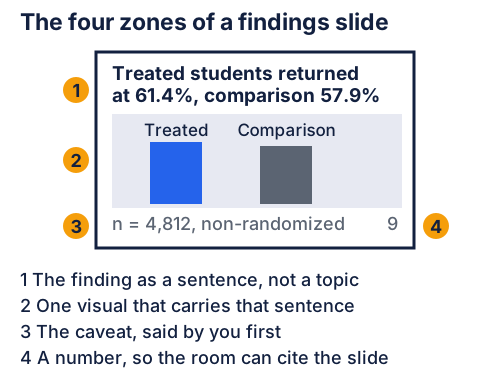
The zones are not a layout preference; they are four separate jobs. The headline is the finding, so the room can quote the slide back to you. The chart is the evidence for that one sentence and nothing more. The caveat is there so you say the weakness before a committee member does. And the number means someone can write "slide 9" in their notes instead of "the chart with the bars."
Slide 12 — Limits and next work
On the slide:
- Single institution — urban, open-access, one state system
- Non-randomized assignment; matched on prior term GPA and credit load only
- Interviews with returners, not with leavers — the people who left are the ones I could not reach
- Next: replicate across the system; recruit leavers through a different channel
What you say: "The third one is the real limit, and it is a limit on Claim 3 specifically." Do not apologize. A limits slide that names the sharpest objection first reads as command of the work.
The committee has read the dissertation. Your slides are not a summary of it — they are an argument about what it proved.
What the committee is deciding while you click through
The vote at the end is not a single pass-or-fail switch. The University of Washington Information School records three outcomes: accept as is with no revisions; accept with revisions, where the pass is contingent on changes; or reject, after which the committee may recommend either permitting a second defense or dropping the candidate from the program. A deck cannot change the quality of the dissertation. It can change how precise the revision list is, because a committee that followed your argument can tell you exactly what to fix instead of asking for a rewrite of something they did not follow.
Which means the committee is running three checks while you present, and each one attaches to particular slides:
| What they are checking | Where your deck answers it |
|---|---|
| Is this candidate the author of this work, in the sense of understanding every decision in it? | Slides 6-8. Every "why this method and not that one" is this check. |
| Do the claims survive the evidence actually collected? | Slides 5, 9, 10, 11 read together. If a claim on slide 5 has no slide behind it, that is the first question. |
| Does the candidate know where the work stops? | Slide 12, and every hedge you volunteer before being asked. |
That third check is why the limits slide is not a formality. It is also why overselling is a bad trade. A claim that runs past its evidence hands the committee something to test, and the testing is done with questions.
What committees do not want on a slide
Three of the sources above give slide-design advice, and it lines up: keep the type big, keep the slide uncluttered, pitch it at people outside your subfield. Valdosta State's list is a straight "DO NOT": no slide transitions, animation or sounds that are distracting, and do not crowd slides with excessive text. Rowe's outline sets a font floor. Its slide counts assume 28 point, and it tells candidates not to go below that for a defense held over videoconference, or below 20 point otherwise, "with the possible exception of important figures and tables that cannot be compressed." It also tells candidates to design the talk "not for your doctoral committee but for intelligent listeners in the field," avoiding acronyms and jargon, because the committee's vote "will put significant weight on how you handled questions from nonmembers of the committee." The Carnegie Mellon guide makes the same point about audience: "The committee members do not necessarily have the same background knowledge as you."
Beyond design there is a content cut list, and this one is ours. These are the slides that turn up in draft decks and earn their removal:
| The slide that gets cut | Why, and where the material goes instead |
|---|---|
| The literature review, three to six slides of it | The committee approved your proposal; they know the literature. Compress it to slide 3 — the gap only. Full coverage moves to the backup deck. |
| An agenda slide listing your chapters | Thirteen slides do not need a table of contents. Carry the navigation in speech instead — the Carnegie Mellon guide asks for transition sentences "to summarize what you have said and tell your audience what they will expect next." Note that the same guide does recommend transition slides, but for a deck covering several separate projects; a single-study talk this short does not need them. |
| Your own biography and credentials | Here the guidance and our advice part company. Valdosta State's outline does include a researcher-background slide, marked "BE VERY BRIEF!" In a 20-minute doctoral slot we would drop it: the committee already knows who you are, and those twenty seconds buy you a finding. |
| Every table from chapter 4 | Two findings slides, chosen. The rest sit in backup, ready when a question reaches them. |
| A full reference list | Here we are only repeating the source: Valdosta State's outline says to list only those works cited in the presentation, that one slide should be enough, and that everything else is already in the dissertation. |
| Screenshots of your instrument, survey or code | Unreadable projected, and they invite a question about formatting rather than about findings. Backup deck. |
| A "future research" wish list of six directions | Two, both of which you could actually start. Six reads as a candidate who has not chosen. |
Test every slide by covering the text and asking what you would say if the slide were blank. If the answer is "read the slide," the slide is doing your job and you have nothing to add to it. That is the one test that catches text-crowding before a rehearsal does.
The same deck for a different dissertation
The thirteen slides above assume a single empirical study. Plenty of doctoral work is not shaped that way, and the deck has to change with it — while the minute budget stays fixed, because the clock does not care.
| Dissertation type | What changes in the deck | Where the time comes from |
|---|---|---|
| Three-article (manuscript) dissertation | Slides 6-10 become three paired blocks, one per article: what it asked, what it found. William & Mary's School of Education sets the format for its EPPL doctoral students, and lists three elements in the concluding chapter: a summary of key findings, "Discussion/Implications — Integration of key findings from the three articles," and implications for future research. Build that integration as its own slide, because it is the thing that makes three papers a dissertation rather than three papers. | Cut design detail to one shared slide covering what the three studies have in common. Article-specific method goes to backup. |
| Qualitative study | Slide 7 splits into sampling logic and researcher positionality. Slides 9-10 become two themes, each anchored to one quotation you read aloud in full. | Slide 8 shrinks — say the coding approach and who checked it, not the whole audit trail. |
| Humanities monograph | Slides 6-8 stop being method and become archive, corpus and critical framework. Slides 9-10 become your two strongest readings, each on a passage you put on the screen. | Slide 3 does more work here, because the gap is a scholarly conversation rather than a missing measurement. |
| Theoretical or computational work | Slide 9 becomes the result and slide 10 the proof sketch or benchmark. Notation goes on screen once, defined, and never expands. | Slide 7 nearly disappears; there is no sample to describe. |
Whatever the shape, the frame slides do not move. Title, problem, gap, questions, claim — those five slides and their five minutes are identical across every dissertation format, because they are the part the committee cannot reconstruct from having read your chapters.
The second deck nobody sees
Behind slide 13, add ten to fifteen more. They are never shown in the talk and they are not optional. The Carnegie Mellon University Libraries guide on defense slide design — originally written by CMU doctoral graduate Xiaoju Chen and maintained by the Libraries — states the trade directly: you will not have time to explain all of the details, so focus on the big picture and "you can put the details in your backup slides."
Which slides belong there is not a guessing game. Work backward from your own deck: every place you compressed something, you created a question, and the backup slide is the answer waiting.
| What you compressed | The backup slide it creates |
|---|---|
| Literature down to one gap slide | The full comparison table of prior studies, with what each one measured |
| Design down to one diagram | Matching or randomization details, attrition, missing-data handling |
| Analysis down to one line | Model specification, assumption checks, robustness or sensitivity runs |
| Findings down to two slides | Every other result, one per slide, in the order your chapter presents them |
| Limits down to four bullets | One slide per limit, with what you would do about it given another year |
| Nothing — this was never in the talk | Instrument, protocol, codebook, consent language, IRB approval date |
Number them, keep a printed index next to your laptop, and practice jumping straight to slide 22 without scrolling through the eight in front of it. Reaching the right slide in four seconds is a small thing that reads, from a committee chair's seat, as command of the material.
Three timed run-throughs, and what each one is for
Rehearsal is not repetition. Valdosta State's guide says "Practice multiple times" and stops there, without saying what each run is for. The division below is ours: a defense deck fails in three distinct ways, so three runs with different jobs will do more than eight aimless ones.
Not in your head — out loud, standing, with the timer visible. You are checking one thing: are you leaving slide 5 at 5:00, slide 8 at 10:00, slide 10 at 15:00? Whatever overruns on run one will overrun on the day. Cut it now, and cut from the frame, never from findings.
The Carnegie Mellon guide asks for at least one practice run in front of colleagues — lab mates, your research group, your friends — and is explicit that "they do not have to be experts in your field." Take that permission literally. Give a friend from another department three questions to answer afterward: what was the problem, what did I find, why does it matter. Any one they miss is a slide problem, not a delivery problem.
Rowe's outline warns candidates to "Expect to be interrupted for short clarification questions during the presentation." So rehearse it: ask two people to break in at random with real questions. This run tests recovery — can you answer, jump to a backup slide, and get back to your place without losing the thread? Do it in the room the defense happens in, on the machine and cable you will use. The same outline says it is best to give a practice run for your entire dissertation committee, but that at minimum you should present it orally to your dissertation supervisor.
Between run two and run three, revise the deck. Rehearsing a deck you already know is broken is the easiest way to spend a week and gain nothing.
What the twenty minutes are actually for
The deck is a small object at the end of a very long project. Your committee has already read the chapters; several of them helped shape those chapters. What they are watching for is whether you can stand behind the work, name what it proved, and name what it did not. That is a different bar than a perfect slide deck, and a more forgiving one.
If you are still assembling the dissertation itself rather than the talk about it — or the chapter-to-slide translation is where you are stuck — our dissertation help service works with doctoral candidates on structure, chapters and defense preparation. For the ground underneath all of it, start with what a dissertation actually is and how long dissertations run by field; if the writing stalled long ago, all but dissertation covers getting moving again.