Live Chat

Start a scholarship essay by putting one concrete detail from your own life on the page and engaging the prompt's question inside the first two sentences. That is narrower than the usual instruction to write a strong hook, and two pressures an academic essay never applies explain why: the reader is deep into a stack of applications, and you are working inside a word cap that is often only a few hundred words. This page shows six complete first paragraphs, written for this article and annotated line by line — four answering one prompt, then two more showing what changes when the question changes. For whole essays, each read against a scoring rubric a real school published, see our scholarship essay examples.
The reading conditions are not a guess. The UNC Chapel Hill Writing Center's handout on application essays warns applicants that "Your readers may have thousands of essays to read, many or most of which will come from qualified applicants," and asks them to picture a reader who "is on the application committee because she has to be, and she's read 48 essays so far that morning." UW–Madison's scholarship guidance draws the practical conclusion: "The first 2-3 sentences are key! This is how you hook your readers in so they want to learn more."
- Engage the prompt inside the first two sentences. An anecdote that has not touched the question yet is asking a tired reader for patience.
- Specificity beats a clever line. Purdue OWL's rule for opening remarks: "Get creative and imaginative in the opening remarks, but make sure it's something that no one else could write."
- The six openings written for this article run 55 to 102 words. The two that work are the two longest.
- Length is rarely the problem. A 102-word opening still leaves 398 words of a 500-word essay.
- "Why do you deserve this" needs a different first sentence than "describe a challenge" — same student, same material, different opening move.
Why a scholarship opening carries a different load
An academic essay introduction works toward a claim about a text or a question. A scholarship opening has no thesis to land on, because the thing being assessed is you. Southcentral Kentucky Community and Technical College's scholarship guide puts the register plainly: "Treat this essay like you would a job interview."
| Compared on | Academic essay introduction | Scholarship essay opening |
|---|---|---|
| Who reads it | One instructor, obliged to finish yours | A committee member partway through a stack |
| Word budget | Set by a page count, rarely tight | Often 10–20% of a cap the provider sets |
| Subject | The text, the data, the question | You, evidenced |
| Ends on | An arguable claim the essay defends | Nothing formal — the prompt, already engaged |
| Failure mode | A vague thesis | A paragraph any applicant could have written |
If the award asks for a full personal statement rather than a short prompt response, the document changes shape and the opening gets more room — our guide to writing a personal statement covers that longer form.
Four openings for the same challenge prompt
Prompt: Tell us about a challenge you have faced and how you handled it. 500 words maximum.
Some version of that question turns up on more scholarship applications than any other. Below are four first paragraphs answering it, weakest first. All four were written for this article by an Apex Essays editor — not student submissions, not excerpts from real applications. Copying one would mean submitting somebody else's sentences.
Everyone faces challenges. Challenges are a part of life, and they are what shape us into the people we become. Throughout my life I have faced many challenges, both big and small, and each one has taught me something valuable about myself. In this essay I will describe a challenge I have faced and explain how I handled it.
Fifty-nine words, four sentences, and a reader could not pick this applicant out of the stack. Sentence four is a pattern Purdue OWL lists under "Do not use boring clichéd intros or conclusions"; its own example reads "This question asks me to discuss...", and In this essay I will describe is the same move in different clothes. The UNC handout gives the general instruction: "Eliminate any generalizations or platitudes." Nothing here is untrue. Nothing here is yours either.
The walk-in freezer at the restaurant where I worked died on a Friday in July. I spent four hours after closing moving forty cases of frozen chicken to a neighbor's garage on a hand truck, and my manager apologized the entire time. I got home at one in the morning. I was sixteen years old and I had a chemistry exam on Monday.
Sixty-three words, and the first two sentences are the best writing on this page. A dead freezer, forty cases of chicken, a hand truck, an apologizing manager — exactly the material Purdue's fifth rule asks for, "something that no one else could write." The failure is the prompt. By the end of the paragraph the reader knows about one bad Friday and still cannot say what the challenge was or whether the student did anything about it. An anecdote not yet connected to the question is a promise the reader has to take on trust, and on essay 49 that trust is thin.
I come from a low-income family, and money has always been tight in our house. My mother works two jobs and my father has not had steady work in three years. Paying for college on my own has been the biggest challenge I have faced, and without scholarships like this one I do not know how I would be able to continue my education.
Sixty-four words, three sentences, and this one does answer the question: money is the challenge. Two things go wrong anyway. Every phrase is a category rather than a detail — low-income family, money tight, two jobs, no steady work — and categories describe hundreds of the other applicants in the pile. Then the prompt's second half, how you handled it, gets no sentence at all; the paragraph argues for the award instead of describing what the student did.
Purdue OWL's pitfall list says "Do not talk about money as a motivator." That guidance is written for personal statements aimed at graduate and professional school, where nobody asked about your finances. A scholarship prompt frequently does ask. The part that transfers is narrower: money as a motive reads badly, money as a specific obstacle you are working around does not — which is why financial need belongs in the essay, just not as the only content in the first paragraph.
For two years I closed a restaurant four nights a week and did calculus at the counter after the last table left. The job was not a résumé line. My mother's hours were cut, and my paycheck went to our phone bill and my brother's bus pass. What it cost me was chemistry: I failed the first semester of it while telling everyone at school that I was fine. What fixed it was not working fewer shifts, because I could not. It was telling my chemistry teacher in January that I was studying at midnight, and asking her for a different plan.
A hundred and two words, six sentences — the longest of the four and the only one that finishes the job. Four mechanics are worth taking:
- The scene comes first. Calculus at the counter after the last table left is doing the same work as the freezer in Opening 2, in one sentence instead of two.
- The difficulty is named as a cost, not a category. Sentence four says a failed semester of chemistry. "Money was tight" gives a reader nothing to hold.
- The last two sentences answer the second half of the prompt. What the student did was ask a teacher for a different plan — a smaller and more concrete action than the transformations weak openings tend to claim.
- One detail is unrepeatable. My brother's bus pass could not appear in anybody else's essay.
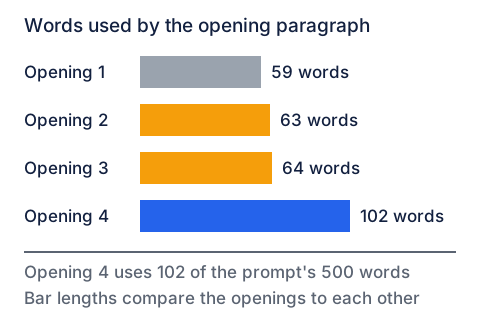
Students cut the first paragraph because it feels self-indulgent, and the cut version is usually the one that says nothing. Being specific costs words; being vague costs the reader.
| Opening | Words | Scene a reader can picture | Prompt engaged | Detail only this student could write |
|---|---|---|---|---|
| 1 | 59 | No | Announced, not engaged | No |
| 2 | 63 | Yes | No | Yes |
| 3 | 64 | No | First half only | No |
| 4 | 102 | Yes | Yes | Yes |
What changes when the prompt is "why do you deserve this"
"Describe a challenge" and "Why do you deserve this scholarship?" are the two shapes most applicants meet, and they want different first sentences. The challenge prompt wants a scene. The deserving prompt wants evidence — and the word deserve pulls almost everyone into self-assessment instead.
Prompt: Why do you deserve this scholarship? 500 words maximum.
I believe I deserve this scholarship because I am a hard worker who has always put education first. I have maintained a 3.8 GPA while working part-time throughout high school, and I am passionate about becoming a nurse so that I can help people. I would be truly honored to be selected for this award.
Fifty-five words, and every one of them is the writer's verdict on the writer. Hard worker, passionate, truly honored — a reader cannot check any of it. Purdue OWL's second rule is the test this paragraph fails: "Try to tell the reader something that no other applicant will be able to say." A 3.8 GPA and a part-time job fail it not because they are unimpressive but because thousands of applicants can write the identical sentence. UNC catalogs the species, listing "I'm a people person" among the platitudes to cut.
Last spring I ran the intake table at a free blood-pressure clinic in the fellowship hall of a church two blocks from my house. I learned how to ask a stranger when he last saw a doctor without it sounding like an accusation. That is the specific thing I want nursing school to sharpen. The award covers the two clinical semesters I cannot cover by picking up more shifts, which is the only part of this I have not been able to solve by working.
Eighty-five words, and the word deserve never appears. Three swaps did the work.
- The trait became an action. "Hard worker" is gone; running an intake table is on the page, where a reader can see it.
- The claim became checkable. Asking a stranger about his last doctor's visit without sounding accusatory is a skill described precisely enough to picture — and it is the kind of thing a recommender could confirm.
- The money sentence names what the award pays for. Two clinical semesters, not gratitude. That answers why you with arithmetic rather than adjectives.
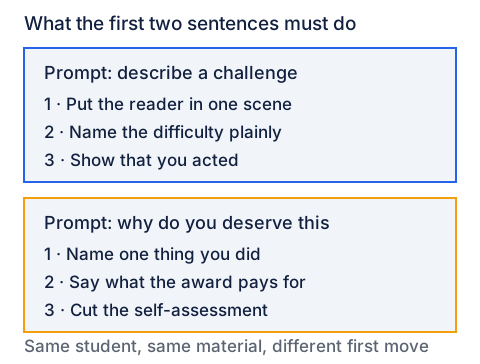
Notice what did not change between Openings 5 and 6: the student, the grades, the job, the nursing goal. Only the first move changed. If your prompt is a college's own supplemental question rather than an outside award, the same discipline applies at even shorter limits — see our walkthrough of Cornell's supplemental essays.
Openings your reader has already met this morning
Each is named by one of the sources cited here. Learn them as shapes: the wording varies, the shape does not.
| Pattern | Where it is named | The wording it hides behind |
|---|---|---|
| The self-introduction | Purdue OWL, clichéd intros | "Allow me to introduce myself. My name is..." |
| The restated prompt | Purdue OWL, clichéd intros | "This question asks me to discuss..." |
| The platitude | UNC Writing Center | "I'm a people person", "Doctors save lives" |
| The price tag | SKYCTC scholarship guide | "I chose this college because it was cheap." |
| The world-changer | SKYCTC, given as a closing warning — but it opens essays too | "with this scholarship, I can change the world" |
One pattern is missing from all of those lists, and arithmetic makes the case against it without needing a source: the famous-quotation opening. Nothing cited here forbids it. But a 25-word epigraph is 5% of a 500-word essay spent on a sentence somebody else wrote, and the reader learns nothing about you until word 26. If you want opening lines with more range than a borrowed quotation, our catalog of essay hooks organized by what each type actually does is a better shelf to shop from.
Grab their attention in the first paragraph. — Callie Womble Edwards, quoted on NC State's Park Scholarships blog
Four checks on the paragraph you already wrote
Run these in order on your own draft. The first two find most of the damage.
Hand what is left to somebody who has not read the prompt and ask what the essay is about. If they cannot say, your paragraph starts later than sentence one — usually a sign the real opening is buried in the middle of it.
Apply Purdue OWL's opening rule literally. Strike hard worker, always been passionate, taught me a valuable lesson. Whatever survives the crossing-out is your actual opening; build outward from it.
Caps vary from a few hundred words to a few thousand, so work in proportions. In a 500-word essay, an opening of roughly 50 to 100 words leaves you 400 to work with. Past a fifth of your total you are writing body paragraphs under the wrong label; under 40 words you rarely fit both a real detail and the prompt.
One question: does this sound like you? A paragraph that impresses a stranger but makes your sister laugh is not your voice, and voice is the one thing in an application nobody else can supply. Fix that before you fix the commas.
What a good opening actually buys you
Not an award. Readers are weighing transcripts, recommendations and every word after your first hundred. What a working first paragraph buys is narrower: a reader still paying attention at word 200, who has already learned one true, specific thing about you that nobody else in the stack could have written. Write it yourself — those details are the whole point, and only you have them. If you want a second reader on a draft you have already written, our admission essay help works on your material rather than replacing it: prompt analysis, structure, and line-level editing on your own paragraphs, with the story and the submission staying yours. Pricing starts at $7.89 per page.