Live Chat


In a US course, "analyze" asks you to break something into its parts and explain how those parts produce a meaning, an effect or a result — then to say something about it a reader could disagree with. "Evaluate" asks you to judge something against criteria and defend the judgment with evidence. "Discuss" is the widest of the three, and the one most likely to mean whatever your course has decided it means.
That last clause is what most explanations leave out. Search this and you land on an alphabetized list of "task words" with one crisp line each. Those lists are mostly British, Australian or New Zealand, they describe a different grading system, and — the part worth knowing — they do not agree with each other. So the durable answer for a US student is not a dictionary entry. It is this: the verb is read against your rubric and your course, not against a glossary.
- Analyze = parts, then significance. UNC defines it as "determine how individual parts create or relate to the whole, figure out how something works, what it might mean, or why it is important."
- The published definitions conflict. Three university sources define these same verbs three different ways, and none mentions that the others exist.
- Most of what ranks here is not American. The "task word" glossary is a Commonwealth genre, built on lecturer, module, marker and marking criteria.
- "Discuss" is local. Harvard tells its students a prompt saying "discuss" still expects an arguable claim; an Australian glossary says it means arguments for and against, ending in a conclusion. Both are right — for their own institution.
- The rubric is where the verb becomes points. On the College Board's AP English Language rubric, commentary that "summarizes the evidence" earns 1 point out of 4; commentary that consistently explains how the evidence supports a line of reasoning earns 4.
The three verbs, in plain American terms
Analyze. The University of North Carolina at Chapel Hill's Writing Center files it under "interpretation words," alongside argue, assess and evaluate. The work runs in that order: parts first, then how they make the whole, then why that matters.
Evaluate. UNC pairs it with "respond": "state your opinion of the subject as good, bad, or some combination of the two, with examples and reasons." A qualifier governs the whole group — do not read these words "as requesting opinion alone … but as requiring opinion that is supported by concrete evidence."
Discuss. Here is the first surprise. UNC's key-terms list runs to nineteen entries across three groups, and "discuss" is not one of them. The most-cited US handout on reading an assignment does not define the verb at all — a signal about how loose the word is.
Why every glossary you found says something different
You mostly meet the same page in different livery: an A-to-Z of task words, each with a one-line meaning, presented as though the word carried a fixed value. Those pages are useful, and they contradict one another on all three verbs.
| Verb | Source | What it publishes |
|---|---|---|
| Analyze | UNC Chapel Hill Writing Center (US) | "determine how individual parts create or relate to the whole, figure out how something works, what it might mean, or why it is important" |
| UNSW Sydney (Australia) | Under analyse: "To find the main ideas, how they are related and why they are important." | |
| University of Portsmouth (UK) | Under analyse: "This term has the widest range of meanings according to the subject." | |
| Evaluate | UNC Chapel Hill Writing Center (US) | "state your opinion of the subject as good, bad, or some combination of the two, with examples and reasons" |
| UNSW Sydney (Australia) | "To give an opinion, supported by some expert opinions, of the truth or importance of a concept. Show the advantages and disadvantages." | |
| University of Portsmouth (UK) | "Similar to 'assess', this often has more emphasis on an overall judgement of something, explaining the extent to which it is, for example, effective, useful, or true." | |
| Discuss | UNC Chapel Hill Writing Center (US) | Not listed among its key terms. |
| UNSW Sydney (Australia) | "To present arguments for and against a point of view and reach a conclusion. The arguments must be supported with appropriate evidence." | |
| University of Portsmouth (UK) | "Provide details about and evidence for or against two or more different views or ideas, often with reference to a statement in the title." |
Two of those sources are not American, and the spelling gives them away: analyse with an s, judgement with an e in the middle. Read on and the vocabulary shifts too — the person grading you is a marker, the class a module, the rubric the marking criteria. That does not make the definitions wrong. It makes them definitions from a system where a department may standardize what "evaluate" means across every course in it, which is not how a US course works.
The best page in that genre already concedes the point. Portsmouth opens its list with a warning almost no competing page carries: "None of these words have a fixed meaning. Your lecturers may have specific definitions for your subject or task…" Translate that into US terms — instructor, syllabus, rubric — and you have this article's whole argument, sitting above a twenty-two-entry dictionary. Compare UNSW, two paragraphs above its own glossary: "Once you have found the clue words and worked out exactly what they mean, you can answer the question correctly." That is the promise the genre makes, and it is the one that breaks.
"Analyze": the move that is not summary
Almost every failed analysis fails the same way: the writer explains the evidence clearly and at length, and never says what it means for the argument. That is summary — a real skill, often necessary, and on its own not what "analyze" was asking for.
The UC Davis Writing Center frames analysis as a link rather than a description: it "moves past summarizing and offers a new way to understand something," and your analysis "shows your own thoughts on the evidence and connects the evidence to your thesis." So the test on a drafted paragraph is whether a reader could disagree with it. If it could only be confirmed by rereading the source, it is summary. If a classmate could read that source and reach a different conclusion, you have made a claim — and the claim is the analysis.
The prompt below was written for this article. It is not from a real course.
"Analyze how Chapter 3 uses weather to shape the reader's sympathy for the narrator."
Summary: the chapter describes three storms, each heavier than the last, and the narrator is caught outside during all three. Analysis: the storms get heavier while the narrator's explanations get shorter, so the weather takes over the job his own account is failing to do — sympathy is transferred by the setting rather than earned by his words.
The second version has a mechanism and a consequence: parts to whole, then significance.
"Evaluate": a judgment, and where the criteria come from
"Evaluate" is the verb students most often answer with a preference: the prompt asks whether a policy worked and the answer explains whether the writer liked it. An evaluation needs a standard, and the standard comes from the course rather than your taste — criteria from a reading, a professional benchmark, a goal the thing was meant to meet, a comparison case you were already given. Naming it out loud is the strongest move available, because it turns an opinion into a measurement a reader can check.
If a prompt says "evaluate" and you cannot name what you are measuring against, that is the question to take to office hours — not "what does evaluate mean?" but "what should I be judging this against?" The second question gets a usable answer in one sentence.
"Discuss": the verb that depends most on where you are
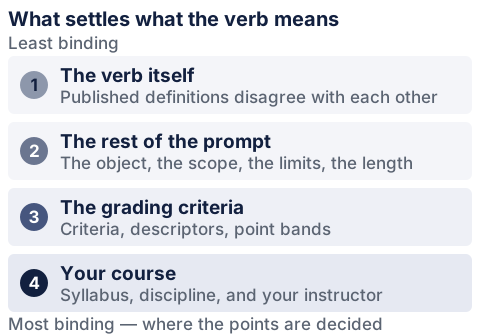
This is the clearest case of a verb whose meaning is set locally, and a published pair of statements proves it. The Harvard College Writing Center tells its own students: "Unless the instructor has specified otherwise, most of your paper assignments at Harvard will ask you to make an argument. So even when the assignment instructions tell you to 'discuss' or 'consider,' your instructor generally expects you to offer an arguable claim in the paper." UNSW, in Australia, defines the same verb as "to present arguments for and against a point of view and reach a conclusion."
Those are not the same instruction. One says take a position and defend it; the other says lay out the debate and land somewhere. Follow the Australian definition in a Harvard course and you have obeyed a published definition while handing in the wrong shape of paper. Neither is wrong — they describe two systems, and only one is yours. So when a US prompt says "discuss," treat it as a request for an argument until something tells you otherwise, and look for that something in the rubric.
The rubric is what settles it
Carnegie Mellon's Eberly Center gives the cleanest working definition: "A rubric is a scoring tool that explicitly describes the instructor's performance expectations for an assignment or piece of work." It names the criteria assessed, the descriptors of what each looks like, and the performance levels separating one score from the next. A definition says what a word means; a rubric says what it is worth.
You can watch that happen on a real US rubric. The College Board's scoring rubric for AP English Language and Composition, published on AP Central, covers all three free-response questions; one hands students a passage and asks for an essay that analyzes the writer's rhetorical choices. The answer is scored out of 6 points in three rows — thesis, 0 to 1; evidence and commentary, 0 to 4; sophistication, 0 to 1 — and the middle row is where the verb gets cashed out.
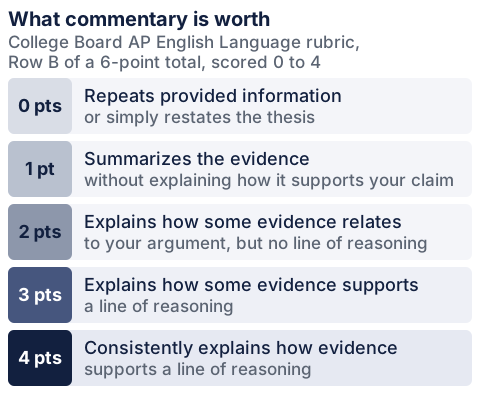
The rubric's own words repay slow reading. At 1 point the commentary "summarizes the evidence but does not explain how the evidence supports the student's argument." At 4 points it "consistently explains how the evidence supports a line of reasoning." A response that simply "repeats provided information" earns 0, and the thesis row draws the line harder still: responses that "describe or repeat the passage rather than making a claim that requires a defense" do not earn the thesis point at all.
That is a better definition of "analyze" than any glossary entry: summary is the floor, and every point above it is bought with explanation of how a specific piece of evidence supports a specific claim. Your own rubric will use different words and a different scale, but it draws that line somewhere. Our guide to reading a rubric walks through the standard layout row by row.
How to read your own prompt in about five minutes
Most prompts carry more than one, and the second is the one students drop. Harvard's list of what to look for: "analyze, compare, discuss, explain, make an argument, propose a solution, trace, or research." Two verbs usually means two things to hand in.
What exactly are you analyzing, and what has been fenced off? Harvard is blunt about the fence: if you were told not to use sources beyond the assigned ones, "they do not want you to bring in other sources." UNC adds that what counts as evidence "can depend on … the discipline, the parameters of the assignment, and your instructor's preference."
Open the grading criteria, find the row the verb belongs to, and read its top band against the band below. The difference between those two sentences is the specific thing being looked for, written by the person who will grade it.
Read the assignment against your syllabus and the assigned readings. UNC: "Your instructor wants you to think about something in a particular way for a particular reason." Discipline sets defaults too — "Social science classes often expect more research. Humanities classes thrive on interpretation and analysis."
UNC, Harvard and Purdue all end in the same place. UNC: "Instructors would prefer to set you straight before you hand the paper in." Purdue's OWL: "Many instructors write their assignment prompts differently… The best way, as always, is to ask the instructor about anything confusing."
Put the answer into your outline before you draft rather than retrofitting it afterward — our essay outlining guide covers where a constraint like that belongs, and if the verb wants a defensible claim, the thesis statement guide is the next step.
Quick reference: ten verbs and where they usually land
Treat this as a starting hypothesis, then check it against your own rubric. Row names vary by course.
| Verb | What a US prompt usually wants | Rubric row it usually lands in |
|---|---|---|
| Analyze | Parts, how they work together, and what that means for your claim | Analysis / commentary |
| Evaluate | A judgment measured against a named standard, with evidence | Analysis / argument |
| Discuss | In a US course, usually an argument — check the rubric before assuming a survey | Thesis / argument |
| Argue | A position defended against the strongest objection to it | Thesis / argument |
| Compare | Similarities and differences that add up to a point, not a list | Analysis / organization |
| Explain | Causes, reasons or mechanism — how or why something happens | Content / understanding |
| Describe | Detail and accuracy; the claim is usually not the point | Content / accuracy |
| Summarize | The important ideas, compressed, in your own words | Comprehension / use of sources |
| Synthesize | Sources put together for a reason that runs through the paper | Use of sources |
| Reflect | Your own experience read against a course concept | Reflection / application |
Both prompts here were written for this article and come from no real course. "Discuss the causes of the 2008 financial crisis" and "Discuss whether deregulation caused the 2008 financial crisis" use the same verb and ask for different papers. The second contains a proposition to agree or disagree with; the first does not. Whenever a verb is followed by whether, the extent to which, or a claim you could argue with, the sentence has already told you more than the verb did.
What to do with all this
These verbs have real, teachable meanings. But no glossary — including the table above — is the final authority, because the people who write glossaries are not the people grading your paper. The prompt narrows the verb, the rubric prices it, and the course decides what good looks like. Run the five steps on the prompt in front of you now. If the verb still looks ambiguous, that is information: either the prompt is genuinely open, or a question to your instructor is overdue.
If you would rather have that reading done alongside you, our assignment help works from your actual prompt and rubric rather than a generic template, and says where a prompt is ambiguous instead of guessing. What any individual instructor concludes about a piece of work is theirs to decide, and nobody outside your course can tell you otherwise.