Live Chat

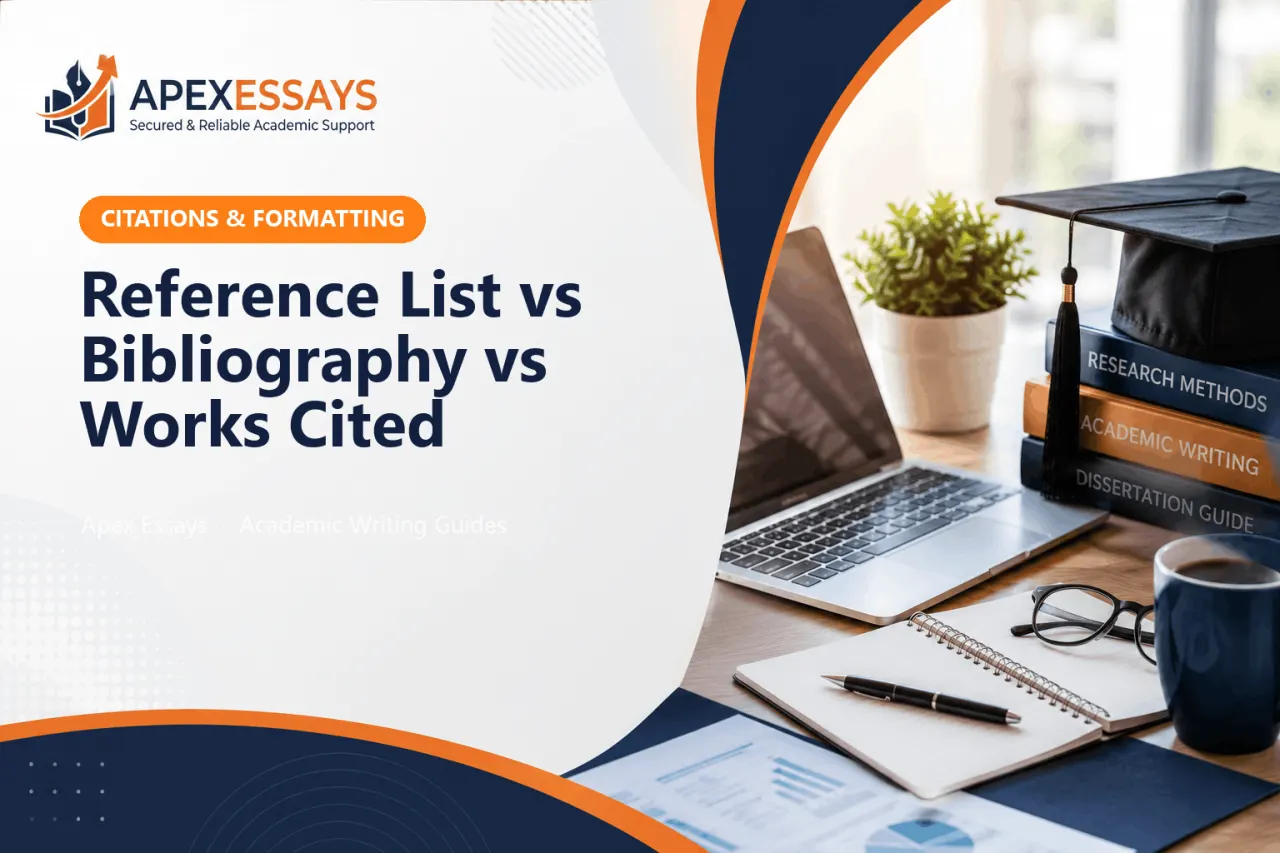
These four names are not four formats. They are four scopes, and the one you use is decided by the style your course runs, not by preference. Works Cited is MLA's label and holds only what you cited. References is APA's label and holds only what you cited. Bibliography is Chicago's label in its notes system, holds everything you cited, and may also hold relevant work you read but never quoted. An annotated bibliography is any of those three with a short paragraph of summary or judgment under each entry.
What follows is the part page one of this search leaves out: which manual and which edition each rule comes from, the five sources APA deliberately keeps off a reference list, the half of Chicago that uses no bibliography at all, and why two of these entries are often the same string of characters.
- Works Cited (MLA 9) holds what you cited. Read something and never cited it? MLA's answer is a separate list titled Works Consulted.
- References (APA 7) holds what you cited, and APA names five specific exceptions that stay out of it — personal communications among them.
- Bibliography (CMOS 18) belongs to Chicago's notes-bibliography system only. Chicago's author–date system uses a reference list, which may be headed References or Works Cited.
- "Everything you consulted" is the free explainers' answer, not Chicago's. A Chicago bibliography must carry everything cited, usually except court cases and other legal sources, and may add works consulted — with a caution about padding.
- An annotated bibliography is a layer, not a fourth style. All three manuals document it: APA 7 §9.51, MLA 9 (a new section in that edition), CMOS 18 §13.68.
- The entry itself often does not change. Since CMOS 18 dropped place of publication, a one-author book looks identical in an MLA 9 works-cited list and a Chicago 18 bibliography.
The short answer, in one table
Every row below names the manual and the edition it comes from, because that is where this question goes wrong. Guidance for these lists has changed twice since 2021: MLA's ninth edition landed in April 2021 and Chicago's eighteenth in 2024, and plenty of pages explaining "the difference" were written before either.
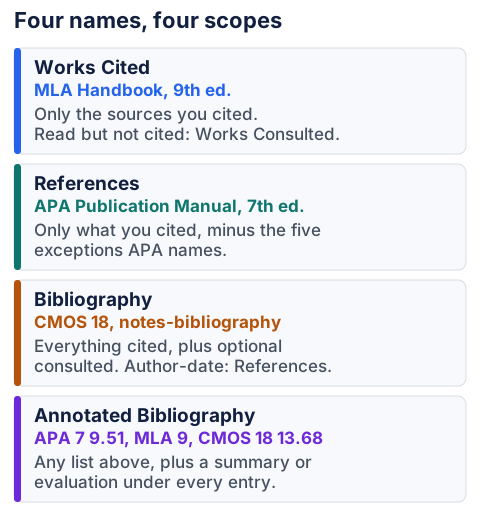
| Heading on the page | Manual and edition | What belongs on it |
|---|---|---|
| Works Cited | MLA Handbook, 9th ed. (April 2021) | Sources you borrowed from and cited. Extra reading goes on a separate Works Consulted list. |
| References | APA Publication Manual, 7th ed. | Every work cited in the text, and only those, with five documented exceptions. |
| Bibliography | CMOS, 18th ed. (2024), §§13.65–73 — notes system | Everything cited in the notes, and optionally relevant works you consulted but did not cite. |
| References or Works Cited | CMOS, 18th ed., §13.102 — author–date system | The works your parenthetical citations point to. Chicago's other half, and the row the free explainers leave out. |
| Annotated Bibliography | APA 7 §9.51 · MLA 9 · CMOS 18 §13.68 | Any of the lists above, with a short summary and/or evaluation under each entry. |
Works Cited: the MLA 9 list
MLA's own answer to this exact question is published on the MLA Style Center, under the heading "What is the difference between source lists titled 'Works Cited,' 'Bibliography,' and 'References'?" It defines the list plainly: "the list titled 'Works Cited' identifies the sources you borrow from—and therefore cite—in the body of your research project." Borrowed from, and therefore cited. Reading a book is not borrowing from it.
What about the four articles you read to understand the argument and then never quoted? MLA has a specific answer, and it is not "put them in anyway": "If you wish to list additional works and your instructor has no objection, create a separate list titled 'Works Consulted.'" Two lists, and the second one needs your instructor's blessing.
That MLA page carries MLA's own notice at the top: "This post relates to content in the eighth edition of the MLA Handbook. For up-to-date guidance, see the ninth edition of the MLA Handbook." Its supporting citations point at the seventeenth edition of the Chicago Manual, which the eighteenth replaced in 2024. It is still the clearest free first-party statement of the works-cited/works-consulted split, so it is quoted here with its edition said out loud — the only honest way to use a superseded page.
MLA also settles something the free explainers do not. Older handbooks allowed other titles for the same list; the seventh edition noted that "[o]ther names for such a listing are Bibliography (literally, 'description of books') and Literature Cited." MLA's recommendation now is narrow: use Works Cited or Works Consulted, and nothing else. If you are writing in MLA, "Bibliography" is not one of your options.
References: the APA 7 list
APA maintains a page called, helpfully, "Reference lists versus bibliographies." Its answer draws the same cited/consulted line, but assigns the words differently from every free explainer on the topic:
APA publications and other publishers and institutions using APA Style generally require reference lists, not bibliographies. A reference list contains works that specifically support the ideas, claims, and concepts in a paper; in contrast, a bibliography provides works for background or further reading and may include descriptive notes (e.g., an annotated bibliography).
Read that twice, because it contains something the free explainers miss entirely. APA has its own concept of a bibliography. It is not a Chicago-only word borrowed on loan. In APA's usage a bibliography is a further-reading list that may carry descriptive notes — which is why APA's annotated-bibliography guidance sits in the same paragraph. APA papers simply do not normally carry one.
The five things APA keeps off the reference list
APA's rule for what goes on the list is a two-way match: "In general, each work cited in the text must appear in the reference list, and each work in the reference list must be cited in the text." Then it names the exceptions. Four of the five competing pages we read list none of them; EasyBib's APA guide lists four, missing the meta-analysis case and never pointing at APA as the source. Two of the exceptions catch students out every term.
| Cited in the text but not in the reference list | APA's stated reason |
|---|---|
| Personal communications — emails, phone calls, texts | Readers cannot retrieve them |
| General mentions of a whole website, a whole periodical, or common software and apps | The use is broad and the source is familiar |
| The source of an epigraph, unless it is a scholarly book or journal | It sets the stage rather than substantiating a point |
| Quotations from participants in research you conducted | They are your original data, and a citation could compromise confidentiality |
| Works in a meta-analysis, marked with an asterisk | Citing them in the text is the author's choice |
The everyday consequence: an interview you conducted, an email from a professor and a lecture you attended in person are cited in your sentences and never appear on your References page. A student who "completes" the reference list by adding them has made it wrong, not thorough. Our side-by-side of APA 7 and MLA 9 covers how the entries themselves are built once you know which list they belong on.
Bibliography: the Chicago 18 list, and the half of Chicago that has none
Here is where almost every page on this search is wrong, and the error is structural rather than a slip. Chicago is two citation systems, and only one of them produces a page headed Bibliography. Chicago's own free Citation Quick Guide sets them out in two consecutive paragraphs:
| Chicago 18 system | In the text | The list at the end |
|---|---|---|
| Notes and bibliography — humanities, history, the arts | Superscript numbers keyed to footnotes or endnotes | "Sources are also usually listed in a separate bibliography." |
| Author–date — sciences and social sciences | Parentheses with author's last name and year | "Each in-text citation matches up with an entry in a reference list, where full bibliographic information is provided." |
So "Chicago uses a bibliography" is true for a history seminar and false for a sociology one. Chicago's guide adds the practical rule: "Students should check with their instructor before deciding which system to use." The eighteenth edition's own index files works cited lists at §13.102 and cross-references it to reference lists, so Works Cited survives in Chicago as a possible heading for an author–date list — while remaining, in MLA, the only one.
Now the second correction, and it is the one that matters most. The free explainers on this search define a bibliography as the list of everything you consulted. Chicago does not. Purdue OWL's guide to the eighteenth edition puts it in the right order: the bibliography "should include all sources cited within the work and may also include other relevant sources that were not cited directly but offer additional reading." Cited is mandatory. Consulted is optional. Northern Michigan University's CMOS 18 guide, keyed to §13.66, adds the caution nobody else prints: "Be careful when including such entries, as you do not want to give the impression that you are padding your bibliography."
One kind of cited source is usually the exception: court cases and other legal materials. Chicago's Q&A, answering from the eighteenth edition, recommends the Bluebook for citing court cases (CMOS §14.170), and library guides that teach Chicago's legal style leave cases out of the bibliography. The University of Northwestern–St. Paul's guide says "Court cases are only cited in notes, not in the bibliography," and Ball State University's says legal resources "do not need to appear in the bibliography." The eighteenth edition's own section on legal-style notes is subscriber-only, so this is the guides' rule rather than quoted Chicago text, and some courses list cases anyway. If your instructor wants a case in the bibliography, Northwestern–St. Paul's guide says to use the same form as the first note.
The prose of CMOS chapter 13 — §§13.65–73 and §13.102 alike — sits behind Chicago's subscription; requesting a section page redirects to a login gateway. What is free and first-party is the eighteenth edition's own back-matter index, which is where the section numbers used here come from — bibliographies, 13.65–73, with special types of: annotated, 13.68, fig. 13.10; bibliographic essays, 13.68, fig. 13.11; … selected, 13.68, fig. 13.9; single-author, 13.68, 13.70, and reference lists … vs. bibliographies, 13.70 … headings for, 13.102, 13.111. The wording of those sections is reported here second-hand from two university guides that name the edition and key their statements to those numbers.
That index line is worth a second look, because it tells you a bibliography is not one thing. The eighteenth edition indexes several kinds — a selected bibliography, a single-author bibliography, a bibliographic essay and an annotated bibliography among them. If a graduate committee asks for a "selected bibliography," they are not being vague — they are naming a documented type, and they mean you to choose.
Annotated bibliography: a layer, not a fourth style
An annotated bibliography is not a rival to the other three; it is one of them with something added underneath. Purdue OWL puts the addition in one sentence: "An annotation is a summary and/or evaluation. Therefore, an annotated bibliography includes a summary and/or evaluation of each of the sources." Purdue names three things an annotation can do — summarize the source, assess it, and reflect on how it fits your project — and notes that a single annotation may do one, some or all of them.
All three manuals now document the format:
- APA 7 covers it at §9.51 of the Publication Manual, and APA's website flags this as guidance that is new to the seventh edition.
- MLA 9 added it as an entirely new section. MLA's own editions comparison chart lists "entirely new sections on inclusive language, annotated bibliographies, and notes" among what the ninth edition brought that the eighth did not.
- CMOS 18 covers it at §13.68, alongside the other special types of bibliography.
The MLA row deserves a footnote. MLA's current "Using MLA Format" hub sends readers wanting annotated-bibliography guidance to a tag archive holding exactly three posts, and all three carry the eighth-edition banner — the newest published in March 2019. MLA's free web guidance on annotated bibliographies predates the edition that first gave them a section. The eighth-edition advice is still sound on the mechanics: style each entry "just as they would in a list of works cited and then append an annotation to the end of the entry," and title the list Annotated Bibliography or Annotated List of Works Cited. Just know which edition you are reading.
What actually goes in the annotation, and how long it runs, is the real assignment. We cover that separately in what an annotated bibliography is and why it gets assigned, with entries pulled apart in worked examples across all three styles.
The entries can be identical. The heading is the real difference.
Students assume switching styles rewrites every line. Often it barely touches them. Chicago's own quick guide prints this bibliography entry for a single-author book, noting beside it that "a place of publication is no longer required in book citations (see CMOS 14.30)" — a change the eighteenth edition made in 2024:
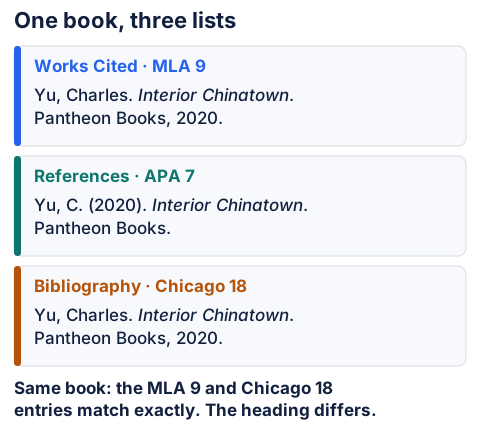
The Chicago line above is Chicago's own printed example. The MLA and APA lines are that same real book set to each manual's documented pattern — MLA's attested book form (author, title, publisher, year) and APA's, which asks for author, year, title and publisher and instructs writers not to include the publisher location.
So if a page tells you these three lists differ mainly in punctuation, it has the emphasis backwards. For a plain book the punctuation can be identical across two of them. What differs is the word at the top of the page and the rule about what is allowed underneath it. Get the heading wrong in MLA and you have used a label MLA does not recommend; get the scope wrong in APA and you have listed a source your text never cites.
What the free advice on this question gets wrong
We opened five pages on this question and its close variants on 20 August 2026 and read them: Citation Machine, Bibliography.com, EasyBib's APA guide, Dominican University's library FAQ and New Mexico State University–Grants. One shared answer, and three problems in it.
Four of the five name no edition of any manual, anywhere on the page. Searching each for the word "edition" returns nothing on Citation Machine, Bibliography.com, Dominican and NMSU. That is not a quibble on a question whose answer changed in 2021 and again in 2024. EasyBib does better in the body — its APA guide says its guidelines "come from the 7th edition of the APA's Publication Manual" — and then undercuts it in the footer of the same page: "We cite according to the 8th edition of MLA, 7th edition of APA, and 17th edition of Chicago (9th edition Turabian)." One edition behind on MLA, one behind on Chicago, disclosed at the bottom of the page. Citation Machine, from the same parent company, prints a Chicago book example carrying a place of publication CMOS 18 no longer requires, and an APA example carrying a publisher location APA 7 removed.
And all of them define a bibliography by what you consulted rather than by what you cited. New Mexico State University–Grants: a bibliography "lists all the material you have consulted in preparing your essay, whether you have actually referred to and cited the work or not." Bibliography.com: "a list of all the sources you consulted to write your paper." Neither sentence is false as far as it goes. Citation Machine takes the framing one step further and makes the extra reading compulsory: a bibliography "requires you to list all sources used during the course of your work, whether you have referred to them specifically in your paper or not," so that "even a source that you used just for background reading needs to be detailed." That is the step CMOS 18 does not take. Cited is what a Chicago bibliography must carry; consulted is a permission it grants, with the padding caution attached.
Then there is the labels problem. Citation Machine calls an APA reference list "essentially the same as a works cited page, just with a different name." Dominican University's library FAQ opens the same way — "Works Cited is sometimes referred to as References. The terms mean the same thing" — and then, to its credit, hands each label back to its own style in the same answer. That second half is the half a skimming reader loses: the two lists hold the same kind of thing, but the words are not swappable, and titling an APA paper's list Works Cited is the wrong heading. EasyBib's APA guide, published under the page title "APA Reference Page: How to Format Works Cited," tells readers that "'Bibliography' also may be used interchangeably, even though there are some differences between the two" — and then, further down the same page, tells the reader to use the label References anyway. The correction is in there; the headline is what gets read.
You can run this check yourself in two minutes: open any citation-generator guide, scroll to the footer, and look for an edition number. It is the fastest quality test there is for a citation page.
Deciding in thirty seconds
Work in this order, and stop at the first line that applies.
| What you have been told | What to type at the top of the page |
|---|---|
| The assignment names a style: MLA | Works Cited. Add a separate Works Consulted only if your instructor agrees. |
| The assignment names a style: APA | References, holding only what your text cites. |
| Chicago, with footnotes or endnotes | Bibliography — everything the notes cite, plus optional further reading. |
| Chicago, with author–date parentheses | References (Chicago also permits Works Cited here). |
| The sheet says "bibliography" but the course runs APA or MLA | Almost always a loose word for "your source list." Use the style's own heading and ask if the assignment reads as though extra reading is wanted. |
| The sheet says "annotated bibliography" | Your style's normal list, plus a summary or evaluation under each entry. |
When the assignment word and the style disagree, ask one question rather than guessing: "Should this list include sources I read but did not cite?" That is the only difference that changes what you submit. The heading follows from the style; the scope is the thing your instructor actually has an opinion about.
One habit is worth carrying out of this. Every rule above is attached to a manual and an edition, and both keep moving — MLA is publicly gathering input for its next edition, and Chicago replaced its seventeenth in 2024. Before you trust any citation page, including a generator's, look for the edition it is working from. If the page does not say, that silence is the finding.
And if the assignment in front of you is an annotated bibliography rather than a plain list, the citation line is the easy half — the paragraph underneath is where the work is. Our annotated bibliography writing service exists for that: original entries with real annotations, delivered to you to review and submit.