Live Chat

An annotated bibliography is a list of sources where each entry is followed by a short paragraph about that source — what it argues, whether it holds up, and what it is doing in your research.
Most students meet it as one line on an assignment sheet and take it for a reference list with extra typing. That assumption is what makes it painful. The citation is the easy half. The paragraph underneath is the actual assignment, and it asks you to do something you were probably never taught to do out loud: judge a source.
- It is a reference list plus a short evaluative paragraph under each entry.
- The point is to make you judge sources before you commit to them — not to format citations.
- An annotation is not an abstract. An abstract describes; an annotation assesses and positions.
- Instructors set it as a checkpoint before a research paper, so it doubles as your outline.
- Typical annotation length is 100–200 words, set by your brief rather than by the style manual.
- Your style changes the citation line above the annotation. The annotation itself barely changes.
Why it gets assigned
Think about how research usually goes wrong. A student collects fifteen sources, skims them, writes the paper, and discovers halfway through that four of the sources do not actually support the argument and two contradict each other in ways that were never noticed.
The annotated bibliography exists to force that discovery earlier, while it is still cheap to fix. By making you write a paragraph about each source, it makes skimming insufficient. You cannot evaluate a method you did not read.
That is also why the assignment usually lands weeks before the paper. It is a checkpoint, not a deliverable — a way for your instructor to see whether your evidence base can carry the argument you are planning.
If yours is a checkpoint for a paper, the positioning sentences you write are effectively a draft outline. Write them properly and the paper's structure is half decided before you start it.
What is inside a single entry
Each entry has two parts, and they do different jobs.
The citation is an ordinary entry in whatever style your course uses — a reference-list entry in APA, a works-cited entry in MLA, a bibliography entry in Chicago. Nothing special happens here.
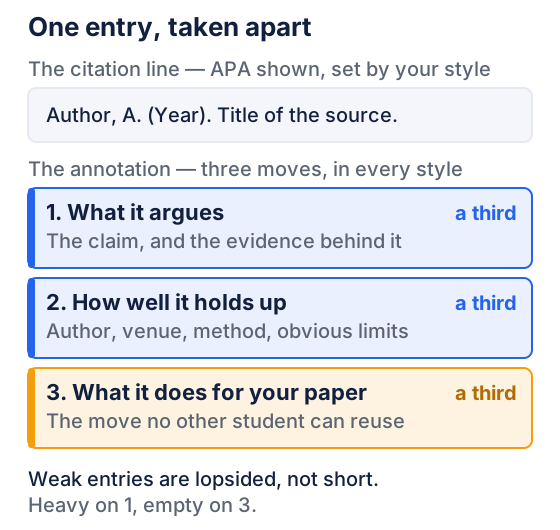
The annotation follows underneath. A good one does three things in sequence: it states what the source argues, it evaluates how well the source supports that argument, and it explains what the source contributes to your project specifically.
The third part is what makes annotations non-transferable. Two students citing the same article in different papers should write different annotations, because the source is doing different work in each.
A word budget that keeps the three parts in proportion
The usual problem is not length. It is balance — 130 words of summary and 20 words of everything else. Deciding the split before you write is what fixes it: give each move roughly a third of your words. In a 150-word annotation, that is about fifty words each. No manual sets that ratio; it is a working target, and the summary tends to run long at the short end, so treat the thirds as the shape you correct toward rather than a quota.
The central claim and the evidence behind it. Not the table of contents. One sentence nobody could write from the title alone.
Who wrote it, published where, with what limits. Scope, date, and whether it reports research or only describes it.
Which section it serves, and why this source over another. Name the disagreement if it disagrees with something else on your list.
Annotation, abstract, summary — three different things
This is the single most common confusion, and it is worth settling clearly.
| Type | Written by | Purpose | Contains judgment? |
|---|---|---|---|
| Abstract | The source's own author | Tell readers what the article contains so they can decide to read it | No |
| Summary | You | Compress the content accurately | No |
| Annotation | You | Assess the source and place it in your research | Yes |
Copying an abstract into an annotation is the fastest way to lose points here. An abstract exists to get the article read. It is written to say what the work covers, not to weigh that work against a question its author has never seen — and that second job is the one an abstract can never do for you.
Here is the gap, on one real book. Take Carol S. Dweck's Mindset (Random House, 2006), in a paper asking whether a university was right to give every first-year student a growth-mindset program. Both versions below are compressed to keep the comparison readable; a real entry runs 100 to 200 words.
Dweck explains the difference between a fixed mindset and a growth mindset, and shows how each shapes the way people respond to difficulty. The book draws on education, sports and business, with many examples throughout.
Dweck is a Stanford psychologist writing for a general readership, so the book describes her research rather than reporting methods and effect sizes. It defines the variable this paper argues about, but it cannot carry a claim about how large the effect is — which is why it anchors the definition section and not the results section.
Both are about the same book. Only the second one is doing the assignment. It takes the argument as given, because the version above it has just stated it, and spends its words on the move description never reaches: a verdict on what the source is good for and what it cannot be asked to prove. What changed is not the level of detail. It is that somebody took a position.
If your annotation would work just as well in someone else's paper, it is not finished.
And it is not a literature review either
Both assignments come out of the same reading, so they get confused constantly. The difference is what each document is a list of. An annotated bibliography is a list of sources, and every source keeps its own slot whether it turned out to be central or marginal. A literature review has no slots — sources are named inside your sentences, several to a paragraph, and one you judged weak may survive as half a clause or not at all. Courses often set the bibliography first for that reason: you judge sources one at a time before you decide which ones have earned room.
The kinds you might be asked for
Briefs use different names for what is essentially a dial between description and judgment.
- Descriptive or indicative — summarizes the source and stops. Rare as a standalone assignment.
- Evaluative or critical — summarizes, then assesses credibility, method and limitations. This is the usual request.
- Combination — the above plus explicit positioning against your own research question. Most common at upper-division and graduate level.
If your brief does not name a type, write the combination version. It contains the other two.
Working out which one your brief wants
Read the assignment sheet against these five questions, in order. The first "yes" decides it.
- Is a rubric attached? It outranks everything below. Count its criteria and check every entry hits each one — instructors grade the rows they were given.
- Does it name your research question, thesis, or "how you will use" each source? Combination. Every entry needs a positioning sentence.
- Does it say evaluate, assess, critique, credibility or limitations? Evaluative, minimum. Description alone will lose points.
- Does it say only "summarize", with a limit under about 100 words? Descriptive is genuinely what is wanted; do not pad it with opinion.
- None of the above? Write the combination version, inside the stated word count.
What your citation style changes, and what it does not
Students lose more time here than on the annotations, usually because they expect the style manual to govern the whole entry. It governs the citation line. Your brief governs the paragraph underneath, and that split holds whichever style you were assigned.
On the line itself, APA is the one that looks different. It moves the publication year forward to sit straight after the author, cuts given names to initials, and drops book titles into sentence case — Dweck's Mindset: The New Psychology of Success in MLA is Mindset: The new psychology of success in APA. MLA and Chicago's notes-and-bibliography system spell the author's name out, keep the year at the end of a book entry, and hold the title in title case.
Chicago is really two systems, and that catches people. Notes-and-bibliography is the humanities version described above. The other, author-date, is the one Chicago says is preferred by many in the sciences and social sciences, and it moves the year forward to sit right after the author exactly as APA does — Dweck's book becomes Dweck, Carol S. 2006. Mindset: The New Psychology of Success. Random House. The spelled-out name and the title case stay put. Only the year moves. Find out which of the two your course means before you copy anyone's template.
The annotation underneath barely moves. Its length and its content come from your brief and your paper rather than from the manual — and where a manual does comment on the annotation's form, as MLA does, it defers to your instructor anyway.
One caveat on MLA. Its own note on annotated bibliographies is a 2016 post on the MLA Style Center, and MLA flags it as content for the eighth edition of the MLA Handbook.
Two lines in it are still worth having. The first: annotations are "generally written as succinct phrases", a line the ninth-edition university guides repeat. Read that as a default, not a ban. The same MLA post tells instructors who "prefer to have your students use complete sentences" how to format the result, and those ninth-edition guides say outright that annotations can also be written as complete sentences. If your brief asks for a word count in the hundreds, it is asking for sentences. The second line worth having: the list "should be titled Annotated Bibliography or Annotated List of Works Cited". Treat the rest of that post as background, and let your brief settle anything it does not cover.
For APA, the annotated-bibliography student paper template on APA Style's sample papers page is the fastest way to see the expected layout, and Purdue OWL sets out the summarize–assess–reflect structure the annotation itself follows.
A plain book is the easy case. Journal articles, chapters and web sources are where the styles really separate, and the in-text citation rules differ from the first mention — our comparison of APA 7th and MLA 9th walks through both.
How long, and how many
Annotation length is set by your instructor far more often than by a style manual — anywhere from 75 words to 250. Where nothing is specified, 100 to 200 words is the working default, which is roughly one tight paragraph.
Source count comes from the brief too. What the brief rarely says is that your sources should not all agree. A bibliography where every entry supports the same position shows you found a consensus and stopped looking. Including a source that complicates your argument, and saying so in its annotation, is a mark of genuine research rather than confirmation.
Citation tools will build the reference line for you, and that part is fine. They cannot write the annotation, because they do not know what your paper argues. An annotation assembled from an abstract reads like one — all description, no assessment, no connection to anything.
Where the points actually go missing
Three problems account for most of the lost points, and none of them is about writing ability.
| What the grader sees | What happened | The fix |
|---|---|---|
| Strong sources that do not fit the question | You judged credibility and forgot relevance | For each entry, name the question it answers and check that it is yours |
| Initials and italics drifting between entries | You trusted a generator across mixed source types | Check one entry against the style's own example, then match the rest to it |
| Tense wandering between entries | Nobody told you the rule differs by style | Pick your style's convention and hold it |
That last one catches good students. MLA and Chicago-style humanities writing use the literary present — "Dweck argues", even for a 2006 book. APA goes the other way: its verb tense guidance asks for past tense or present perfect when you describe previous research, as in "Martin (2020) addressed" or "researchers have studied". Both are correct; only one is correct in your paper.
Edge cases your brief probably does not cover
A source you read and rejected. If the brief asks for "sources considered", include it and spend the annotation on why you rejected it — a well-argued rejection is evidence of judgment. If it asks for "sources you will use", leave it out.
Sources that are not journal articles. A government dataset, a court opinion or a documentary can belong if your question needs it. The annotation then carries more weight: it has to say what the source is good for and what it cannot prove.
Grouping instead of alphabetizing. Alphabetical by author surname is the safe default, and it matches the reference list your reader already knows how to scan. If your brief asks for thematic grouping, add a one-line note at the top saying how the page is ordered — a grader still has to find a specific entry quickly.
Two sources making the same point. Keep both only if the second adds a different population, method, date or country — and say what it adds. Otherwise cut one.
Do annotations end up in the paper? Not as written. They are working notes with a grade attached; sentences get rewritten into the literature review later.
Where it sits in the research process
Roughly in the middle, and that placement is deliberate.
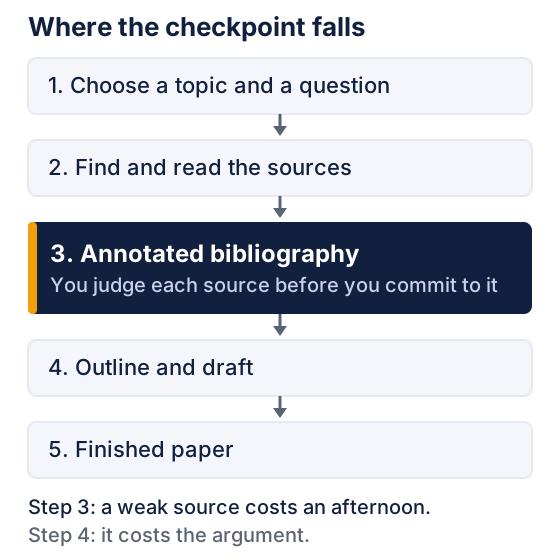
You need enough of a research question to judge relevance, so it comes after topic selection. You need to have read the sources properly, so it comes after collection. And it comes before drafting, because its whole purpose is to stop you drafting on a weak evidence base. Our guide to writing a research paper step by step shows where the checkpoint falls in the wider sequence.
Treated that way, it saves time rather than costing it. Treated as a formatting exercise the night before it is due, it costs a weekend and teaches nothing.
If the reading load is the problem rather than the writing, our annotated bibliography help reads the sources and writes evaluative annotations tied to your actual research question, from $7.89 a page — part of our broader paper writing service.