Live Chat


A discussion section answers one question: what do your results mean? The section before it reports what you found. The section after it says what to carry away. The discussion is the only part of the paper where you are allowed to argue — to say what your numbers suggest, what they cannot show, and how they sit beside everyone else's numbers.
UC Irvine's scientific-writing guide puts the reason in one sentence, quoting Chris A. Mack's How to Write a Good Scientific Paper (SPIE, 2018): "Evidence does not explain itself; the results must be presented and then explained." A table is not an argument. Someone has to say what it means, and in your paper that someone is you.
That still does not tell you which of your sentences belongs where, so this guide does two things. It writes one finding out as all three sections, so you can see which words move. And it answers "what goes in it" from the two published standards that specify the section, rather than from the five-step checklist that circulates everywhere with no source attached.
- Results report, discussion interprets, conclusion compresses. George Mason University's writing center: "In the Results section, you simply report your findings. In the Discussion section, you comment on them."
- The sharpest test for the line above yours is UNC Chapel Hill's: "Nothing your readers can dispute should appear in the Results section."
- Two named standards do not ask for the same first move. ICMJE: "It is useful to begin the discussion by briefly summarizing the main findings, and explore possible mechanisms or explanations for these findings." APA's JARS–Quant Table 1 lists five Discussion items and a summary is not among them.
- Say each thing once. USC: recommendations "can be included in either the discussion or conclusion of your paper, but do not repeat your recommendations in the both sections."
- Your paper may not have one. IMRaD is a format for empirical work, and some fields label the same section "Conclusions."
The same finding, written three ways
Most guides hand you a table of differences. A table gives you the categories; it does not show the sentence-level move, which is where people get stuck.
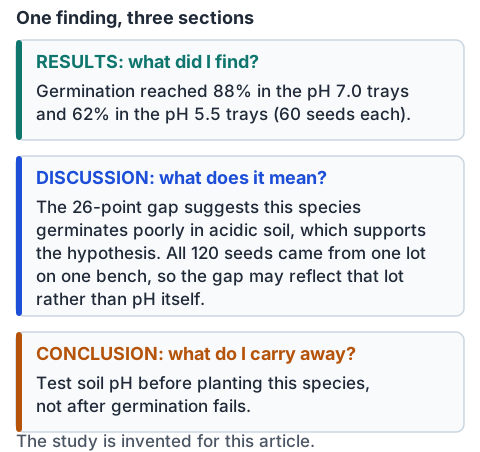
The germination study above does not exist. There is no greenhouse, no seed lot and no result — the 88% and 62% figures were made up for this walkthrough so the same numbers could appear in all three sentences. Nothing here is a claim about germination, soil pH or seed viability. The shape of the three sentences is the point.
As a results sentence: Germination reached 88% in the pH 7.0 trays and 62% in the pH 5.5 trays (60 seeds each). Nothing in that can be argued with; it is a count. UNC Chapel Hill's Scientific Research Reports handout draws the line exactly there: "don't try to draw conclusions about the results—save them for the Discussion section. In this section, you're reporting facts." Its test is the most useful sentence in any guide we read: "Nothing your readers can dispute should appear in the Results section."
As a discussion passage: The 26-point gap suggests this species germinates poorly in acidic soil, which supports the hypothesis. All 120 seeds came from one lot on one bench, so the gap may reflect that lot rather than pH itself. Two things changed. The verb moved from "reached" to "suggests," which is arguable. And the second sentence gives away the reason a reader might doubt the first — which is what makes the first credible.
As a conclusion sentence: Test soil pH before planting this species, not after germination fails. The number is gone, and so is the hedging and the limitation. USC's companion page on conclusions explains why: "A conclusion is not merely a summary of the main topics that have been covered or a re-statement of the research problem; it is a synthesis of key points derived from your analysis of the study's findings." A conclusion is what survives when the evidence is taken away.
Take any sentence you have written and ask which it is. Could a reasonable reader dispute it? If not, it belongs in results. Does it explain, compare or qualify a number already reported? Discussion. Would it still make sense to someone who never saw your data? Conclusion. A sentence that fits two boxes is usually two sentences that have not been separated yet.
If the section before this one is the trouble, our walkthrough of how to write a results section covers what belongs above the line.
What goes in it, according to the standards that define it
Search this topic and you meet the same five moves everywhere: summarize, interpret, compare to the literature, admit limitations, recommend future work. Reasonable advice — and folk knowledge, repeated from page to page with nothing underneath it.
Two documents actually specify the section for large parts of US academic publishing, and both are free to read. APA's Journal Article Reporting Standards publish a table headed "Information Recommended for Inclusion in Manuscripts That Report New Data Collections Regardless of Research Design," carrying a 2024 copyright. The ICMJE Recommendations — written for authors submitting to ICMJE member journals, and voluntarily used by many journals outside that membership — were updated in January 2026. They do not say the same thing.
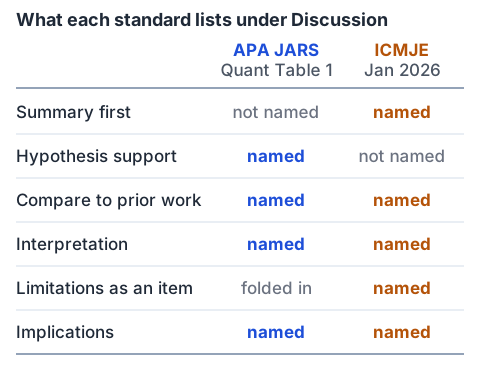
APA's five. JARS–Quant Table 1 lists exactly five items under Discussion. Support of Original Hypotheses: "Provide a statement of support or nonsupport for all hypotheses, whether primary or secondary, including" a distinction between the two and discussion of any exploratory analyses. Similarity of Results: "Discuss similarities and differences between reported results and work of others." Interpretation: "Provide an interpretation of the results, taking into account" a list beginning with "sources of potential bias and threats to internal and statistical validity." Generalizability: "Discuss generalizability (external validity) of the findings, taking into account" the target population and setting. Implications: "Discuss implications for future research, program, or policy."
What is missing from that list is the interesting part. There is no "summarize your findings" move, and no standalone limitations item — the limitation work is folded into Interpretation and Generalizability, where it attaches to specific claims instead of sitting in a paragraph of its own. That is a statement about this table, not about APA generally, and should be read that narrowly. It does mean the universal "step one: summarize" is not what APA's own reporting standard asks for.
ICMJE opens the other way. Its guidance begins: "It is useful to begin the discussion by briefly summarizing the main findings, and explore possible mechanisms or explanations for these findings." It then asks you to "Emphasize the new and important aspects of your study and put your findings in the context of the totality of the relevant evidence," and to "State the limitations of your study, and explore the implications of your findings for future research and for clinical practice or policy."
ICMJE also carries two rules absent from the popular checklists. One: "Do not repeat in detail data or other information given in other parts of the manuscript, such as in the Introduction or the Results section." Two, which nobody teaches: "Avoid claiming priority or alluding to work that has not been completed." Announcing that yours is the first study to do something, or gesturing at results you have not finished collecting, is a named error.
Follow whichever standard your field uses; if neither is specified, open with the summary, which costs one short paragraph. What the disagreement should change is your confidence in the checklist — it is a convention, not a rule handed down from anywhere, and if your instructor's handout orders the moves differently, the handout wins.
Drafting it, in an order that works
The section is easier to write out of order. Write the interpretation first, while you still remember what surprised you, and assemble the rest around it.
Write the plain answer, no hedging and no citations. It may not survive to the final draft, but everything else gets arranged around it. USC's ordering advice for each finding is "first state the answer, then the relevant results, then cite the work of others."
USC recommends you "interpret and discuss the significance of your findings in the same sequence you described them in your results section," with one exception: leading with a genuinely unexpected result is fine.
USC describes the shape as an inverted pyramid: "Organize the discussion from the general to the specific, linking your findings to the literature, then to theory, then to practice." Cite to explain your result, not to decorate it — and if a study disagrees with you, "don't ignore it--clearly explain why your research findings differ from theirs."
Attach each one to the claim it weakens rather than dumping them in a paragraph. UNC sets a threshold worth borrowing: "don't indicate that the experiment had a weakness unless you're fairly certain that a) it really occurred and b) you can explain reasonably well how that weakness affected your results." Guessing that the room was warm is not a limitation.
USC: "The discussion section should end with a concise summary of the principal implications of the findings regardless of their significance." Then choose one section for your recommendations, because the same guide warns against making the same recommendations twice.
How long should a discussion section be?
Your assignment sheet decides, and if it does not, the rubric usually does — reading a rubric line by line answers this faster than any general rule. What is worth knowing is that the institutional guides give no overall length on purpose: USC, UNC, UC Irvine and George Mason all describe the moves without prescribing a word count for the section. The one figure USC does give covers the opening move only — your statement of the major findings should be "a direct, declarative, and succinct proclamation of the study results, usually in one paragraph."
You will find confident figures elsewhere — six paragraphs, 1,000 to 1,500 words, three to four pages. None of the pages we checked attributes those numbers to anything, so treat them as somebody's habit rather than a standard. The one real constraint is proportional: USC notes that the conclusion "is often the shortest section of the paper, requiring only two or three well-developed paragraphs," which caps how much of your argument you can defer to it.
If you are writing a lab report, the job is smaller
Most advice on this topic is written for someone submitting a manuscript or finishing a graduate degree. If you are a first-year student with a three-page lab report due Thursday, that advice is aimed over your head — you are not going to discuss external validity in a target population.
UNC Chapel Hill's handout is written for you, and it opens by lowering the stakes: "The discussion section is probably the least formalized part of the report, in that you can't really apply the same structure to every type of experiment." Its five objectives work as an outline for almost any course lab:
- "Explain whether the data support your hypothesis"
- "Acknowledge any anomalous data or deviations from what you expected"
- "Derive conclusions, based on your findings, about the process you're studying"
- "Relate your findings to earlier work in the same area (if you can)"
- "Explore the theoretical and/or practical implications of your findings"
Verbs are where lab discussions most often go wrong. Students write that the experiment proved something, on the strength of a few trials in an afternoon. UNC supplies replacements: "Use less absolutely conclusive language, including such words as 'suggest,' 'indicate,' 'correspond,' 'possibly,' 'challenge,' etc." Swapping "proves" for "suggests" costs nothing and makes the sentence defensible. For the sections around it, our breakdown of what a lab report looks like works through a full example.
When your paper does not have a discussion section
Your paper may not be empirical. George Mason's writing center defines the format this way: "'IMRaD' format refers to a paper that is structured by four main sections: Introduction, Methods, Results, and Discussion. This format is often used for lab reports as well as for reporting any planned, systematic research in the social sciences, natural sciences, or engineering and computer sciences." Notice which fields are not in that list. A literature paper, a history essay or a philosophy paper has no methods and no results, so it has nothing for a discussion section to discuss. If a prompt for one of those uses the word "discussion," it almost certainly means the analysis — your argument about the text — which is worth asking about rather than guessing.
Your field may merge or rename it. Some departments and journals run a combined "Results and Discussion." UNC records the naming problem plainly: the IMRaD format "may take slightly different shapes depending on the discipline or audience; some ask you to include an abstract or separate section for the hypothesis, or call the Discussion section 'Conclusions,' or change the order of the sections (some professional and academic journals require the Methods section to appear last)." A heading marked Conclusions may be asking for the work described on this page.
Where the choice is yours, USC advises against merging early on: "If you choose to combine the results section and the discussion section into a single narrative, you must be clear in how you report the information discovered and your own interpretation of each finding. This approach is not recommended if you lack experience writing college-level research papers." Keeping them apart is a scaffold — it forces you to notice when a sentence has quietly become an argument.
Five ways it goes wrong, and what the sources say
| What goes wrong | What the source says | The fix |
|---|---|---|
| You write a second results section | USC lists "Do not restate your results" first among problems to avoid; UC Irvine's guide says "Also do not repeat your results, this is a discussion." | Use what USC calls "bridge sentences" — name the result in half a sentence, then spend the rest interpreting it. |
| A new number appears | USC: "Do not introduce new results in the discussion section." | Move the number up into results and refer back to it. If it did not earn a place there, it does not belong here either. |
| The claim outruns the evidence | USC: "be careful that you have not read more into the findings than can be supported by the evidence you have gathered. Remember that the data are the data: nothing more, nothing less." | Read each sentence for its main verb. "Shows," "proves" and "confirms" usually need to become "suggests" or "is consistent with." |
| Limitations turn into an apology | USC: "Avoid using an apologetic tone; however, be honest and self-critical." | Name the limitation, say how far it moves the finding, and stop. One clause of effect beats a paragraph of regret. |
| Recommendations get made twice | USC: recommendations "can be included in either the discussion or conclusion of your paper, but do not repeat your recommendations in the both sections." | Pick one section. If the future work grows out of a specific limitation, keep it beside that limitation. |
There is a sixth, about posture rather than content. USC frames the limitations move as a choice you get to make first: "It is far better for you to identify and acknowledge your study's limitations than to have them pointed out by your professor!" Written that way, the limitations paragraph is not a confession — it is you showing that you already know where your own argument is soft.
What to do with your draft today
Run the placement test over your discussion sentence by sentence. Anything nobody could argue with belongs in results. Anything that would still make sense to a reader who never saw your data belongs in the conclusion. What is left — the explaining, comparing and qualifying — is your discussion, and it is usually shorter and sharper than the draft you started with. Then check your verbs, check that no number appears here for the first time, and check that your recommendations are made in exactly one place.
If the paper around the section is the real problem, our guide to writing a research paper covers building the argument from the assignment sheet forward. And if the deadline is closer than the draft, our research paper writing service works alongside you — pressure-testing whether a finding supports the claim you want to make, and drafting sections you review, revise and submit as your own. The interpretation has to be yours, because interpretation is the only thing the discussion section is for.