Live Chat


A compare and contrast essay can be built two ways, and almost every example you find online only shows you one of them. Block (also called subject-by-subject) gives one text or subject its own paragraphs, then gives the other its own paragraphs. Point-by-point takes one point of comparison at a time and handles both subjects inside the same paragraph. Same evidence, same thesis, two completely different reading experiences.
So this post does the thing the examples usually skip: it writes the same comparison twice, once each way, in full, on the same pair of texts — the Declaration of Independence and the Gettysburg Address. You get both drafts, an annotation of every move each one makes, and a plain rule for deciding which pattern your material actually wants.
Both essays below were written for this article by our editorial team. They are demonstration drafts, not student work and not papers for sale. Every quotation inside them comes from a primary text we link: the National Archives transcript of the Declaration and the National Park Service transcript of the Gettysburg Address. Copy the structure; write your own sentences.
- The pattern is a body-paragraph decision. Your introduction, thesis and conclusion are near-identical either way — which is why both examples below share one introduction.
- Block needs a synthesis paragraph; point-by-point does not. The UNC Writing Center warns that subject-by-subject organization risks a paper that "will simply be a list of points," and recommends "a very strong, analytical thesis and at least one body paragraph that ties all of your different points together."
- Count the crossings. Over three points of comparison, the block version crosses between the two texts once; the point-by-point version crosses five times.
- Topic sentences give the pattern away. In block they name a subject; in point-by-point they name a point. Read only your topic sentences and you know which essay you actually wrote.
- The choice, in one question from Boston University's writing program: can you divide your claims more easily "into different ideas (point-by-point) or into different voices (block-by-block)?"
The two shapes, named by the people who teach them
The University of North Carolina at Chapel Hill Writing Center, in its handout on comparing and contrasting, describes the block pattern in one sentence: "Begin by saying everything you have to say about the first subject you are discussing, then move on and make all the points you want to make about the second subject." It then names the cost. "The danger of this subject-by-subject organization is that your paper will simply be a list of points" — and instructors, it says, want you "to compare or contrast two or more things very directly, rather than just listing the traits the things have."
The fix UNC recommends is structural, not stylistic: if you use block, "you will probably want to have a very strong, analytical thesis and at least one body paragraph that ties all of your different points together." That extra paragraph is not decoration. It is the price of the pattern.
Point-by-point spreads that work out. In UNC's words, "Rather than addressing things one subject at a time, you may wish to talk about one point of comparison at a time" — one paragraph per point, both subjects inside it. The comparing happens continuously instead of being saved up for the end.
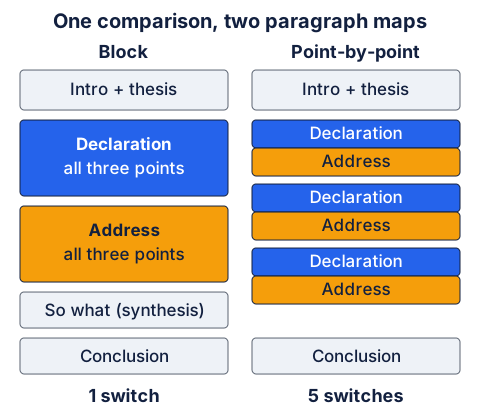
Those crossing counts are the reading experience. One crossing means your reader holds an entire text in memory before meeting the other. Five crossings means the two texts are never more than a few sentences apart, so nothing has to be remembered. Neither is better in the abstract; they suit different material.
The pair, the thesis, and the three points
Both drafts below answer the same prompt: compare how the Declaration of Independence and the Gettysburg Address define the United States. It is a standard US history or composition assignment, and it works as a demonstration because both texts are short, public, and quotable to the word.
A comparison needs a reason to exist before it needs a pattern. Here the reason is textual: both documents rest on the same five words, all men are created equal, and they give those words a different job. That observation becomes the thesis:
The Declaration states equality as a self-evident truth in order to end a government; the Address restates it as a proposition in order to keep one alive — and that one change of word changes who each document addresses and what it asks for.
Three points of comparison fall out of that thesis, and both drafts use the same three in the same order: (1) what status each document gives the equality claim, (2) whom each one addresses, (3) what each asks that audience to do. Our guide to building a thesis statement outline works the same move on other topics.
Pick your points before you pick your pattern. Points come from the thesis; the pattern only decides where to put them. Doing it the other way around is how students end up with a shape they then have to fill.
The introduction both drafts share
This paragraph is identical in both versions, and that is the first thing to notice. Choosing block or point-by-point does not change how you open. Like every sentence in both drafts, it was written by our editorial team for this article.
Introduction, used unchanged by both drafts:
Eighty-seven years separate the Declaration of Independence from the Gettysburg Address, and Lincoln's opening sentence counts them out loud. "Four score and seven years ago," he begins, dating the nation's birth to 1776 rather than to the Constitution of 1787. That choice puts the two documents into the same argument. Both build the country on the same five words — all men are created equal — and both treat those words as load-bearing. What they do not share is the weight they ask the words to carry. The Declaration states equality as a self-evident truth in order to end a government; the Address restates it as a proposition in order to keep one alive — and that one change of word changes who each document addresses and what it asks for.
Example 1: the block method, in full
The body runs two evidence paragraphs — one per document, each covering all three points in the same order — then the tie-together paragraph UNC recommends for this pattern, then the conclusion. The draft below was written by our editorial team as a demonstration for this article; it is not a paper for sale and not a paper to submit.
Body paragraph 1 — the Declaration, all three points
Start with the Declaration's own footing. It treats its central claim as settled before it argues anything: "We hold these truths to be self-evident, that all men are created equal." Self-evident means the claim needs no proof, which is precisely what the document needs, because everything after it is a legal case resting on that footing — governments derive "their just powers from the consent of the governed," so a government that forfeits consent may be replaced. Its audience follows from the same logic. The opening paragraph says that "a decent respect to the opinions of mankind requires that they should declare the causes which impel them to the separation," and the charges against the king are introduced with "let Facts be submitted to a candid world." The reader being addressed is a juror, not a citizen. And what the document asks of that juror is judgment rather than labor: read the record, agree the case is proved, and recognize a separation the signers have already carried out. The dateline, "In Congress, July 4, 1776," marks an act finished at the moment of writing.
Body paragraph 2 — the Address, the same three points in the same order
The Address inherits those same five words and immediately downgrades their status. Lincoln's nation is "conceived in liberty, and dedicated to the proposition that all men are created equal." A proposition is not self-evident; it is a claim put forward to be proved, and Lincoln names the proof in the next sentence — the war is "testing whether that nation, or any nation so conceived and so dedicated, can long endure." The audience shifts with the claim. Where the Declaration wrote outward to "a candid world," the Address turns to the people standing in front of it: "It is for us the living, rather, to be dedicated here to the unfinished work which they who fought here have thus far so nobly advanced." The first-person plural, running through the speech from its second sentence on, now governs every resolution that follows. What that audience is asked for is not a verdict but continued effort — "increased devotion to that cause," the resolve "that these dead shall not have died in vain," and the survival of "government of the people, by the people, and for the people." Nothing in the speech is finished.
Body paragraph 3 — synthesis, the paragraph this pattern cannot skip
Set the two side by side and the difference is one word doing structural work. Truth lets the Declaration stop arguing and start acting; proposition obliges the Address to keep arguing and keep asking. That is why the earlier document can name a date and the later one cannot — a truth is established on the day you declare it, while a proposition is only ever as proved as the last generation that carried it. Lincoln's arithmetic in the first line is the tell. By counting back eighty-seven years to 1776 rather than to 1787, he claims the Declaration as the founding document and then reopens its central sentence as unfinished business. The Address is not a tribute to the Declaration; it is an argument about how the Declaration should be read.
Conclusion
Both documents describe one country and rest on the same claim about equality, which is why they are so often quoted in the same breath. The difference is what each does with that sentence. One uses it to end an obligation; the other uses it to create one. A reader who catches the shift from truth to proposition has the whole distance between 1776 and 1863 in a single word.
What that draft is doing, paragraph by paragraph:
- Paragraph 1 takes the points in order. Status of the claim, then audience, then request. That order is a promise — paragraph 2 repeats it exactly, and the repetition is what lets a reader hold two long paragraphs against each other.
- Paragraph 2 signals the comparison without doing it yet. "Inherits those same five words," "where the Declaration wrote outward" — backward glances that keep the first text alive in memory. Without them, block reads as two unrelated essays stapled together.
- Paragraph 3 is where the essay earns its thesis. Delete it and you have a competent double summary and no argument — exactly the failure UNC describes.
- The conclusion adds a consequence, not a recap. "One uses it to end an obligation; the other uses it to create one" appears nowhere above it.
Example 2: the same comparison, point by point
Same thesis, same evidence, same introduction. What changes is that each body paragraph now owns one point and visits both documents inside it — and the synthesis paragraph disappears, because the synthesis is happening three times instead of once. This second draft is ours too, written for this article and for the same reason: to be copied as a shape, not as sentences.
Body paragraph 1 — point one: what status the claim gets
The first difference is what each document says the equality claim is. The Declaration files it as settled: "We hold these truths to be self-evident, that all men are created equal." Self-evident closes the question — the sentence becomes a foundation rather than an argument, which is why everything built on it can be legal reasoning instead of persuasion. The Address files the identical words as open. Lincoln's nation is "dedicated to the proposition that all men are created equal," and a proposition is a claim put forward for proof; he names the proof immediately, since the war is "testing whether that nation, or any nation so conceived and so dedicated, can long endure." So the two documents share a sentence and disagree about its logical status. That disagreement is not a contradiction but a sequence: the Address can only reopen the claim because the Declaration first closed it.
Body paragraph 2 — point two: who is being addressed
The audience changes along with the claim. The Declaration writes outward, to strangers. It opens by saying that "a decent respect to the opinions of mankind requires that they should declare the causes which impel them to the separation," and it introduces its charges with "let Facts be submitted to a candid world" — positioning its reader as a juror weighing a case brought by somebody else. The Address writes inward, to the people in front of it: "It is for us the living, rather, to be dedicated here to the unfinished work which they who fought here have thus far so nobly advanced." The pronoun is first-person plural, and it governs every resolution Lincoln goes on to make. A juror is asked to stay impartial; a "we" is asked to be implicated. The same move that turned a truth into a proposition also turned an audience into a participant.
Body paragraph 3 — point three: what each one asks for
Because the audiences differ, the requests do. What the Declaration wants from a candid world is recognition: read the record, accept that the case is proved, treat the separation as accomplished. Its own dateline, "In Congress, July 4, 1776," marks a completed act, and the document asks its reader for nothing beyond that recognition. What the Address wants is labor that has not happened yet — "increased devotion to that cause," the resolve "that these dead shall not have died in vain," and a government "of the people, by the people, and for the people" that has to be kept from perishing. The Declaration's verbs finish; the Address's verbs continue. That is the practical difference between founding a country and holding one, and it explains why the later text keeps the earlier one's sentence but not its tense.
Conclusion
Read in that order, the two documents are one argument in two stages. The Declaration establishes the principle and closes the case; the Address reopens the principle and hands the case to the reader. The five words in the middle do not change. What changes is whether they are being asserted or being tested — and Lincoln's first line, counting back eighty-seven years, makes sure nobody misses which document he is testing.
Those three body paragraphs are not three shapes. They are one shape run three times, and it is worth seeing laid out, because the shape is copyable and the sentences are not.
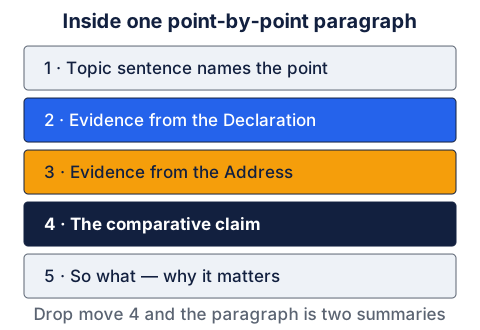
Check it against paragraph 2. Move 1 is "The audience changes along with the claim." Moves 2 and 3 are the two quoted blocks. Move 4 is "A juror is asked to stay impartial; a 'we' is asked to be implicated" — a sentence that could not be written about either document alone. Move 5 links it back to the thesis. Five moves, in that order, three times.
What actually changed between the two drafts
Nothing in the evidence, and nothing in the argument. Here is the complete list of differences.
| Element | Block draft | Point-by-point draft |
|---|---|---|
| Introduction and thesis | Unchanged | Unchanged |
| Evidence paragraphs | 2 — one per document | 3 — one per point |
| Topic sentences name | A document ("Start with the Declaration's own footing") | A point ("The first difference is what each document says the equality claim is") |
| Where the comparison happens | Once, in a dedicated synthesis paragraph | Three times, at the end of each body paragraph |
| Crossings between texts | 1 | 5 |
| Extra paragraph required | Yes — the synthesis | No |
| What goes wrong when it fails | Two summaries with no argument | Choppy paragraphs that state differences without explaining them |
The topic-sentence row is the fastest self-check there is: read only your topic sentences. If they name subjects, you wrote block, whatever your outline claimed. If they name points, you wrote point-by-point. If they name neither, the draft has no organizing pattern at all, and the fix is to go back to outlining before drafting rather than to keep editing sentences.
The same difference, on a pair you already know
Two founding documents make the contrast visible, but they are not what most assignments hand you. So here is that same structural difference on a pair almost every student already has an opinion about — online classes and in-person classes — reduced to nothing but topic sentences. This is a skeleton, not a third example: the claims are left as blanks because they are yours to make, and the sentences around them are yours to write.
Say the three points you settle on are pace, contact and cost. Written as block, your topic sentences would run:
- "An online course sets pace, contact and cost in one particular way: [your claim covering all three]."
- "An in-person course answers the same three questions differently: [your claim covering all three]."
- "Put the two side by side and the difference is [your one-sentence comparative claim]." — the synthesis paragraph, the one this pattern cannot skip.
Written point by point, those same three points give you three topic sentences instead, and no fourth paragraph:
- "The first difference is pace: [your claim]."
- "Contact changes along with it: [your claim]."
- "What each one costs you follows from both: [your claim]."
Read the two lists against each other and the whole decision is visible before a single piece of evidence has been written down. Block gives you two subjects and one comparison; point-by-point gives you three comparisons and no separate one. Do this with your own pair before you draft — topic sentences first, in both orders — then pick the list you would rather defend and go looking for the quotations that fill it.
Which pattern your material wants
Boston University's Writing Program, in its comparative analysis teaching module, names both patterns as "point-by-point & block-by-block structure," and its organization activity reduces the choice to one question: looking at your main claims, "can you more easily divide them into different ideas (point-by-point) or into different voices (block-by-block)?" Ideas versus voices. That is usually enough to decide.
UNC adds the strongest single case for block: the lens comparison, "in which you use one subject or item (which isn't really your main topic) to better understand another item (which is)." Its example is comparing a poem already covered in class with one you are reading on your own — summarize the first briefly, then spend most of the essay on the second. When one subject exists to illuminate the other, block is the honest shape, because the two are not getting equal treatment and should not pretend to.
| If your material looks like this | Use | Because |
|---|---|---|
| One subject is a lens on the other; coverage is deliberately unequal | Block | The shape matches the argument. Forcing equal paragraphs would misrepresent it. |
| Short essay, two subjects, and you have only a little to say on each point | Block | Fewer crossings keep a short piece from feeling like a table read aloud. |
| Three or more points, each genuinely contested between the subjects | Point-by-point | The reader can hold one point in mind while you argue it, instead of holding a whole subject. |
| Technical or detail-heavy subjects the reader cannot memorize | Point-by-point | Nothing has to be carried in memory from one paragraph to the next. |
| More than two subjects | Point-by-point | Block would demand three or four long blocks before the first comparison arrives. |
UNC also gives an ordering rule that applies to both patterns: if the comparison serves an argument, "keep in mind that the last point you make is the one you are leaving your reader with." Put your strongest point last. In our drafts, the request each document makes of its audience carries the thesis furthest, so it comes last inside every evidence paragraph and forms the final body paragraph of the point-by-point version.
The same three-point skeleton on other pairs
The pattern transfers. What changes is which three points earn a paragraph. These are illustrative pairings, not assignments from any real course:
| Pair | Three points that usually earn a paragraph | Likely pattern |
|---|---|---|
| Two poems from the same unit | Who is speaking; what the form does to the pace; what each one does with its central image | Block, if one poem is the lens |
| A novel and its film adaptation | What is cut; what is invented; what the changes do to the ending | Block, novel first |
| Two lab methods | What sample each needs; sensitivity; cost and time per run | Point-by-point |
| Two US public-health programs | Who is eligible; how each is funded; what each counts as success | Point-by-point |
The sentences that hold either pattern together
Both patterns fail in the same place: the seam. UNC is blunt about it — "To help your reader keep track of where you are in the comparison/contrast, you'll want to be sure that your transitions and topic sentences are especially strong." Its cue-word list is worth keeping open while you draft: "like, similar to, also, unlike, similarly, in the same way, likewise, again, compared to, in contrast, in like manner, contrasted with, on the contrary, however, although, yet, even though, still, but, nevertheless, conversely, at the same time, regardless, despite, while, on the one hand … on the other hand."
Cue words alone will not carry a seam. The strongest transitions in both drafts carry an idea across, not just a signal: "The Address inherits those same five words and immediately downgrades their status" names the connection and takes a position in one breath. That is the job a bridge sentence does, and it beats any connector on the list.
The most common failure in both patterns is not structural — it is a missing sentence. If a body paragraph presents subject A, presents subject B, and stops, the reader has been handed two facts and asked to do the comparing. State the comparative claim out loud, in your own words, every time.
Before you draft
Write the thesis first, list the points it forces you to cover, then ask the Boston University question — ideas or voices — and only then pick a shape. If you pick block, budget for the synthesis paragraph from the start rather than discovering you need it at 2 a.m. If you pick point-by-point, write the comparative claim of each paragraph before you write the evidence around it; the evidence is easier to select once you know what it has to prove.
If you want the wider process rather than this one decision, our walkthrough of writing an essay from a blank page covers the stages either pattern sits inside. And if the deadline has already passed the point where structure advice helps, our essay writing service starts at $7.89 per page and works with you on the outline before anything gets drafted.