Live Chat


ALEKS is adaptive courseware from McGraw Hill that decides, one topic at a time, what you are ready to learn next. Instead of a chapter list it gives you a pie, and instead of a grade a count of topics. Two things confuse almost everyone: the pie holds two kinds of credit and adds them together, and a Knowledge Check can take credit away.
That second one is why most people search for this. You put six hours in over a weekend, a Knowledge Check fires, and the number in the middle of your pie is smaller than it was on Friday. Nothing broke and nothing was lost. That number counts topics you have practiced and topics you have proved; the check moved some between the columns and sent a few back. It can fall in the same session your command of the material goes up. Here is the mechanic, in McGraw Hill's current words, with the arithmetic.
- The number in the middle of the pie is not your mastery count. McGraw Hill: it "represents the total number of topics a student has mastered and learned."
- Practice earns Learned. Only a Knowledge Check earns Mastered.
- A check can send topics back — including ones you had already mastered.
- A shrinking pie is not automatically a falling grade. A graded Pie Progress Goal "reports the highest water mark for learning."
- Checks fire on documented triggers: 20 topics learned plus 5 hours, or 10 hours, or 60 days.
- Review mode is free. It "does not affect their knowledge state or count of Mastered, Learned, or Remaining topics."
What ALEKS is, and what the pie is counting
ALEKS breaks a course into a few hundred discrete topics — not chapters, but single things you can either do or not do, like solving a rational equation. It works out which ones you can already do, then hands you the ones you are ready for.
The pie is the map. McGraw Hill's ALEKS Support Center says it "allows the student to see overall progress toward completion of the class. Slices represent topic categories." The shading carries real information: "the darker color in the slice represents topics mastered, the lighter color represents topics learned, and the outer space without color represents the topics remaining to be learned and mastered."
So a slice can be three-quarters filled and still be mostly the lighter shade. The center number is where trouble starts. McGraw Hill's mastered-versus-learned article defines it as "a counter that represents the total number of topics a student has mastered and learned." Two states, one number, and nothing shows the split until you click a slice.
Learned and mastered are two different things
McGraw Hill's definition is one sentence each. "Mastered" refers to topics a student "has demonstrated mastery of in a Knowledge Check." "Learned" is topics a student "has practiced successfully in the Learning Path but has not yet been assessed on through a Knowledge Check."
Read that again with the emphasis on tense. Learned is what you did. Mastered is what you could still do later, on a question you did not know was coming. It is the cleanest case of completion versus mastery in US courseware, because ALEKS names both states on screen.
Getting into Learned is straightforward. The Learning Path documentation says "once students consistently and correctly answer several questions ALEKS considers this topic Learned." UMass Dartmouth's student guide notes where the system shows how close you are: "a progress bar in the top right of each question shows how many more correct answers you need to advance to the next topic."
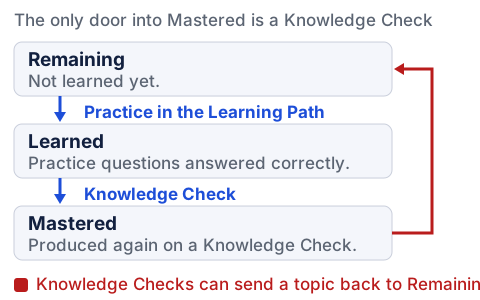
| State | What it means | What puts a topic here |
|---|---|---|
| Remaining | Not learned yet. | Where every topic starts, plus anything a check sends back. |
| Learned | Practiced successfully, not yet assessed. | Answering several questions on it correctly in the Learning Path. |
| Mastered | Demonstrated on an assessment you did not schedule. | Answering a question on it correctly during a Knowledge Check. |
One relief, same documentation: if a topic is beating you, "ALEKS will provide a new topic to work on"; switch topics yourself and "students will not lose any work in partially-learned topics."
What a Knowledge Check is actually doing
A Knowledge Check is a short adaptive assessment, and the important word is adaptive. McGraw Hill's knowledge base gives its scale in a sentence: it "asks students approximately 20-30 questions to determine their precise knowledge state in their ALEKS course. A Knowledge Check will determine, for each topic in the course, which topics each student knows, which topics each student doesn't know, and which topics each student is ready to learn."
That explains most of what feels unfair. Twenty-odd questions decide the status of every topic in the course. ALEKS is not grading a quiz; it infers a whole map from a handful of probes, each chosen from how you answered the last. Hence the question about something you mastered in week two, and one wrong answer moving several topics.
Three documented behaviors follow. You are not told how you are doing: "during a Knowledge Check, students will not be told whether answers are correct or incorrect." There is an I Don't Know button for a question students "do not know how to solve," but where they "have an idea about how to solve the question, they should do their best to work through it." And you can stop partway: "if students log out while a Knowledge Check is in progress, they will continue from where they left off when they log in next."
McGraw Hill's advice is to "take their time and be honest as they work through a Knowledge Check, as the results will determine their personalized learning path in ALEKS." That is practical, not moral. A lucky guess buys a topic you cannot do, ALEKS hands you the topics sitting on top of it, and the whole stack comes back on the next check.
Tulane University's student success office puts it the same way to incoming students taking its self-diagnostic assessment. Its answer to "Can I fail ALEKS?" is: "No. ALEKS is not a test- it's an assessment. It tells you what you know and what you don't know."
Why the pie shrinks after a Knowledge Check
The sentence that answers the question sits in McGraw Hill's current documentation: "At regular intervals, ALEKS gives Progress Knowledge Checks to assess students' retention of recently learned and previously mastered topics. If students demonstrate in a Knowledge Check that they have not retained a previously learned or mastered topic, ALEKS automatically moves that topic to the queue of topics in the Learning Path to be practiced and learned again."
A second article adds the part that stings: results "may indicate the need to further review topics previously deemed as 'learned'. These topics, and perhaps others that are linked to them, are then returned to the Topic Carousel for additional practice." Lose a prerequisite and the topics standing on it can go with it. The University of Louisiana at Lafayette's mathematics department puts it in one line for its placement students: "If you do not show mastery during the Knowledge Check, the topics will be added back into your Learning Pie so you can review them again."
Now the arithmetic. Say your course has 320 topics and you are carrying 142 mastered and 38 learned. The counter reads 180 — 180 of 320, or 56.25%.
A Progress Knowledge Check runs. It confirms 31 of your 38 learned topics and sends the other 7 back. It finds 6 topics you had mastered earlier that you can no longer produce, and sends those back too. And because it probes past the edge of what you practiced, it finds 4 topics you never touched that you already know.
Count it. Mastered goes to 142 − 6 + 31 + 4 = 171. Learned goes to 0, because every topic in that column has been resolved. The counter shows mastered plus learned, so it now reads 171 — 53.44%.
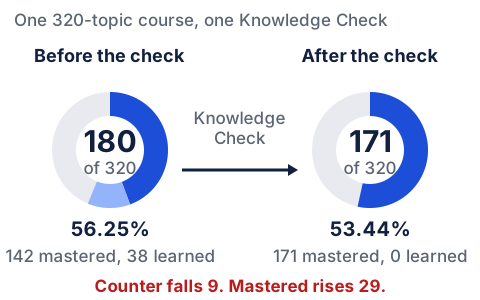
That is the whole illusion. The number that dropped and the number that measures what you can do are not the same number. One fell by 9, the other rose by 29, and the 13 topics sent back are yours to redo.
When Knowledge Checks arrive, and the one you can postpone
Knowledge Checks are not random, and knowing the triggers takes the dread out. McGraw Hill publishes three intervals for the automatic ones: after 20 topics are learned and 5 hours are spent in learning mode; after 10 hours in learning mode; and after 60 days without one, or 30 days for higher-education chemistry.
So a long catch-up session triggers a check inside itself; a quiet month triggers one anyway.
The other kinds sit around your course structure. The Understanding Knowledge Checks guide linked from McGraw Hill's ALEKS grading page lists the Initial Knowledge Check, which "occurs after the student completes the Tools Tutorial"; Post-Objective Knowledge Checks, arriving "when the student learns all topics in the Objective or upon the Objective due date"; and instructor-built Scheduled Knowledge Checks, which "may be calculated as part of the ALEKS grade."
The post-objective one blocks you: "once it becomes available, students must complete the Post-Objective Knowledge Check before continuing." The same guide notes that "students may delay these Knowledge Checks by up to 24 hours if desired." Use that window to take it when you can concentrate, not to put it off — the check is the only thing that converts learned topics to mastered, and 24 hours can run you into the objective's due date. A record of what is due, kept outside the platform, is the cheapest guard against that.
A Scheduled Knowledge Check set to Comprehensive runs about 25 questions and assesses "all the material in the class," so it can stand in for a final. Courses using it that way sometimes run it under remote proctoring, a different experience even though the questions behave the same.
What a smaller pie does to your grade
Usually less than you fear, and the reason sits where students never look. ALEKS Implementation Manager Tammy Louie, writing for instructors, explains how a Pie Progress Goal is scored: it "gives credit for the highest level of learning that a student completes. While the student might see their total number of mastered topics go up and down (indicating a weak area that they should re-visit after taking a knowledge check), Pie Progress reports the highest water mark for learning."
So the graded figure ratchets: your pie can fall and the recorded score does not follow. That post, from May 2024, also gives the timing — "at the due date, a score will be recorded. If you've paired with your LMS, the scores will populate in the LMS gradebook." That is the courseware rule generally: the platform grades and holds the score; your LMS gradebook gets a copy on somebody else's schedule.
Module grades are less forgiving: "module grades only include learned topics that occur before the due date." Later work still improves your pie, but not that module's score.
One more separation surprises people. In McGraw Hill's documentation, ALEKS quiz, test and homework assignments are "optional, auto-graded assignments that are separate from the adaptive path," and work in them "does not fill in their ALEKS Pie/Pie Progress, nor does it inform their adaptive path."
Those assignments follow ordinary auto-grading rules, set per assignment rather than by universal convention. Instructors choose Question Attempts and Assignment Attempts separately, so "an attempt" means one thing at the question level and a different thing at the assignment level. Check which of the two your instructor actually set before assuming you have three tries at anything — and do not carry the word across to another platform, because each vendor meters this differently. Partial credit is a checkbox: "uncheck the box next to Partial Credit if you only want full or no credit for multi-part questions." Form and value are scored separately, which is why McGraw Hill documents building "a question where students will provide a numeric answer that is graded to a specific number of significant digits and has a tolerance range." Inside the pie there is no partial credit at all: mastered, learned or remaining, nothing between.
What to do with the topics it sent back
The instinct after a bad check is to grind out new topics to lift the number. Wrong order: the ones that came back are what ALEKS just showed to be load-bearing.
"When students complete a Knowledge Check, their numbers of Mastered, Learned, and Remaining topics update to reflect their knowledge state." Look at the split, not the headline. If mastered rose while the counter fell, the check did what it was built to do.
Your reports list them. These are the ones the system has evidence you cannot produce today, and in ALEKS's own words the topics "linked to them" may have gone back too — so clearing the root often clears several.
ALEKS's most under-used feature. Review "is a safe environment for students to practice, and does not affect their knowledge state or count of Mastered, Learned, or Remaining topics" — and McGraw Hill recommends reviewing "especially before a Progress Knowledge Check to improve retention."
The trigger arithmetic rewards this. Twenty topics plus five hours fires a check, so one long session gets assessed on material learned an hour earlier. Shorter sessions across a week put distance between learning a topic and reproducing it.
A pie that falls after a Knowledge Check is the system doing the one thing it was built for: asking whether you can still produce something a week later. Uncomfortable, and the right question, because the midterm asks it too.
If the real problem is that you are eight objectives behind and every check catches material you never had time to learn, that is a workload problem, not a mechanics one. Our ALEKS coursework help works alongside a live course from $37.89 a week: we prepare worked solutions and practice for the topics your check sent back, delivered outside the platform, and you do the work in your own account. We never ask for your ALEKS login and never enter anything for you. Mastered topics have to be yours — that is the only kind that survives the next check.