Live Chat

An essay introduction is one paragraph that does three things: it brings the reader in, it supplies the background the argument needs, and it states the claim the essay will defend. Most pages promising examples show the first thing — a clever opening line — and stop. This page shows the whole paragraph: four complete introductions, annotated sentence by sentence, plus one prompt opened three ways so you can watch a weak introduction become a working one.
The three-part shape is not ours. Purdue OWL's guidance for argument papers says an introduction should "Set the context," "State why the main idea is important," and "State your thesis/claim." The University of Wisconsin–Madison Writing Center names the same three jobs: announce "your paper's topic and purpose," situate that purpose "in relation to what you've discussed in your course," and "offer your readers a preview of how you will satisfy that purpose."
- One paragraph is the default. Purdue OWL: "Your introductory and concluding material should always be in a new paragraph."
- The four introductions written for this article run 73 to 134 words, across three to six sentences. Length follows the assignment.
- Context is the move students skip. In the annotated example below, three context sentences take 58 of the paragraph's 105 words — more than the hook and thesis together.
- The thesis usually lands last. UW–Madison: "You will often read them toward the end of an introduction: the thesis statement."
- A hook is optional, and it can wait. The UNC Chapel Hill Writing Center offers opening strategies while "remembering that they may not be suitable for all kinds of papers," and advises: "Try writing your introduction last."
What every introduction on this page is doing
Three moves, usually in this order.
- The hook. One or two sentences whose job is to make the next sentence worth reading. UNC's options are specific — "an intriguing example," "a puzzling scenario," "a vivid and perhaps unexpected anecdote," "a thought-provoking question." For a longer menu by essay type, see what makes an essay hook actually work.
- The context. The facts and framing a reader needs before your claim can mean anything. It carries the reader from a general opening to a specific argument, which is why it is sometimes taught on its own as the bridge.
- The thesis. The arguable claim the essay defends. Purdue OWL wants "A clear, concise, and defined thesis statement that occurs in the first paragraph of the essay," warning that without it "it will be quite difficult to compose an effective or persuasive essay." Building one is its own job — see our thesis statement outline and template.
UNC's Writing Center puts the paragraph's purpose practically: "Your introduction is an important road map for the rest of your paper."
Every introduction below was written for this article — not student papers, not excerpts. The material inside them is real (Frankenstein, "The Lottery," the Articles of Confederation, the New Deal), so you can check the claims; the essays do not exist. Copying one would mean submitting someone else's words. Use them as models of the moves, then write your own.
A literary analysis introduction, sentence by sentence
Assignment: a 1,500-word essay, sophomore English. Prompt: Analyze the function of the frame narrative in Mary Shelley's Frankenstein.
Every account in Frankenstein reaches the reader secondhand. Mary Shelley's 1818 novel opens not with Victor Frankenstein but with Robert Walton, an explorer writing letters home to his sister from a ship in the Arctic. Victor's confession sits inside Walton's letters, and the creature's own account sits inside Victor's. Readers usually treat that arrangement as period furniture and read straight past it toward the horror plot. But the frame is doing argumentative work: by making every narrator depend on a listener who has reasons to believe him, Shelley turns the novel's central question from what the creature is into whom we are willing to trust.
| Sentence | Move | What it is doing |
|---|---|---|
| 1 (8 words) | Hook | A flat claim about the text — no quotation, no question. Eight words against a 39-word thesis makes the paragraph accelerate. |
| 2 (27 words) | Context | Author, date, and the structural fact the essay depends on. A grader knows you have the book open. |
| 3 (14 words) | Context | Shows the nesting instead of describing it, replacing a paragraph of plot summary. |
| 4 (17 words) | Context | Names the ordinary reading the essay argues against — the sentence that gives the essay a reason to exist. |
| 5 (39 words) | Thesis | Arguable, specific, and it predicts the essay's shape: a reader can guess the body paragraphs from it. |
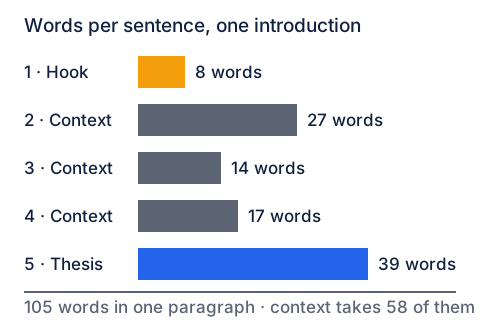
That proportion is the useful part. Students asking how to write a better introduction usually mean the first sentence — the smallest thing in the paragraph. The middle is where a grader learns whether you understand the text.
An expository introduction for a history essay
Assignment: a 1,000-word explanatory essay, US history survey. Prompt: Explain why the Articles of Confederation were replaced.
The first American government could ask the states for money, but it could not make them pay. The Articles of Confederation, ratified in 1781, gave Congress no power to tax directly and no power to regulate trade between the states. When farmers in western Massachusetts rose against debt collection in 1786, it was a state militia, not a national one, that put the rising down. Most accounts stop there and treat the Articles as simply too weak to survive. The replacement was not a verdict on weakness alone: the delegates who met in Philadelphia in 1787 were solving a narrower and harder problem, which was how to give a national government its own revenue without handing it the powers the states had just fought a war to escape.
An expository prompt asks you to explain rather than argue, and students read that as permission to open with a summary. This one still ends on a claim, because an explanation with a point is easier to follow. Two mechanics are worth stealing: the hook is a concrete asymmetry ("could ask… could not make"), and the paragraph never says "this essay will explain" — the reader can already see what it will.
Sentences two and three are dated facts; in a real submission each would carry a citation. Mark them as you draft — hunting for sources afterward is how citations land on the wrong claim.
An argumentative introduction that names the disagreement
Assignment: a 1,200-word position essay, first-year composition. Prompt: Should your state require a personal finance course to graduate high school?
A senior who can factor a polynomial may still have no idea what an APR is. Personal finance keeps turning up as a proposed graduation requirement, and the argument runs along the same two lines every time. Supporters point to the decisions students face within months of leaving: a lease, a first paycheck with withholdings on it, a credit card offer in the mail. Opponents answer that the school day is already full, and that a new requirement displaces something else that someone fought to put there. Both sides are arguing about the wrong variable. The case for requiring personal finance does not rest on whether the subject matters, because everyone in the room concedes that it does; it rests on whether a single semester changes what an eighteen-year-old actually does three years later.
Six sentences, 134 words — the longest here, and it earns the length by summarizing a disagreement before entering it. Three details do the work:
- The thesis takes two sentences. "Both sides are arguing about the wrong variable" is the pivot; the next sentence is the claim. That beats one 45-word sentence.
- The hook carries no statistic. An unsourced number loses a careful grader; a sourced one needs setup that kills the momentum.
- The objection arrives first. Sentence four states the opposing case in its own terms — the only condition under which a reader who holds it keeps reading.
A timed in-class introduction, in three sentences
Under exam conditions the three moves still apply, minus the decorative half. Here it is at 73 words — four minutes of a 60-minute blue-book exam.
Prompt: Was the New Deal a turning point in the relationship between Americans and the federal government?
The New Deal changed what Americans expected the federal government to do, and that expectation outlasted the programs themselves. Between 1933 and 1938 the federal government took on unemployment relief, bank regulation, and old-age insurance, responsibilities that had previously belonged to states, to employers, or to nobody. That shift in the baseline of federal responsibility, not the recovery figures that economists still argue over, is what makes the New Deal a turning point.
There is no hook. Sentence one is a compressed answer, sentence two is the evidence base as a single list, sentence three is the thesis with a concession folded in — granting the economics while claiming the constitutional shift. Copy the ordering: answer the question in your first sentence. Run out of clock at minute 55 and an examiner has still read your position.
One prompt, three openings
Finished introductions only show the destination. This is the road — one prompt, What does the setting contribute to Shirley Jackson's "The Lottery"?, opened three ways, weakest first. All three drafts were written for this article.
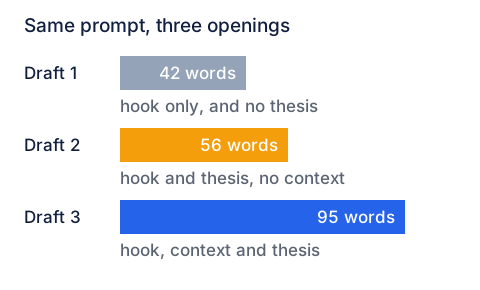
Draft 1 — 42 words. A generic opening, and no thesis.
Setting is one of the most important elements in literature. Authors have used setting to create mood since the beginning of storytelling. In "The Lottery," Shirley Jackson uses setting in an interesting way. This essay will discuss the setting of the story.
Nothing here is false, and nothing here is about the story. UNC has a name for the first two sentences — "the 'dawn of man' introduction," which makes "broad, sweeping statements about the relevance of this topic since the beginning of time." Sentence four fails differently: announcing a topic claims nothing about it.
Draft 2 — 56 words. Hook and thesis, no context.
Shirley Jackson's "The Lottery" opens on a clear June morning, with flowers out and children filling their pockets with stones. The setting is the whole trick of the story: Jackson spends her descriptive energy on how pleasant and unremarkable the village is, so that the stoning at the end reads as something a normal place does.
A real improvement, and most students stop here — the hook is specific and the claim is arguable. What is missing is the middle: a reader who has not read the story does not know what the lottery is, and one who has does not know why the question is worth asking.
Draft 3 — 95 words. All three moves.
"The Lottery" opens on a clear June morning, with flowers out, the grass green, and boys filling their pockets with stones. Shirley Jackson published the story in The New Yorker in 1948, and its final page still catches first-time readers flat. The warning was on the first page all along, hidden in the setting. By spending her opening paragraphs on how ordinary and pleasant the village is, and by putting the stones in children's hands long before anyone explains what they are for, Jackson makes the stoning read as local custom rather than as horror.
Two sentences separate Draft 2 from Draft 3, and neither is decorative. The publication fact places the story; the "warning was on the first page" sentence turns a description into a puzzle the essay solves. Context is not padding — it earns the thesis.
Five openings that lose the reader
UNC names five patterns under the heading "Five kinds of less effective introductions." Learn them by name — graders recognize all five instantly.
| Pattern | What UNC says it is | How it sounds |
|---|---|---|
| The placeholder | "contains several sentences that are vague and don't really say much" | "There are many interesting aspects of this topic worth exploring." |
| The restated question | Stopping at "JUST restating the question" | "In this essay I will discuss why the Articles were replaced." |
| The Webster's Dictionary | "begins by giving the dictionary definition of one or more of the words" | "The dictionary defines setting as the time and place in which a story happens." |
| The "dawn of man" | "makes broad, sweeping statements about the relevance of this topic since the beginning of time" | "Since the beginning of civilization, humans have told stories about violence." |
| The book report | "gives the name and author of the book … and offers other basic facts" | "Frankenstein is a novel by Mary Shelley about a scientist and his monster." |
The placeholder is not always a mistake at the drafting stage — UNC's own advice makes room for it: "Don't be afraid to write a tentative introduction first and then change it later." The failure is leaving it in, and the same page offers the escape hatch: "Try writing your introduction last."
How long an introduction should be, and how to test yours
Here is what the four introductions written for this article measure. None of the writing centers cited on this page — UNC, Purdue OWL, UW–Madison — publishes a word count for an introduction; the number depends on the assignment.
| Example | Essay length | Sentences | Words |
|---|---|---|---|
| Literary analysis | 1,500 words | 5 | 105 |
| Expository history | 1,000 words | 5 | 128 |
| Argumentative | 1,200 words | 6 | 134 |
| Timed in-class | 60-minute exam | 3 | 73 |
Three to six sentences, 73 to 134 words. The floor is set by the moves: one sentence each is too thin, and Purdue OWL points the same way, telling writers they "should be wary of paragraphs that only have two or three sentences." The ceiling is patience — once the introduction runs past a fifth of your first page, you are writing body paragraphs with the wrong label on them.
Four checks, in the order that finds problems fastest.
Find the sentence a reader could disagree with. If you cannot underline one, you have an announcement rather than a thesis — Draft 1 is the diagnostic case.
If the paragraph is unharmed, that sentence was throat-clearing. Every "dawn of man" opening passes this test by vanishing.
Hand it to someone who has not done the reading. The facts they ask for are the context sentences you skipped — the check that separates Draft 2 from Draft 3.
Almost every introduction improves once you know what you argued. If the two disagree, the introduction is the one out of date.
If you are stuck below the paragraph level, working the argument out first tends to unstick it — our guide to outlining an essay before you write a single word is built for that stage. If the problem is the deadline rather than the paragraph, our custom essay writing service works alongside your own draft: research, structure, and revision on the essay you were assigned, which you review and submit yourself.