Live Chat


A literature review is a piece of writing that surveys the existing research on a question and argues something about it — usually that there is a gap, a disagreement, or a pattern the field has not fully reckoned with.
That definition is short, and most students still get it wrong on the first attempt. Not because it is hard, but because three other documents look very similar and none of them is a literature review. It is quicker to learn what it is not.
- A literature review makes an argument about a body of research. It is not a neutral report.
- It is organized by idea — theme, method, theory, or chronology — never source by source.
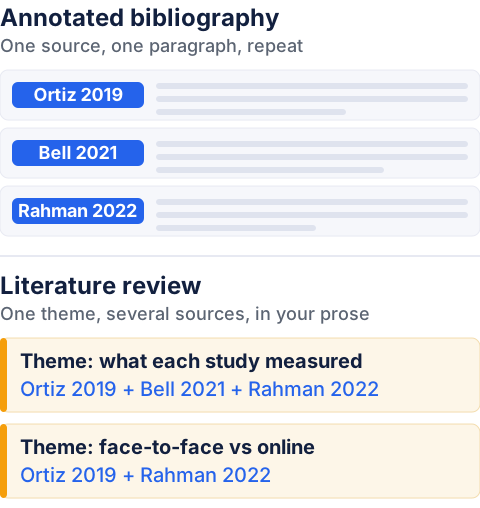
- It is not an annotated bibliography: that is a list; this is continuous prose that synthesizes.
- It is not a summary of everything written on the topic; it is selective and justified.
- Grouping several studies in one sentence follows style-specific rules — APA sets a default order and gives you one marked way out of it; MLA leaves the order entirely to you.
- It usually ends by naming the gap your own research fills.
Three things it is not
Each of these confusions produces a recognizably different failure.
Not an annotated bibliography. An annotated bibliography is a list: entry, paragraph, entry, paragraph. A literature review is continuous prose in which sources appear inside your sentences because they are doing argumentative work. If your review has one paragraph per source, you have written a bibliography with the citations moved.
Not a summary of the field. Completeness is not the goal and is not possible. You select the work that bears on your question and you justify the boundaries — dates, methods, populations. A review that tries to cover everything covers nothing at depth.
Not a methods section. The methods section explains what you did. The literature review explains what others found and why that leaves room for you. Systematic reviews blur this, because their search protocol is itself a method — but in a standard dissertation chapter the two stay separate.
The distinction is not ours alone. The UNC Writing Center puts it in one line: a literature review "is usually organized around ideas, not the sources themselves as an annotated bibliography would be organized."
Read your review and ask: could a reader state my position on this literature after finishing it? If the honest answer is "they would know what has been published," it is a summary. If it is "they would know what I think is missing and why," it is a review.
What it is actually doing
A literature review has a job inside a larger piece of work, and knowing the job clarifies the writing.
It establishes that your question is worth asking. If everything about it has been settled, there is no project. If nothing has been written at all, either the question is not important or you have not searched properly.
It shows you can be trusted with the field. An advisor reading your review is checking whether you know which work matters and whether you can tell strong studies from weak ones.
And it defines the space your own research occupies. The last paragraph should make your research question feel inevitable rather than arbitrary.
Where you meet one
The label covers several documents of very different scale.
| Context | Typical length | What it does |
|---|---|---|
| Section of a research paper | A few paragraphs to 2 pages | Situates one study |
| Master's thesis chapter | 15–30 pages | Maps the field, opens the gap |
| Doctoral dissertation chapter | 30–60 pages | Demonstrates command of the whole field |
| Standalone review article | Varies widely | Published contribution in its own right |
| Systematic review | Varies widely | Follows a protocol set in advance; a study in itself |
The two middle labels follow US usage, where a master's student writes a thesis and a doctoral student writes a dissertation. UK and Commonwealth programs reverse the pair, so a "master's dissertation" in a British handbook is the same document as a US master's thesis — worth knowing before you copy a chapter template off the internet.
The last row is a genuinely different animal. A systematic review specifies its search strategy, inclusion criteria and screening process in advance, and reports them. If the assignment says systematic, the protocol is not optional.
Scale changes what the review has to prove. In a standard research paper it only has to justify one study, so two pages can do it. As a chapter of a dissertation it has to prove you know the field — a different and much longer job.
How it gets organized
The organizing principle is the clearest signal of whether a review works. There are four common ones.
- Thematic — grouped by the ideas or debates in the field. The most common, and usually the strongest.
- Methodological — grouped by how the research was done. Useful when the method is itself the disagreement.
- Chronological — grouped by time. Only justified when the field genuinely changed direction, and you must say when and why.
- Theoretical — grouped by the models and frameworks the field argues with. Purdue OWL lists this one alongside the other three; it is common in the humanities and in any project built on a named framework.
What none of them is: alphabetical, or in the order you happened to read things. If your section headings are author names, the organization has not happened yet.
Choosing between them
Work down this list and stop at the first yes.
If the argument is really about instruments, samples or designs, organize methodologically. The method is the debate, so make it the structure.
A policy, a technology, a landmark study. Chronological is then defensible — but name the change, not just the decade.
Organize theoretically, around the models themselves, and close on the one you adopt.
Right most of the time, and choosing it on purpose still beats drifting into it.
Choosing the pattern is not the same as building it. The standard sorting tool for that is a synthesis matrix: a grid with your sources down one side and your themes across the other. Each cell holds what one source says about one theme. Filling it in is the job that turns a reading pile into the pattern you just chose.
How many sources is enough
No style authority sets a number. Advisors and course assignments sometimes do, and where yours does, that number wins over any advice online.
Failing that, use a structural test rather than a count. Every theme needs at least two or three sources with something substantive to say about it. It needs sources that argue with each other, not sources that mention it in passing. A theme supported by one study is not a theme; it is a source wearing a heading. If a section cannot hold two or three sources in tension, merge it into its neighbor.
So the number that matters is a per-theme number, not a per-chapter one. Forty sources cited once each make a weaker review than twenty-five where every theme holds three studies that disagree with each other. When an advisor says you need more sources, what they usually mean is that one section is carrying its whole claim on a single citation — so count by section before you go back to the database.
Two situations break the test in opposite directions.
Almost nothing exists on your exact question. Resist declaring the field empty — that claim is hard to defend and easy to disprove. Widen by one ring: the same question in an adjacent population, the same method in another discipline, or the theory your question rests on. A gap you cannot map is usually a search problem.
The search returns thousands of results. Your boundaries are too loose. Tighten one at a time — dates, then population, then method — and write down each decision as you make it. Those sentences become the paragraph justifying your scope.
What "critical" means here
Assignment prompts almost always ask for a critical literature review, and the word is doing real work.
Critical does not mean negative. It means you are weighing rather than reporting. A critical review notices that two studies reached opposite conclusions and asks why — different populations, different instruments, twenty years apart. It notices that a widely cited finding rests on one small sample. It notices what the field has not looked at.
The practical difference is simple. Descriptive writing says what each source found. Critical writing says what the sources, taken together, mean — and that sentence usually mentions more than one study at once.
The same material, written three ways
Here is the difference at sentence level. The author names and dates below are placeholders written for this article, not real studies.
Weak. "Ortiz (2019) studied peer feedback in first-year writing and found improvements in draft quality. Bell (2021) surveyed students and found that most valued peer comments. Rahman (2022) examined peer feedback in online classes and found no effect on final grades."
Three accurate sentences. The reader finishes with three facts and no idea what you think. Most first drafts land here, and it is a note-taking problem showing through rather than a writing one.
Better. "Several studies report that peer feedback improves draft quality (Bell, 2021; Ortiz, 2019), though results in online settings have been less consistent (Rahman, 2022)."
The sources now share a sentence and the paragraph has a shape, which is why this version usually gets waved through. Two things are still wrong with it. "Less consistent" turns a null result into a vague one and explains nothing. And the grouped citation quietly treats Ortiz and Bell as though they found the same thing, when Ortiz measured drafts and Bell asked students how they felt. This is grouping. It reads like synthesis and is not.
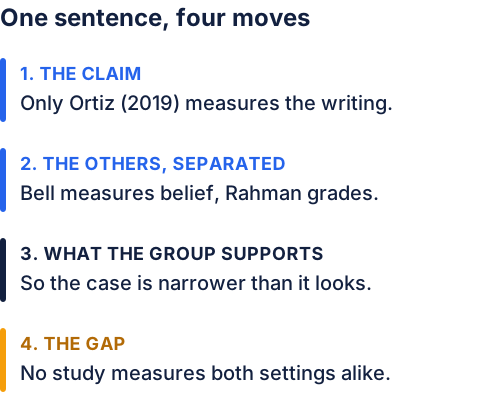
Strong. "Only one of these studies measures the writing itself (Ortiz, 2019); the others record what students believe about peer feedback (Bell, 2021) or track final grades in an online class (Rahman, 2022). Three different outcomes are being reported as one finding, so the case for peer feedback is narrower than a group of three citations makes it look — and no study here applies the same measure to both face-to-face and online groups."
That version weighs the studies instead of reporting them, says what they can and cannot support together, and ends on what nobody has done. The last clause is your gap, showing up mid-chapter and already doing real work.
Citing several studies in one sentence
Synthesis produces a citation shape you rarely use anywhere else: three or four sources inside a single set of parentheses. Each style handles it differently, and the differences are the kind that cost formatting points.
APA 7 sets a default order. Multiple works in one parenthetical citation go in alphabetical order, separated by semicolons — APA Style gives the example (Adams et al., 2019; Shumway & Shulman, 2015; Westinghouse, 2017). Alphabetical is the default, with one named exception.
The exception is how APA lets you rank sources. The same page tells you to place the work most directly relevant to your point first, then a semicolon and a phrase such as "see also" before the remaining citations, which stay alphabetical: (Sampson & Hughes, 2020; see also Augustine, 2017; Melara et al., 2018; Pérez, 2014). So an APA parenthesis can signal which study carries the claim. It just makes you announce that you are doing it.
MLA 9 hands the order back to you. Semicolons again, but the MLA Style Center states that "the order of those sources (alphabetic, by importance, by date) is up to you." Nothing in the citation marks the choice you made.
Chicago notes-and-bibliography uses no parenthetical at all. Sources go in numbered footnotes or endnotes, and the author-date alternative behaves much more like APA; the Chicago-Style Citation Quick Guide sets out both systems. Where several sources support one point, Chicago's own Q&A — answered against the 17th edition, one behind the current 18th — says to use a single note and separate the sources inside it with semicolons. Check the edition your department requires before you rely on it.
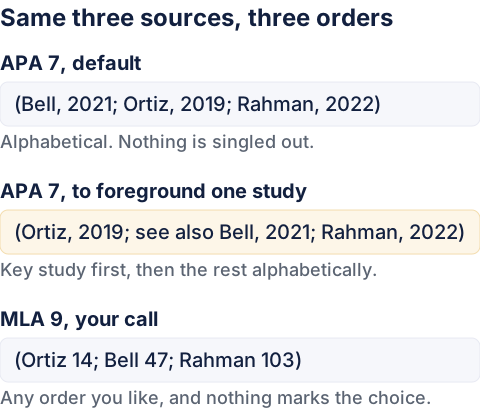
The practical consequence is about where you put emphasis. APA and MLA both let you foreground a source, and only one of them makes the foregrounding visible. In APA, a plain alphabetical parenthesis says nothing about relative weight, so either use the "see also" construction or name the load-bearing study in the sentence itself. In MLA, sequence does the work silently, so put the load-bearing source first — and do not count on your reader reading the order as a ranking.
Confirm the required style before you draft. Converting grouped citations between APA and MLA is not a find-and-replace job — the ordering logic changes, and so does the work your sentence has to do. Our APA 7 vs MLA 9 comparison sets the two side by side.
Where reviews go wrong, and the last check before you submit
Six problems account for most advisor feedback on a review chapter. Each has a specific cause and a specific repair.
| What the grader sees | What actually caused it | The fix |
|---|---|---|
| The chapter reads like an essay about the topic | You reviewed the subject instead of the research on it | Every paragraph should be about what researchers found or argued, not about the phenomenon itself |
| A source appears once and never returns | It never belonged to a theme | Find its theme or cut it; an orphan citation reads as padding |
| "Where is your voice?" | Every sentence is attributed to someone else | Add one interpretive sentence after each group of cited ones — what the group means, not what it says |
| A 1990s finding sits beside a 2020s one with no comment | Chronology present but unacknowledged | Say whether the older result still holds, and what changed if it does not |
| The chapter ends by summarizing itself | No gap was ever stated | Rewrite the last paragraph to name what is missing and why your question follows from it |
| Sections are uneven — one long, three thin | Themes came from the sources rather than the question | Rebuild the themes from your research question, then re-sort the sources into them |
The third row surprises people most. A chapter can be accurate, well cited and still fail, because nothing in it is something a reader could disagree with.
Three final passes catch what the table does not. Each takes a minute.
- Read only your topic sentences. If they form an argument on their own, the structure holds. If they read as a list of surnames, the sources are still running the chapter.
- Check your grouped citations against the required style. That is where APA, MLA and Chicago diverge most, and it is among the easiest formatting points to lose.
- Confirm every paraphrase is genuinely yours, not a lightly edited abstract. Compression is where accidental plagiarism creeps into a review.
Our guide on finding a dissertation research topic covers the stage before this one, where the boundaries first get set.
If the chapter is due and the reading pile is not moving, our literature review writing service builds a thematically organized, properly synthesized review around your research question, from $7.89 a page — part of our paper writing service.